×
Request Free Sample ×

Kindly complete the form below to receive a free sample of this Report

* Please use a valid business email

Leading companies partner with us for data-driven Insights

clients tt-cursor
Hero Background

Surface to Air Missiles Market

ID: MRFR/AD/21263-HCR
128 Pages
Sejal Akre
October 2025

Surface to Air Missiles Market Research Report By Type (Short Range Surface-to-Air Missiles (SR-SAMs), Medium Range Surface-to-Air Missiles (MR-SAMs), Long Range Surface-to-Air Missiles (LR-SAMs)), By Propulsion System (Solid Rocket Motors, Liquid Rocket Motors, Ramjet Engines), By Guidance System (Infrared homing, Semi-active radar homing, Active radar homing), By Application (Air Defense, Missile Defense, Anti-Satellite Warfare), By Platform (Land-Based, Sea-Based, Air-Based) and By Regional (North America, Europe, South America, Asia Paci... read more

Share:
Download PDF ×

We do not share your information with anyone. However, we may send you emails based on your report interest from time to time. You may contact us at any time to opt-out.

Surface to Air Missiles Market Infographic
Purchase Options

Surface to Air Missiles Market Summary

As per MRFR analysis, the Surface to Air Missiles Market Size was estimated at 6135.57 USD Billion in 2024. The Surface to Air Missiles industry is projected to grow from 6513.03 USD Billion in 2025 to 11832.22 USD Billion by 2035, exhibiting a compound annual growth rate (CAGR) of 6.15 during the forecast period 2025 - 2035.

Key Market Trends & Highlights

The Surface to Air Missiles Market is poised for substantial growth driven by technological advancements and geopolitical tensions.

  • Technological advancements in missile systems are enhancing the effectiveness of air defense capabilities in North America.
  • Geopolitical tensions in the Asia-Pacific region are accelerating the demand for advanced missile defense systems.
  • The air defense segment remains the largest market, while the missile defense segment is experiencing rapid growth.
  • Increasing defense budgets and the rising threat of aerial attacks are key drivers propelling market expansion.

Market Size & Forecast

2024 Market Size 6135.57 (USD Billion)
2035 Market Size 11832.22 (USD Billion)
CAGR (2025 - 2035) 6.15%

Major Players

Raytheon Technologies (US), Lockheed Martin (US), Northrop Grumman (US), Thales Group (FR), MBDA (FR), Saab AB (SE), Boeing (US), Kongsberg Gruppen (NO), Rafael Advanced Defense Systems (IL), Almaz-Antey (RU)

Surface to Air Missiles Market Trends

The Surface to Air Missiles Market is currently experiencing a dynamic evolution, driven by advancements in technology and increasing geopolitical tensions. Nations are prioritizing the enhancement of their air defense systems, leading to a surge in demand for sophisticated missile systems. This market is characterized by a diverse range of products, including short-range, medium-range, and long-range systems, each designed to address specific operational requirements. The integration of cutting-edge technologies, such as artificial intelligence and improved guidance systems, appears to be a focal point for manufacturers aiming to enhance the effectiveness and reliability of these defense solutions. Moreover, the growing emphasis on modernization and upgrades of existing systems is notable. Countries are investing in research and development to ensure their air defense capabilities remain robust against evolving threats. Collaborative efforts between governments and defense contractors are likely to foster innovation, resulting in the introduction of next-generation missile systems. As the Surface to Air Missiles Market continues to expand, it seems poised to play a crucial role in shaping the future of aerial defense strategies across various regions, reflecting the ongoing commitment to national security and defense preparedness.

Technological Advancements

The Surface to Air Missiles Market is witnessing rapid technological advancements, particularly in missile guidance and targeting systems. Innovations such as enhanced radar capabilities and integration of artificial intelligence are likely to improve accuracy and response times, making these systems more effective in countering aerial threats.

Geopolitical Tensions

Increasing geopolitical tensions across various regions are driving nations to bolster their air defense capabilities. This trend suggests a heightened focus on acquiring advanced surface to air missile systems as countries seek to protect their airspace from potential threats, thereby influencing market dynamics.

Modernization Initiatives

Many countries are prioritizing the modernization of their existing air defense systems. This trend indicates a shift towards upgrading older missile systems with newer technologies, enhancing their operational effectiveness and extending their service life, which is likely to impact procurement strategies in the Surface to Air Missiles Market.

Surface to Air Missiles Market Drivers

Geopolitical Tensions

Geopolitical tensions are a significant driver of the Global Surface to Air Missiles Market Industry. Ongoing conflicts and territorial disputes compel nations to bolster their air defense capabilities. For instance, tensions in Eastern Europe and the Asia-Pacific region have led countries to invest heavily in surface-to-air missile systems to deter potential threats. This strategic imperative is reflected in the increasing procurement of advanced missile systems, which is likely to sustain market growth. As nations seek to enhance their deterrence posture, the market is projected to expand significantly, reaching an estimated 11828.3 USD Billion by 2035.

Increasing Defense Budgets

The Global Surface to Air Missiles Market Industry is experiencing growth driven by rising defense budgets across various nations. Countries are prioritizing the enhancement of their air defense systems in response to evolving threats. For instance, the United States has allocated substantial funds to upgrade its missile defense capabilities, reflecting a broader trend among NATO allies. This increase in defense spending is projected to contribute to the market's expansion, with the industry expected to reach 6135.6 USD Billion in 2024. As nations invest in advanced technologies, the demand for sophisticated surface-to-air missile systems is likely to rise, further stimulating market growth.

Technological Advancements

Technological advancements play a pivotal role in shaping the Global Surface to Air Missiles Market Industry. Innovations in missile guidance systems, radar technology, and interception capabilities are enhancing the effectiveness of surface-to-air missiles. For example, the integration of artificial intelligence and machine learning into missile systems allows for improved target acquisition and engagement. As these technologies evolve, they not only increase the operational efficiency of existing systems but also drive the development of next-generation missiles. This trend is expected to contribute to a compound annual growth rate of 6.15% from 2025 to 2035, indicating a robust future for the industry.

Market Trends and Projections

The Global Surface to Air Missiles Market Industry is poised for substantial growth, with projections indicating a market size of 6135.6 USD Billion in 2024 and an anticipated increase to 11828.3 USD Billion by 2035. This growth trajectory reflects a compound annual growth rate of 6.15% from 2025 to 2035. Key factors driving this expansion include rising defense budgets, technological advancements, geopolitical tensions, and the increasing threat of aerial attacks. As nations prioritize the enhancement of their air defense systems, the market is expected to witness significant developments in missile technology and procurement strategies.

Rising Threat of Aerial Attacks

The rising threat of aerial attacks, including those from unmanned aerial vehicles (UAVs) and cruise missiles, is propelling the Global Surface to Air Missiles Market Industry. As adversaries increasingly employ sophisticated aerial tactics, nations are compelled to invest in robust air defense systems to protect critical infrastructure and military assets. The proliferation of UAV technology has particularly heightened concerns, prompting governments to enhance their surface-to-air missile capabilities. This trend underscores the necessity for advanced missile systems that can effectively counter emerging aerial threats, thereby driving demand within the market and contributing to its anticipated growth.

Collaborative Defense Initiatives

Collaborative defense initiatives among nations are fostering growth in the Global Surface to Air Missiles Market Industry. Joint military exercises and defense agreements facilitate technology sharing and enhance interoperability among allied forces. For example, NATO's collaborative efforts to develop integrated air and missile defense systems exemplify this trend. Such initiatives not only improve collective defense capabilities but also stimulate demand for advanced surface-to-air missile systems. As countries work together to address shared security challenges, the market is likely to benefit from increased procurement and investment in cutting-edge missile technologies.
Market Segment Insights

By Application: Air Defense (Largest) vs. Missile Defense (Fastest-Growing)

In the Surface to Air Missiles Market, the application segment is primarily dominated by Air Defense, which holds a significant share due to the rising emphasis on national security across various nations. This segment benefits from an increase in defense budgets and the continuous modernization of military capabilities, allowing countries to invest substantially in air defense systems. Meanwhile, the Missile Defense segment is gaining traction, reflecting a growing concern over missile threats and the need for advanced interception technologies.

Air Defense (Dominant) vs. Missile Defense (Emerging)

Air Defense serves as the cornerstone of the Surface to Air Missiles Market, fulfilling critical needs for intercepting and neutralizing aerial threats. As countries enhance their defensive infrastructures, the innovations in missile technology focus on increasing range and accuracy, ensuring these systems can adapt to evolving aerial threats. In contrast, the Missile Defense sector is emerging rapidly as nations react to asymmetric warfare threats and advancements from adversarial forces. The growing emphasis on intercepting incoming missiles has spurred technological developments, making effectiveness in this segment crucial for defense initiatives, thus fostering a competitive environment in missile technology.

By End Use: Military (Largest) vs. Government (Fastest-Growing)

In the Surface to Air Missiles Market, the end-use segment is divided into three critical categories: Military, Government, and Civil Defense. The Military segment holds the largest share, driven by the substantial investments made in defense systems by various countries to enhance their aerial defense capabilities. Conversely, the Government segment is growing rapidly, spurred by increasing geopolitical tensions and the desire for improved national security measures that require specialized missile programs.

Military: Dominant vs. Government: Emerging

The Military segment remains a dominant force in the Surface to Air Missiles Market, characterized by a robust demand for advanced missile systems that ensure strategic superiority. This segment is marked by extensive research and development efforts, resulting in cutting-edge technologies and systems tailored for combat scenarios. Meanwhile, the Government segment is emerging swiftly, primarily fueled by rising defense budgets and collaborative defense agreements among nations. This segment's growth is further supported by the increasing need for readiness against aerial threats, prompting governments to invest in missile defense systems that are technologically advanced and adaptable to various operational contexts.

By Launch Platform: Ground-Based (Largest) vs. Airborne (Fastest-Growing)

The Surface to Air Missiles Market is significantly shaped by various launch platforms, including Ground-Based, Airborne, and Naval systems. Among these, Ground-Based platforms hold the largest share, owing to their established infrastructure and reliability. This segment has been the backbone of air defense systems, enjoying widespread adoption across various military organizations, which further solidifies its dominance in market distribution. Airborne systems, while currently smaller in market share, are rapidly gaining attention due to their flexibility and increased engagement capabilities in contested environments, making them a key focus of development efforts within the market.

Ground-Based (Dominant) vs. Airborne (Emerging)

Ground-Based launch platforms are characterized by their proven capability to engage aerial threats from fixed locations, often supported by complex radar systems and command centers. They provide high stability and can be deployed in various terrains, making them ideal for comprehensive air defense strategies. In contrast, Airborne platforms are emerging as a vital part of modern warfare, offering the advantage of mobility and the ability to react quickly to threats. These platforms are integral for force projection and can engage targets in hostile environments without exposing ground assets, thus appealing to nations looking to enhance their defense capabilities swiftly.

By Range: Short Range (Largest) vs. Long Range (Fastest-Growing)

In the Surface to Air Missiles Market, the Short Range segment holds the largest share, attributed to its widespread adoption for tactical defense against aerial threats at close distances. This segment is primarily utilized by military forces for providing immediate protection in conflict zones, enhancing its market share substantially. In comparison, the Long Range segment, while smaller in overall market share, is rapidly gaining traction due to advancements in technology that enable engagement of threats at greater distances, making it a vital component in modern military strategies.

Short Range (Dominant) vs. Medium Range (Emerging)

The Short Range segment of surface to air missiles is characterized by its ability to offer swift response capabilities against low-flying aircraft and guided munitions. It is widely deployed by various military organizations for short-distance engagements, proving essential in urban warfare scenarios. Meanwhile, the Medium Range segment, although currently classified as emerging, exhibits significant potential for growth. Its development is driven by the demand for missiles capable of engaging airborne threats at intermediate distances, bridging the gap between short-range and long-range systems, thus attracting investments and enhancing technological innovations.

By Guidance System: Active Radar (Largest) vs. Infrared (Fastest-Growing)

The Surface to Air Missiles Market exhibits diverse guidance systems, with Active Radar leading the segment, reflecting a robust share due to its advanced capability in targeting. Semi-Active Radar and Command Guidance follow, offering distinct functionalities for specific tactical requirements. These systems are essential for optimizing missile effectiveness in various scenarios, ensuring that Active Radar remains at the forefront of adoption by military forces globally. Growth trends in the guidance systems segment highlight a significant shift towards Infrared systems, characterized by their enhanced accuracy and lower susceptibility to countermeasures. As defense forces increasingly prioritize stealth and precision, the demand for Infrared technology is expected to accelerate. This shift is also propelled by technological advancements and an emphasis on multi-role aircraft functionalities, driving innovation in missile guidance systems.

Guidance Systems: Active Radar (Dominant) vs. Command Guidance (Emerging)

Active Radar has established itself as the dominant technology in the Surface to Air Missiles Market due to its superior targeting capabilities and effectiveness in diverse combat scenarios. Its ability to engage targets with precision makes it a preferred choice among defense forces, resulting in a strong foothold within the sector. In contrast, Command Guidance represents an emerging technology, relying on continuous guidance from an operator, which can limit its application range. However, it remains valuable for specific tactical operations, particularly in situations where real-time adjustments are necessary. As advancements in technology continue to evolve, both systems may refine their operational roles, shaping the future landscape of missile guidance.

Get more detailed insights about Surface to Air Missiles Market

Regional Insights

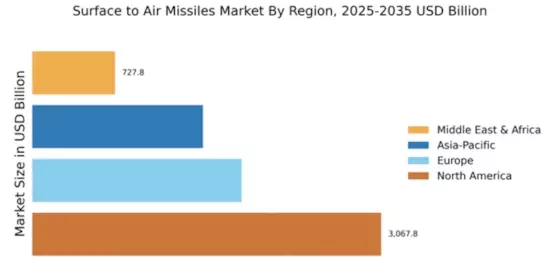
The Surface to Air Missiles Market is segmented into North America, Europe, APAC, South America, and MEA. North America held the largest market share in 2023 and is expected to maintain its dominance throughout the forecast period. The region is home to major defense contractors and a significant number of military bases, which drives the demand for surface-to-air missiles. Europe is the second-largest market, followed by APAC.

The APAC region is expected to witness the highest growth rate during the forecast period, owing to the rising defense expenditure of countries such as China and India.South America and MEA are expected to account for a smaller share of the market.

Source Primary Research, Secondary Research, Market Research Future Database and Analyst Review

Key Players and Competitive Insights

The Surface to Air Missiles Market is characterized by a dynamic competitive landscape, driven by technological advancements and increasing defense budgets across various nations. Key players such as Raytheon Technologies (US), Lockheed Martin (US), and MBDA (FR) are at the forefront, focusing on innovation and strategic partnerships to enhance their market positions. Raytheon Technologies (US) emphasizes the development of next-generation missile systems, while Lockheed Martin (US) is actively pursuing collaborations with international defense agencies to expand its global footprint. MBDA (FR) is leveraging its expertise in multi-role missile systems, indicating a trend towards integrated solutions that cater to diverse operational needs.

The market structure appears moderately fragmented, with several players vying for dominance. Key tactics include localizing manufacturing to reduce costs and optimize supply chains, which is becoming increasingly vital in a landscape marked by geopolitical tensions. The collective influence of these major companies shapes competitive dynamics, as they strive to balance innovation with operational efficiency, thereby enhancing their market share.

In November 2025, Raytheon Technologies (US) announced a partnership with the Indian government to co-develop advanced surface-to-air missile systems. This strategic move not only signifies Raytheon's commitment to expanding its presence in the Asia-Pacific region but also aligns with India's defense modernization efforts. Such collaborations are likely to bolster technological exchange and enhance local manufacturing capabilities, thereby fostering a more resilient supply chain.

In October 2025, Lockheed Martin (US) secured a contract with the U.S. Department of Defense for the production of the latest variant of the Terminal High Altitude Area Defense (THAAD) system. This contract, valued at approximately $1.5 billion, underscores Lockheed's strategic focus on enhancing missile defense capabilities amid evolving threats. The financial implications of this contract are substantial, potentially positioning Lockheed Martin as a leader in the high-altitude missile defense segment.

In September 2025, MBDA (FR) unveiled its latest missile system, designed for interoperability with NATO forces. This development reflects MBDA's strategic intent to cater to the growing demand for integrated defense solutions among allied nations. The emphasis on interoperability may enhance collaborative defense efforts, thereby strengthening alliances and improving operational effectiveness in joint missions.

As of December 2025, current trends in the Surface to Air Missiles Market indicate a shift towards digitalization and AI integration, with companies increasingly investing in smart technologies to enhance missile guidance and targeting systems. Strategic alliances are becoming pivotal, as they enable companies to pool resources and expertise, fostering innovation. The competitive differentiation is likely to evolve from traditional price-based competition to a focus on technological superiority and supply chain reliability, suggesting that companies that prioritize innovation and adaptability will thrive in this rapidly changing environment.

Key Companies in the Surface to Air Missiles Market market include

Industry Developments

The Surface-to-Air Missiles (SAM) market is projected to grow from an estimated USD 27.62 billion in 2023 to USD 45.6 billion by 2032, exhibiting a CAGR of 5.73% during the forecast period (2024-2032).

This growth can be attributed to increasing geopolitical tensions, rising defense expenditure, and advancements in missile technology.Recent news developments in the SAM market include Raytheon Missiles Defense received a USD 1.2 billion contract to provide Patriot missiles to the US Army. Lockheed Martin secured a USD 2 billion contract to upgrade the Patriot missile system for the US Army. MBDA unveiled a new surface-to-air missile system called the CAMM-ER, designed to counter emerging air threats.These developments indicate a growing demand for advanced SAM systems to protect against evolving aerial threats.

Future Outlook

Surface to Air Missiles Market Future Outlook

The Surface to Air Missiles Market is projected to grow at a 6.15% CAGR from 2024 to 2035, driven by technological advancements, increasing defense budgets, and geopolitical tensions.

New opportunities lie in:

  • Development of advanced missile guidance systems
  • Integration of AI for target acquisition
  • Expansion into emerging markets with tailored solutions

By 2035, the market is expected to be robust, reflecting substantial growth and innovation.

Market Segmentation

Surface to Air Missiles Market Range Outlook

  • Short Range
  • Medium Range
  • Long Range

Surface to Air Missiles Market End Use Outlook

  • Military
  • Government
  • Civil Defense

Surface to Air Missiles Market Application Outlook

  • Air Defense
  • Missile Defense
  • Counter-Insurgency
  • Naval Defense

Surface to Air Missiles Market Guidance System Outlook

  • Active Radar
  • Semi-Active Radar
  • Infrared
  • Command Guidance

Surface to Air Missiles Market Launch Platform Outlook

  • Ground-Based
  • Airborne
  • Naval

Report Scope

MARKET SIZE 20246135.57(USD Billion)
MARKET SIZE 20256513.03(USD Billion)
MARKET SIZE 203511832.22(USD Billion)
COMPOUND ANNUAL GROWTH RATE (CAGR)6.15% (2024 - 2035)
REPORT COVERAGERevenue Forecast, Competitive Landscape, Growth Factors, and Trends
BASE YEAR2024
Market Forecast Period2025 - 2035
Historical Data2019 - 2024
Market Forecast UnitsUSD Billion
Key Companies ProfiledRaytheon Technologies (US), Lockheed Martin (US), Northrop Grumman (US), Thales Group (FR), MBDA (FR), Saab AB (SE), Boeing (US), Kongsberg Gruppen (NO), Rafael Advanced Defense Systems (IL), Almaz-Antey (RU)
Segments CoveredApplication, End Use, Launch Platform, Range, Guidance System
Key Market OpportunitiesAdvancements in drone detection technologies enhance opportunities within the Surface to Air Missiles Market.
Key Market DynamicsTechnological advancements and geopolitical tensions drive demand for enhanced Surface to Air Missile systems across various regions.
Countries CoveredNorth America, Europe, APAC, South America, MEA

Leave a Comment

FAQs

What is the size of the Surface to Air Missiles Market?

Surface to Air Missiles Market 11832.22 Billion and Grow at a CAGR of6.15% by 2025 -2035

What was at a the size of the Surface to Air Mwas at asiles Market ?

The Surface to Air6135.57 Billion USD by 2024

Download Free Sample

Kindly complete the form below to receive a free sample of this Report

Compare Licence

×
Features License Type
Single User Multiuser License Enterprise User
Price $4,950 $7,250 $5,950
Maximum User Access Limit 1 User Upto 10 Users Unrestricted Access Throughout the Organization
Free Customization
Direct Access to Analyst
Deliverable Format
Platform Access
Discount on Next Purchase 10% 15% 15%
Printable Versions