Surgical Clip Market (2026 - 2035)

Surgical Clip Market Research Report: Size, Share, Trend Analysis By Types (Hemostatic Clips, Ligating Clips, Biliary Clips, Tissue Clips), By Material (Metal, Plastic, Absorbable, Non-absorbable), By Applications (General Surgery, Cardiac Surgery, Orthopedic Surgery, Gynecological Surgery, Urological Surgery), By End Use (Hospitals, Ambulatory Surgical Centers, Specialty Clinics) and By Regional (North America, Europe, South America, Asia Pacific, Middle East and Africa) - Growth Outlook & Industry Forecast 2025 To 2035

Forecast Period
2026-2035
CAGR
5.58%
2025 Market Size
USD 644.7 Million
2035 Market Size
USD 1,109.5 Million
Medical Device ● Updated August 24, 2026 Report ID: MRFR/MED/40747-HCR | Pages: 128 | Author: Rahul Gotadki, Satyendra Maurya

Surgical Clip Market Summary

The Surgical Clip Market was valued at USD 644.7 Million in 2025 and opens the forecast window at USD 680.7 Million in 2026, climbing to USD 1,109.5 Million by 2035 at a 5.58% CAGR. Growth is not speculative here. It tracks two hard catalysts: the Lancet Commission on Global Surgery benchmark requiring an additional 143 million procedures annually to close the surgical access gap [1], and sustained public capital deployment into operating-theatre capacity, including India's PM-ABHIM allocation of roughly USD 8.1 billion through 2026 for health infrastructure [11].

The decade is defined by the substitution of technology. The theater standard through the 2000s was reusable stainless-steel ligating instruments and hand-loaded single-fire appliers. However, these are being replaced by pre-loaded multi-fire cartridges, polymer locking geometries, and radiolucent designs that do not interfere with post-operative CT and MRI imaging. Ethicon, Teleflex, and Grena have all transitioned their product families to single-use sterile packaging. This transition has been further bolstered by CMS surgical site infection penalties, which have the potential to jeopardize up to 1% of Medicare inpatient payments [5].

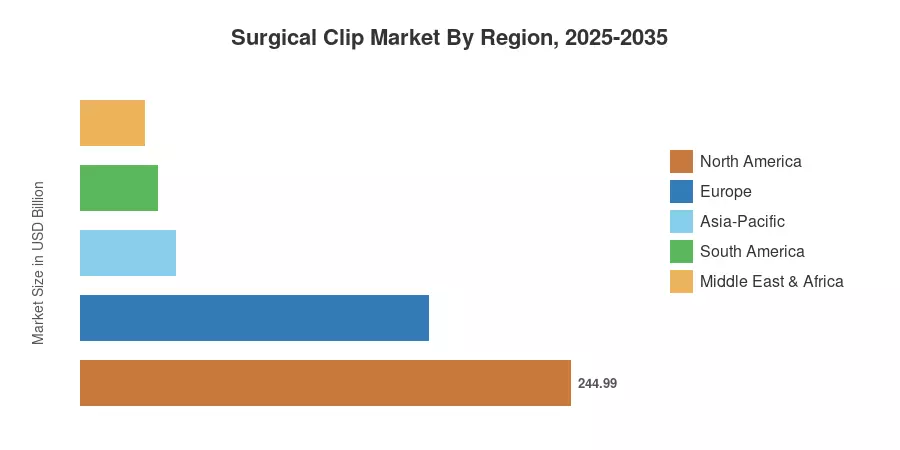
Approximately 6,100 Medicare-certified ambulatory surgical centers are the foundation of North America's 38.0% revenue share in 2025. China's volume-based procurement has expanded device access, resulting in the quickest expansion of the Asia-Pacific region at a compound annual growth rate (CAGR) of 7.4%. Demand in Europe is influenced by EU MDR recertification cycles, which is why it is ranked second. Rather than a capital-equipment category, the Surgical Clip Market enters the 2030s as a consumable-driven, procedure-linked category.


Key Report Takeaways

• By Device Type

  • Ligating clips command 68.0% of 2025 global revenue, reflecting their role across cholecystectomy, appendectomy and hysterectomy workflows
  • Aneurysm clips generate USD 135.4 million, sustained by neurovascular caseloads in tertiary centres.

• By Material

  • Titanium retains 54.0% share on the strength of decades of biocompatibility evidence.
  • Polymer variants advance at a 6.9% CAGR, driven by imaging-artifact avoidance.

• By Region

  • North America leads the Surgical Clip Market with USD 245.0 Million in 2025 revenue.
  • Asia-Pacific posts the fastest regional CAGR at 7.4% across the forecast window.
  • Europe accounts for 27.0% of global demand, with Germany the largest national contributor.

The Surgical Clip Market therefore rewards manufacturers with breadth across both open and minimally invasive platforms.


Market Size and Forecast (2021–2035)

Figures below blend bottom-up procedure modelling — national surgical volume registries, hospital discharge datasets and ASC utilisation filings — with top-down validation against reported device-segment revenues from publicly listed manufacturers. The Surgical Clip Market forecast applies a constant-currency USD basis.
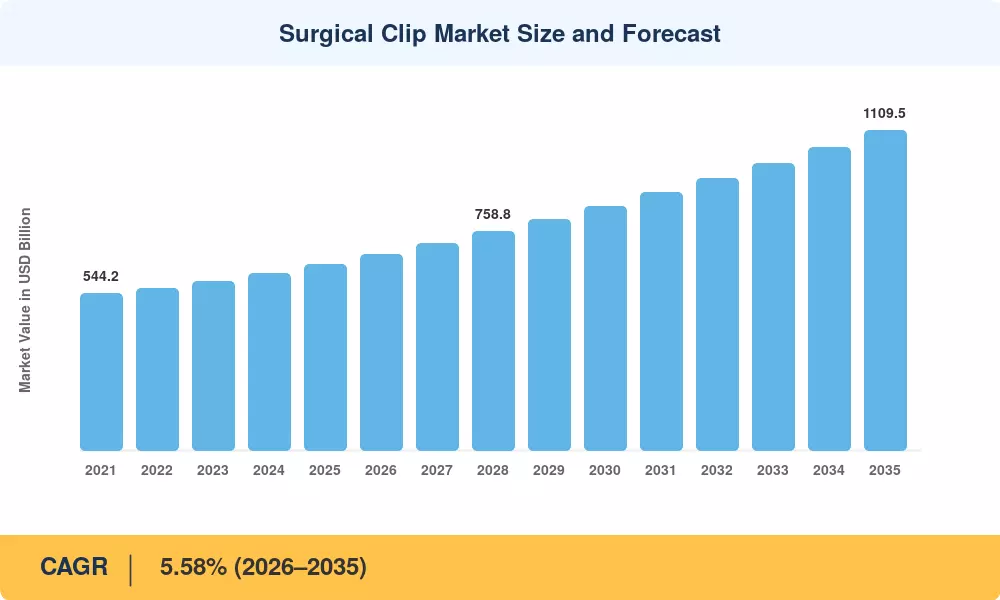
Surgical Clip Market Size and Forecast
Our Impact
Enabled $4.3B Revenue Impact for Fortune 500 and Leading Multinationals
Partnering with 2000+ Global Organizations Each Year
30K+ Citations by Top-Tier Firms in the Industry

Driver Impact Analysis

Driver ~% Impact on CAGR Geographic Relevance Impact Timeline
Rising global surgical volumes ~1.3 pp Global Medium-term (2–4 yr)
Migration to minimally invasive technique ~1.1 pp NA, Europe, APAC Short-term (≤2 yr)
Ambulatory surgical centre expansion ~0.8 pp North America Medium-term (2–4 yr)
Ageing demographics, chronic disease load ~0.7 pp Europe, Japan Long-term (≥4 yr)
Absorbable and polymer material innovation ~0.6 pp Global Long-term (≥4 yr)
Public hospital procurement in Asia ~0.6 pp Asia-Pacific Medium-term (2–4 yr)
Single-use preference under infection protocols ~0.5 pp Global Short-term (≤2 yr)


Surgical Volume Expansion

Roughly five billion people lack access to safe surgery, and closing that gap demands 143 million additional operations each year [1]. That deficit converts directly into consumable demand for the Surgical Clip Market, because vessel and duct occlusion is procedure-agnostic. The World Bank's health system financing commitments — exceeding USD 34 billion in active IDA and IBRD health lending — fund the theatre capacity that makes those volumes real [12].

Minimally Invasive Substitution

Laparoscopic cholecystectomy now accounts for over 92% of gallbladder removals in high-income systems [3]. Endoscopic and laparoscopic surgical clips replaced suture ligation in these workflows because clip application takes seconds against minutes, and theatre time in US hospitals costs USD 36 to USD 47 per minute [4]. Every avoided minute funds the consumable premium.

Ambulatory Site-of-Care Shift

CMS has added more than 300 procedures to the ASC covered-procedures list since 2019, and ASC facility payments run 45% to 60% below hospital outpatient rates for comparable cases [5]. Lower-cost sites favour pre-loaded, single-use applicators that eliminate reprocessing overhead.

Material and Imaging Innovation

Titanium artifacts degrade CT reconstruction quality in post-operative surveillance, a documented concern in oncologic follow-up [7]. Polymer alternatives resolve it. FDA 510(k) clearances for polymer ligation devices rose steadily across 2023–2025, and absorbable chemistries now target resorption windows of 180 to 240 days [8].


Restraints Impact Analysis

Restraint weightings are directional estimates of drag on compound growth. They interact — tender-driven price erosion, for example, amplifies the effect of substitute technologies by narrowing R&D headroom across the Surgical Clip Market.

Restraint ~% Impact on CAGR Geographic Relevance Impact Timeline
Substitution by energy-based vessel sealing ~-0.9 pp NA, Europe Long-term (≥4 yr)
Tender-based price erosion ~-0.7 pp Europe, APAC Medium-term (2–4 yr)
EU MDR recertification burden ~-0.5 pp Europe Medium-term (2–4 yr)
DRG bundling and reimbursement compression ~-0.4 pp North America Medium-term (2–4 yr)
Titanium and polymer input cost volatility ~-0.3 pp Global Short-term (≤2 yr)


Advanced Energy Devices

Ultrasonic and advanced bipolar sealers now handle vessels up to 7 mm without mechanical occlusion, and adoption in colorectal and bariatric surgery has climbed sharply [9]. Where a sealer is already in the tray, clip consumption per case falls. The offset: capital cost of USD 18,000 to USD 45,000 per generator keeps mechanical occlusion dominant in resource-constrained theatres.

Procurement Price Compression

China's centralised volume-based procurement has cut device prices by 50% to 80% across successive national tender rounds [13]. Similar consolidated purchasing through European group buying organisations compresses unit economics even as volumes rise, muting revenue growth relative to procedure growth.

Regulatory Recertification Load

EU MDR transition costs run between EUR 40,000 and EUR 200,000 per device family, and notified body capacity constraints have extended review timelines well beyond original expectations [10]. Smaller specialist manufacturers have rationalised legacy SKUs rather than recertify them.


Surgical Clip Market Opportunities

Imaging-Compatible Portfolios

Radiolucent polymer platforms let oncology and vascular teams run clean post-operative surveillance imaging. Manufacturers that pair these with validated MRI-safety labelling can defend price against tender pressure, and the opportunity extends across every device-type line in the Surgical Clip Market.

Emerging-Market Theatre Buildout

India, Indonesia, Nigeria and Egypt are all expanding public surgical capacity under national health infrastructure programmes [11][12]. Locally manufactured, cost-engineered ligating clips priced 30% to 45% below imported equivalents can capture first-fit positions in these theatres before global brands establish distribution.

ASC-Specific Product Configuration

Ambulatory centres want procedure-specific kits, not catalogue SKUs. Bundling appliers, clips and trocar-compatible accessories into single sterile packs reduces picking labour and inventory carrying cost — a measurable saving in facilities running 12 to 20 cases daily.

Data-Linked Consumable Models

RFID- and barcode-tagged cartridges feed automated implant registries and enable consumption-based contracting, where hospitals pay per case rather than per box. Vendors gain utilisation telemetry they can monetise as benchmarking analytics, a business model migrating into the Surgical Clip Market from orthopaedic implants.

Absorbable Chemistry Differentiation

Bioresorbable polymer clips eliminate permanent foreign-body retention, addressing a persistent patient-preference concern in paediatric and reproductive surgery. Clinical evidence generation remains the gating factor, and early movers who fund it will define the reimbursement narrative.


Surgical Clip Market Future Outlook

Robotic Platform Integration

Robotic surgical procedure volumes surpassed 2.7 million annually worldwide and continue compounding at double digits [17]. Robotic consoles require clip appliers engineered to specific wristed-instrument geometries, creating platform-locked accessory demand. Suppliers who secure design-in positions with console manufacturers gain durable annuity revenue that insulates the Surgical Clip Market from open-tender commoditisation.

Consumption-Based Commercial Models

Hospitals increasingly prefer per-procedure pricing over per-unit purchasing. Managed-consumable contracts shift inventory risk to suppliers while giving buyers budget predictability — a structure already common in cardiac rhythm management and now spreading across general surgical consumables.

Sustainability and Reprocessing Pressure

Healthcare accounts for roughly 4.4% of global net emissions, and operating theatres generate a disproportionate share of hospital waste [18]. Nordic and Dutch tenders now score carbon footprint explicitly. Expect recyclable applicator bodies and reduced-packaging formats to become qualification criteria rather than differentiators.

Supply Chain Regionalisation

Post-pandemic sourcing policy favours regional manufacturing. India's PLI scheme for medical devices committed roughly USD 400 million to domestic production capacity [11], and comparable programmes operate in Brazil and Saudi Arabia. The Surgical Clip Market will consequently see more local assembly and fewer single-origin supply chains by 2035.


Surgical Clip Market Segmentation

Segmentation in the Surgical Clip Market maps to device type, material, surgery type and end user. Metric disclosure varies by segment.

By Device Type

Segment Metric (2025) Primary Demand Driver
Ligating Clips 68.0% share Cholecystectomy and appendectomy volume
Aneurysm Clips USD 135.4 Million Neurovascular caseload in tertiary centres
Other Types 5.9% CAGR Specialty and hybrid application growth


Ligating clips dominate with a 68.0% share because they attach to the highest-frequency procedures in general surgery. Aneurysm clips occupy the opposite end: low volume, high unit value, long product lifecycles, and intense surgeon loyalty to specific closing-force profiles. The Surgical Clip Market's revenue centre of gravity sits firmly in the ligating category, but margin concentration favours neurovascular. The ‘’other segment’’ known as is the fastest growing, with 5.9% CAGR.

By Material

Segment Metric (2025) Primary Demand Driver
Titanium USD 348.1 Million Established biocompatibility evidence base
Polymer 6.9% CAGR Imaging compatibility and absorbability
Other Materials 9.0% share Specialty alloy and hybrid constructions


The material-based surgical clip market is dominated by Titanium, valued at USD 348.1 million in 2025 due to its established biocompatibility evidence base. Meanwhile, Polymer serves as the fastest-growing segment, expanding at a 6.9% CAGR driven by imaging compatibility and absorbability. Additionally, Other Materials account for a 9.0% share, supported by specialty alloy and hybrid constructions.

By Surgery Type

Segment Metric (2025) Primary Demand Driver
Automated Surgery Clips 58.0% share Multi-fire efficiency in laparoscopic workflows
Manual Surgery Clips USD 270.8 Million Cost sensitivity in open and emergency surgery


The surgical clip market categorized by surgery type is dominated by Automated Surgery Clips, holding a major share of 58.0% due to their multi-fire efficiency in laparoscopic workflows. Meanwhile, Manual Surgery Clips represent the remaining segment valued at USD 270.8 Million, driven by cost sensitivity in open and emergency surgery.

By End User

Segment Metric (2025) Primary Demand Driver
Hospitals 64.0% share Complex and inpatient surgical caseload
Ambulatory Surgical Centres USD 148.3 Million Site-of-care migration under payer incentives
Specialty Clinics 6.4% CAGR Focused urology and gynaecology practices
Others 4.0% share Academic and research institutions


The end-user segment for surgical clips is dominated by Hospitals, commanding a 64.0% share driven by complex and inpatient surgical caseloads. Meanwhile, Specialty Clinics emerge as the fastest-growing segment with a 6.4% CAGR, propelled by focused urology and gynaecology practices. Additional adoption comes from Ambulatory Surgical Centres valued at USD 148.3 Million and Others holding a 4.0% share.

Regional Market Share Analysis

Region Metric (2025) Primary Investment Themes
North America 38.0% share ASC buildout, single-use conversion
Europe USD 174.1 Million MDR compliance, sustainability procurement
Asia-Pacific 7.4% CAGR (2026–2035) Public hospital expansion, local manufacturing
South America 6.0% share Private hospital networks, import substitution
Middle East & Africa USD 32.2 Million Medical tourism hubs, national health visions
Total USD 644.7 Million

Regional distribution in the Surgical Clip Market follows surgical infrastructure density more closely than population. Mature systems generate higher revenue per procedure; emerging systems generate higher procedure growth.


North America

Country Metric Key Driver
US 82.0% of region ASC procedure migration under CMS coverage expansion
Canada USD 22.1 Million Provincial surgical backlog reduction funding
Mexico 6.9% CAGR IMSS-Bienestar hospital network upgrades


The US, dominating 82.0% of the region, anchors the Surgical Clip Market through sheer procedure density — over 48 million inpatient and outpatient surgical episodes annually [4]. Canada's provinces committed CAD 1.5 billion to surgical backlog reduction following pandemic deferrals [2], a spending pulse that lifts consumable demand through 2027.

Europe

Country Metric Key Driver
Germany 22.0% of region High per-capita surgical throughput, DRG-funded theatres
UK USD 29.6 Million NHS elective recovery programme procurement
France 15.0% of region Ambulatory surgery national target of 70%
Italy USD 20.9 Million Regional hospital modernisation under PNRR
Spain 6.4% CAGR Private hospital group expansion
Nordic Countries 7.0% of region Sustainability-weighted tender criteria
Russia USD 10.4 Million Domestic device import substitution policy
Rest of Europe 12.0% of region Central European capacity investment


Europe's dynamics run through regulation. EU MDR has thinned the SKU count available to European buyers, concentrating share among manufacturers able to absorb conformity assessment cost [10]. Germany dominates the European region with 22.0% of the region. Italy's PNRR channels roughly EUR 15.6 billion into health infrastructure, a meaningful theatre-capacity signal [15].

Asia-Pacific

Country Metric Key Driver
China USD 47.9 Million Tier-2 and tier-3 hospital surgical upgrading
India 8.6% CAGR Ayushman Bharat surgical package coverage
Japan 21.0% of region Ageing population, high endoscopic penetration
South Korea USD 15.5 Million Medical device export and domestic adoption
ASEAN 12.0% of region Medical tourism in Thailand, Malaysia, Singapore
Rest of Asia-Pacific USD 13.9 Million Development-financed hospital construction


The Asia-Pacific surgical clip market exhibits diverse regional momentum. Japan represents the dominating segment, holding 21.0% of the region due to an aging population and high endoscopic penetration. India emerges as the fastest-growing segment with an 8.6% CAGR, propelled by Ayushman Bharat surgical package coverage. Additional key markets include China (USD 47.9 Million) driven by tier-2 and tier-3 hospital upgrading, ASEAN (12.0% of the region) supported by medical tourism in Thailand, Malaysia, and Singapore, South Korea (USD 15.5 Million), and the Rest of Asia-Pacific (USD 13.9 Million).

South America

Country Metric Key Driver
Brazil 52.0% of region SUS public surgical volume, ANVISA registrations
Argentina USD 7.7 Million Private prepaid health plan surgical coverage
Rest of South America 7.1% CAGR Chilean and Colombian hospital investment


The South American surgical clip market is led by Brazil as the dominating segment, accounting for 52.0% of the region due to SUS public surgical volume and ANVISA registrations. The Rest of South America represents the fastest-growing segment with a 7.1% CAGR, driven by Chilean and Colombian hospital investment. Meanwhile, Argentina contributes USD 7.7 Million, supported by private prepaid health plan surgical coverage.

Middle East & Africa

Country Metric Key Driver
Saudi Arabia USD 8.7 Million Vision 2030 health sector transformation
UAE 19.0% of region Medical tourism and private hospital density
South Africa USD 6.8 Million NHI pilot procurement and private groups
Egypt 8.1% CAGR Universal Health Insurance rollout
Rest of MEA 20.0% of region Donor-funded surgical capacity programmes


Saudi Arabia's Vision 2030 health transformation targets privatisation of a substantial share of public hospital capacity, drawing international operators who standardise on branded consumables [16]. Egypt's universal insurance rollout, phased governorate by governorate, is the region's most consequential volume story.


Surgical Clip Market By Region, 2025-2035

Competitive Benchmarking

Concentration in the Surgical Clip Market is moderate. The estimated top-five share sits near 52–56%, with an HHI in the 880–950 range — enough consolidation to sustain pricing discipline in premium segments, enough fragmentation that regional specialists win meaningful tender volume.

Company Est. Revenue Share Range Key Offerings Strategic Positioning
Teleflex Incorporated ~14–17% Hem-o-lok polymer ligation systems, appliers Polymer category leader, strong urology franchise
Medtronic plc ~12–15% Multi-fire titanium clip appliers Broad surgical portfolio, robotic platform tie-in
Johnson & Johnson (Ethicon) ~11–14% Ligating and absorbable clip families Global distribution scale, surgeon training reach
B. Braun (Aesculap) ~7–9% Titanium ligating and neurosurgical clips Neurovascular depth, European hospital base
Applied Medical Resources ~5–7% Ligation and vessel occlusion systems Value-based pricing challenger model
Grena Ltd ~3–5% Polymer ligation clips, single-use appliers Cost-competitive polymer specialist
Conmed Corporation ~3–5% Endoscopic ligation devices Minimally invasive accessory focus
Boston Scientific ~3–4% Endoscopic haemostasis clips Gastrointestinal endoscopy adjacency
Péters Surgical ~2–4% Ligating clips and sutures European and francophone market strength
Micro-Tech (Nanjing) ~2–3% Endoscopic clip systems Asia-Pacific manufacturing cost base
Scanlan International ~1–2% Precision vascular and aneurysm clips Boutique cardiovascular specialisation
Lepu Medical Technology ~1–2% Ligation and closure devices Domestic China tender participation


Recent News & Developments

  • Teleflex (March 2024): Expanded Hem-o-lok manufacturing capacity in Malaysia, targeting Asia-Pacific supply resilience and shorter tender lead times [19]
  • Medtronic (September 2024): Received FDA clearance for an updated multi-fire clip applier optimised for robotic-assisted general surgery workflows [20]
  • Ethicon / Johnson & Johnson (June 2023): Launched a next-generation absorbable ligation platform in selected European markets following MDR certification [10]
  • B. Braun (November 2024): Announced EUR 250 million investment across European production sites, including surgical instrument lines [21]
  • China NHSA (January 2025): Extended volume-based procurement to additional general surgery consumable categories, compressing unit pricing nationally [13]
  • Boston Scientific (August 2023): Completed acquisition activity strengthening its endoscopic haemostasis portfolio and clip-based closure capability [22]
  • EU Commission (March 2023): Extended MDR transition deadlines to December 2027 for higher-risk legacy devices, easing near-term certification bottlenecks [10]
  • Grena Ltd (May 2025): Secured additional CE certification for its polymer ligation range under full MDR conformity assessment [10]


Surgical Clip Market Report Scope

Parameter Detail
Market Scope Global surgical clips, including ligating, aneurysm and specialty types, across all care settings
Study Period 2021–2035 (Historical 2021–2024; Base Year 2025; Forecast 2026–2035)
CAGR 5.58% (2026–2035)
Market Size Checkpoints USD 644.7 Million (2025); USD 680.7 Million (2026); USD 1,109.5 Million (2035)
Fastest Growing Segments Polymer material; Ambulatory surgical centre end user; Asia-Pacific region
Companies Profiled 12 leading manufacturers across global and regional tiers
Valuation Currency USD, constant-currency basis

FAQs

What procurement criteria matter most when hospitals evaluate suppliers in the Surgical Clip Market?
Closing force consistency, applicator ergonomics, and cartridge misfire rates outrank unit price in tertiary centres. Value-analysis committees increasingly require documented dislodgement data before formulary approval [3].
How should investors assess acquisition targets in this category?
Prioritise targets with certified MDR portfolios and robotic platform design-ins, since both create switching costs. Standalone manual applier businesses face the steepest terminal-value risk [10].
Do polymer and titanium products compete directly across the Surgical Clip Market?
Rarely head-to-head. Polymer wins where imaging surveillance or resorption matters; titanium holds neurovascular and high-force applications where clinical evidence depth is decisive [7].
What integration challenges arise when converting a theatre to single-use appliers?
Inventory SKU proliferation and staff retraining absorb the first two quarters of savings. Facilities that pre-build procedure-specific kits shorten that payback meaningfully [5].
Which emerging use cases could expand the Surgical Clip Market beyond general surgery?
Bariatric revision surgery, transplant vascular preparation and veterinary surgical applications are all growing adjacencies. Each demands distinct closing-force specifications rather than repackaged existing SKUs [17].
How does regulatory classification differ across major jurisdictions?
The FDA generally treats these as Class II devices requiring 510(k) clearance. EU MDR classification varies by intended use and implant duration, with permanent devices facing stricter conformity routes [10].
What warranty and liability exposure should distributors anticipate?
Dislodgement events generate the majority of product liability claims in this category. Distributors should confirm manufacturer indemnity coverage and lot-level traceability before signing territory agreements [19].    
Author
Author
Author Profile
Rahul Gotadki LinkedIn
Research Manager
He holds an experience of about 9+ years in Market Research and Business Consulting, working under the spectrum of Life Sciences and Healthcare domains. Rahul conceptualizes and implements a scalable business strategy and provides strategic leadership to the clients. His expertise lies in market estimation, competitive intelligence, pipeline analysis, customer assessment, etc.
Co-Author
Co-Author Profile
Satyendra Maurya LinkedIn
Research Analyst
An accomplished research analyst with high proficiency in market forecasting, data visualization, competitive benchmarking, and others. He holds a pronounced track record in research and consulting projects for sectors such as life sciences, medical devices, and healthcare IT. His capabilities in qualitative and quantitative analysis have resulted in positive client outcomes. Working on niche market trends, opportunities, sales, and forecasted value is part of his skill set.
Share::
Request Free Sample
Download Free Sample

Kindly complete the form below to receive a free sample of this Report

* Please use a valid business email

Share::
Request Free Sample
Download PDF ×

We do not share your information with anyone. However, we may send you emails based on your report interest from time to time. You may contact us at any time to opt-out.
















