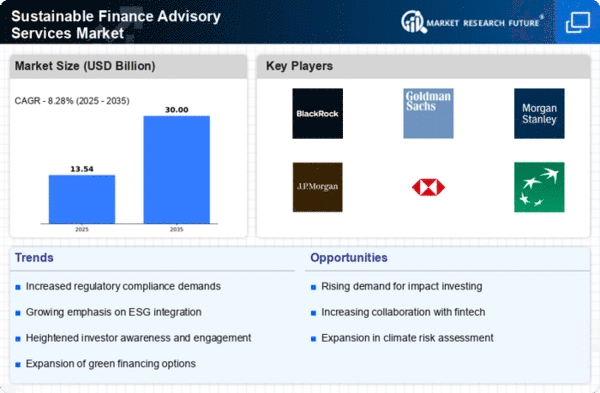
The Sustainable Finance Advisory Services Market is currently characterized by a dynamic competitive landscape, driven by increasing regulatory pressures and a growing emphasis on environmental, social, and governance (ESG) criteria. Major players are actively positioning themselves to capitalize on these trends through various strategic initiatives. For instance, BlackRock (US) has been focusing on integrating sustainability into its investment strategies, which appears to enhance its market presence. Similarly, J.P. Morgan (US) has been expanding its advisory services to include comprehensive ESG assessments, thereby catering to a broader client base. These strategies collectively contribute to a competitive environment that is increasingly centered around sustainability and responsible investment practices.In terms of business tactics, companies are increasingly localizing their services to better meet regional regulatory requirements and client expectations. This localization, coupled with supply chain optimization, is becoming essential for maintaining competitive advantage. The market structure is moderately fragmented, with several key players exerting significant influence. The collective actions of these firms suggest a trend towards consolidation, as they seek to enhance their service offerings and operational efficiencies.
In November Goldman Sachs (US) announced a partnership with a leading technology firm to develop an AI-driven platform aimed at enhancing ESG data analytics. This strategic move is likely to position Goldman Sachs at the forefront of sustainable finance, enabling it to provide more precise insights to clients and improve decision-making processes. The integration of AI into their advisory services could potentially redefine how financial institutions approach sustainability metrics.
In October HSBC (GB) launched a new initiative focused on financing renewable energy projects in emerging markets. This initiative not only aligns with global sustainability goals but also reflects HSBC's commitment to expanding its footprint in high-growth regions. By targeting emerging markets, HSBC is likely to tap into new revenue streams while promoting sustainable development, thereby enhancing its competitive positioning.
In September Deutsche Bank (DE) unveiled a comprehensive sustainability framework aimed at aligning its investment portfolio with the Paris Agreement targets. This framework is indicative of Deutsche Bank's proactive approach to sustainability, as it seeks to mitigate climate-related risks while appealing to environmentally conscious investors. Such initiatives are crucial in a market where stakeholder expectations are rapidly evolving.
As of December the competitive trends in the Sustainable Finance Advisory Services Market are increasingly defined by digitalization, sustainability, and the integration of advanced technologies such as AI. Strategic alliances are becoming pivotal in shaping the current landscape, as firms collaborate to enhance their service offerings and operational capabilities. Looking ahead, it is anticipated that competitive differentiation will increasingly pivot from traditional price-based competition to a focus on innovation, technological advancement, and supply chain reliability. This shift underscores the necessity for firms to adapt and evolve in a rapidly changing market environment.