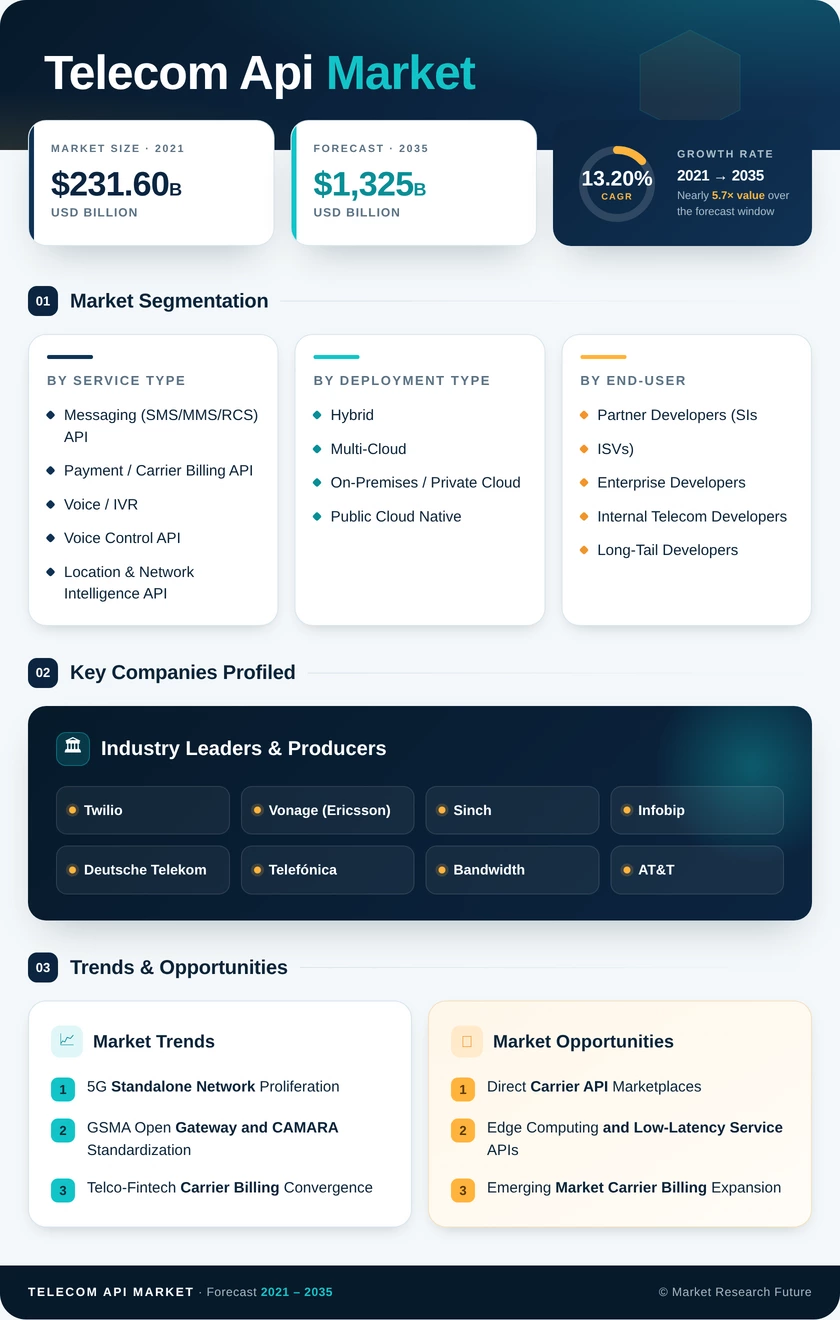
Telecom API Market

ID: MRFR/ICT/1733-HCR
100 Pages
Ankit Gupta
Last Updated: June 17, 2026
Telecom API Market Size, Share and Research Report By Service Type (Messaging (SMS/MMS/RCS) API, Payment / Carrier Billing API, Voice / IVR and Voice Control API, Location & Network Intelligence API, Identity & Number Verification API, Quality-of-Service / Network Slicing API), By Deployment Type (Hybrid, Multi-Cloud, On-Premises / Private Cloud, Public Cloud Native), By End-User (Partner Developers (SIs, ISVs), Enterprise Developers, Internal Telecom Developers, Long-Tail Developers), By Business Model (Aggregator-Led CPaaS, Direct Carrier Exposure, API Marketplace / Exchange, Embedded / White-Label) and By Regional (North America, Europe, South America, Asia Pacific, Middle East and Africa) - Industry Forecast to 2035.
Download PDF ×

We do not share your information with anyone. However, we may send you emails based on your report interest from time to time. You may contact us at any time to opt-out.

  1. 1 Market Overview |
    1. 1.1 Study Assumptions & Market Definition |
    2. 1.2 Scope of the Study |
    3. 1.3 Research Methodology
  2. 2 Market Summary & Key Takeaways
  3. 3 Market Dynamics |
    1. 3.1 Market Drivers Analysis | |
      1. 3.1.1 5G Standalone Network Proliferation | |
      2. 3.1.2 GSMA Open Gateway & CAMARA Standardization | |
      3. 3.1.3 Telco-Fintech Carrier Billing Convergence | |
      4. 3.1.4 RCS Business Messaging Cross-Platform Rollout | |
      5. 3.1.5 Edge Computing & Low-Latency API Demand | |
      6. 3.1.6 AI-Driven Network Orchestration & Intent APIs | |
      7. 3.1.7 Regulatory Open-Access Mandates (EU DMA, TRAI) |
    2. 3.2 Market Restraints Analysis | |
      1. 3.2.1 Data Privacy & Cross-Border Compliance Complexity | |
      2. 3.2.2 API Security Vulnerabilities & Fraud Exposure | |
      3. 3.2.3 Margin Pressure from Aggregator Intermediation | |
      4. 3.2.4 Legacy BSS/OSS Integration Friction | |
      5. 3.2.5 Fragmented National Numbering & Regulatory Regimes |
    3. 3.3 Market Opportunity Analysis | |
      1. 3.3.1 Direct Carrier API Marketplaces | |
      2. 3.3.2 Edge Computing & Low-Latency Service APIs | |
      3. 3.3.3 Emerging Market Carrier Billing Expansion | |
      4. 3.3.4 AI-Orchestrated Intent-Based Network APIs | |
      5. 3.3.5 Identity Verification & Anti-Fraud APIs |
    4. 3.4 Industry Value Chain Analysis |
    5. 3.5 Porter's Five Forces Analysis
  4. 4 Global Telecom API Market Size & Forecast (2021–2035) |
    1. 4.1 Historical Market Size (2021–2025) |
    2. 4.2 Current & Forecast Market Size (2026–2035) |
    3. 4.3 Market Size by Revenue (USD Billion) |
    4. 4.4 Year-over-Year Growth Analysis
  5. 5 Segmentation Analysis |
    1. 5.1 By Service Type | |
      1. 5.1.1 Messaging (SMS/MMS/RCS) API | |
      2. 5.1.2 Payment / Carrier Billing API | |
      3. 5.1.3 Voice / IVR and Voice Control API | |
      4. 5.1.4 Location & Network Intelligence API | |
      5. 5.1.5 Identity & Number Verification API | |
      6. 5.1.6 Quality-of-Service / Network Slicing API |
    2. 5.2 By Deployment Type | |
      1. 5.2.1 Hybrid | |
      2. 5.2.2 Multi-Cloud | |
      3. 5.2.3 On-Premises / Private Cloud | |
      4. 5.2.4 Public Cloud Native |
    3. 5.3 By End-User | |
      1. 5.3.1 Partner Developers (SIs, ISVs) | |
      2. 5.3.2 Enterprise Developers | |
      3. 5.3.3 Internal Telecom Developers | |
      4. 5.3.4 Long-Tail Developers |
    4. 5.4 By Business Model | |
      1. 5.4.1 Aggregator-Led CPaaS | |
      2. 5.4.2 Direct Carrier Exposure | |
      3. 5.4.3 API Marketplace / Exchange | |
      4. 5.4.4 Embedded / White-Label
  6. 6 Regional Analysis |
    1. 6.1 North America | |
      1. 6.1.1 United States | |
      2. 6.1.2 Canada | |
      3. 6.1.3 Mexico |
    2. 6.2 Europe | |
      1. 6.2.1 Germany | |
      2. 6.2.2 United Kingdom | |
      3. 6.2.3 France | |
      4. 6.2.4 Italy | |
      5. 6.2.5 Spain | |
      6. 6.2.6 Nordic Countries | |
      7. 6.2.7 Russia | |
      8. 6.2.8 Rest of Europe |
    3. 6.3 Asia-Pacific | |
      1. 6.3.1 China | |
      2. 6.3.2 India | |
      3. 6.3.3 Japan | |
      4. 6.3.4 South Korea | |
      5. 6.3.5 ASEAN | |
      6. 6.3.6 Rest of Asia-Pacific |
    4. 6.4 South America | |
      1. 6.4.1 Brazil | |
      2. 6.4.2 Argentina | |
      3. 6.4.3 Rest of South America |
    5. 6.5 Middle East & Africa | |
      1. 6.5.1 Saudi Arabia | |
      2. 6.5.2 UAE | |
      3. 6.5.3 South Africa | |
      4. 6.5.4 Egypt | |
      5. 6.5.5 Rest of MEA
  7. 7 Competitive Landscape |
    1. 7.1 Market Share Analysis (2026) |
    2. 7.2 Competitive Benchmarking Matrix |
    3. 7.3 Company Profiles | |
      1. 7.3.1 Twilio | |
      2. 7.3.2 Vonage (Ericsson) | |
      3. 7.3.3 Sinch | |
      4. 7.3.4 Infobip | |
      5. 7.3.5 Deutsche Telekom | |
      6. 7.3.6 Telefónica | |
      7. 7.3.7 Bandwidth | |
      8. 7.3.8 AT&T | |
      9. 7.3.9 Nokia (Network as Code) | |
      10. 7.3.10 Plivo
  8. 8 Future Outlook & Strategic Recommendations (2026–2035) |
    1. 8.1 AI-Native API Orchestration |
    2. 8.2 Platform Economics & Developer Ecosystem Scale |
    3. 8.3 6G Preparedness & Sensing APIs |
    4. 8.4 ESG Reporting & Sustainable API Infrastructure
  9. 9 Recent Developments & News
  10. 10 Frequently Asked Questions (FAQs)
  11. 11 Report Scope & Methodology |
    1. 11.1 Study Period & Base Year |
    2. 11.2 Data Sources & Citations |
    3. 11.3 Abbreviations
  12. 12 LIST OF TABLES |
  13. TABLE 1 Global Telecom API Market Size & Forecast, by Revenue (USD Billion), 2021–2035 |
  14. TABLE 2 Global Telecom API Market — Year-over-Year Growth Analysis, 2021–2035 |
  15. TABLE 3 Global Telecom API Market — Driver Impact Analysis |
  16. TABLE 4 Global Telecom API Market — Restraint Impact Analysis |
  17. TABLE 5 Global Telecom API Market Size, by Service Type, 2021–2035 (USD Billion) |
  18. TABLE 6 Global Telecom API Market Size, by Deployment Type, 2021–2035 (USD Billion) |
  19. TABLE 7 Global Telecom API Market Size, by End-User, 2021–2035 (USD Billion) |
  20. TABLE 8 Global Telecom API Market Size, by Business Model, 2021–2035 (USD Billion) |
  21. TABLE 9 Global Telecom API Market Size, by Region, 2021–2035 (USD Billion) |
  22. TABLE 10 North America Telecom API Market Size, by Country, 2021–2035 (USD Billion) |
  23. TABLE 11 Europe Telecom API Market Size, by Country, 2021–2035 (USD Billion) |
  24. TABLE 12 Asia-Pacific Telecom API Market Size, by Country, 2021–2035 (USD Billion) |
  25. TABLE 13 South America Telecom API Market Size, by Country, 2021–2035 (USD Billion) |
  26. TABLE 14 Middle East & Africa Telecom API Market Size, by Country, 2021–2035 (USD Billion) |
  27. TABLE 15 Competitive Benchmarking Matrix — Global Telecom API Market, 2026 |
  28. TABLE 16 Company Profiles — Key Players, Global Telecom API Market |
  29. TABLE 17 Recent Developments & Strategic Announcements, 2024–2025 |
  30. TABLE 18 Report Scope & Methodology Summary |
  31. TABLE 19 Detailed Sources and Citations |
  32. TABLE 20 North America Telecom API Market Size, by Service Type, 2021–2035 (USD Billion) |
  33. TABLE 21 North America Telecom API Market Size, by Deployment Type, 2021–2035 (USD Billion) |
  34. TABLE 22 North America Telecom API Market Size, by End-User, 2021–2035 (USD Billion) |
  35. TABLE 23 North America Telecom API Market Size, by Business Model, 2021–2035 (USD Billion) |
  36. TABLE 24 Europe Telecom API Market Size, by Service Type, 2021–2035 (USD Billion) |
  37. TABLE 25 Europe Telecom API Market Size, by Deployment Type, 2021–2035 (USD Billion) |
  38. TABLE 26 Europe Telecom API Market Size, by End-User, 2021–2035 (USD Billion) |
  39. TABLE 27 Europe Telecom API Market Size, by Business Model, 2021–2035 (USD Billion) |
  40. TABLE 28 Asia-Pacific Telecom API Market Size, by Service Type, 2021–2035 (USD Billion) |
  41. TABLE 29 Asia-Pacific Telecom API Market Size, by Deployment Type, 2021–2035 (USD Billion) |
  42. TABLE 30 Asia-Pacific Telecom API Market Size, by End-User, 2021–2035 (USD Billion) |
  43. TABLE 31 Asia-Pacific Telecom API Market Size, by Business Model, 2021–2035 (USD Billion) |
  44. TABLE 32 South America Telecom API Market Size, by Service Type, 2021–2035 (USD Billion) |
  45. TABLE 33 South America Telecom API Market Size, by Deployment Type, 2021–2035 (USD Billion) |
  46. TABLE 34 South America Telecom API Market Size, by End-User, 2021–2035 (USD Billion) |
  47. TABLE 35 South America Telecom API Market Size, by Business Model, 2021–2035 (USD Billion) |
  48. TABLE 36 Middle East & Africa Telecom API Market Size, by Service Type, 2021–2035 (USD Billion) |
  49. TABLE 37 Middle East & Africa Telecom API Market Size, by Deployment Type, 2021–2035 (USD Billion) |
  50. TABLE 38 Middle East & Africa Telecom API Market Size, by End-User, 2021–2035 (USD Billion) |
  51. TABLE 39 Middle East & Africa Telecom API Market Size, by Business Model, 2021–2035 (USD Billion) |
  52. TABLE 40 United States Telecom API Market Size, by Service Type, 2021–2035 (USD Billion) |
  53. TABLE 41 United States Telecom API Market Size, by Deployment Type, 2021–2035 (USD Billion) |
  54. TABLE 42 United States Telecom API Market Size, by End-User, 2021–2035 (USD Billion) |
  55. TABLE 43 United States Telecom API Market Size, by Business Model, 2021–2035 (USD Billion) |
  56. TABLE 44 Canada Telecom API Market Size, by Service Type, 2021–2035 (USD Billion) |
  57. TABLE 45 Canada Telecom API Market Size, by Deployment Type, 2021–2035 (USD Billion) |
  58. TABLE 46 Canada Telecom API Market Size, by End-User, 2021–2035 (USD Billion) |
  59. TABLE 47 Canada Telecom API Market Size, by Business Model, 2021–2035 (USD Billion) |
  60. TABLE 48 Mexico Telecom API Market Size, by Service Type, 2021–2035 (USD Billion) |
  61. TABLE 49 Mexico Telecom API Market Size, by Deployment Type, 2021–2035 (USD Billion) |
  62. TABLE 50 Mexico Telecom API Market Size, by End-User, 2021–2035 (USD Billion) |
  63. TABLE 51 Mexico Telecom API Market Size, by Business Model, 2021–2035 (USD Billion) |
  64. TABLE 52 Germany Telecom API Market Size, by Service Type, 2021–2035 (USD Billion) |
  65. TABLE 53 Germany Telecom API Market Size, by Deployment Type, 2021–2035 (USD Billion) |
  66. TABLE 54 Germany Telecom API Market Size, by End-User, 2021–2035 (USD Billion) |
  67. TABLE 55 Germany Telecom API Market Size, by Business Model, 2021–2035 (USD Billion) |
  68. TABLE 56 United Kingdom Telecom API Market Size, by Service Type, 2021–2035 (USD Billion) |
  69. TABLE 57 United Kingdom Telecom API Market Size, by Deployment Type, 2021–2035 (USD Billion) |
  70. TABLE 58 United Kingdom Telecom API Market Size, by End-User, 2021–2035 (USD Billion) |
  71. TABLE 59 United Kingdom Telecom API Market Size, by Business Model, 2021–2035 (USD Billion) |
  72. TABLE 60 France Telecom API Market Size, by Service Type, 2021–2035 (USD Billion) |
  73. TABLE 61 France Telecom API Market Size, by Deployment Type, 2021–2035 (USD Billion) |
  74. TABLE 62 France Telecom API Market Size, by End-User, 2021–2035 (USD Billion) |
  75. TABLE 63 France Telecom API Market Size, by Business Model, 2021–2035 (USD Billion) |
  76. TABLE 64 China Telecom API Market Size, by Service Type, 2021–2035 (USD Billion) |
  77. TABLE 65 China Telecom API Market Size, by Deployment Type, 2021–2035 (USD Billion) |
  78. TABLE 66 China Telecom API Market Size, by End-User, 2021–2035 (USD Billion) |
  79. TABLE 67 China Telecom API Market Size, by Business Model, 2021–2035 (USD Billion) |
  80. TABLE 68 India Telecom API Market Size, by Service Type, 2021–2035 (USD Billion) |
  81. TABLE 69 India Telecom API Market Size, by Deployment Type, 2021–2035 (USD Billion) |
  82. TABLE 70 India Telecom API Market Size, by End-User, 2021–2035 (USD Billion) |
  83. TABLE 71 India Telecom API Market Size, by Business Model, 2021–2035 (USD Billion) |
  84. TABLE 72 Japan Telecom API Market Size, by Service Type, 2021–2035 (USD Billion) |
  85. TABLE 73 Japan Telecom API Market Size, by Deployment Type, 2021–2035 (USD Billion) |
  86. TABLE 74 Japan Telecom API Market Size, by End-User, 2021–2035 (USD Billion) |
  87. TABLE 75 Japan Telecom API Market Size, by Business Model, 2021–2035 (USD Billion) |
  88. TABLE 76 South Korea Telecom API Market Size, by Service Type, 2021–2035 (USD Billion) |
  89. TABLE 77 South Korea Telecom API Market Size, by Deployment Type, 2021–2035 (USD Billion) |
  90. TABLE 78 South Korea Telecom API Market Size, by End-User, 2021–2035 (USD Billion) |
  91. TABLE 79 South Korea Telecom API Market Size, by Business Model, 2021–2035 (USD Billion) |
  92. TABLE 80 Brazil Telecom API Market Size, by Service Type, 2021–2035 (USD Billion) |
  93. TABLE 81 Brazil Telecom API Market Size, by Deployment Type, 2021–2035 (USD Billion) |
  94. TABLE 82 Brazil Telecom API Market Size, by End-User, 2021–2035 (USD Billion) |
  95. TABLE 83 Brazil Telecom API Market Size, by Business Model, 2021–2035 (USD Billion) |
  96. TABLE 84 Saudi Arabia Telecom API Market Size, by Service Type, 2021–2035 (USD Billion) |
  97. TABLE 85 Saudi Arabia Telecom API Market Size, by Deployment Type, 2021–2035 (USD Billion) |
  98. TABLE 86 Saudi Arabia Telecom API Market Size, by End-User, 2021–2035 (USD Billion) |
  99. TABLE 87 Saudi Arabia Telecom API Market Size, by Business Model, 2021–2035 (USD Billion) |
  100. TABLE 88 UAE Telecom API Market Size, by Service Type, 2021–2035 (USD Billion) |
  101. TABLE 89 UAE Telecom API Market Size, by Deployment Type, 2021–2035 (USD Billion) |
  102. TABLE 90 UAE Telecom API Market Size, by End-User, 2021–2035 (USD Billion) |
  103. TABLE 91 UAE Telecom API Market Size, by Business Model, 2021–2035 (USD Billion)
  104. 13 LIST OF FIGURES |
  105. FIGURE 1 Global Telecom API Market Dynamics — Drivers, Restraints, and Opportunities |
  106. FIGURE 2 Telecom API Industry Value Chain Analysis |
  107. FIGURE 3 Porter's Five Forces Analysis — Global Telecom API Market |
  108. FIGURE 4 Global Telecom API Market Size Trend & Forecast (USD Billion), 2021–2035 |
  109. FIGURE 5 Global Telecom API Market Share, by Service Type (%), 2025 |
  110. FIGURE 6 Global Telecom API Market Share, by Deployment Type (%), 2025 |
  111. FIGURE 7 Global Telecom API Market Share, by End-User (%), 2025 |
  112. FIGURE 8 Global Telecom API Market Share, by Business Model (%), 2025 |
  113. FIGURE 9 Global Telecom API Market Share, by Region (%), 2025 |
  114. FIGURE 10 North America Telecom API Market Size Trend (USD Billion), 2021–2035 |
  115. FIGURE 11 Europe Telecom API Market Size Trend (USD Billion), 2021–2035 |
  116. FIGURE 12 Asia-Pacific Telecom API Market Size Trend (USD Billion), 2021–2035 |
  117. FIGURE 13 South America Telecom API Market Size Trend (USD Billion), 2021–2035 |
  118. FIGURE 14 Middle East & Africa Telecom API Market Size Trend (USD Billion), 2021–2035 |
  119. FIGURE 15 Competitive Landscape — Market Share Heat Map, Global Telecom API Market, 2026 |
  120. FIGURE 16 Competitive Positioning Matrix — Key Players, Global Telecom API Market

Segmentation Quick Reference

DimensionSub-SegmentsDominant SegmentFastest Growing Segment
Service TypeMessaging (SMS/MMS/RCS) API, Payment / Carrier Billing API, Voice / IVR and Voice Control API, Location & Network Intelligence API, Identity & Number Verification API, Quality-of-Service / Network Slicing APIMessaging (SMS/MMS/RCS) APIQuality-of-Service / Network Slicing API
Deployment TypeHybrid, Multi-Cloud, On-Premises / Private Cloud, Public Cloud NativeHybridMulti-Cloud
End-UserPartner Developers (SIs, ISVs), Enterprise Developers, Internal Telecom Developers, Long-Tail DevelopersPartner Developers (SIs, ISVs)Long-Tail Developers
Business ModelAggregator-Led CPaaS, Direct Carrier Exposure, API Marketplace / Exchange, Embedded / White-LabelAggregator-Led CPaaSAPI Marketplace / Exchange


Market Segmentation Overview

By Service Type

Sub-SegmentKey Trend
Messaging (SMS/MMS/RCS) APIRCS business messaging migration from legacy SMS; Apple interoperability catalyst
Payment / Carrier Billing APITelco-fintech convergence; unbanked population payment gateway
Voice / IVR and Voice Control APICCaaS modernization; AI-powered interactive voice response
Location & Network Intelligence APIFraud prevention geofencing; logistics fleet optimization
Identity & Number Verification APISIM-swap detection; silent authentication for financial services
Quality-of-Service / Network Slicing APIEnterprise SLA guarantees, gaming, and XR low-latency tiers


Messaging APIs retain the largest revenue share due to the massive A2P authentication and customer engagement market. RCS adoption on iOS has accelerated the migration from legacy SMS toward higher-margin interactive messaging channels with rich media, verified sender profiles, and embedded payment capabilities.

By Deployment Type

Sub-SegmentKey Trend
HybridData sovereignty balances with cloud scalability; predominant architecture for tier-one carriers
Multi-CloudVendor-neutral orchestration gaining traction; resilience-first enterprise strategy
On-Premises / Private CloudRegulatory compliance for sensitive network data; declining share
Public Cloud NativeRapid scaling for self-service developer portals; long-tail segment enabler


Hybrid architectures dominate because operators balance edge-latency requirements against the scalability benefits of public cloud. Multi-cloud adoption is accelerating as carriers seek to avoid hyperscaler lock-in while maintaining fault tolerance across geographic deployments.

By End-User

Sub-SegmentKey Trend
Partner Developers (SIs, ISVs)Vertical-solution embedding; enterprise multiplier channel
Enterprise DevelopersDirect API consumption for internal automation and customer experience
Internal Telecom DevelopersBSS/OSS modernization; internal process automation
Long-Tail DevelopersSelf-service sandbox adoption; lowest onboarding friction


Partner developers serve as ecosystem multipliers by embedding network APIs into vertical solutions distributed across thousands of downstream enterprises. Long-tail developers represent the fastest-growing segment, benefiting from democratized API access and free-tier sandbox environments.

By Business Model

Sub-SegmentKey Trend
Aggregator-Led CPaaSBroadest developer reach through multi-carrier abstraction layers
Direct Carrier ExposureMargin recapture strategy; premium SLA differentiation
API Marketplace / ExchangeFederated discovery across operator boundaries; GSMA Open Gateway aligned
Embedded / White-LabelOEM integration for invisible connectivity in vertical SaaS platforms


Aggregator-led models command the largest share but face margin pressure as operators pursue direct API marketplace strategies. The API marketplace and exchange model is growing fastest, enabled by GSMA Open Gateway's federated architecture that eliminates per-operator integration overhead.