Download Free Sample
Kindly complete the form below to receive a free sample of this Report
Television Production Equipment MRO Services Market Size, Share and Trends Analysis Research Report Information By End Use (TV Networks, Film Studios, Event Management, Educational Institutions), By Application (Broadcasting, Film Production, Live Events, Post-Production), By Service Type (Maintenance, Repair, Overhaul, Calibration), By Equipment Type (Cameras, Lighting, Audio, Editing Systems), And By Region – Market Forecast Till 2035.
As per MRFR analysis, the Television Production Equipment MRO Services Market was estimated at 6.5 USD Billion in 2024. The market is projected to grow from 6.7 in 2025 to 9.0 by 2035, exhibiting a compound annual growth rate (CAGR) of 3.0% during the forecast period 2025 - 2035.
The Television Production Equipment MRO Services Market is experiencing a dynamic shift towards technological integration and sustainability.
| 2024 Market Size | 6.5 (USD Billion) |
| 2035 Market Size | 9.0 (USD Billion) |
| CAGR (2025 - 2035) | 3.0% |
Sony (JP), Panasonic (JP), Blackmagic Design (AU), Avid Technology (US), Grass Valley (US), Canon (JP), ARRI (DE), NewTek (US), Telestream (US)
Our Impact
Enabled $4.3B Revenue Impact for Fortune 500 and Leading Multinationals
Partnering with 2000+ Global Organizations Each Year
30K+ Citations by Top-Tier Firms in the Industry
The Television Production Equipment MRO Services Market is currently experiencing a dynamic evolution, driven by the increasing demand for high-quality content and the rapid advancement of technology. As production companies strive to enhance their operational efficiency, the need for maintenance, repair, and overhaul services for television production equipment has become paramount. This market appears to be influenced by various factors, including the growing trend of remote production and the integration of advanced technologies such as artificial intelligence and automation. These developments suggest a shift towards more streamlined processes, potentially reducing downtime and improving overall productivity. Moreover, the competitive landscape of the Television Production Equipment MRO Services Market is characterized by a diverse range of service providers, each vying to offer innovative solutions tailored to the unique needs of production houses. Collaboration between equipment manufacturers and service providers seems to be on the rise, fostering a more integrated approach to equipment maintenance. This collaboration may lead to enhanced service offerings, ensuring that production companies can maintain their equipment in optimal condition. As the market continues to evolve, it is likely that new trends will emerge, further shaping the future of MRO services in the television production sector.
The integration of advanced technologies into MRO services is becoming increasingly prevalent. This trend indicates a shift towards automation and artificial intelligence, which may enhance the efficiency of maintenance processes and reduce operational costs for production companies.
The rise of remote production capabilities is influencing the demand for MRO services. As production teams adapt to new workflows, the need for specialized maintenance and support services tailored to remote setups appears to be growing.
There is a noticeable trend towards sustainability within the Television Production Equipment MRO Services Market. Companies are increasingly seeking eco-friendly solutions and practices, which may lead to the development of greener maintenance options and a focus on reducing waste.
Cost efficiency remains a critical driver in the Television Production Equipment MRO Services Market. Production companies are under constant pressure to optimize budgets while maintaining high production values. This has led to a heightened focus on preventive maintenance strategies, which can significantly reduce long-term costs associated with equipment failure. By investing in MRO services, companies can avoid costly repairs and extend the life of their equipment, ultimately leading to better financial performance. The market data indicates that organizations prioritizing cost-effective MRO solutions are more likely to achieve sustainable growth. As a result, MRO service providers are increasingly offering flexible pricing models and service packages that cater to the diverse needs of production companies.
The Television Production Equipment MRO Services Market is experiencing a surge in demand for high-quality content, driven by the proliferation of streaming platforms and digital media. As production companies strive to meet audience expectations, they increasingly invest in advanced equipment and maintenance services. This trend is reflected in the growing market for production equipment, which is projected to reach substantial figures in the coming years. The need for reliable maintenance, repair, and operations services becomes paramount to ensure that equipment functions optimally, thereby enhancing the overall production quality. Consequently, MRO services are becoming integral to the production process, as they help mitigate downtime and extend the lifespan of expensive equipment.
The expansion of remote production capabilities is reshaping the Television Production Equipment MRO Services Market. As more productions occur outside traditional studio environments, the need for portable and adaptable equipment has surged. This shift necessitates specialized MRO services that can address the unique challenges associated with remote setups. The market is witnessing an increase in demand for equipment that is not only high-quality but also easy to transport and set up. MRO providers are adapting their services to support remote production teams, offering on-site maintenance and rapid response solutions. This trend indicates a potential growth area for MRO services, as production companies seek to ensure that their remote operations run smoothly and efficiently.
Technological advancements are significantly influencing the Television Production Equipment MRO Services Market. Innovations such as 4K and 8K resolution cameras, advanced lighting systems, and sophisticated audio equipment are reshaping production standards. As these technologies evolve, the complexity of maintenance and repair increases, necessitating specialized MRO services. The market for production equipment is projected to grow, with estimates suggesting a compound annual growth rate that reflects the increasing reliance on cutting-edge technology. MRO services must adapt to these advancements, ensuring that technicians are equipped with the necessary skills and knowledge to handle modern equipment. This dynamic creates opportunities for MRO providers to offer tailored services that align with the latest technological trends.
The Television Production Equipment MRO Services Market is increasingly influenced by the need for compliance with safety and regulatory standards. As production environments become more complex, adherence to safety protocols is paramount to protect personnel and equipment. Regulatory bodies are imposing stricter guidelines, which necessitate regular maintenance and inspections of production equipment. This trend is driving demand for MRO services that ensure compliance with industry standards. Companies that prioritize safety and compliance are likely to experience fewer accidents and equipment failures, which can have significant financial implications. The market for MRO services is expected to expand as production companies seek reliable partners to help navigate the complexities of compliance and safety regulations.
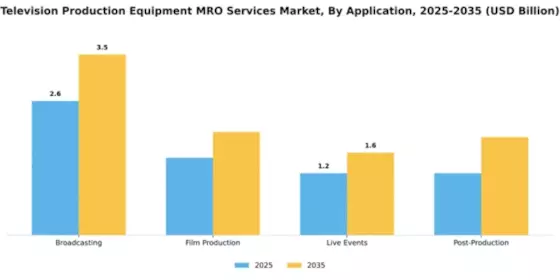
The Television Production Equipment MRO Services Market is significantly influenced by various application segments, with Broadcasting commanding the largest market share. This segment benefits from the consistent demand for quality broadcasting equipment and support services necessary for live and recorded broadcasts. Conversely, Film Production, while smaller in share, is emerging as the fastest-growing segment, driven by increased investments in high-quality content and evolving production techniques.
Film Production (Emerging) vs. Live Events (Dominant)
The Film Production segment is characterized by innovative production technologies and a rising trend towards high-definition and 4K content creation, significantly enhancing its market appeal. This segment is increasingly prioritizing quality, thus boosting demand for specialized maintenance and repair services. In contrast, the Live Events segment remains dominant, capitalizing on the growing inclination for live broadcasting and event coverage. This segment heavily relies on reliable technical equipment and timely MRO services to ensure seamless operations during events, positioning it as a consistent revenue generator in the market.
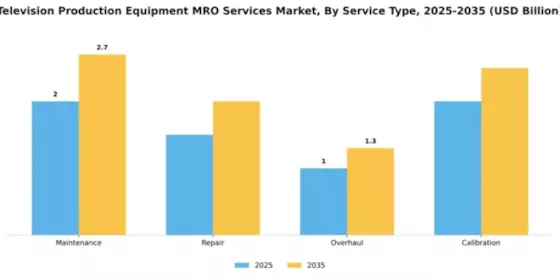
The Television Production Equipment MRO Services Market is characterized by varied contributions from its service types. Maintenance holds a significant portion of the market, being vital for ensuring the consistent functionality of production equipment. Repair services follow closely, supporting the quick rectification of issues that arise during production. Overhaul services are essential for comprehensive updates of older equipment, while Calibration, though smaller in market share, is rapidly gaining traction as studios focus on precision and quality in content creation.
Maintenance (Dominant) vs. Calibration (Emerging)
Maintenance stands as the dominant service in the Television Production Equipment MRO Services Market, ensuring that equipment remains in peak operational status and preventing costly downtimes. Its established role is underscored by dependency on regular servicing practices and schedules, which are crucial for the continuity of production activities. On the other hand, Calibration has emerged as a vital service, recognized for its role in optimizing performance and accuracy of video and audio equipment. As technology evolves and the demand for high-quality production rises, Calibration services are witnessing increased adoption. Studios are prioritizing precision in their productions, leading to a heightened focus on calibration as essential for maintaining industry standards.
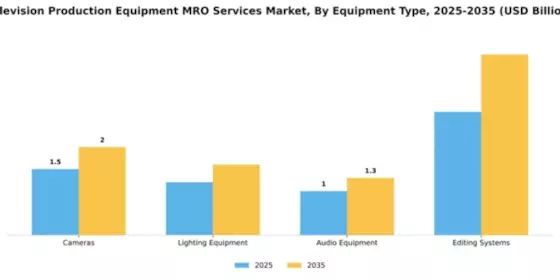
In the Television Production Equipment MRO Services Market, the distribution of market share is heavily influenced by the equipment types utilized during production. Cameras represent the largest segment, owing to their essential role in capturing high-quality footage. Other significant segments include Lighting Equipment, Audio Equipment, and Editing Systems, which also contribute to the overall market framework by enhancing the production quality and experience. Each equipment type serves different functions that are critical for successful television production, leading to a strongly segmented marketplace.
Lighting Equipment (Dominant) vs. Audio Equipment (Emerging)
Lighting Equipment has established itself as a dominant force in the Television Production Equipment MRO Services Market due to its crucial role in creating the desired visual atmosphere and improving overall production quality. As technology advances, the demand for sophisticated lighting solutions such as LED fixtures, which offer versatility and energy efficiency, has surged. Conversely, Audio Equipment is emerging as a key area of growth, driven by the increasing recognition of its importance in enhancing sound quality during production. Innovations in audio capture technology and the demand for immersive sound experiences are propelling this segment forward, marking it as a vital focus for future investments.
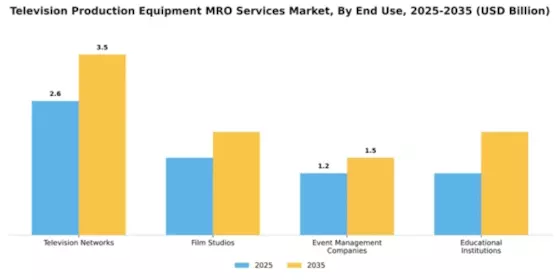
In the Television Production Equipment MRO Services Market, 'Television Networks' hold a substantial share, with a considerable portion of the market dedicated to maintaining and upgrading their equipment to ensure high-quality broadcasts. This segment typically demands a wide range of services, from routine inspections to complex repairs, which reinforces its positioning within the market. In comparison, 'Film Studios', with their vibrant production activities, represent a rapidly expanding portion. The growing demand for content across various platforms fuels the need for sophisticated equipment maintenance, allowing film studios to enhance their production capabilities significantly. Furthermore, this segment is witnessing an influx of innovations and advanced technology solutions, catering to the specific needs of television networks and film studios alike. The digital transformation of the media landscape and increased competition compel these entities to optimize their equipment's performance, leading to an increased emphasis on MRO services. By investing in enhanced maintenance services, both segments can achieve better operational efficiency and production quality as they adapt to evolving viewer preferences.
Television Networks (Dominant) vs. Event Management Companies (Emerging)
The market position of 'Television Networks' stands as dominant due to their reliance on sophisticated broadcasting equipment, necessitating regular maintenance and repair services. These networks utilize a wide array of production tools to deliver engaging content to their audiences, making MRO services critical to ensure uninterrupted service delivery and superior broadcast quality. In contrast, 'Event Management Companies' are emerging players in this market. While they require maintenance services, their needs are specific to creating high-quality live experiences rather than ongoing production. Their growth is driven by an increase in live events and corporate functions. As they seek to enhance the audiovisual aspects of their events, they will increasingly turn to MRO services, broadening the market opportunities available for providers.
Get more detailed insights about Television Production Equipment MRO Services Market Request Free Sample
North America continues to lead the Television Production Equipment MRO Services market, holding a significant share of 3.25B in 2024. The region's growth is driven by high demand for advanced broadcasting technologies and stringent regulatory standards that promote quality and safety. The increasing investment in media and entertainment infrastructure further fuels this growth, making it a hub for innovation and service excellence. The competitive landscape is characterized by major players such as Avid Technology, Grass Valley, and Sony, which dominate the market with their cutting-edge solutions. The U.S. stands out as the leading country, supported by a robust ecosystem of technology providers and service companies. This concentration of expertise and resources positions North America as a pivotal region for MRO services in the television production sector.
Europe's Television Production Equipment MRO Services market is valued at 1.8B, reflecting a growing demand for high-quality production services. The region benefits from a diverse media landscape and supportive regulations that encourage innovation and investment. Key drivers include the increasing consumption of digital content and the need for regular maintenance and upgrades of production equipment to meet evolving standards. Leading countries such as Germany, the UK, and France are at the forefront of this growth, with a competitive landscape featuring companies like ARRI and Panasonic. The presence of established players and a focus on sustainability in production practices further enhance the region's attractiveness for MRO services. "The European audiovisual sector is committed to maintaining high standards of quality and innovation," European Commission report, European Commission.
The Asia-Pacific region, valued at 1.5B, is witnessing rapid growth in the Television Production Equipment MRO Services market. This expansion is driven by increasing investments in media infrastructure and a rising demand for high-definition content. Regulatory support for digital transformation and technological advancements in broadcasting are key catalysts for this growth, making the region a focal point for MRO services. Countries like Japan, Australia, and China are leading the charge, with significant contributions from companies such as Blackmagic Design and Canon. The competitive landscape is evolving, with new entrants and innovations enhancing service offerings. The region's diverse market dynamics present both challenges and opportunities for MRO service providers, emphasizing the need for adaptability and strategic partnerships.
The Middle East and Africa region, valued at 0.95B, presents a unique landscape for Television Production Equipment MRO Services. The market is driven by increasing media consumption and investments in broadcasting infrastructure. However, challenges such as regulatory hurdles and varying levels of technological adoption can impact growth. Despite these challenges, the region is gradually embracing modernization and innovation in media production. Countries like South Africa and the UAE are leading the way, with a growing number of local and international players entering the market. The competitive landscape is characterized by a mix of established companies and new entrants, creating opportunities for collaboration and growth. The region's potential for MRO services is significant, as demand for quality production continues to rise.
The Television Production Equipment MRO Services Market is characterized by a dynamic competitive landscape, driven by technological advancements and the increasing demand for high-quality production capabilities. Key players such as Sony (JP), Panasonic (JP), and Avid Technology (US) are strategically positioned to leverage innovation and digital transformation. Sony (JP) focuses on enhancing its service offerings through advanced analytics and customer engagement, while Panasonic (JP) emphasizes sustainability in its operations, aiming to reduce environmental impact. Avid Technology (US) is actively pursuing partnerships to expand its software solutions, thereby enhancing its competitive edge. Collectively, these strategies contribute to a robust competitive environment, where innovation and service quality are paramount.The market structure appears moderately fragmented, with several players vying for market share. Key business tactics include localizing manufacturing to reduce costs and optimize supply chains, which is increasingly vital in a globalized economy. The influence of major companies is significant, as they not only set industry standards but also drive technological advancements that smaller players must adapt to in order to remain competitive.In November Blackmagic Design (AU) announced the launch of a new line of production equipment aimed at enhancing live broadcasting capabilities. This strategic move is likely to position the company favorably in a market that increasingly values real-time production efficiency. By focusing on innovative solutions, Blackmagic Design (AU) may attract a broader customer base, particularly among smaller production houses looking for cost-effective yet high-quality equipment.In October Grass Valley (US) unveiled a partnership with a leading cloud service provider to enhance its MRO services through cloud-based solutions. This collaboration is indicative of a broader trend towards digitalization in the industry, allowing Grass Valley (US) to offer more flexible and scalable services. The integration of cloud technology could potentially streamline operations for clients, making it a strategic advantage in a competitive market.In September Canon (JP) expanded its service network in Europe, focusing on localized support for its MRO services. This expansion is significant as it reflects Canon's commitment to enhancing customer service and operational efficiency. By increasing its presence in key markets, Canon (JP) may strengthen its competitive position and better respond to regional demands.As of December the competitive trends in the Television Production Equipment MRO Services Market are increasingly defined by digitalization, sustainability, and the integration of AI technologies. Strategic alliances are becoming more prevalent, as companies recognize the need to collaborate in order to innovate effectively. The shift from price-based competition to a focus on technological advancement and supply chain reliability is evident, suggesting that future competitive differentiation will hinge on the ability to innovate and adapt to changing market demands.




The Television Production Equipment MRO Services Market is projected to grow at a 3.0% CAGR from 2025 to 2035, driven by technological advancements and increasing demand for high-quality production.
New opportunities lie in:
By 2035, the market is expected to be robust, reflecting sustained growth and innovation.
| MARKET SIZE 2024 | 6.5(USD Billion) |
| MARKET SIZE 2025 | 6.7(USD Billion) |
| MARKET SIZE 2035 | 9.0(USD Billion) |
| COMPOUND ANNUAL GROWTH RATE (CAGR) | 3.0% (2025 - 2035) |
| REPORT COVERAGE | Revenue Forecast, Competitive Landscape, Growth Factors, and Trends |
| BASE YEAR | 2024 |
| Market Forecast Period | 2025 - 2035 |
| Historical Data | 2019 - 2024 |
| Market Forecast Units | USD Billion |
| Key Companies Profiled | Sony (JP), Panasonic (JP), Blackmagic Design (AU), Avid Technology (US), Grass Valley (US), Canon (JP), ARRI (DE), NewTek (US), Telestream (US) |
| Segments Covered | Application, Service Type, Equipment Type, End Use |
| Key Market Opportunities | Integration of advanced automation technologies enhances efficiency in the Television Production Equipment MRO Services Market. |
| Key Market Dynamics | Technological advancements drive demand for efficient maintenance, repair, and operations services in television production equipment. |
| Countries Covered | North America, Europe, APAC, South America, MEA |
The market is projected to reach a valuation of 9.0 USD Billion by 2035.
In 2024, the overall market valuation was 6.5 USD Billion.
The expected CAGR for the market during the forecast period 2025 - 2035 is 3.0%.
By application, the Broadcasting segment is anticipated to have the highest valuation, projected at 3.5 USD Billion.
The projected valuation for Maintenance is 2.7 USD Billion, while Repair is expected to reach 2.0 USD Billion.
Editing Systems are expected to dominate, with a projected valuation of 4.1 USD Billion by 2035.
The Film Production segment is anticipated to grow to 2.0 USD Billion by 2035.
Television Networks are projected to reach 3.5 USD Billion, while Film Studios are expected to reach 2.0 USD Billion by 2035.
Key players such as Sony and Panasonic are instrumental in driving innovation and market growth within the Television Production Equipment MRO Services Market.
The Live Events segment is projected to reach a valuation of 1.6 USD Billion by 2035.


Kindly complete the form below to receive a free sample of this Report

“This is really good guys. Excellent work on a tight deadline. I will continue to use you going forward and recommend you to others. Nice job”


“Thanks. It’s been a pleasure working with you, please use me as reference with any other Intel employees.”


“Thanks for sending the report it gives us a good global view of the Betaïne market.”


“Thank you, this will be very helpful for OQS.”


“We found the report very insightful! we found your research firm very helpful. I'm sending this email to secure our future business.”


“I am very pleased with how market segments have been defined in a relevant way for my purposes (such as "Portable Freezers & refrigerators" and "last-mile"). In general the report is well structured. Thanks very much for your efforts.”


“I have been reading the first document or the study, ,the Global HVAC and FP market report 2021 till 2026. Must say, good info! I have not gone in depth at all parts, but got a good indication of the data inside!”


“We got the report in time, we really thank you for your support in this process. I also thank to all of your team as they did a great job.”


“The Automotive 48V ECU Components Procurement Intelligence Study” was a complex project, but the Market Research Future (MRFR) team handled it with quality, agility, and customer-centricity. They delivered all requested data on time and within the agreed scope. The team, including Shubhendra Anand and Rahul Gotadki, was always readily available to clarify questions and swiftly implement necessary adjustments, driving the project to a successful conclusion within a very demanding timeframe.
I would also like to specifically commend Akshay Agarwal for his responsiveness and support at every stage—from our initial inquiry on May 6th through to final delivery on June 18th. His dedication made the entire process seamless.”



