×
Request Free Sample ×

Kindly complete the form below to receive a free sample of this Report

* Please use a valid business email

Leading companies partner with us for data-driven Insights

clients tt-cursor
Hero Background

Terminal Management System Market

ID: MRFR/SEM/2254-HCR
100 Pages
Shubham Munde
October 2025

Terminal Management System Market Research Report Information By Component (Software and Services), By Project (Greenfield and Brownfield), By Vertical (Oil & Gas and Chemicals), And By Region (North America, Europe, Asia-Pacific, And Rest Of The World) – Industry Forecast Till 2035

Share:
Download PDF ×

We do not share your information with anyone. However, we may send you emails based on your report interest from time to time. You may contact us at any time to opt-out.

Terminal Management System Market Infographic
Purchase Options

Terminal Management System Market Summary

As per MRFR analysis, the Terminal Management System Market Size was estimated at 1709.74 USD Million in 2024. The Terminal Management System industry is projected to grow from 1902.98 USD Million in 2025 to 5552.19 USD Million by 2035, exhibiting a compound annual growth rate (CAGR) of 11.3 during the forecast period 2025 - 2035.

Key Market Trends & Highlights

The Terminal Management System Market is poised for substantial growth driven by technological advancements and evolving industry needs.

  • The integration of advanced technologies is transforming operational efficiencies in the Terminal Management System Market.
  • North America remains the largest market, while Asia-Pacific is emerging as the fastest-growing region, reflecting diverse regional demands.
  • Fleet Management continues to dominate the market, whereas Cargo Management is witnessing rapid growth due to increasing logistics needs.
  • Rising demand for automation and a focus on supply chain resilience are key drivers propelling market expansion.

Market Size & Forecast

2024 Market Size 1709.74 (USD Million)
2035 Market Size 5552.19 (USD Million)
CAGR (2025 - 2035) 11.3%

Major Players

ABB (CH), Siemens (DE), Honeywell (US), Schneider Electric (FR), Emerson (US), Rockwell Automation (US), Kongsberg Gruppen (NO), Wärtsilä (FI), Cavotec (CH)

Terminal Management System Market Trends

The Terminal Management System Market is currently experiencing a transformative phase, driven by the increasing need for efficient logistics and supply chain management. Organizations are recognizing the importance of optimizing terminal operations to enhance productivity and reduce operational costs. This market is characterized by the integration of advanced technologies such as automation, artificial intelligence, and data analytics, which are reshaping traditional practices. As companies strive for greater efficiency, the demand for sophisticated terminal management solutions is likely to rise, indicating a shift towards more streamlined processes and improved decision-making capabilities. Moreover, the growing emphasis on sustainability and environmental responsibility is influencing the Terminal Management System Market. Companies are increasingly adopting eco-friendly practices, which necessitate the implementation of systems that can monitor and manage resources effectively. This trend suggests that terminal management solutions will not only focus on operational efficiency but also on minimizing environmental impact. As the market evolves, stakeholders must remain vigilant to emerging technologies and changing regulatory landscapes that could further shape the future of terminal management.

Integration of Advanced Technologies

The Terminal Management System Market is witnessing a notable trend towards the integration of advanced technologies. Automation, artificial intelligence, and data analytics are becoming essential components of terminal operations. These technologies enhance efficiency, streamline processes, and provide valuable insights for decision-making.

Focus on Sustainability

There is a growing emphasis on sustainability within the Terminal Management System Market. Companies are increasingly adopting eco-friendly practices, which require systems that can effectively monitor and manage resources. This trend indicates a shift towards solutions that prioritize environmental responsibility alongside operational efficiency.

Enhanced Data Security Measures

As the Terminal Management System Market expands, the need for robust data security measures is becoming more pronounced. Organizations are prioritizing the protection of sensitive information, leading to the development of advanced security protocols and technologies. This trend highlights the importance of safeguarding data in an increasingly digital landscape.

Terminal Management System Market Drivers

Emergence of Smart Ports

The emergence of smart ports is reshaping the Global Terminal Management System Market Industry. Smart ports leverage advanced technologies such as AI, IoT, and automation to enhance operational efficiency and sustainability. These ports focus on reducing environmental impact while improving service delivery. The transition towards smart port initiatives is prompting terminal operators to invest in sophisticated management systems that can support these technologies. This trend is expected to contribute to the market's growth as more ports adopt smart technologies to remain competitive and meet evolving industry demands.

Increasing Demand for Automation

The Global Terminal Management System Market Industry is experiencing a notable surge in demand for automation solutions. This trend is driven by the need for enhanced operational efficiency and reduced human error in terminal operations. Automation technologies streamline processes such as cargo handling, inventory management, and billing, thereby improving overall productivity. As companies increasingly adopt automated systems, the market is projected to grow from 1.71 USD Billion in 2024 to 5.55 USD Billion by 2035, reflecting a compound annual growth rate of 11.3% from 2025 to 2035. This shift towards automation is likely to redefine operational paradigms within the industry.

Integration of IoT and Big Data Analytics

The integration of Internet of Things (IoT) and big data analytics is transforming the Global Terminal Management System Market Industry. IoT devices enable real-time monitoring of terminal operations, while big data analytics provides insights into operational efficiency and predictive maintenance. This combination allows terminal operators to optimize resource allocation and minimize downtime. The growing emphasis on data-driven decision-making is likely to propel the adoption of advanced terminal management systems. As organizations leverage these technologies, the market is expected to witness substantial growth, driven by the demand for enhanced operational intelligence.

Regulatory Compliance and Safety Standards

The Global Terminal Management System Market Industry is significantly influenced by stringent regulatory compliance and safety standards. Governments worldwide are implementing more rigorous regulations to ensure the safety and security of terminal operations. Compliance with these regulations necessitates advanced terminal management systems that can monitor and report on various operational metrics. This need for compliance drives investment in technology solutions that facilitate adherence to safety protocols. As a result, organizations are increasingly integrating sophisticated terminal management systems to meet these regulatory requirements, thereby contributing to the market's growth.

Global Trade Growth and Supply Chain Optimization

The Global Terminal Management System Market Industry is closely tied to the growth of global trade and the need for supply chain optimization. As international trade volumes increase, terminal operators are under pressure to enhance their operational capabilities to accommodate higher cargo throughput. Terminal management systems play a crucial role in optimizing supply chain processes, facilitating smoother logistics, and improving turnaround times. This demand for efficiency in handling increased cargo volumes is likely to drive investments in terminal management technologies, thereby fostering market expansion in the coming years.

Market Segment Insights

By Application: Fleet Management (Largest) vs. Cargo Management (Fastest-Growing)

In the Terminal Management System Market, the Application segment is segmented into Fleet Management, Cargo Management, Inventory Management, and Asset Tracking. Among these, Fleet Management holds the largest market share, driven by the increasing need for operational efficiency and the management of transportation logistics. Cargo Management, however, is not far behind, as it is projected to experience the fastest growth due to the rising e-commerce sector and heightened demand for real-time tracking of shipments.

Fleet Management (Dominant) vs. Cargo Management (Emerging)

Fleet Management serves as the backbone of logistics and transportation operations, providing real-time insights into vehicle status, route optimization, and maintenance schedules. Its dominance is primarily attributed to the rising need for operational efficiency and cost reduction among companies. In contrast, Cargo Management is emerging rapidly as the market increasingly recognizes the importance of tracking cargo throughout the supply chain. The need for real-time visibility, combined with innovations in technology, are propelling Cargo Management forward, making it a vital component for businesses looking to enhance their logistical capabilities.

By Deployment Type: Cloud-Based (Largest) vs. Hybrid (Fastest-Growing)

The Terminal Management System Market shows a significant distribution in terms of deployment types, with Cloud-Based solutions capturing the largest share. This deployment type offers flexibility and scalability, making it highly appealing for organizations aiming for operational efficiency. In contrast, the Hybrid deployment model is gaining traction among businesses seeking a balance between on-premises control and cloud accessibility, representing a growing segment of the market.

Cloud-Based (Dominant) vs. Hybrid (Emerging)

Cloud-Based deployment stands out as the dominant choice in the Terminal Management System Market, providing advantages such as seamless integration and reduced operational costs. Businesses are leaning towards this model due to its ability to facilitate remote access and improve collaboration across teams. On the other hand, the Hybrid deployment model is emerging rapidly, allowing organizations to maintain secure data on-premises while leveraging cloud computing for additional capabilities. This combination appeals to companies looking for flexibility in their operations, driving the growth of hybrid solutions and catering to varying needs of efficiency and security.

By End User: Logistics Companies (Largest) vs. Shipping Companies (Fastest-Growing)

In the Terminal Management System Market, Logistics Companies hold the largest share, leveraging advanced technologies to streamline operations and improve efficiency. The growing reliance on supply chain optimization has allowed this segment to dominate market presence. Meanwhile, Shipping Companies, driven by increasing global trade and e-commerce, are rapidly emerging as the fastest-growing segment. This elevation in demand necessitates innovative solutions, enhancing their market position significantly.

Logistics Companies (Dominant) vs. Shipping Companies (Emerging)

Logistics Companies are recognized as a dominant force in the Terminal Management System Market, characterized by their robust infrastructure and adaptability to new technologies. They play a crucial role in enhancing the overall efficiency of supply chain management. On the other hand, Shipping Companies are an emerging player, focusing on integrating advanced terminal management systems to optimize cargo handling and tracking processes. This segment is quickly gaining traction as digital transformation accelerates, allowing them to respond promptly to market demands and improve operational efficiency.

By Technology: Internet of Things (Largest) vs. Artificial Intelligence (Fastest-Growing)

The Technology segment of the Terminal Management System Market is primarily dominated by the Internet of Things (IoT), which has established a substantial market presence. IoT's capacity to connect various devices and facilitate real-time data exchange has made it an indispensable component. In contrast, Artificial Intelligence (AI) is rapidly emerging as a significant player, characterized by its ability to automate processes and enhance decision-making through intelligent data insights. Both technologies are crucial to advancing operational capabilities in various terminal management applications.

Technology: IoT (Dominant) vs. AI (Emerging)

The Internet of Things (IoT) is the dominant force within the Technology segment of the Terminal Management System Market, renowned for its ability to seamlessly integrate and manage a plethora of devices across terminal operations. It enhances visibility, reduces operational costs, and streamlines logistics processes, thereby directly impacting efficiency. Meanwhile, Artificial Intelligence (AI) is an emerging leader, leveraging machine learning and advanced algorithms to interpret vast datasets, predict trends, and automate decision-making processes. This combination of automation and intelligence positions AI as a transformative force for the future, complementing IoT technologies and driving further innovations within terminal management.

By System Type: Terminal Operating System (Largest) vs. Cargo Management System (Fastest-Growing)

In the Terminal Management System Market, the distribution of market share reveals that the Terminal Operating System segment holds the largest share compared to its counterparts. This is attributed to the advanced functionalities and comprehensive nature of terminal operating systems which streamline operations, enhance efficiency, and provide real-time data analytics. The Cargo Management System follows, capturing notable interest due to its capabilities in handling cargo logistics effectively, although it currently constitutes a smaller slice of the overall market.

Terminal Operating System (Dominant) vs. Cargo Management System (Emerging)

The Terminal Operating System (TOS) is dominating the market, providing comprehensive solutions that integrate various terminal operations such as vessel scheduling, yard management, and cargo handling. It enhances operational efficiency, minimizes turnaround times, and significantly reduces costs associated with terminal operations. In contrast, the Cargo Management System (CMS) is emerging rapidly, driven by the need for enhanced tracking, reporting, and management of cargo across various stages of transportation. The CMS emphasizes agility and responsiveness in dynamic logistics environments, making it increasingly preferable among companies aiming to enhance cargo handling and supply chain dynamics.

Get more detailed insights about Terminal Management System Market

Regional Insights

North America : Market Leader in TMS

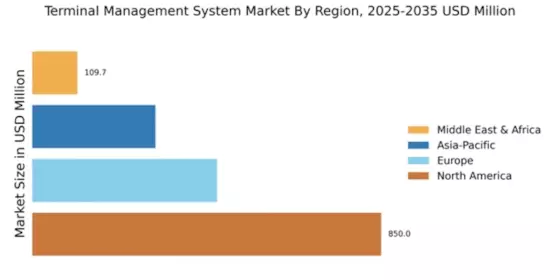
North America is poised to maintain its leadership in the Terminal Management System (TMS) market, holding a significant market share of $850.0M as of 2024. The region's growth is driven by increasing automation in logistics and stringent regulatory frameworks that promote efficiency and safety. The demand for advanced TMS solutions is further fueled by the rise in e-commerce and the need for real-time data analytics in supply chain management. The competitive landscape in North America is robust, featuring key players such as Honeywell, Emerson, and Rockwell Automation. These companies are investing heavily in R&D to innovate and enhance their offerings. The U.S. stands out as the leading country, supported by a strong infrastructure and technological advancements. The presence of major corporations and a favorable business environment further solidify North America's position in the TMS market.

Europe : Emerging TMS Innovations

Europe is witnessing a significant transformation in the Terminal Management System (TMS) market, with a market size of $450.0M. The growth is largely attributed to stringent EU regulations aimed at enhancing operational efficiency and sustainability in logistics. The European market is also experiencing a shift towards digitalization, with companies increasingly adopting smart technologies to streamline operations and reduce costs. Leading countries such as Germany, France, and the UK are at the forefront of this transformation, hosting major players like Siemens and Schneider Electric. The competitive landscape is characterized by a mix of established firms and innovative startups, all vying for market share. The European market's focus on sustainability and compliance with regulations is driving the demand for advanced TMS solutions, making it a dynamic region for growth.

Asia-Pacific : Rapid Growth in TMS Adoption

Asia-Pacific is rapidly emerging as a key player in the Terminal Management System (TMS) market, with a market size of $300.0M. The region's growth is driven by increasing urbanization, rising trade activities, and the need for efficient logistics solutions. Governments are also implementing policies to support digital transformation in supply chains, further propelling demand for TMS solutions. Countries like China, India, and Japan are leading the charge, with significant investments in infrastructure and technology. The competitive landscape is becoming increasingly crowded, with both local and international players vying for market share. Companies such as Kongsberg Gruppen and Wärtsilä are expanding their presence, capitalizing on the growing demand for advanced TMS solutions in this dynamic region.

Middle East and Africa : Untapped Potential in TMS

The Middle East and Africa (MEA) region presents untapped potential in the Terminal Management System (TMS) market, with a market size of $109.74M. The growth is driven by increasing investments in logistics infrastructure and a growing emphasis on operational efficiency. Governments are recognizing the importance of modernizing supply chains, which is catalyzing the adoption of TMS solutions across various sectors. Leading countries such as the UAE and South Africa are making strides in enhancing their logistics capabilities. The competitive landscape is still developing, with opportunities for both established players and new entrants. Companies are focusing on building partnerships and collaborations to leverage the growing demand for TMS solutions in the region, making it a promising market for future growth.

Key Players and Competitive Insights

The Terminal Management System Market is currently characterized by a dynamic competitive landscape, driven by the increasing demand for operational efficiency and automation across various sectors. Key players such as ABB (CH), Siemens (DE), and Honeywell (US) are strategically positioned to leverage their technological expertise and extensive portfolios. ABB (CH) focuses on digital transformation and innovation, aiming to enhance its offerings through advanced analytics and IoT integration. Siemens (DE) emphasizes regional expansion and partnerships, particularly in emerging markets, to bolster its market presence. Honeywell (US) is actively pursuing mergers and acquisitions to diversify its product range and enhance its competitive edge. Collectively, these strategies contribute to a moderately fragmented market structure, where innovation and technological advancements play a pivotal role in shaping competitive dynamics.

In terms of business tactics, companies are increasingly localizing manufacturing and optimizing supply chains to enhance responsiveness and reduce operational costs. The competitive structure of the market appears to be moderately fragmented, with several key players exerting influence through their unique capabilities and strategic initiatives. This fragmentation allows for a diverse range of solutions, catering to various customer needs while fostering healthy competition among the major players.

In November 2025, Siemens (DE) announced a strategic partnership with a leading logistics firm to develop integrated terminal management solutions aimed at enhancing supply chain efficiency. This collaboration is expected to leverage Siemens' advanced automation technologies, thereby streamlining operations and reducing costs for clients. The strategic importance of this partnership lies in its potential to create a comprehensive ecosystem that addresses the complexities of modern logistics, positioning Siemens as a frontrunner in the market.

In October 2025, Honeywell (US) unveiled a new suite of AI-driven terminal management solutions designed to optimize asset utilization and improve decision-making processes. This launch reflects Honeywell's commitment to innovation and its focus on integrating cutting-edge technologies into its offerings. The introduction of these solutions is likely to enhance operational efficiency for clients, thereby reinforcing Honeywell's competitive position in the market.

In December 2025, ABB (CH) completed the acquisition of a software company specializing in predictive maintenance solutions for terminal operations. This acquisition is anticipated to bolster ABB's capabilities in providing data-driven insights, enabling clients to minimize downtime and enhance operational reliability. The strategic significance of this move lies in ABB's ability to offer comprehensive solutions that address the evolving needs of the terminal management sector.

As of December 2025, current competitive trends indicate a strong emphasis on digitalization, sustainability, and AI integration within the Terminal Management System Market. Strategic alliances are increasingly shaping the landscape, as companies seek to combine their strengths to deliver innovative solutions. Looking ahead, competitive differentiation is likely to evolve, with a shift from price-based competition to a focus on innovation, technology, and supply chain reliability. This transition underscores the importance of adaptability and forward-thinking strategies in maintaining a competitive edge in a rapidly changing market.

Key Companies in the Terminal Management System Market market include

Industry Developments

June 2020: Implico's terminal management system, OpenTAS, got certified for Excise Movement and Control System (EMCS) version 2.4.

April 2019: Emerson Automation launched Terminal Manager, the advanced software for controlling all terminal operational and commercial activity.

Future Outlook

Terminal Management System Market Future Outlook

The Terminal Management System Market is projected to grow at 11.3% CAGR from 2024 to 2035, driven by automation, regulatory compliance, and demand for efficiency.

New opportunities lie in:

  • Integration of AI-driven analytics for predictive maintenance
  • Expansion into emerging markets with tailored solutions
  • Development of mobile applications for real-time monitoring

By 2035, the market is expected to be robust, driven by innovation and strategic expansions.

Market Segmentation

Terminal Management System Market End User Outlook

  • Logistics Companies
  • Shipping Companies
  • Oil and Gas Industry
  • Manufacturing Sector

Terminal Management System Market Technology Outlook

  • Internet of Things
  • Artificial Intelligence
  • Blockchain
  • Data Analytics

Terminal Management System Market Application Outlook

  • Fleet Management
  • Cargo Management
  • Inventory Management
  • Asset Tracking

Terminal Management System Market System Type Outlook

  • Terminal Operating System
  • Cargo Management System
  • Inventory Management System

Terminal Management System Market Deployment Type Outlook

  • On-Premises
  • Cloud-Based
  • Hybrid

Report Scope

MARKET SIZE 20241709.74(USD Million)
MARKET SIZE 20251902.98(USD Million)
MARKET SIZE 20355552.19(USD Million)
COMPOUND ANNUAL GROWTH RATE (CAGR)11.3% (2024 - 2035)
REPORT COVERAGERevenue Forecast, Competitive Landscape, Growth Factors, and Trends
BASE YEAR2024
Market Forecast Period2025 - 2035
Historical Data2019 - 2024
Market Forecast UnitsUSD Million
Key Companies ProfiledABB (CH), Siemens (DE), Honeywell (US), Schneider Electric (FR), Emerson (US), Rockwell Automation (US), Kongsberg Gruppen (NO), Wärtsilä (FI), Cavotec (CH)
Segments CoveredApplication, Deployment Type, End User, Technology, System Type
Key Market OpportunitiesIntegration of advanced analytics and automation enhances efficiency in the Terminal Management System Market.
Key Market DynamicsRising demand for automation in logistics drives innovation and competition in the Terminal Management System market.
Countries CoveredNorth America, Europe, APAC, South America, MEA

Market Highlights

Author
Shubham Munde
Research Analyst Level II

With a technical background in information technology & semiconductors, Shubham has 4.5+ years of experience in market research and analytics with the tasks of data mining, analysis, and project execution. He is the POC for our clients, for their consulting projects running under the ICT/Semiconductor domain. Shubham holds a Bachelor’s in Information and Technology and a Master of Business Administration (MBA). Shubham has executed over 150 research projects for our clients under the brand name Market Research Future in the last 2 years. His core skill is building the research respondent relation for gathering the primary information from industry and market estimation for niche markets. He is having expertise in conducting secondary & primary research, market estimations, market projections, competitive analysis, analysing current market trends and market dynamics, deep-dive analysis on market scenarios, consumer behaviour, technological impact analysis, consulting, analytics, etc. He has worked on fortune 500 companies' syndicate and consulting projects along with several government projects. He has worked on the projects of top tech brands such as IBM, Google, Microsoft, AWS, Meta, Oracle, Cisco Systems, Samsung, Accenture, VMware, Schneider Electric, Dell, HP, Ericsson, and so many others. He has worked on Metaverse, Web 3.0, Zero-Trust security, cyber-security, blockchain, quantum computing, robotics, 5G technology, High-Performance computing, data centers, AI, automation, IT equipment, sensors, semiconductors, consumer electronics and so many tech domain projects.

Leave a Comment

FAQs

How much is the Terminal Management System market?

The Terminal Management System market size was valued at USD 1.71 billion in 2024.

What is the growth rate of the Terminal Management System market?

The market is projected to grow at a CAGR of 11.30% during the forecast period, 2025 to 2035.

Which region held the largest market share in the Terminal Management System market?

North America had the largest share of the market

Who are the key players in the Terminal Management System market?

The key players in the market are ABB Ltd. (Switzerland), Honeywell International Inc. (US), Yokogawa Electric Corporation (Japan), Siemens AG (Germany), Schneider Electric (France), Rockwell Automation Inc. (US), Endress+Hauser Management AG (Switzerland), Emerson Electric Corporation (US), Implico GmbH (Germany), General Atomics Corp. (California).

Which component led the Terminal Management System market?

The services category dominated the market in 2022.

Which project had the largest market share in the Terminal Management System market?

The brownfield had the largest share of the market.

Which vertical had the largest market share in the Terminal Management System market?

The oil & gas category had the largest share of the market.

Download Free Sample

Kindly complete the form below to receive a free sample of this Report

Compare Licence

×
Features License Type
Single User Multiuser License Enterprise User
Price $4,950 $5,950 $7,250
Maximum User Access Limit 1 User Upto 10 Users Unrestricted Access Throughout the Organization
Free Customization
Direct Access to Analyst
Deliverable Format
Platform Access
Discount on Next Purchase 10% 15% 15%
Printable Versions