×
Request Free Sample ×

Kindly complete the form below to receive a free sample of this Report

Leading companies partner with us for data-driven Insights

clients tt-cursor
Hero Background

Testing Inspection Certification in Consumer Goods Retail Market

ID: MRFR/ICT/41395-HCR
100 Pages
Aarti Dhapte
October 2025

Testing, Inspection and Certification in Consumer Goods and Retail Market Research Report By Service Type (Testing, Inspection, Certification, Consulting), By Product Type (Textiles, Electronics, Food Beverages, Toys, Cosmetics), By End Use Sector (Retail, Manufacturing, E-commerce, Wholesale), By Test Method (Destructive Testing, Non-destructive Testing, Field Testing, Laboratory Testing) and By Regional (North America, Europe, South America, Asia Pacific, Middle East and Africa) - Forecast to 2035

Share:
Download PDF ×

We do not share your information with anyone. However, we may send you emails based on your report interest from time to time. You may contact us at any time to opt-out.

Testing Inspection Certification in Consumer Goods Retail Market Infographic
Purchase Options

Testing Inspection Certification in Consumer Goods Retail Market Summary

As per MRFR analysis, the Testing, Inspection and Certification in Consumer Goods and Retail Market was estimated at 29.04 USD Billion in 2024. The industry is projected to grow from 30.22 USD Billion in 2025 to 44.99 USD Billion by 2035, exhibiting a compound annual growth rate (CAGR) of 4.06 during the forecast period 2025 - 2035.

Key Market Trends & Highlights

The Testing, Inspection and Certification market in Consumer Goods and Retail is evolving towards greater consumer awareness and technological integration.

  • Consumer awareness regarding product safety and quality is on the rise, particularly in North America.
  • Technological advancements are reshaping testing methodologies, enhancing efficiency and accuracy in the Asia-Pacific region.
  • Sustainability initiatives are increasingly influencing consumer preferences, driving demand for eco-friendly products across various segments.
  • Regulatory compliance pressure and consumer demand for quality assurance are key drivers propelling growth in the Testing and Textiles segments.

Market Size & Forecast

2024 Market Size 29.04 (USD Billion)
2035 Market Size 44.99 (USD Billion)
CAGR (2025 - 2035) 4.06%

Major Players

SGS (CH), Bureau Veritas (FR), Intertek (GB), TÜV Rheinland (DE), TÜV SÜD (DE), Dekra (DE), UL (US), Eurofins (LU), Applus+ (ES)

Testing Inspection Certification in Consumer Goods Retail Market Trends

The Testing, Inspection and Certification in Consumer Goods and Retail Market is currently experiencing a dynamic evolution, driven by increasing consumer awareness and regulatory demands. As consumers become more discerning, they seek assurance regarding product safety, quality, and compliance with standards. This heightened scrutiny compels manufacturers and retailers to prioritize testing and certification processes, ensuring that their offerings meet both local and international regulations. Furthermore, the rise of e-commerce has introduced new challenges and opportunities, as online platforms necessitate rigorous inspection protocols to maintain consumer trust and satisfaction. In addition, technological advancements are reshaping the landscape of testing and inspection services. Automation and digital tools are streamlining processes, enhancing efficiency, and reducing turnaround times. This shift not only benefits service providers but also empowers businesses to respond swiftly to market changes. As sustainability becomes a focal point for consumers, the Testing, Inspection and Certification in Consumer Goods and Retail Market is likely to see an increased emphasis on eco-friendly practices and certifications. Overall, the market appears poised for growth, adapting to evolving consumer expectations and regulatory frameworks.

Increased Consumer Awareness

There is a noticeable rise in consumer awareness regarding product safety and quality. This trend compels manufacturers to invest in comprehensive testing and certification processes to ensure compliance with established standards.

Technological Advancements

The integration of advanced technologies is transforming testing and inspection methodologies. Automation and digital solutions are enhancing operational efficiency, allowing for quicker and more accurate assessments.

Focus on Sustainability

Sustainability is becoming a critical consideration in the Testing, Inspection and Certification in Consumer Goods and Retail Market. Companies are increasingly seeking eco-friendly certifications to meet consumer demand for environmentally responsible products.

Testing Inspection Certification in Consumer Goods Retail Market Drivers

E-commerce Growth

The rapid expansion of e-commerce has significantly impacted the Testing, Inspection and Certification in Consumer Goods and Retail Market. As online shopping becomes increasingly prevalent, consumers are more concerned about the authenticity and safety of products purchased online. This has led to a heightened demand for third-party testing and certification services to validate product claims and ensure compliance with safety standards. According to recent data, e-commerce sales have surged, with projections indicating a continued upward trajectory. Consequently, retailers and manufacturers are prioritizing certification to enhance their credibility and attract discerning consumers. This trend underscores the necessity for robust testing and inspection processes to mitigate risks associated with online transactions.

Technological Integration

The integration of advanced technologies is transforming the Testing, Inspection and Certification in Consumer Goods and Retail Market. Innovations such as artificial intelligence, blockchain, and the Internet of Things are streamlining testing processes and enhancing accuracy. For instance, AI-driven analytics can predict potential product failures, allowing for proactive testing and quality assurance. Additionally, blockchain technology is being utilized to create transparent supply chains, ensuring that products are traceable and compliant with safety standards. This technological evolution not only improves efficiency but also reduces costs associated with testing and certification. As companies adopt these technologies, the demand for sophisticated testing services is likely to increase, reshaping the landscape of the industry.

Sustainability Initiatives

Sustainability has emerged as a pivotal driver in the Testing, Inspection and Certification in Consumer Goods and Retail Market. With growing environmental concerns, consumers and businesses alike are prioritizing sustainable practices. This shift is prompting companies to seek certification for eco-friendly products and processes, thereby enhancing their market appeal. Data indicates that a substantial portion of consumers prefer products that are certified as sustainable, which has led to an increase in demand for testing services that assess environmental impact. Furthermore, regulatory bodies are increasingly requiring sustainability certifications, compelling businesses to adapt their practices accordingly. This trend not only fosters responsible consumption but also drives innovation in testing methodologies, as companies strive to meet sustainability standards.

Regulatory Compliance Pressure

The Testing, Inspection and Certification in Consumer Goods and Retail Market is increasingly influenced by stringent regulatory frameworks. Governments and regulatory bodies are imposing more rigorous standards to ensure product safety and quality. This trend is particularly evident in sectors such as food and beverages, electronics, and textiles, where compliance with safety regulations is paramount. For instance, the introduction of the General Product Safety Directive in various regions has necessitated enhanced testing protocols. As a result, companies are compelled to invest in comprehensive testing and certification processes to avoid penalties and maintain market access. This regulatory pressure not only drives demand for testing services but also fosters a culture of quality assurance within organizations, thereby enhancing consumer trust.

Consumer Demand for Quality Assurance

In the Testing, Inspection and Certification in Consumer Goods and Retail Market, there is a marked increase in consumer demand for quality assurance. Modern consumers are more informed and discerning, often seeking products that have been rigorously tested and certified. This shift in consumer behavior is driving companies to prioritize quality control measures and invest in certification processes. Data suggests that a significant percentage of consumers are willing to pay a premium for certified products, indicating a strong market incentive for businesses to enhance their testing and inspection protocols. As a result, organizations are increasingly collaborating with certification bodies to ensure their products meet the evolving expectations of quality and safety.
Market Segment Insights

By Service Type: Testing (Largest) vs. Consulting (Fastest-Growing)

In the Testing, Inspection, and Certification market for Consumer Goods and Retail, the service type segment showcases a diverse distribution among key service types. Testing holds the largest share, driven by the increasing demand for quality assurance across various consumer products. Meanwhile, Inspection and Certification services also maintain significant positions; however, their market shares are comparatively smaller than Testing. Consulting, although traditionally considered a support service, has seen increasing adoption and usage, marking its emergence in this competitive landscape. The growth trends within these service types are characterized by evolving consumer expectations and regulatory changes. Testing remains at the forefront due to stringent quality norms imposed by governments and agencies worldwide. On the other hand, the Consulting segment is experiencing rapid growth as businesses seek expert advice to navigate complex regulations and streamline operations, making it the fastest-growing area. This drive seeks innovative solutions that enhance compliance and operational efficiency, enabling companies to stay competitive in the market.

Testing (Dominant) vs. Consulting (Emerging)

Testing services are characterized by their comprehensive approaches to evaluating product safety, quality, and performance across various consumer goods. The dominant position of Testing in the market stems from its critical role in meeting regulatory requirements and consumer demands for safety and reliability. On the other hand, Consulting services, though previously seen as supplementary, are emerging as an essential component for businesses looking to adapt to increasingly complex marketplace challenges. Consulting provides strategic guidance and tailored solutions to enhance operational efficiency and ensure compliance with stringent standards. This shift indicates a growing recognition of the value that expert insights bring, enabling companies to not only adhere to regulations but also adopt best practices that drive long-term success.

By Product Type: Textiles (Largest) vs. Electronics (Fastest-Growing)

In the Testing, Inspection, and Certification market for Consumer Goods and Retail, Textiles hold a substantial share, making it the largest segment among various product types. This segment benefits from heightened consumer awareness regarding product safety and quality, leading to increased demand for compliance certifications. Following closely is the Electronics segment, which has experienced a remarkable surge as consumers demand ever-advanced technological products that meet stringent standards.

Textiles: Quality Assurance (Dominant) vs. Electronics: Innovation Testing (Emerging)

The Textiles segment is characterized by its rigorous quality assurance protocols, ensuring that apparel and fabric goods meet safety and durability standards. Its dominance in the market is supported by a long-standing tradition of testing requirements, driven by consumer expectations for sustainable and safe textiles. In contrast, Electronics represents an emerging sector, driven by rapid technological advancements and the demand for innovative testing solutions. This segment focuses on performance validity, regulatory compliance, and product safety, adapting to trends such as smart devices and IoT, further propelling its growth.

By End Use Sector: Retail (Largest) vs. E-commerce (Fastest-Growing)

The consumer goods and retail market showcases distinctive segmentation within its end use sectors, with retail leading the market share. Retail represents the most substantial portion of the testing, inspection, and certification landscape, driven by increasing consumer demand for quality assurance and compliance. On the other hand, the e-commerce segment, while smaller in comparison, is rapidly expanding as online shopping continues to rise, necessitating extensive testing and certification for products to build consumer trust and regulatory compliance. Growth trends point towards significant shifts in consumer behavior, largely fueled by technological advancements and the digital transformation of retail. The e-commerce sector, particularly, is experiencing explosive growth, bolstered by the acceleration of online sales and the need for enhanced logistics and safety standards. This trend is encouraging more investment in testing and inspection services, as businesses strive to meet stringent quality requirements in a competitive environment.

Retail (Dominant) vs. E-commerce (Emerging)

The retail sector remains dominant in the Testing, Inspection, and Certification (TIC) market, characterized by established players focusing on compliance with safety regulations and quality standards. Retailers are keen on ensuring the highest product quality to fortify consumer confidence, which in turn drives extensive TIC services across various consumer goods categories. Meanwhile, the e-commerce sector is emerging rapidly, requiring innovative TIC solutions to address unique challenges like logistics, safety concerns, and product authenticity. As the e-commerce market grows, businesses are increasingly prioritizing testing and certification to mitigate risks associated with online transactions, ultimately leading to a more robust and trustworthy shopping experience for consumers.

By Test Method: Laboratory Testing (Largest) vs. Non-destructive Testing (Fastest-Growing)

In the Testing, Inspection and Certification market, Laboratory Testing holds the largest market share among the test methods utilized. Driven by its extensive application across various consumer goods and retail sectors, it delivers reliable and replicable results, affirming its dominance. Non-destructive Testing follows closely behind, gaining traction as businesses prioritize quality assurance without compromising product integrity. This method is increasingly preferred for its ability to offer detailed analyses without damaging the tested items, catering to a growing demand in safety and compliance testing.

Laboratory Testing: Dominant vs. Non-destructive Testing: Emerging

Laboratory Testing is recognized as the dominant force within the test methods segment, leveraging sophisticated technologies to ensure thorough evaluation of consumer goods. It provides significant advantages in precision and reliability, making it the go-to choice for manufacturers seeking rigorous compliance with industry standards. Conversely, Non-destructive Testing is emerging as a crucial player, characterized by its flexibility and the ability to assess materials in their operational state. This method is witnessing rapid adoption due to increasing safety regulations and the need for sustainable practices, thereby shaping its position as a vital testing approach across various sectors.

Get more detailed insights about Testing Inspection Certification in Consumer Goods Retail Market

Regional Insights

North America : Innovation and Compliance Leader

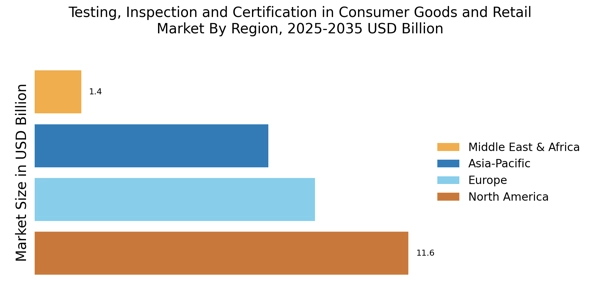
North America is the largest market for Testing, Inspection, and Certification (TIC) in Consumer Goods and Retail, holding approximately 40% of the global market share. The region's growth is driven by stringent regulatory requirements, increasing consumer awareness, and the demand for high-quality products. The rise in e-commerce and online retailing has further fueled the need for reliable testing services, ensuring product safety and compliance with regulations. The United States and Canada are the leading countries in this sector, with major players like UL and Intertek dominating the market. The competitive landscape is characterized by a mix of global and regional firms, focusing on innovation and technological advancements. Key players are investing in digital solutions and automation to enhance service delivery and meet the evolving needs of consumers and businesses alike.

Europe : Regulatory Framework and Standards

Europe is the second-largest market for TIC in Consumer Goods and Retail, accounting for approximately 30% of the global market share. The region's growth is propelled by stringent regulations and standards set by the European Union, which mandate rigorous testing and certification processes. The increasing focus on sustainability and environmental compliance is also driving demand for TIC services, as companies seek to align with EU directives and consumer expectations. Germany, France, and the UK are the leading countries in this market, with key players like Bureau Veritas and TÜV Rheinland playing significant roles. The competitive landscape is marked by a strong emphasis on quality assurance and innovation, with companies investing in advanced technologies to improve testing efficiency. The presence of established firms and a robust regulatory environment contribute to a dynamic market landscape.

Asia-Pacific : Emerging Market with Growth Potential

Asia-Pacific is witnessing rapid growth in the TIC market for Consumer Goods and Retail, holding approximately 25% of the global market share. The region's expansion is driven by increasing manufacturing activities, rising disposable incomes, and a growing middle class. Additionally, the demand for quality assurance and safety standards is escalating, particularly in countries like China and India, where regulatory frameworks are becoming more stringent. China and Japan are the leading countries in this sector, with a competitive landscape featuring both local and international players. Companies like SGS and Intertek are expanding their operations to cater to the growing demand for TIC services. The market is characterized by innovation and investment in technology, as firms seek to enhance their service offerings and meet the diverse needs of consumers and businesses in the region.

Middle East and Africa : Diverse Market with Unique Challenges

The Middle East and Africa region is gradually emerging in the TIC market for Consumer Goods and Retail, holding approximately 5% of the global market share. The growth is driven by increasing consumer awareness, regulatory changes, and the need for quality assurance in various sectors. Countries in this region are focusing on improving product safety and compliance, which is essential for attracting foreign investment and enhancing trade relations. South Africa and the UAE are the leading countries in this market, with a competitive landscape that includes both local and international players. The presence of key firms like Dekra and Eurofins is notable, as they adapt to the unique challenges of the region. The market is characterized by a growing emphasis on certification and testing services, driven by the need for compliance with international standards and consumer expectations.

Testing Inspection Certification in Consumer Goods Retail Market Regional Image

Key Players and Competitive Insights

The Global Testing, Inspection and Certification in the Consumer Goods and Retail Industry Market plays a crucial role in enhancing product safety, quality, and compliance. As consumers increasingly demand higher standards, the need for rigorous testing and certification processes becomes paramount. This market is characterized by a range of players offering diverse services, from product testing to comprehensive inspection and certification solutions. 

Companies operating within this space face competition not only from other testing and certification organizations but also from regulatory bodies and industry standards that shape consumer expectations. As globalization continues to influence trade, the ability to provide certifications that are recognized globally is paramount, making the competitive landscape particularly dynamic and multifaceted.Bureau Veritas stands prominently in the Testing, Inspection and Certification in Consumer Goods and Retail Market, leveraging its extensive experience and established reputation. 

With a wide-ranging portfolio of services, the company has positioned itself as a trusted partner for manufacturers and retailers seeking compliance with international standards. Bureau Veritas benefits from a robust global presence, allowing it to cater to diverse markets and customer needs. Its strengths lie in its comprehensive testing capabilities and commitment to quality assurance, which are essential for ensuring the safety and performance of consumer goods. The company employs advanced technologies and methodologies to streamline inspection processes, thereby enhancing operational efficiency and customer satisfaction. 

It also invests heavily in research and development, ensuring that its testing services remain at the forefront of industry innovations and regulatory changes.Applus+ also plays a significant role in the Testing, Inspection and Certification in Consumer Goods and Retail Market by offering a variety of services that ensure product quality and regulatory compliance. The company prides itself on its technical expertise and its capacity to adapt to the evolving needs of clients in the consumer goods sector. 

Applus+ features a strong emphasis on customer-centric solutions, helping businesses navigate complex compliance requirements and market dynamics effectively. Its operational strengths include a vast network of laboratories and testing facilities that ensure timely delivery of services across multiple regions. By focusing on continuous improvement and technological advancements, Applus+ enhances service delivery and maintains competitive differentiation in the marketplace. This strategic focus on innovation and adaptability positions Applus+ favorably in a fast-paced industry where consumer expectations and regulatory demands are continually evolving.

Key Companies in the Testing Inspection Certification in Consumer Goods Retail Market market include

Industry Developments

Bureau Veritas and SGS continue to strengthen their market positions through strategic innovations and enhancements in service offerings, adapting to the ongoing demand for sustainability and safety in consumer goods. Applus+ is increasing its investments in digital technologies to improve efficiency and expand its service capabilities, responding to evolving consumer needs. 

There have been notable expansions in the alliances among key players, with UL LLC enhancing its food safety and quality services following recent collaborations with major retailers. In terms of financial performance, SCS Global Services has reported significant growth, driven by increased demand for third-party certifications in eco-friendly products. Eurofins Scientific has also indicated robust growth due to its expanded laboratory services for pharmaceuticals and food testing, signalling an upward trend in market valuation and confidence. 

Recent merger activities include NSF International acquiring the assets of a regional testing laboratory to bolster its market presence and testing capabilities. As the market continues to evolve, these developments highlight the industry's resilience and its focus on adapting to regulatory changes and consumer preferences. The continuous growth in valuations and service diversification among key players underscores a competitive landscape ripe for innovation and collaboration.

Future Outlook

Testing Inspection Certification in Consumer Goods Retail Market Future Outlook

The Testing, Inspection and Certification market is projected to grow at 4.06% CAGR from 2024 to 2035, driven by increasing regulatory requirements and consumer safety awareness.

New opportunities lie in:

  • Expansion of digital testing platforms for remote inspections.
  • Development of eco-friendly certification processes for sustainable products.
  • Integration of AI-driven analytics for enhanced quality control.

By 2035, the market is expected to be robust, driven by innovation and heightened compliance demands.

Market Segmentation

Testing Inspection Certification in Consumer Goods Retail Market Test Method Outlook

  • Destructive Testing
  • Non-destructive Testing
  • Field Testing
  • Laboratory Testing

Testing Inspection Certification in Consumer Goods Retail Market Product Type Outlook

  • Textiles
  • Electronics
  • Food Beverages
  • Toys
  • Cosmetics

Testing Inspection Certification in Consumer Goods Retail Market Service Type Outlook

  • Testing
  • Inspection
  • Certification
  • Consulting

Testing Inspection Certification in Consumer Goods Retail Market End Use Sector Outlook

  • Retail
  • Manufacturing
  • E-commerce
  • Wholesale

Report Scope

MARKET SIZE 202429.04(USD Billion)
MARKET SIZE 202530.22(USD Billion)
MARKET SIZE 203544.99(USD Billion)
COMPOUND ANNUAL GROWTH RATE (CAGR)4.06% (2024 - 2035)
REPORT COVERAGERevenue Forecast, Competitive Landscape, Growth Factors, and Trends
BASE YEAR2024
Market Forecast Period2025 - 2035
Historical Data2019 - 2024
Market Forecast UnitsUSD Billion
Key Companies ProfiledMarket analysis in progress
Segments CoveredMarket segmentation analysis in progress
Key Market OpportunitiesIntegration of advanced technologies enhances efficiency in Testing, Inspection and Certification in Consumer Goods and Retail Market.
Key Market DynamicsRising regulatory scrutiny drives demand for Testing, Inspection and Certification services in consumer goods and retail sectors.
Countries CoveredNorth America, Europe, APAC, South America, MEA

Leave a Comment

FAQs

What is the projected market valuation for the Testing, Inspection and Certification in Consumer Goods and Retail Market by 2035?

The projected market valuation for 2035 is 44.99 USD Billion.

What was the overall market valuation in 2024 for the Testing, Inspection and Certification sector?

The overall market valuation in 2024 was 29.04 USD Billion.

What is the expected CAGR for the Testing, Inspection and Certification market from 2025 to 2035?

The expected CAGR during the forecast period 2025 - 2035 is 4.06%.

Which service type segment had the highest valuation in 2024?

In 2024, the Testing segment had the highest valuation at 10.0 USD Billion.

What is the projected valuation for the Electronics product type segment by 2035?

The projected valuation for the Electronics product type segment by 2035 is 12.0 USD Billion.

Which end-use sector is expected to grow the most by 2035?

The Manufacturing end-use sector is expected to grow to 12.0 USD Billion by 2035.

What was the valuation of the Certification service type segment in 2024?

The Certification service type segment was valued at 6.0 USD Billion in 2024.

How much is the Non-destructive Testing method projected to be valued by 2035?

The Non-destructive Testing method is projected to be valued at 12.0 USD Billion by 2035.

Which key player is recognized as a leader in the Testing, Inspection and Certification market?

SGS (CH) is recognized as a leading player in the Testing, Inspection and Certification market.

What is the projected growth for the Food Beverages product type segment by 2035?

The Food Beverages product type segment is projected to grow to 10.0 USD Billion by 2035.

Download Free Sample

Kindly complete the form below to receive a free sample of this Report

Compare Licence

×
Features License Type
Single User Multiuser License Enterprise User
Price $4,950 $5,950 $7,250
Maximum User Access Limit 1 User Upto 10 Users Unrestricted Access Throughout the Organization
Free Customization
Direct Access to Analyst
Deliverable Format
Platform Access
Discount on Next Purchase 10% 15% 15%
Printable Versions

















