×
Request Free Sample ×

Kindly complete the form below to receive a free sample of this Report

* Please use a valid business email

Leading companies partner with us for data-driven Insights

clients tt-cursor
Hero Background

Textile Coatings Market

ID: MRFR/CnM/4457-CR
111 Pages
Chitranshi Jaiswal
August 2023

Textile Coatings Market Research Report By Application (Automotive, Home Textiles, Industrial Textiles, Protective Clothing, Sportswear), By Type (Polyurethane Coatings, Acrylic Coatings, Silicone Coatings, Fluoropolymer Coatings), By Technology (Water-Based Coatings, Solvent-Based Coatings, Bio-Based Coatings), By End Use (Clothing, Home Furnishings, Technical Textiles) and By Regional (North America, Europe, South America, Asia Pacific, Middle East and Africa) - Forecast to 2035.

Share:
Download PDF ×

We do not share your information with anyone. However, we may send you emails based on your report interest from time to time. You may contact us at any time to opt-out.

Textile Coatings Market Infographic
Purchase Options

Textile Coatings Market Summary

As per MRFR analysis, the Textile Coatings Market Size was estimated at 7010.82 USD Billion in 2024. The Textile Coatings industry is projected to grow from 7356.6 USD Billion in 2025 to 11905.77 USD Billion by 2035, exhibiting a compound annual growth rate (CAGR) of 4.93 during the forecast period 2025 - 2035.

Key Market Trends & Highlights

The Textile Coatings Market is experiencing a dynamic shift towards sustainability and technological integration.

  • North America remains the largest market for textile coatings, driven by robust demand across various applications.
  • Asia-Pacific is emerging as the fastest-growing region, fueled by increasing investments in technical textiles and smart technologies.
  • Waterproofing coatings dominate the market, while flame retardant coatings are witnessing rapid growth due to heightened safety regulations.
  • Sustainability initiatives and technological advancements are key drivers, particularly in the automotive and medical textiles sectors.

Market Size & Forecast

2024 Market Size 7010.82 (USD Billion)
2035 Market Size 11905.77 (USD Billion)
CAGR (2025 - 2035) 4.93%

Major Players

BASF SE (DE), The Dow Chemical Company (US), Huntsman Corporation (US), Clariant AG (CH), Solvay SA (BE), AkzoNobel N.V. (NL), Covestro AG (DE), Wacker Chemie AG (DE), Fabrico (US)

Textile Coatings Market Trends

The Textile Coatings Market is currently experiencing a dynamic evolution, driven by various factors that influence consumer preferences and technological advancements. The increasing demand for functional textiles, which offer properties such as water resistance, stain resistance, and UV protection, appears to be a primary catalyst for growth. Additionally, the rising awareness regarding sustainability and eco-friendly materials is prompting manufacturers to innovate and develop coatings that align with environmental standards. This shift towards sustainable practices not only enhances the appeal of products but also addresses regulatory pressures that are becoming more prevalent in the industry. Moreover, the integration of smart technologies into textile coatings is gaining traction, suggesting a potential transformation in how textiles are utilized across various sectors. The incorporation of sensors and other electronic components into fabrics could lead to the development of intelligent textiles that respond to environmental stimuli. As the Textile Coatings Market continues to evolve, it is likely that these trends will shape the future landscape, influencing both production methods and consumer choices. The interplay between functionality, sustainability, and technological innovation may define the trajectory of this market in the coming years.

Sustainability Focus

The emphasis on eco-friendly materials is reshaping the Textile Coatings Market. Manufacturers are increasingly adopting sustainable practices, which include using biodegradable and non-toxic substances in their coatings. This trend not only caters to environmentally conscious consumers but also aligns with global regulatory frameworks aimed at reducing environmental impact.

Smart Textiles Integration

The integration of smart technologies into textile coatings is emerging as a notable trend. This involves embedding sensors and electronic components within fabrics, enabling textiles to interact with their environment. Such innovations could lead to the creation of multifunctional textiles that offer enhanced performance and user experience.

Functional Coatings Demand

There is a growing demand for functional coatings that provide specific properties such as water resistance, stain resistance, and UV protection. This trend reflects a shift in consumer preferences towards textiles that not only serve aesthetic purposes but also offer practical benefits, thereby expanding the applications of coated fabrics.

Textile Coatings Market Drivers

Sustainability Initiatives

Sustainability initiatives are becoming a pivotal driver within the Global Textile Coatings Market Industry. As environmental concerns gain prominence, manufacturers are increasingly adopting eco-friendly coating materials and processes. This shift not only aligns with regulatory requirements but also caters to the growing consumer preference for sustainable products. For instance, the introduction of water-based coatings and bio-based polymers is gaining traction, reducing the environmental footprint of textile production. This trend is expected to contribute to the market's growth, with estimates suggesting a rise to 7.5 USD Billion by 2035, as sustainability becomes a core focus for industry stakeholders.

Growth in End-Use Industries

The expansion of end-use industries is a crucial factor driving the Global Textile Coatings Market Industry. Sectors such as automotive, construction, and healthcare are increasingly utilizing coated textiles for their enhanced properties. In the automotive industry, for instance, coated fabrics are employed for upholstery and interior applications, providing durability and aesthetic appeal. Similarly, in healthcare, coated textiles are used for medical garments and equipment, ensuring hygiene and safety. This diversification across various sectors is expected to bolster the market, with projections indicating a growth trajectory towards 7.5 USD Billion by 2035.

Emerging Markets and Globalization

Emerging markets and globalization play a significant role in shaping the Global Textile Coatings Market Industry. As economies in regions such as Asia-Pacific and Latin America continue to develop, the demand for textile coatings is expected to rise. Factors such as urbanization, increasing disposable incomes, and changing lifestyles contribute to this trend. Furthermore, globalization facilitates the exchange of technology and innovation, enabling local manufacturers to adopt advanced coating solutions. This dynamic is likely to enhance market growth, with the industry poised to reach a valuation of 4.7 USD Billion in 2024.

Rising Demand for Functional Textiles

The Global Textile Coatings Market Industry experiences a notable surge in demand for functional textiles, driven by advancements in technology and consumer preferences. Functional textiles, which include water-resistant, flame-retardant, and UV-protective fabrics, are increasingly sought after in various sectors such as automotive, healthcare, and sportswear. This trend is likely to propel the market's growth, with projections indicating a market value of 4.7 USD Billion in 2024. As manufacturers innovate to meet these demands, the industry is expected to witness a compound annual growth rate of 4.34% from 2025 to 2035, further solidifying the importance of textile coatings in enhancing fabric performance.

Technological Advancements in Coating Processes

Technological advancements in coating processes significantly influence the Global Textile Coatings Market Industry. Innovations such as digital printing and nanotechnology are enhancing the efficiency and effectiveness of textile coatings. These technologies allow for precise application, reduced waste, and improved durability of coatings. For example, the integration of nanotechnology enables the development of coatings that provide superior water repellency and stain resistance. As these technologies continue to evolve, they are likely to attract investments and drive market growth, potentially leading to a market valuation of 4.7 USD Billion by 2024.
Market Segment Insights

By Application: Waterproofing (Largest) vs. Flame Retardant (Fastest-Growing)

The Textile Coatings Market comprises various applications including Waterproofing, Flame Retardant, Stain Resistance, UV Protection, and Anti-Microbial capacities. Among these, Waterproofing holds the largest share, driven by the increasing demand for durable textiles in outdoor and industrial applications. This segment effectively retains significant market traction due to its essential role in enhancing fabric functionality and longevity, thus catering to a wide range of end-user industries such as sports, automotive, and clothing. In contrast, the Flame Retardant segment is recognized as the fastest-growing application within the Textile Coatings Market. This growth can be attributed to escalating safety regulations and rising awareness regarding fire safety in various sectors including furniture, construction, and transportation. The growing emphasis on safe environments combined with advances in textile technology bolsters the demand for flame retardant coatings, positioning this application as crucial for future growth trajectories.

Waterproofing (Dominant) vs. Anti-Microbial (Emerging)

Waterproofing coatings are the dominant force in the Textile Coatings Market, primarily due to their extensive utilization in sectors requiring high performance and durability, such as outdoor apparel and safety gear. Their ability to provide protection against moisture enhances both the lifespan and functionality of textiles, making them indispensable in consumer products and industrial supplies. On the other hand, Anti-Microbial coatings represent an emerging segment that is gaining traction. As public health concerns continue to rise, especially in contexts like sportswear, healthcare textiles, and personal protective equipment, the demand for anti-microbial properties in fabrics is witnessing robust growth. This segment is characterized by innovative solutions targeting bacteria and fungi, making textiles safer and more hygienic, thereby appealing particularly to health-conscious consumers and industries.

By End Use: Apparel (Largest) vs. Medical Textiles (Fastest-Growing)

The Textile Coatings Market showcases a distinct distribution across various end-use segments, with apparel commanding the largest share. It is widely recognized for its applications in garments and fashion, driven by an increasing focus on innovative fabrics and functional coatings. In contrast, medical textiles are emerging rapidly, utilizing specialized coatings to enhance biocompatibility and functionality. This segmentation demonstrates how diverse the demands and applications are across different sectors within the market.

Apparel (Dominant) vs. Medical Textiles (Emerging)

The apparel segment remains dominant in the Textile Coatings Market due to its vast applications in casual and performance wear. Innovations in fabric technology, such as water repellency and stain resistance, continue to enhance its appeal among consumers. On the other hand, medical textiles are emerging as a key segment, particularly due to an increasing emphasis on hygiene and patient safety. The incorporation of antimicrobial and other functional coatings in medical textiles indicates a significant shift towards high-tech solutions, catering to the growing demand in healthcare settings. This growing focus reflects the industry's response to evolving safety and performance requirements.

By Type: Polyurethane Coatings (Largest) vs. Acrylic Coatings (Fastest-Growing)

In the Textile Coatings Market, polyurethane coatings represent the largest segment due to their widespread adoption across various applications, including furniture, automotive, and outdoor textiles. This segment is favored for its durability, flexibility, and resistance to various environmental factors, making it a preferred choice among manufacturers. In contrast, acrylic coatings are witnessing rapid growth as they are increasingly being recognized for their sustainability and low environmental impact, positioning them as the fastest-growing segment in this market.

Polyurethane Coatings (Dominant) vs. Acrylic Coatings (Emerging)

Polyurethane coatings are the dominant player in the Textile Coatings Market, primarily due to their superior performance characteristics, including high abrasion resistance and flexibility. They are extensively used in applications where durability is paramount, such as in protective clothing and upholstery. Conversely, acrylic coatings are emerging strongly, driven by the growing emphasis on eco-friendly formulations. They offer excellent clarity, UV resistance, and quick drying times, which attract environmentally conscious consumers and manufacturers. As innovations drive the development of water-based formulations within the acrylic segment, their position is expected to strengthen further within the market.

By Technology: Water-Based Technology (Largest) vs. Nanotechnology (Fastest-Growing)

In the Textile Coatings Market, Water-Based Technology holds the largest share, appealing to environmentally-conscious consumers due to its lower volatile organic compound emissions. In contrast, Solvent-Based Technology remains significant but is gradually declining in preference. Powder Coating Technology offers a durable and specialized solution, while Electrostatic Coating enhances precision and efficiency in application processes, contributing to its steady market position.

Water-Based Technology (Dominant) vs. Nanotechnology (Emerging)

Water-Based Technology represents a dominant solution in the Textile Coatings Market, driving sustainability efforts among manufacturers. Its eco-friendly properties and safety profile have led to increased adoption across various textile applications. Emerging rapidly is Nanotechnology, which is revolutionizing textile coatings with advancements in application methods and performance enhancements. This technology focuses on improving durability, water-resistance, and antimicrobial properties of coatings, appealing to innovative brands seeking cutting-edge solutions. Together, these technologies highlight the industry's shift towards sustainable practices alongside performance innovation.

By Functionality: Durability (Largest) vs. Flexibility (Fastest-Growing)

In the Textile Coatings Market, functionality plays a critical role in determining product performance, with durability emerging as the largest segment. Durability accounts for a significant proportion of the market share, reflecting the growing demand for long-lasting textile applications across various industries. Meanwhile, flexibility has garnered attention as the fastest-growing segment, driven by the increasing need for versatile materials that cater to different consumer preferences and functionalities. As the market evolves, factors such as lifestyle changes and technological advancements are propelling the growth of both durability and flexibility. Durability continues to thrive due to rising expectations for high-performance textiles, whereas flexibility is expanding due to innovations aimed at enhancing the comfort and adaptability of fabric products. This dual growth trend indicates that customers are increasingly prioritizing both long-lasting durability and flexible options.

Durability (Dominant) vs. Flexibility (Emerging)

Durability is recognized as the dominant functionality in the Textile Coatings Market, emphasizing the need for robustness in end applications such as outdoor gear and industrial textiles. This segment is characterized by strong performance metrics, such as resistance to wear and tear, which are critical for meeting industry standards. On the other hand, flexibility represents an emerging trend driven by consumer demand for adaptable and comfortable textiles. Flexible coatings are designed to enhance the pliability of fabrics without compromising on performance, making them ideal for applications in fashion and performance wear. The growing interest in multifunctional products positions flexibility as a significant player in the evolving market landscape.

Get more detailed insights about Textile Coatings Market

Regional Insights

North America : Established Market with Growth Potential

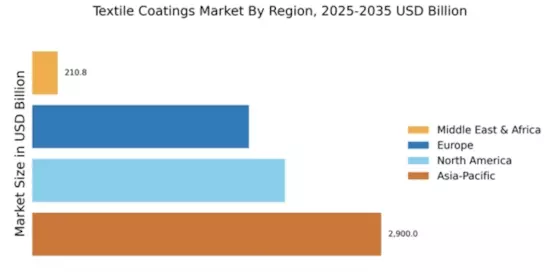
The North American textile coatings market, valued at $2100.0M, is driven by increasing demand for high-performance textiles across various industries, including automotive and healthcare. Regulatory support for sustainable practices is also a significant catalyst, encouraging innovation in eco-friendly coatings. The region's focus on advanced manufacturing technologies further enhances market growth, positioning it as a key player in the global landscape. Leading countries like the US and Canada dominate the market, with major players such as BASF SE and The Dow Chemical Company driving competition. The presence of established companies fosters innovation and collaboration, ensuring a robust supply chain. As the market evolves, investments in R&D are expected to yield new products that meet the growing consumer demand for functionality and sustainability.

Europe : Innovation and Sustainability Focus

Europe's textile coatings market, valued at $1800.0M, is characterized by a strong emphasis on sustainability and innovation. Regulatory frameworks, such as the EU's Green Deal, are pushing manufacturers to adopt eco-friendly practices, driving demand for sustainable textile coatings. The region's commitment to reducing carbon footprints is a significant growth driver, attracting investments in green technologies and materials. Germany, France, and Italy are leading countries in this market, with key players like Clariant AG and AkzoNobel N.V. enhancing competitive dynamics. The presence of numerous SMEs alongside large corporations fosters a diverse market landscape. As European consumers increasingly prioritize sustainability, companies are innovating to meet these demands, ensuring a competitive edge in the global market.

Asia-Pacific : Emerging Powerhouse in Textile Coatings

Asia-Pacific holds the largest market share in the textile coatings sector, valued at $2900.0M. The region's rapid industrialization and urbanization are key growth drivers, leading to increased demand for high-performance textiles in various applications, including fashion and automotive. Government initiatives promoting manufacturing and exports further catalyze market expansion, making it a focal point for global investments. Countries like China, India, and Japan are at the forefront, with major players such as Huntsman Corporation and Solvay SA contributing to a competitive landscape. The presence of a robust supply chain and skilled workforce enhances the region's attractiveness for foreign investments. As consumer preferences shift towards innovative and functional textiles, the market is poised for sustained growth in the coming years.

Middle East and Africa : Emerging Market with Growth Potential

The Middle East and Africa textile coatings market, valued at $210.82M, is gradually gaining traction due to increasing demand for textiles in various sectors, including construction and automotive. The region's focus on diversifying economies and enhancing manufacturing capabilities is driving growth. Regulatory support for local production and sustainability initiatives is also fostering a conducive environment for market expansion. Countries like South Africa and the UAE are leading the market, with a growing number of local and international players entering the scene. The competitive landscape is evolving, with companies investing in R&D to develop innovative products tailored to regional needs. As the market matures, opportunities for growth are expected to increase, particularly in sustainable textile solutions.

Key Players and Competitive Insights

The Textile Coatings Market is currently characterized by a dynamic competitive landscape, driven by innovation, sustainability, and technological advancements. Key players such as BASF SE (DE), The Dow Chemical Company (US), and Huntsman Corporation (US) are actively shaping the market through strategic initiatives. BASF SE (DE) focuses on developing eco-friendly coatings, which aligns with the growing demand for sustainable products. Meanwhile, The Dow Chemical Company (US) emphasizes digital transformation and smart manufacturing processes to enhance operational efficiency. Huntsman Corporation (US) is leveraging partnerships to expand its product offerings, particularly in high-performance textiles, thereby enhancing its competitive positioning.

The market structure appears moderately fragmented, with several players vying for market share. Key business tactics include localizing manufacturing to reduce costs and optimize supply chains. This strategy not only enhances responsiveness to regional demands but also mitigates risks associated with global supply chain disruptions. The collective influence of these major players fosters a competitive environment where innovation and sustainability are paramount, driving the market forward.

In November 2025, BASF SE (DE) announced the launch of a new line of biodegradable textile coatings aimed at reducing environmental impact. This strategic move is significant as it positions BASF as a leader in sustainable solutions, catering to the increasing consumer preference for eco-friendly products. The introduction of these coatings is likely to enhance brand loyalty and attract environmentally conscious customers, thereby strengthening BASF's market presence.

In October 2025, The Dow Chemical Company (US) unveiled a new digital platform designed to streamline the development of textile coatings. This initiative is crucial as it integrates advanced analytics and AI, enabling faster product development cycles and improved customer engagement. By adopting such digital solutions, The Dow is not only enhancing its operational capabilities but also setting a benchmark for innovation in the industry.

In September 2025, Huntsman Corporation (US) entered into a strategic partnership with a leading textile manufacturer to co-develop high-performance coatings for outdoor applications. This collaboration is indicative of Huntsman's strategy to diversify its product portfolio and tap into niche markets. The partnership is expected to yield innovative solutions that meet the specific needs of outdoor textile applications, thereby reinforcing Huntsman's competitive edge.

As of December 2025, the Textile Coatings Market is witnessing trends such as increased digitalization, a strong focus on sustainability, and the integration of AI technologies. Strategic alliances are becoming increasingly important, as they enable companies to pool resources and expertise, fostering innovation. The competitive landscape is shifting from traditional price-based competition to a focus on technological advancements and supply chain reliability. This evolution suggests that companies that prioritize innovation and sustainability will likely emerge as leaders in the Textile Coatings Market.

Key Companies in the Textile Coatings Market market include

Industry Developments

  • Q2 2025: DuPont introduces fluoropolymer-free textile coating to meet evolving environmental standards DuPont launched a new fluoropolymer-free textile coating in 2023, designed to comply with stricter sustainability regulations and address growing demand for eco-friendly solutions in the textile coatings market.
  • Q2 2025: EU REACH regulatory changes boost adoption of bio-based textile coatings Recent regulatory updates under the EU's REACH framework have accelerated the shift toward bio-based coatings in the textile sector, prompting manufacturers to invest in sustainable product development.
  • Q2 2025: Milliken & Company increases R&D investment in high-performance textile coatings Milliken & Company announced expanded research and development efforts focused on enhancing the performance and sustainability of its textile coatings, responding to rising industry demand for advanced protective fabrics.

Future Outlook

Textile Coatings Market Future Outlook

The Textile Coatings Market is projected to grow at a 4.93% CAGR from 2024 to 2035, driven by innovations in sustainable materials, increasing demand for performance textiles, and advancements in coating technologies.

New opportunities lie in:

  • Development of eco-friendly textile coatings for sustainable fashion brands.
  • Integration of smart textiles with advanced coating technologies.
  • Expansion into emerging markets with tailored coating solutions for local industries.

By 2035, the Textile Coatings Market is expected to achieve robust growth, driven by innovation and strategic market expansion.

Market Segmentation

Textile Coatings Market Type Outlook

  • Polyurethane Coatings
  • Acrylic Coatings
  • Silicone Coatings
  • Polyvinyl Chloride Coatings
  • Epoxy Coatings

Textile Coatings Market End Use Outlook

  • Apparel
  • Home Textiles
  • Automotive Textiles
  • Industrial Textiles
  • Medical Textiles

Textile Coatings Market Technology Outlook

  • Solvent-Based Technology
  • Water-Based Technology
  • Powder Coating Technology
  • Nanotechnology
  • Electrostatic Coating

Textile Coatings Market Application Outlook

  • Waterproofing
  • Flame Retardant
  • Stain Resistance
  • UV Protection
  • Anti-Microbial

Textile Coatings Market Functionality Outlook

  • Durability
  • Flexibility
  • Breathability
  • Thermal Insulation
  • Chemical Resistance

Report Scope

MARKET SIZE 20247010.82(USD Billion)
MARKET SIZE 20257356.6(USD Billion)
MARKET SIZE 203511905.77(USD Billion)
COMPOUND ANNUAL GROWTH RATE (CAGR)4.93% (2024 - 2035)
REPORT COVERAGERevenue Forecast, Competitive Landscape, Growth Factors, and Trends
BASE YEAR2024
Market Forecast Period2025 - 2035
Historical Data2019 - 2024
Market Forecast UnitsUSD Billion
Key Companies ProfiledBASF SE (DE), The Dow Chemical Company (US), Huntsman Corporation (US), Clariant AG (CH), Solvay SA (BE), AkzoNobel N.V. (NL), Covestro AG (DE), Wacker Chemie AG (DE), Fabrico (US)
Segments CoveredApplication, End Use, Type, Technology, Functionality
Key Market OpportunitiesIntegration of sustainable materials and technologies in the Textile Coatings Market presents significant growth opportunities.
Key Market DynamicsRising demand for sustainable textile coatings drives innovation and competition among manufacturers in the market.
Countries CoveredNorth America, Europe, APAC, South America, MEA

Market Highlights

Author
Chitranshi Jaiswal
Research Analyst Level I

In her 3 years of experience in the market research field, she has handled critical cross-domain projects. She has an in-depth knowledge of market estimation & analysis, problem-solving, primary as well as secondary research, and team management.She holds an engineering degree and is an MBA professional from a well-known university, capable of evaluating the market and competitive conditions. An exceptional strategist with excellent communication skills and a passion for delivering cutting-edge & practical insights for the market. Proficient in multi-tasking, and can successfully deal with competing demands, while maintaining complete confidentiality. Generated business through active client and project development, networking, and high-quality responses. Her knowledge and skills have helped in making solid business decisions, securing funding from investors, and avoiding business failures.

Leave a Comment

FAQs

What was the expected market size of the Textile Coatings Market in 2024?

The Textile Coatings Market was valued at 4.7 USD Billion in 2024.

What is the projected market value for the Textile Coatings Market by 2035?

The market is projected to reach 7.5 USD Billion by 2035.

What is the CAGR for the Textile Coatings Market from 2025 to 2035?

Textile Coatings Market is expected to grow with a CAGR of 4.93% in the period 2025-2035

Which region held the largest market share in the Textile Coatings Market for 2024?

North America held significant market share, valued at 1.2 USD Billion in 2024.

What are the expected market values for Automotive applications in the Textile Coatings Market for 2024 and 2035?

The Automotive segment was valued at 2.0 USD Billion in 2024 and is expected to grow to 3.2 USD Billion by 2035.

What key players are operating in the Textile Coatings Market?

Key players in the market include Archroma, Clariant, Covestro, Bayer, and several others.

What is the anticipated market value for Home Textiles application in 2035?

The Home Textiles application segment is projected to reach 1.6 USD Billion by 2035.

How much is the Textile Coatings Market for Industrial Textiles expected to grow by 2035?

The Industrial Textiles segment is anticipated to grow from 0.8 USD Billion in 2024 to 1.3 USD Billion by 2035.

What was the market value for Protective Clothing in 2024?

The Protective Clothing application was valued at 0.7 USD Billion in 2024.

What was the market size for the Asia Pacific region in the Textile Coatings Market for 2024?

The Asia Pacific region was valued at 1.3 USD Billion in 2024 within the Textile Coatings Market.

Download Free Sample

Kindly complete the form below to receive a free sample of this Report

Compare Licence

×
Features License Type
Single User Multiuser License Enterprise User
Price $4,950 $5,950 $7,250
Maximum User Access Limit 1 User Upto 10 Users Unrestricted Access Throughout the Organization
Free Customization
Direct Access to Analyst
Deliverable Format
Platform Access
Discount on Next Purchase 10% 15% 15%
Printable Versions