×
Request Free Sample ×

Kindly complete the form below to receive a free sample of this Report

* Please use a valid business email

Leading companies partner with us for data-driven Insights

clients tt-cursor
Hero Background

Thermoelectric Module Market

ID: MRFR/SEM/7031-HCR
111 Pages
Aarti Dhapte
October 2025

Thermoelectric Module Market Research Report Information By Model (Single Stage, Multi Stage), By Type (Bulk Thermoelectric Modules, Micro Thermoelectric Modules, Thin-Film Thermoelectric Modules), By Application (Aerospace and Defense, Automotive, Consumer Electronics, Healthcare, Food and Beverage, Energy and Utility, Others), And By Region (North America, Europe, Asia-Pacific, And Rest Of The World) – Market Forecast Till 2035

Share:
Download PDF ×

We do not share your information with anyone. However, we may send you emails based on your report interest from time to time. You may contact us at any time to opt-out.

Thermoelectric Module Market Infographic
Purchase Options

Thermoelectric Module Market Summary

As per MRFR analysis, the Thermoelectric Module Market Size was estimated at 876.76 USD Million in 2024. The thermoelectric module industry is projected to grow from 949.63 USD Million in 2025 to 2110.19 USD Million by 2035, exhibiting a compound annual growth rate (CAGR) of 8.31 during the forecast period 2025 - 2035.

Key Market Trends & Highlights

The Thermoelectric Module Market is poised for substantial growth driven by energy efficiency and technological advancements.

  • The North American region remains the largest market for thermoelectric modules, primarily due to its robust industrial base.
  • Asia-Pacific is emerging as the fastest-growing region, fueled by increasing investments in renewable energy and sustainable technologies.
  • The power generation segment dominates the market, while the automotive segment is experiencing rapid growth due to advancements in thermoelectric materials.
  • Key market drivers include the rising adoption of renewable energy sources and the growing demand for waste heat recovery systems.

Market Size & Forecast

2024 Market Size 876.76 (USD Million)
2035 Market Size 2110.19 (USD Million)
CAGR (2025 - 2035) 8.31%

Major Players

TE Technology (US), Ferrotec (JP), II-VI Incorporated (US), Laird Thermal Systems (US), RMT Ltd (GB), KELVIN (DE), Thermoelectric Power Generation (US), Elekta (SE)

Thermoelectric Module Market Trends

The Thermoelectric Module Market is currently experiencing a notable transformation, driven by advancements in materials science and increasing demand for energy-efficient solutions. As industries seek to reduce their carbon footprint, thermoelectric modules are emerging as viable alternatives for waste heat recovery and temperature control applications. This shift is further supported by government initiatives promoting sustainable technologies, which appear to bolster investment in research and development. The integration of these modules into various sectors, including automotive, aerospace, and consumer electronics, suggests a growing recognition of their potential benefits. Moreover, the market landscape is evolving with the introduction of innovative designs and enhanced performance characteristics. Manufacturers are focusing on improving the efficiency and reliability of thermoelectric modules, which may lead to broader adoption across diverse applications. The increasing emphasis on renewable energy sources and the need for efficient thermal management systems indicate that the Thermoelectric Module Market is poised for substantial growth. As stakeholders continue to explore new opportunities, the future of this market appears promising, with potential advancements likely to reshape its dynamics in the coming years.

Rising Demand for Energy Efficiency

The Thermoelectric Module Market is witnessing a surge in demand for energy-efficient solutions. Industries are increasingly adopting these modules to optimize energy consumption and minimize waste, aligning with global sustainability goals.

Technological Advancements in Materials

Innovations in materials science are significantly enhancing the performance of thermoelectric modules. New materials are being developed to improve efficiency and reliability, which could lead to broader applications across various sectors.

Government Support for Sustainable Technologies

Government initiatives aimed at promoting sustainable technologies are playing a crucial role in the growth of the Thermoelectric Module Market. These policies are encouraging investment in research and development, fostering innovation in this field.

Thermoelectric Module Market Drivers

Market Growth Projections

The Global Thermoelectric Module Market Industry is poised for substantial growth, with projections indicating a market value of 0.88 USD Billion in 2024 and an anticipated increase to 2.11 USD Billion by 2035. This growth trajectory suggests a compound annual growth rate of 8.28% from 2025 to 2035, reflecting the increasing adoption of thermoelectric technologies across various sectors. The market's expansion is likely driven by factors such as advancements in material science, rising energy efficiency demands, and government support for clean energy initiatives. These projections underscore the potential for thermoelectric modules to play a pivotal role in future energy solutions.

Advancements in Material Science

Recent advancements in material science are propelling the Global Thermoelectric Module Market Industry forward. Innovations in thermoelectric materials, such as bismuth telluride and skutterudites, have led to improved efficiency and performance of thermoelectric modules. These materials exhibit enhanced thermoelectric properties, enabling better heat-to-electricity conversion rates. As a result, applications in refrigeration, power generation, and waste heat recovery are becoming more viable and economically attractive. The ongoing research and development efforts in this field suggest a robust growth trajectory, with the market projected to reach 2.11 USD Billion by 2035, indicating a strong future for thermoelectric technologies.

Government Initiatives and Support

Government initiatives aimed at promoting clean energy technologies are significantly influencing the Global Thermoelectric Module Market Industry. Various countries are implementing policies and providing funding to support the development and commercialization of thermoelectric technologies. These initiatives often focus on reducing greenhouse gas emissions and enhancing energy efficiency. For instance, subsidies and grants for research in thermoelectric materials and applications can stimulate innovation and market growth. Such supportive measures are likely to create a favorable environment for the adoption of thermoelectric modules, further driving market expansion in the coming years.

Growing Demand for Energy Efficiency

The Global Thermoelectric Module Market Industry is experiencing a surge in demand driven by the increasing emphasis on energy efficiency across various sectors. As industries strive to reduce energy consumption and carbon footprints, thermoelectric modules offer a viable solution for waste heat recovery and energy generation. For instance, in automotive applications, these modules can convert excess heat from engines into usable electrical energy, enhancing overall vehicle efficiency. This trend is expected to contribute significantly to the market, with projections indicating a market value of 0.88 USD Billion in 2024, reflecting a growing recognition of thermoelectric technology's potential.

Rising Applications in Automotive Sector

The automotive sector is increasingly recognizing the benefits of thermoelectric modules, which is a key driver for the Global Thermoelectric Module Market Industry. With the automotive industry focusing on improving fuel efficiency and reducing emissions, thermoelectric generators are being integrated into vehicles to harness waste heat from engines. This application not only enhances vehicle performance but also contributes to sustainability goals. As the automotive market evolves, the demand for thermoelectric modules is expected to grow, with a projected compound annual growth rate of 8.28% from 2025 to 2035, indicating a robust future for this technology.

Increasing Adoption in Renewable Energy Systems

The integration of thermoelectric modules in renewable energy systems is a notable driver for the Global Thermoelectric Module Market Industry. As the world shifts towards sustainable energy solutions, thermoelectric technology plays a crucial role in enhancing the efficiency of solar and geothermal energy systems. For example, thermoelectric generators can be used alongside solar panels to convert excess heat into electricity, thereby maximizing energy output. This synergy not only improves the overall efficiency of renewable systems but also aligns with global sustainability goals. The anticipated growth in this sector is likely to be significant, contributing to the overall market expansion.
Market Segment Insights

By Application: Power Generation (Largest) vs. Cooling Systems (Fastest-Growing)

In the Thermoelectric Module Market, Power Generation currently holds the largest share among the various application segments. This segment contributes significantly to the overall demand, driven by the increasing focus on sustainable energy solutions and the need for efficient power conversion technologies. Cooling Systems follows closely behind, showcasing a noteworthy share as well, benefiting from advancements in thermal management solutions across diverse industries. The growth trends within this segment are promising, particularly for Cooling Systems, which is emerging as the fastest-growing application area. This growth is propelled by rising demands in consumer electronics and automotive sectors for efficient cooling solutions, as they are imperative for improving performance and longevity. Furthermore, innovations in temperature measurement technologies and their integration with IoT devices underscore the evolving landscape, enhancing the overall applicability of thermoelectric modules.

Power Generation: Dominant vs. Cooling Systems: Emerging

The Power Generation segment represents the dominant force in the Thermoelectric Module Market, primarily due to its ability to efficiently convert waste heat into usable electrical energy. This capability is crucial for industries looking to enhance energy efficiency and reduce environmental impact. On the other hand, the Cooling Systems segment is considered an emerging player, rapidly gaining traction primarily in consumer electronics and automotive applications. With the growing need for effective thermal management in compact devices, this segment is witnessing innovative designs and materials that cater to modern cooling requirements. The convergence of these applications not only drives competition but also fosters technological advancements, enhancing the operational efficiency of thermoelectric solutions.

By End Use: Industrial (Largest) vs. Automotive (Fastest-Growing)

In the Thermoelectric Module Market, the end-use segment is characterized by distinct applications that cater to various sectors. The industrial segment holds the largest share, driven by the need for efficient temperature control and power generation in manufacturing processes. Following industrial applications, the commercial sector is also notable, contributing significantly to market dynamics through HVAC and refrigeration solutions, while residential applications represent a smaller yet essential market component focused on energy efficiency at home. The growth trends within the end-use segments reflect a diverse landscape, with the automotive sector emerging as the fastest-growing area. This surge is primarily due to the rising demand for thermoelectric generators in electric vehicles, aiming at energy recovery and improved fuel efficiency. Additionally, advancements in aerospace technologies are stimulating interest in thermoelectric modules, promising innovations in thermal management that further support the market's expansion.

Industrial (Dominant) vs. Aerospace (Emerging)

The industrial sector dominates the Thermoelectric Module Market, leveraging thermoelectric devices for temperature regulation, waste heat recovery, and power generation applications. It stands out for its adoption of high-performance modules that cater to heavy machinery and manufacturing environments. On the other hand, the aerospace sector, while emerging, holds significant potential due to the increasing focus on lightweight, energy-efficient systems in aircraft and spacecraft. The adoption of thermoelectric modules in aerospace is driven by their ability to perform reliably in extreme conditions, offering advantages in spacecraft thermal management and providing auxiliary power in remote areas, positioning this segment for strategic growth.

By Material Type: Bismuth Telluride (Largest) vs. Skutterudites (Fastest-Growing)

In the Thermoelectric Module Market, Bismuth Telluride currently holds the largest market share due to its proven efficiency and versatility in various applications, particularly in low-temperature environments. Lead Telluride and Silicon-Germanium also contribute significantly, focusing mainly on high-temperature applications. Skutterudites, although smaller in market share, have been gaining traction as innovative materials provide enhanced performance, which is expected to shift market dynamics in the coming years.

Material: Bismuth Telluride (Dominant) vs. Skutterudites (Emerging)

Bismuth Telluride is renowned for its effectiveness in thermoelectric conversion, making it the dominant material in the Thermoelectric Module Market. Its adaptability for various temperatures and reliable performance has solidified its status among manufacturers. In contrast, Skutterudites are emerging as a promising alternative, marked by their ability to operate efficiently at higher temperatures with good thermoelectric properties. Their unique crystalline structure facilitates effective energy conversion, and ongoing research aims to enhance their operational capabilities. As technology progresses, Skutterudites may increasingly carve out a significant market share, particularly in industrial applications requiring robust durability.

By Technology: Thermoelectric Generators (Largest) vs. Thermoelectric Coolers (Fastest-Growing)

In the Thermoelectric Module Market, the segment values exhibit varied market share distributions. Thermoelectric Generators lead the market as the largest segment, primarily due to their applications in power generation in remote areas and industrial settings. Following closely are Thermoelectric Coolers, which are gaining traction in consumer electronics and refrigeration due to their efficiency and compact size. Multi Stage and Hybrid Systems also hold certain share portions but are less prevalent compared to the leading segments. Currently, the growth trends within this segment are largely influenced by technological advancements aimed at improving efficiency and performance. Thermoelectric Coolers are the fastest-growing segment, driven by increasing consumer demand for energy-efficient cooling solutions. Additionally, the rising focus on sustainable energy solutions enhances the adoption of Thermoelectric Generators across various applications. This evolving landscape is further supported by favorable government initiatives promoting green technologies.

Technology: Thermoelectric Generators (Dominant) vs. Thermoelectric Coolers (Emerging)

Thermoelectric Generators (TEGs) represent the dominant technology within the Thermoelectric Module Market, primarily utilized for waste heat recovery and power generation. Their ability to convert temperature differences into electrical energy makes them ideal for industrial applications. In contrast, Thermoelectric Coolers (TECs) are emerging as a significant segment, especially in consumer electronics and refrigeration systems. TECs are valued for their compactness and energy efficiency, providing cooling without moving parts, which enhances reliability. Both technologies reflect significant innovation, with TEGs focusing on enhancing conversion efficiency, while TECs are evolving with improved materials and designs, driving broader adoption in diverse sectors.

Get more detailed insights about Thermoelectric Module Market

Regional Insights

North America : Market Leader in Innovation

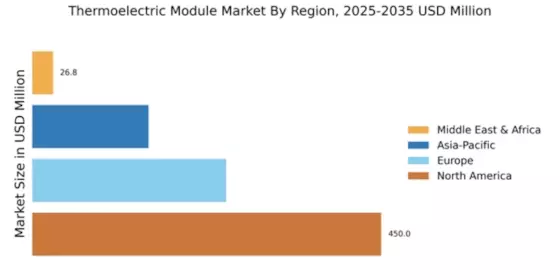
North America is poised to maintain its leadership in the thermoelectric module market, holding a significant share of 350.0M in 2025. The region's growth is driven by increasing demand for energy-efficient solutions and stringent regulations promoting sustainable technologies. Government initiatives aimed at reducing carbon emissions further catalyze market expansion, making it a hub for innovation in thermoelectric applications. The competitive landscape is robust, with key players like TE Technology, II-VI Incorporated, and Laird Thermal Systems leading the charge. The U.S. is the primary market, supported by advanced research and development capabilities. The presence of established companies fosters a dynamic environment for new entrants, ensuring continuous advancements in thermoelectric technology.

Europe : Emerging Market with Potential

Europe is witnessing a growing interest in thermoelectric modules, with a market size of 250.0M in 2025. The region's commitment to sustainability and energy efficiency drives demand, supported by EU regulations promoting green technologies. The increasing focus on renewable energy sources and waste heat recovery systems further enhances market prospects, positioning Europe as a key player in the thermoelectric landscape. Leading countries such as Germany and the UK are at the forefront, with companies like KELVIN and RMT Ltd contributing to market growth. The competitive environment is characterized by innovation and collaboration among industry players, ensuring the development of advanced thermoelectric solutions. The European market is expected to expand as regulatory frameworks continue to support sustainable practices.

Asia-Pacific : Rapid Growth and Adoption

Asia-Pacific is emerging as a significant player in the thermoelectric module market, with a projected size of 220.0M in 2025. The region's rapid industrialization and increasing energy demands are key growth drivers. Governments are implementing policies to enhance energy efficiency and reduce emissions, creating a favorable environment for thermoelectric technologies. The rising adoption of electric vehicles and renewable energy sources further fuels market growth. Countries like Japan and China are leading the charge, with major companies such as Ferrotec and Thermoelectric Power Generation actively participating in the market. The competitive landscape is evolving, with a focus on innovation and technological advancements. As the region continues to invest in sustainable energy solutions, the thermoelectric module market is expected to thrive.

Middle East and Africa : Emerging Market Opportunities

The Middle East and Africa region is gradually recognizing the potential of thermoelectric modules, with a market size of 56.76M in 2025. The growth is driven by increasing energy demands and a shift towards sustainable energy solutions. Governments are beginning to implement policies aimed at enhancing energy efficiency, which is expected to catalyze market development. The region's unique climate conditions also present opportunities for thermoelectric applications in cooling and power generation. Countries like South Africa and the UAE are exploring thermoelectric technologies, with a focus on integrating them into renewable energy projects. The competitive landscape is still developing, with opportunities for both local and international players. As awareness of thermoelectric solutions grows, the market is likely to expand, driven by innovation and investment in sustainable technologies.

Key Players and Competitive Insights

The Thermoelectric Module Market is currently characterized by a dynamic competitive landscape, driven by increasing demand for energy-efficient solutions and advancements in materials science. Key players such as TE Technology (US), Ferrotec (JP), and II-VI Incorporated (US) are strategically positioned to leverage innovation and technological advancements. TE Technology (US) focuses on enhancing the efficiency of thermoelectric devices, while Ferrotec (JP) emphasizes expanding its manufacturing capabilities to meet growing global demand. II-VI Incorporated (US) is actively pursuing mergers and acquisitions to bolster its product portfolio and market reach, thereby shaping a competitive environment that is increasingly focused on technological differentiation and operational excellence.

In terms of business tactics, companies are localizing manufacturing to reduce lead times and optimize supply chains. The market structure appears moderately fragmented, with several players vying for market share. However, the collective influence of major companies is significant, as they drive innovation and set industry standards. This competitive structure fosters an environment where collaboration and strategic partnerships are essential for growth and sustainability.

In November 2025, TE Technology (US) announced a partnership with a leading automotive manufacturer to develop thermoelectric modules for electric vehicles. This collaboration is strategically important as it positions TE Technology at the forefront of the automotive industry's shift towards electrification, potentially enhancing its market share in a rapidly growing segment.

In October 2025, Ferrotec (JP) unveiled a new line of high-performance thermoelectric modules designed for industrial applications. This launch reflects Ferrotec's commitment to innovation and its strategy to cater to diverse market needs, thereby strengthening its competitive position. The introduction of these modules is likely to attract new customers and expand its footprint in the industrial sector.

In September 2025, II-VI Incorporated (US) completed the acquisition of a thermoelectric technology firm, enhancing its capabilities in the renewable energy sector. This acquisition is indicative of II-VI's strategy to integrate advanced technologies into its product offerings, which may lead to improved efficiency and performance in thermoelectric applications.

As of December 2025, current competitive trends in the Thermoelectric Module Market include a strong emphasis on digitalization, sustainability, and the integration of AI technologies. Strategic alliances are increasingly shaping the landscape, as companies recognize the value of collaboration in driving innovation. Looking ahead, competitive differentiation is likely to evolve from traditional price-based competition to a focus on technological advancements, innovation, and supply chain reliability, suggesting a transformative shift in how companies position themselves in the market.

Key Companies in the Thermoelectric Module Market market include

Industry Developments

  • Q2 2024: Ferrotec Holdings Corporation Announces Opening of New Manufacturing Facility in Malaysia Ferrotec Holdings Corporation inaugurated a new manufacturing facility in Malaysia dedicated to the production of thermoelectric modules, aiming to expand its global supply capacity and support growing demand in electronics and automotive sectors.
  • Q2 2024: Laird Thermal Systems Launches Next-Generation PowerCycling Thermoelectric Module Market Laird Thermal Systems introduced its new PowerCycling thermoelectric module, designed for high reliability and extended life in demanding temperature cycling applications such as medical diagnostics and industrial automation.
  • Q2 2024: Gentherm Announces Strategic Partnership with Global Automotive OEM for Thermoelectric Cooling Systems Gentherm entered into a strategic partnership with a major global automotive manufacturer to supply advanced thermoelectric cooling modules for next-generation electric vehicles.
  • Q3 2024: KELK Ltd. Expands Production Capacity for Thermoelectric Modules in Japan KELK Ltd. announced the expansion of its thermoelectric module production facility in Japan to meet increasing demand from the automotive and industrial sectors.
  • Q3 2024: TEC Microsystems GmbH Unveils Ultra-Compact Thermoelectric Module Market for Wearable Devices TEC Microsystems GmbH launched a new ultra-compact thermoelectric module specifically designed for integration into wearable health monitoring devices.
  • Q4 2024: Thermonamic Electronics (Jiangxi) Corp. Ltd. Secures Major Contract for Thermoelectric Modules in Medical Equipment Thermonamic Electronics (Jiangxi) Corp. Ltd. won a significant contract to supply thermoelectric modules for use in advanced medical diagnostic equipment.
  • Q4 2024: Ferrotec Holdings Corporation Announces Acquisition of European Thermoelectric Module Market Manufacturer Ferrotec Holdings Corporation completed the acquisition of a leading European thermoelectric module manufacturer to strengthen its market position and expand its product portfolio.
  • Q1 2025: RMT Ltd. Receives Regulatory Approval for New Thermoelectric Module Market in Aerospace Applications RMT Ltd. obtained regulatory approval for its latest thermoelectric module designed for use in aerospace thermal management systems.
  • Q1 2025: Laird Thermal Systems Announces Executive Appointment: New CTO to Lead Thermoelectric Innovation Laird Thermal Systems appointed a new Chief Technology Officer to drive innovation in thermoelectric module technology and oversee R&D initiatives.
  • Q2 2025: KRYOTHERM Launches High-Efficiency Thermoelectric Module Market for Industrial Cooling KRYOTHERM introduced a new high-efficiency thermoelectric module aimed at industrial cooling applications, featuring improved energy performance and reliability.
  • Q2 2025: Gentherm Secures Multi-Year Supply Agreement for Thermoelectric Modules with Leading Medical Device Company Gentherm signed a multi-year supply agreement to provide thermoelectric modules for temperature control in a range of medical devices.
  • Q3 2025: Ferrotec Holdings Corporation Announces $50 Million Investment to Expand Thermoelectric Module Market R&D Ferrotec Holdings Corporation announced a $50 million investment to expand research and development activities focused on next-generation thermoelectric modules.

Future Outlook

Thermoelectric Module Market Future Outlook

The Thermoelectric Module Market is projected to grow at an 8.31% CAGR from 2024 to 2035, driven by advancements in energy efficiency and increasing demand for sustainable technologies.

New opportunities lie in:

  • Development of compact thermoelectric generators for remote applications.
  • Integration of thermoelectric modules in electric vehicle systems.
  • Expansion into waste heat recovery solutions for industrial processes.

By 2035, the market is expected to be robust, driven by innovation and diverse applications.

Market Segmentation

Thermoelectric Module Market End Use Outlook

  • Industrial
  • Commercial
  • Residential
  • Automotive
  • Aerospace

Thermoelectric Module Market Technology Outlook

  • Single Stage
  • Multi Stage
  • Thermoelectric Generators
  • Thermoelectric Coolers
  • Hybrid Systems

Thermoelectric Module Market Application Outlook

  • Power Generation
  • Cooling Systems
  • Temperature Measurement
  • Automotive
  • Consumer Electronics

Thermoelectric Module Market Material Type Outlook

  • Bismuth Telluride
  • Lead Telluride
  • Silicon-Germanium
  • Skutterudites
  • Half-Heusler Alloys

Report Scope

MARKET SIZE 2024876.76(USD Million)
MARKET SIZE 2025949.63(USD Million)
MARKET SIZE 20352110.19(USD Million)
COMPOUND ANNUAL GROWTH RATE (CAGR)8.31% (2024 - 2035)
REPORT COVERAGERevenue Forecast, Competitive Landscape, Growth Factors, and Trends
BASE YEAR2024
Market Forecast Period2025 - 2035
Historical Data2019 - 2024
Market Forecast UnitsUSD Million
Key Companies ProfiledTE Technology (US), Ferrotec (JP), II-VI Incorporated (US), Laird Thermal Systems (US), RMT Ltd (GB), KELVIN (DE), Thermoelectric Power Generation (US), Elekta (SE)
Segments CoveredApplication, End Use, Material Type, Technology
Key Market OpportunitiesGrowing demand for energy-efficient cooling solutions drives innovation in the Thermoelectric Module Market.
Key Market DynamicsRising demand for energy-efficient solutions drives innovation and competition in the thermoelectric module market.
Countries CoveredNorth America, Europe, APAC, South America, MEA

Market Highlights

Author
Aarti Dhapte
Team Lead - Research

She holds an experience of about 6+ years in Market Research and Business Consulting, working under the spectrum of Information Communication Technology, Telecommunications and Semiconductor domains. Aarti conceptualizes and implements a scalable business strategy and provides strategic leadership to the clients. Her expertise lies in market estimation, competitive intelligence, pipeline analysis, customer assessment, etc.

Leave a Comment

FAQs

How much is the Thermoelectric Module market?

The Thermoelectric Module Market size was valued at USD 0.88 billion in 2024.

What is the growth rate of the Thermoelectric Module market?

The global market is projected to grow at a CAGR of 8.31% during the forecast period, 2025 to 2035.

Which region held the largest market share in the Thermoelectric Module market?

Asia Pacific had the largest share of the global Thermoelectric-Module market.

Who are the key players in the Thermoelectric-Module market?

The key players in the market are TEC Microsystem, Phononic Devices, Ferrotec Corporation, Laird Thermal Systems, KELK Ltd, Crystal Ltd, Guangdong Fuxin Technology, Kryotherm, Coherent, TE Technology Inc.

Which Model led the market of Thermoelectric Modules?

The Single Stage category dominated the market in 2022.

Which Application had the largest market share in the market of Thermoelectric Modules?

The Consumer Electronics segment had the largest share in the global market for Thermoelectric Modules.

Download Free Sample

Kindly complete the form below to receive a free sample of this Report

Compare Licence

×
Features License Type
Single User Multiuser License Enterprise User
Price $4,950 $5,950 $7,250
Maximum User Access Limit 1 User Upto 10 Users Unrestricted Access Throughout the Organization
Free Customization
Direct Access to Analyst
Deliverable Format
Platform Access
Discount on Next Purchase 10% 15% 15%
Printable Versions