×
Request Free Sample ×

Kindly complete the form below to receive a free sample of this Report

* Please use a valid business email

Leading companies partner with us for data-driven Insights

clients tt-cursor
Hero Background

Thin Film Material Market

ID: MRFR/CnM/28777-HCR
100 Pages
Priya Nagrale
October 2025

Thin Film Material Market Research Report: By Application (Semiconductors, Solar cells, Displays, Optical coatings, Sensors, Batteries, Fuel cells, Other), By Material Type (Metals, Semiconductors, Dielectrics, Polymers, Other), By Deposition Method (Physical vapor deposition, Chemical vapor deposition, Molecular beam epitaxy, Sol-gel, Other), By Product Type (Thin film transistors, Light-emitting diodes, Solar cells, Capacitors, Resistors, Sensors, Fuel cells, Medical devices) and By Regional (North America, Europe, South America, Asia Paci... read more

Share:
Download PDF ×

We do not share your information with anyone. However, we may send you emails based on your report interest from time to time. You may contact us at any time to opt-out.

Thin Film Material Market Infographic
Purchase Options

Thin Film Material Market Summary

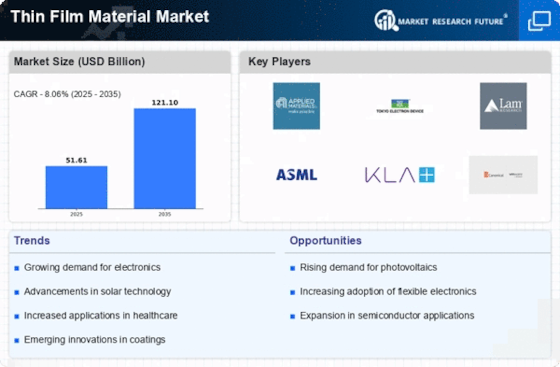
As per MRFR analysis, the Thin Film Material Market Size was estimated at 51.61 USD Billion in 2024. The Thin Film Material industry is projected to grow from 55.77 USD Billion in 2025 to 121.1 USD Billion by 2035, exhibiting a compound annual growth rate (CAGR) of 8.06 during the forecast period 2025 - 2035.

Key Market Trends & Highlights

The Thin Film Material Market is poised for substantial growth driven by technological advancements and sustainability initiatives.

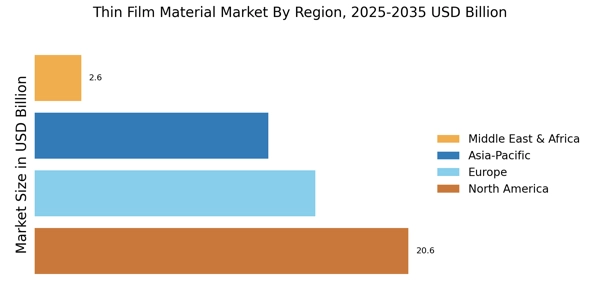
  • North America remains the largest market for thin film materials, driven by robust demand in the semiconductor sector.
  • Asia-Pacific is emerging as the fastest-growing region, particularly in the solar cell segment, reflecting a shift towards renewable energy.
  • The semiconductor segment continues to dominate the market, while polymers are rapidly gaining traction as the fastest-growing material type.
  • Rising demand for renewable energy solutions and advancements in electronics technologies are key drivers propelling market expansion.

Market Size & Forecast

2024 Market Size 51.61 (USD Billion)
2035 Market Size 121.1 (USD Billion)
CAGR (2025 - 2035) 8.06%

Major Players

Applied Materials (US), Tokyo Electron (JP), Lam Research (US), ASML (NL), KLA Corporation (US), Canon (JP), Veeco Instruments (US), First Solar (US), Corning (US)

Thin Film Material Market Trends

The Thin Film Material Market is currently experiencing a dynamic evolution, driven by advancements in technology and increasing applications across various sectors. This market encompasses a wide range of materials, including metals, oxides, and polymers, which are utilized in electronics, optics, and energy solutions. The growing demand for lightweight and efficient materials in industries such as solar energy and consumer electronics appears to be a significant factor influencing market growth. Furthermore, the trend towards miniaturization in electronic devices necessitates the use of thin films, which offer enhanced performance while occupying minimal space. In addition to technological advancements, environmental considerations are shaping the Thin Film Material Market. The push for sustainable and eco-friendly materials is prompting manufacturers to innovate and develop products that align with these values. This shift not only addresses regulatory pressures but also caters to the increasing consumer preference for green technologies. As the market continues to evolve, it seems likely that the integration of smart materials and nanotechnology will further enhance the capabilities of thin films, potentially leading to new applications and opportunities in the future.

Sustainability Initiatives

The Thin Film Material Market is witnessing a growing emphasis on sustainability, as manufacturers strive to develop eco-friendly materials. This trend is driven by regulatory pressures and consumer demand for greener products, prompting innovations that reduce environmental impact.

Technological Advancements

Rapid advancements in technology are significantly influencing the Thin Film Material Market. Innovations in deposition techniques and material formulations are enhancing the performance and versatility of thin films, enabling their use in diverse applications.

Miniaturization in Electronics

The trend towards miniaturization in electronic devices is propelling the demand for thin films. As devices become smaller and more compact, the need for lightweight and efficient materials is becoming increasingly critical, driving growth in this market.

Thin Film Material Market Drivers

Increased Adoption of Smart Technologies

The Thin Film Material Market is benefiting from the increased adoption of smart technologies across various sectors. Smart devices, including wearables and IoT applications, require advanced materials that can meet their unique performance demands. Thin film materials are particularly well-suited for these applications due to their lightweight and flexible nature. The market for smart technologies is expected to grow significantly, with estimates suggesting a value of over 1 trillion USD by 2025. This growth is likely to drive the demand for thin film materials, as manufacturers seek to integrate these materials into their products to enhance functionality and user experience. As smart technology adoption continues to rise, the Thin Film Material Market is expected to expand in tandem.

Rising Demand for Renewable Energy Solutions

The Thin Film Material Market is experiencing a notable surge in demand due to the increasing focus on renewable energy solutions. Thin film materials are integral in the production of solar panels, which are becoming increasingly popular as countries strive to meet energy efficiency targets. The International Energy Agency indicates that solar energy capacity is expected to grow significantly, potentially reaching over 1,000 GW by 2025. This growth is likely to drive the demand for thin film materials, as they offer advantages such as lightweight and flexible properties, making them suitable for various applications. As the world transitions towards sustainable energy sources, the Thin Film Material Market is poised to benefit from this trend, with manufacturers investing in innovative materials to enhance efficiency and reduce costs.

Growing Investment in Research and Development

Investment in research and development is a critical driver for the Thin Film Material Market. As industries seek to innovate and improve the performance of thin film materials, companies are allocating substantial resources to R&D initiatives. This trend is evident in the increasing number of patents filed related to thin film technologies, which suggests a robust interest in developing new materials with enhanced properties. The market for advanced materials is projected to grow at a compound annual growth rate of around 10% through 2025, indicating a strong potential for the Thin Film Material Market. Enhanced performance characteristics, such as improved durability and efficiency, are likely to emerge from these R&D efforts, thereby expanding the application scope of thin film materials.

Regulatory Support for Advanced Material Technologies

Regulatory support for advanced material technologies is emerging as a key driver for the Thin Film Material Market. Governments are increasingly recognizing the importance of innovative materials in achieving sustainability goals and enhancing technological capabilities. Policies aimed at promoting research and development in advanced materials are being implemented, which could lead to increased funding and support for the Thin Film Material Market. For instance, initiatives that encourage the use of sustainable materials in manufacturing processes are likely to create new opportunities for thin film technologies. As regulatory frameworks evolve to support innovation, the Thin Film Material Market may experience accelerated growth, driven by the need for compliance and the pursuit of advanced material solutions.

Advancements in Electronics and Semiconductor Technologies

The Thin Film Material Market is significantly influenced by advancements in electronics and semiconductor technologies. The increasing miniaturization of electronic devices necessitates the use of thin film materials, which provide essential properties such as high conductivity and low weight. According to recent data, the semiconductor market is projected to reach approximately 600 billion USD by 2025, with thin film materials playing a crucial role in the development of next-generation devices. These materials are utilized in various applications, including transistors, sensors, and displays, which are essential for modern electronics. As technology continues to evolve, the demand for innovative thin film materials is expected to rise, further propelling the Thin Film Material Market forward.


Market Segment Insights

By Application: Semiconductors (Largest) vs. Solar cells (Fastest-Growing)

In the Thin Film Material Market, the application segments are highly diverse, contributing significantly to overall market dynamics. Semiconductors represent the largest share, driven by advanced technologies and the increasing demand for miniaturized electronic components. Solar cells follow closely, capturing attention with rapidly growing market presence as renewable energy solutions gain traction globally. Other notable segments include displays, optical coatings, sensors, batteries, and fuel cells, each contributing to the industry's comprehensive landscape, albeit at varying scales.

Semiconductors (Dominant) vs. Solar cells (Emerging)

The semiconductor segment remains dominant in the Thin Film Material Market, characterized by its remarkable performance in microelectronics and integration into smartphones and computers. Innovations in thin film technology enhance the functionality and efficiency of chips, driving its sustained relevance and market share. Conversely, solar cells are emerging rapidly as the world shifts towards sustainable energy solutions. This segment is experiencing significant advancements in material technology and efficiency, driven by government initiatives and a growing consumer demand for clean energy. As a result, solar cells are not only enhancing their market presence but are also reshaping the industry's focus towards greener alternatives.

By Material Type: Metals (Largest) vs. Polymers (Fastest-Growing)

In the Thin Film Material Market, the distribution of market share is notably diverse, with metals leading the segment due to their established applications in various industries. Metals are utilized for their excellent conductivity and durability, making them a preferred choice for numerous thin film applications. Following metals, semiconductors have a significant presence, serving vital roles in electronics, while dielectrics and polymers have emerging but vital shares, often catering to specialized applications in flexible electronics and insulation materials.

Materials: Metals (Dominant) vs. Polymers (Emerging)

Metals dominate the Thin Film Material Market primarily because of their widespread use in electronics and energy applications, offering superior thermal and electrical conductivity. Prominent metals include aluminum, copper, and gold, which are known for their reliability and performance. On the other hand, polymers are emerging segments characterized by their flexibility, lightweight properties, and the ability to be processed at lower costs. This growing segment is becoming increasingly significant in the production of flexible displays and wearable technologies, indicating a shift towards more adaptable materials that meet modern consumer demands and technological advancements.

By Deposition Method: Physical Vapor Deposition (Largest) vs. Chemical Vapor Deposition (Fastest-Growing)

In the Thin Film Material Market, Physical Vapor Deposition (PVD) currently holds the largest market share. This deposition method is favored for its capability to provide high-quality films and is widely used across various industries, including electronics and optics. On the other hand, Chemical Vapor Deposition (CVD) is witnessing rapid adoption and is recognized as the fastest-growing method in this segment due to its versatility and ability to produce uniform coatings on complex geometries. The competitive landscape is evolving as industries strive for improved performance and efficiency in their manufacturing processes.

Physical Vapor Deposition (Dominant) vs. Chemical Vapor Deposition (Emerging)

Physical Vapor Deposition (PVD) is positioned as the dominant force in the Thin Film Material Market, particularly renowned for its high-rate deposition and excellent film quality. It encompasses techniques such as sputtering and thermal evaporation, making it suitable for applications in semiconductors and optical coatings. Conversely, Chemical Vapor Deposition (CVD) is emerging rapidly, characterized by its chemical versatility and efficacy in creating thin films with controlled compositional properties. CVD processes are expanding in industries such as photovoltaic and microelectronics, catering to the demand for advanced materials that enhance device performance and durability.

By Product Type: Thin Film Transistors (Largest) vs. Solar Cells (Fastest-Growing)

The Thin Film Material Market is characterized by a diverse range of product types, with thin film transistors holding the largest market share due to their extensive application in display technologies and electronics. Following closely are solar cells, which are rapidly gaining traction, fueled by the global push toward renewable energy sources and sustainable solutions. Other segments, such as light-emitting diodes, capacitors, and medical devices, also contribute to the overall market dynamics but are overshadowed by the dominant presence of transistors and the emerging potential of solar cells.

Electronics: Thin Film Transistors (Dominant) vs. Solar Cells (Emerging)

Thin film transistors (TFTs) are essential in modern electronic displays, providing flexibility and lightweight characteristics that traditional technologies cannot match. Their integration in smartphones, tablets, and televisions underscores their dominant position in the Thin Film Material Market. Conversely, solar cells are emerging as a critical player, driven by advancements in photovoltaic technologies and increasing governmental support for clean energy initiatives. This market segment is characterized by innovation, with new materials enhancing efficiency and production processes. The growing consumer acceptance and demand for solar energy solutions also contribute to the rapid growth of this segment, indicating a future-oriented shift in the market.

Get more detailed insights about Thin Film Material Market

Regional Insights

North America : Innovation and Leadership Hub

North America is the largest market for thin film materials, holding approximately 40% of the global share. The region's growth is driven by advancements in semiconductor technology, renewable energy initiatives, and stringent regulations promoting sustainable practices. The demand for high-performance materials in electronics and solar applications is also on the rise, supported by government incentives and funding for research and development. The United States leads the market, with key players like Applied Materials, Lam Research, and KLA Corporation driving innovation. Canada is also emerging as a significant player, focusing on clean technology and sustainable materials. The competitive landscape is characterized by a mix of established companies and startups, fostering a dynamic environment for growth and collaboration.

Europe : Sustainable Growth and Innovation

Europe is the second-largest market for thin film materials, accounting for around 30% of the global market share. The region's growth is fueled by a strong emphasis on sustainability, with regulations mandating the use of eco-friendly materials in manufacturing processes. The European Green Deal and Horizon Europe initiatives are pivotal in driving demand for innovative thin film technologies, particularly in renewable energy and electronics sectors. Germany, France, and the Netherlands are at the forefront, with companies like ASML and First Solar leading the charge. The competitive landscape is robust, with a mix of established firms and innovative startups. The presence of research institutions and government support further enhances the region's capabilities in developing advanced thin film materials.

Asia-Pacific : Rapid Growth and Expansion

Asia-Pacific is witnessing rapid growth in the thin film materials market, holding approximately 25% of the global share. The region's expansion is driven by increasing demand for consumer electronics, solar energy solutions, and advancements in semiconductor manufacturing. Countries like China and Japan are leading the charge, supported by government initiatives aimed at boosting technological innovation and sustainability in manufacturing processes. China is the largest market in the region, with significant investments in renewable energy and electronics. Japan follows closely, with key players like Tokyo Electron and Canon contributing to the competitive landscape. The presence of numerous manufacturers and a focus on R&D are propelling the region's growth in thin film technologies, making it a vital player in the global market.

Middle East and Africa : Emerging Market Potential

The Middle East and Africa region is gradually emerging in the thin film materials market, currently holding about 5% of the global share. The growth is primarily driven by increasing investments in renewable energy projects, particularly solar energy, and a growing electronics market. Governments in the region are implementing policies to diversify their economies, which is fostering demand for advanced materials in various applications. Countries like South Africa and the UAE are leading the way, with initiatives aimed at enhancing local manufacturing capabilities. The competitive landscape is still developing, with a mix of local and international players entering the market. The region's potential for growth in thin film technologies is significant, especially as it seeks to leverage its natural resources for sustainable development.

Thin Film Material Market Regional Image

Key Players and Competitive Insights

The Thin Film Material Market is currently characterized by a dynamic competitive landscape, driven by technological advancements and increasing demand across various sectors, including electronics, solar energy, and optics. Key players such as Applied Materials (US), Tokyo Electron (JP), and ASML (NL) are strategically positioned to leverage their innovative capabilities and extensive product portfolios. Applied Materials (US) focuses on enhancing its semiconductor manufacturing technologies, while Tokyo Electron (JP) emphasizes partnerships to expand its market reach. ASML (NL), known for its lithography systems, continues to invest heavily in R&D to maintain its competitive edge. Collectively, these strategies foster a robust competitive environment, where innovation and technological prowess are paramount.

In terms of business tactics, companies are increasingly localizing manufacturing and optimizing supply chains to enhance operational efficiency. The Thin Film Material Market appears moderately fragmented, with several key players exerting significant influence. This structure allows for a diverse range of products and services, catering to the specific needs of various industries. The collective actions of these major companies shape market dynamics, as they strive to differentiate themselves through advanced technologies and customer-centric solutions.

In September 2025, Lam Research (US) announced a strategic partnership with a leading semiconductor manufacturer to co-develop next-generation thin film deposition technologies. This collaboration is expected to enhance Lam Research's product offerings and solidify its position in the semiconductor market. The strategic importance of this partnership lies in its potential to accelerate innovation and improve manufacturing processes, thereby addressing the growing demand for advanced semiconductor solutions.

In August 2025, KLA Corporation (US) unveiled a new suite of inspection tools designed specifically for thin film applications in the solar energy sector. This launch reflects KLA's commitment to sustainability and its focus on expanding its footprint in the renewable energy market. The introduction of these tools is strategically significant, as it positions KLA to capitalize on the increasing adoption of solar technologies, aligning with global sustainability goals.

In July 2025, First Solar (US) announced the expansion of its manufacturing capabilities in the United States, aiming to increase production of its thin film solar panels. This move is indicative of First Solar's strategy to enhance supply chain reliability and meet the surging demand for renewable energy solutions. The expansion not only strengthens First Solar's market position but also underscores the growing importance of domestic manufacturing in the context of global supply chain challenges.

As of October 2025, the Thin Film Material Market is witnessing trends such as digitalization, sustainability, and the integration of artificial intelligence in manufacturing processes. Strategic alliances among key players are shaping the competitive landscape, fostering innovation and collaboration. Looking ahead, it is likely that competitive differentiation will increasingly hinge on technological advancements and supply chain reliability, rather than solely on price. This shift underscores the importance of innovation and adaptability in navigating the evolving market landscape.

Key Companies in the Thin Film Material Market market include

Industry Developments

The Thin Film Material Market size was valued at USD 30.47 billion in 2023 and is projected to grow at a CAGR of 8.06% from 2024 to 2032, reaching USD 88.73 billion by 2032. The growth of the market is attributed to increasing demand for thin film materials in various applications, including electronics, solar energy, and automotive.Recent advancements in thin film technology have led to the development of new materials with improved properties, such as higher efficiency, flexibility, and durability. This has opened up new opportunities for thin film materials in various applications.

For instance, thin film solar cells are becoming increasingly popular due to their low cost and high efficiency.Key players in the thin film material market are focusing on research and development to improve the performance of their products. For example, in 2023, Sumitomo Chemical Company announced the development of a new transparent conductive film with high electrical conductivity and flexibility. This film is expected to find applications in touch screens and other electronic devices.

Future Outlook

Thin Film Material Market Future Outlook

The Thin Film Material Market is projected to grow at 8.06% CAGR from 2024 to 2035, driven by advancements in technology, increasing demand in electronics, and renewable energy applications.

New opportunities lie in:

  • Development of advanced photovoltaic materials for solar applications.
  • Expansion into flexible electronics for wearables and IoT devices.
  • Investment in R&D for high-performance coatings in automotive and aerospace sectors.

By 2035, the Thin Film Material Market is expected to achieve substantial growth and innovation.

Market Segmentation

Thin Film Material Market Application Outlook

  • Semiconductors
  • Solar cells
  • Displays
  • Optical coatings
  • Sensors
  • Batteries
  • Fuel cells
  • Others

Thin Film Material Market Product Type Outlook

  • Thin film transistors
  • Light-emitting diodes
  • Solar cells
  • Capacitors
  • Resistors
  • Sensors
  • Fuel cells
  • Medical devices

Thin Film Material Market Material Type Outlook

  • Metals
  • Semiconductors
  • Dielectrics
  • Polymers
  • Others

Thin Film Material Market Deposition Method Outlook

  • Physical vapor deposition
  • Chemical vapor deposition
  • Molecular beam epitaxy
  • Sol-gel
  • Others

Report Scope

MARKET SIZE 202451.61(USD Billion)
MARKET SIZE 202555.77(USD Billion)
MARKET SIZE 2035121.1(USD Billion)
COMPOUND ANNUAL GROWTH RATE (CAGR)8.06% (2024 - 2035)
REPORT COVERAGERevenue Forecast, Competitive Landscape, Growth Factors, and Trends
BASE YEAR2024
Market Forecast Period2025 - 2035
Historical Data2019 - 2024
Market Forecast UnitsUSD Billion
Key Companies ProfiledMarket analysis in progress
Segments CoveredMarket segmentation analysis in progress
Key Market OpportunitiesAdvancements in flexible electronics drive demand for innovative solutions in the Thin Film Material Market.
Key Market DynamicsTechnological advancements drive innovation in thin film materials, enhancing performance across various applications and industries.
Countries CoveredNorth America, Europe, APAC, South America, MEA

Leave a Comment

FAQs

What is the current valuation of the Thin Film Material Market as of 2025?

The Thin Film Material Market is valued at approximately 51.61 USD Billion in 2024.

What is the projected market size for the Thin Film Material Market by 2035?

The market is projected to reach around 121.1 USD Billion by 2035.

What is the expected CAGR for the Thin Film Material Market during the forecast period 2025 - 2035?

The expected CAGR for the Thin Film Material Market during 2025 - 2035 is 8.06%.

Which application segment is anticipated to dominate the Thin Film Material Market?

The Semiconductors application segment is expected to dominate, with a valuation range of 15.0 to 35.0 USD Billion.

What are the key players in the Thin Film Material Market?

Key players include Applied Materials, Tokyo Electron, Lam Research, ASML, KLA Corporation, Canon, Veeco Instruments, First Solar, and Corning.

How does the valuation of solar cells compare to other application segments in 2025?

The solar cells application segment is projected to range from 10.0 to 25.0 USD Billion, indicating strong growth potential.

What deposition method is expected to have the highest market valuation?

Physical vapor deposition is anticipated to have the highest valuation, ranging from 15.5 to 35.0 USD Billion.

Which material type segment shows the most promise in the Thin Film Material Market?

The Semiconductors material type segment is projected to range from 15.48 to 35.0 USD Billion, suggesting robust demand.

What product type is expected to see significant growth in the Thin Film Material Market?

Solar cells are expected to see significant growth, with a projected valuation of 15.0 to 35.0 USD Billion.

How do the valuations of metals and dielectrics compare in the Thin Film Material Market?

The metals segment is projected to range from 10.32 to 25.0 USD Billion, while dielectrics are expected to range from 12.81 to 30.0 USD Billion.

Download Free Sample

Kindly complete the form below to receive a free sample of this Report

Compare Licence

×
Features License Type
Single User Multiuser License Enterprise User
Price $4,950 $ $7,250
Maximum User Access Limit 1 User Upto 10 Users Unrestricted Access Throughout the Organization
Free Customization
Direct Access to Analyst
Deliverable Format
Platform Access
Discount on Next Purchase 10% 15% 15%
Printable Versions