Thyristor Market (2026 - 2035)

Thyristor Market Size, Share and Research Report By Power Rating (500 MV, 500 MV-1000 MV, and 1000 MV), By End Use (Consumer Electronics, Telecommunication & Networking, Industrial, Automotive, Aerospace & Defense and Others) And By Region (North America, Europe, Asia-Pacific, And Rest Of The World) –Industry Forecast Till 2035
ID: MRFR/SEM/15655-HCR
128 Pages
Ankit Gupta, Shubham Munde
Last Updated: July 28, 2026
Thyristor Market
Market Size
Forecast Period2026-2035
CAGR (2026-2035)3.73%
2025 Market SizeUSD 1.93 Billion
2035 Market SizeUSD 2.93 Billion
Key Players
Infineon Technologies
Hitachi Energy
Mitsubishi Electric
STMicroelectronics
Vishay Intertechnology
Littelfuse
Opportunities
  • Intelligent Power Module Integration
  • Offshore Wind HVDC Export Cables
  • Emerging-Market Grid Electrification

Thyristor Market Summary

The global Thyristor Market was valued at USD 1.93 billion in 2025, with the forecast period beginning at USD 2.11 billion in 2026 and climbing to USD 2.93 billion by 2035 at a compound annual growth rate of 3.73%. Demand remains anchored in high-voltage direct current (HVDC) transmission corridors, where utilities continue to specify line-commutated converter valves for multi-gigawatt links. The IEA's 2024 World Energy Outlook earmarked over USD 640 billion in global grid expansion through 2035, a spending trajectory that underpins sustained procurement of high-power semiconductor switches [1].

Thyristors occupy a mature yet indispensable tier of the power-semiconductor stack. While silicon-carbide MOSFETs and IGBTs capture design wins in automotive traction inverters and medium-voltage drives, thyristors retain an unassailable position in ultra-high-power switching above 5 kV. China's State Grid Corporation alone committed roughly USD 28 billion to UHVDC backbone buildouts between 2023 and 2028, locking in multi-year device orders [2]. Module integrators are responding by embedding gate drivers, current sensors, and thermal-management features into intelligent power modules, pushing average selling prices upward even as discrete device pricing falls.

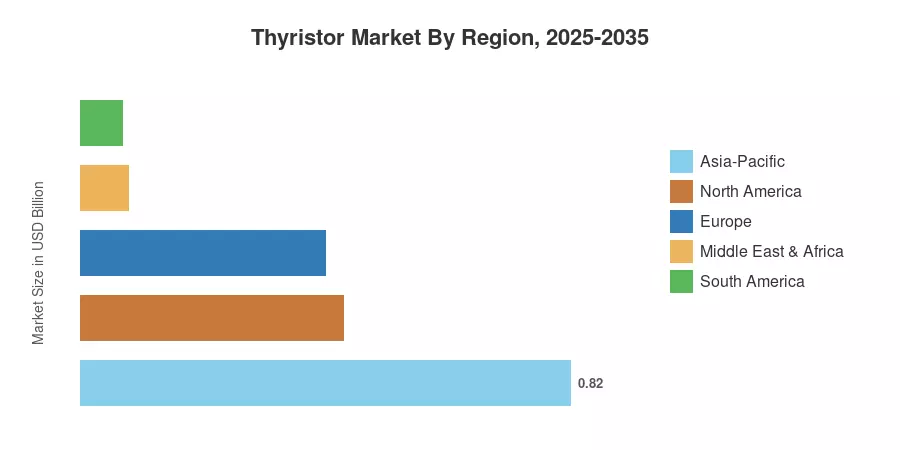
Asia-Pacific commands approximately 42.3% of the Thyristor Market, driven by China's grid investments and India's renewable integration buildout. The Middle East & Africa region is projected to expand at the fastest clip — a 4.40% CAGR through 2035 — as Gulf states electrify desalination, green-hydrogen, and rail infrastructure. Europe holds the second-largest share at roughly 21%, supported by North Sea HVDC interconnectors and the EU's TEN-E cross-border energy program. The Thyristor Market is poised for steady expansion as grid modernization and renewable integration sustain demand through the next decade.


Key Report Takeaways

• By Device Type

  • Silicon-controlled rectifiers accounted for 61.1% of Thyristor Market revenue in 2025, reflecting their dominance in HVDC valve stacks and industrial rectification.
  • Gate turn-off thyristors are forecast to advance at a 4.12% CAGR through 2035, gaining traction in traction drives and flexible AC transmission systems.

• By End-Use Industry

  • Industrial drives and motor control represented 26.6% of Thyristor Market demand in 2025, led by metals, mining, and cement plant retrofits.
  • Renewable power conversion is set to record the fastest growth at a 4.76% CAGR as wind and solar installations require grid-tie converter stacks.

• By Region

  • Asia-Pacific retained the largest Thyristor Market share at 42.3% in 2025.
  • The Middle East & Africa is projected to be the fastest-growing region at a 4.40% CAGR through 2035.


Thyristor Market Size and Forecast (2021–2035)

Market Research Future employs a triangulated methodology combining top-down revenue modeling from semiconductor industry associations, bottom-up device shipment tracking across wafer fabs, and validated interviews with procurement leads at transmission utilities and industrial OEMs. Historical data draws on customs databases, corporate filings, and SEMI fabrication statistics, while forecast projections apply macro-weighted regression calibrated to grid investment pipelines and industrial CapEx cycles.
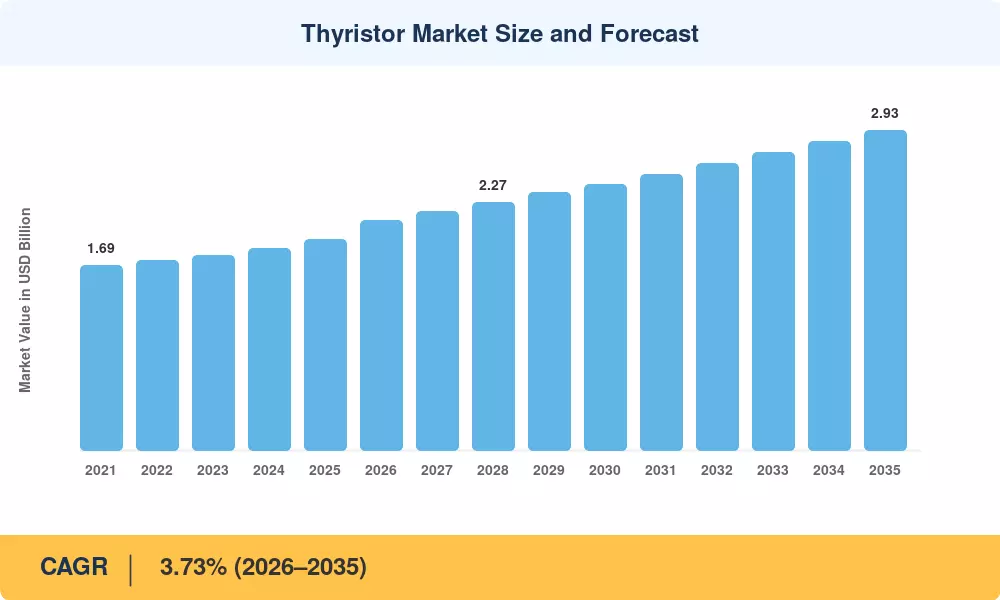
Thyristor Market Size and Forecast
Our Impact
Enabled $4.3B Revenue Impact for Fortune 500 and Leading Multinationals
Partnering with 2000+ Global Organizations Each Year
30K+ Citations by Top-Tier Firms in the Industry

Driver Impact Analysis

Driver ~% Impact on CAGR Geographic Relevance Impact Timeline
HVDC transmission expansion +0.95% Asia-Pacific, Europe Long-term (≥4 yr)
Renewable grid integration +0.72% Global Medium-term (2–4 yr)
Industrial electrification and motor-drive retrofits +0.55% North America, Europe Short-term (≤2 yr)
Green-hydrogen electrolyser deployment +0.40% Middle East, Europe Long-term (≥4 yr)
Rail electrification programs +0.30% India, ASEAN Medium-term (2–4 yr)
Data-center UPS and power-conditioning upgrades +0.25% North America, Asia-Pacific Short-term (≤2 yr)
Replacement cycle for aging HVDC converter stations +0.20% Europe, North America Medium-term (2–4 yr)


HVDC Transmission Expansion

The single largest demand catalyst for the Thyristor Market is the global buildout of HVDC corridors. China's State Grid Corporation plans to commission at least 14 new UHVDC lines by 2030, each requiring thousands of thyristor valves rated above 8 kV per device [2]. India's Green Energy Corridor Phase II allocates roughly USD 2 billion for inter-regional HVDC links connecting Rajasthan and Gujarat solar parks to load centers in the south and east [10].

Renewable Grid Integration

As solar and wind capacity surpasses 4,500 GW globally by 2030 per IRENA projections, grid-tie power-conversion systems are proliferating [7]. Static VAR compensators and thyristor-controlled series capacitors stabilize transmission networks against intermittent generation.

Industrial Electrification and Motor-Drive Retrofits

The U.S. Department of Energy's Better Plants Program targets 25% energy-intensity reduction across more than 270 partner facilities by 2030, incentivizing soft-starter and variable-speed-drive upgrades that depend on thyristor-based front-end converters [8]. In Europe, the revised Energy Efficiency Directive (2023/1791) establishes binding energy consumption reduction targets. It mandates Energy Management Systems/audits based on enterprise energy consumption thresholds (e.g., >10 TJ or >85 TJ annual consumption), funneling demand toward thyristor-controlled drives in cement, steel, and pulp-and-paper plants [13].

Green-Hydrogen Electrolyser Deployment

Alkaline electrolysers rated above 10 MW typically use thyristor rectifier stacks for DC power conversion. The EU's REPowerEU plan targets 10 million tonnes of domestic green-hydrogen production by 2030, translating to an estimated 65–80 GW of electrolyser capacity. Saudi Arabia's NEOM green-hydrogen complex alone is sized at 2.2 GW of electrolysis, with commissioning slated for 2026 [14].


Restraints Impact Analysis

Restraint ~% Impact on CAGR Geographic Relevance Impact Timeline
Wide-bandgap semiconductor substitution –0.45% Global Long-term (≥4 yr)
Price pressure from Chinese discrete suppliers –0.30% Asia-Pacific, Middle East Short-term (≤2 yr)
Counterfeit device risk and certification delays –0.20% Global Medium-term (2–4 yr)
Long qualification cycles for new grid projects –0.15% Europe, North America Long-term (≥4 yr)
Declining legacy industrial load in mature economies –0.10% Europe, Japan Medium-term (2–4 yr)


Wide-Bandgap Semiconductor Substitution

SiC MOSFETs and GaN transistors continue to erode thyristor design wins in medium-voltage applications below 3.3 kV. Infineon and Wolfspeed have scaled SiC wafer production to 200 mm. As SiC devices push toward 6.5 kV ratings, the addressable Thyristor Market in traction inverters and industrial drives faces incremental substitution pressure over the next decade.

Price Pressure from Chinese Discrete Suppliers

Chinese manufacturers like WeEn Semiconductors and Yangzhou Yangjie offer stud-mount and capsule thyristors at typical selling prices 20–30% below European counterparts [16]. This aggressive pricing is compressing margins across the low and mid-power sectors of the Thyristor Market, driving incumbent manufacturers towards higher value module solutions and decreasing per-unit revenue growth in the fastest volume tiers.


Counterfeit Device Risk

ERAI reported a 25% year-over-year increase in counterfeit semiconductor incidents in 2024, with thyristors among the top ten most-counterfeited device families [17]. Utilities and grid OEMs increasingly demand full die-traceability and lot-level certifications, adding 4–8 weeks to procurement timelines and elevating total cost of ownership for legitimate suppliers.


Thyristor Market Opportunities

Intelligent Power Module Integration

Module integrators are embedding thyristor dies alongside gate drivers, temperature sensors, and current monitors into single-package solutions. This shift unlocks higher ASPs and positions module suppliers to capture value in smart-grid and industrial automation platforms.

Offshore Wind HVDC Export Cables

Europe alone plans to install more than 120 GW of offshore wind by 2030, most of it requiring long-distance HVDC export cables [12]. Each converter platform demands valve halls housing hundreds of thyristor stacks, creating a concentrated procurement opportunity for manufacturers with maritime-grade packaging and extended reliability certifications.

Emerging-Market Grid Electrification

Sub-Saharan Africa and Southeast Asia continue to remain vastly under-electrified, with the World Bank projecting that 570 million people lack dependable access to the grid [19]. As these regions develop trunk transmission lines and industrial zones, thyristor-based FACTS devices and rectifier stacks will be part of the supply chain. Concessional finance is being provided for grid backbone projects in Nigeria, Vietnam, and Bangladesh by international development banks. The Thyristor Market is set to profit.


Electrolyser Rectification for Green Hydrogen

The worldwide green-hydrogen electrolyser capacity is predicted to exceed 130 GW by 2035 [9]. Alkaline electrolysis is the most economical option for large-scale plants, which need thyristor rectifier modules in excess of 10 MW. This would provide a fresh demand vertical for the Thyristor Market, apart from its existing basis in utilities and heavy industries.


Data Monetization Through Digital-Twin Valve Monitoring

High-voltage direct current (HVDC) and flexible AC transmission system (FACTS) operators are increasingly deploying predictive condition-monitoring tools and digital-twin models to evaluate thyristor valve health in real time. By continuously analyzing real-time telemetry—including junction temperatures, gate-firing symmetry, and voltage stress across series-connected thyristor levels—utilities can optimize predictive maintenance schedules, prevent unplanned valve outages, and extend the operational lifespan of converter station assets.


Thyristor Market Future Outlook

Grid Digitalization and AI-Optimized Power Flow

Artificial intelligence is entering transmission operations through predictive maintenance algorithms that monitor thyristor valve health in real time. Digital-twin platforms — piloted by Hitachi Energy and Siemens Energy — analyze junction-temperature trends, gate-timing drift, and coolant flow anomalies to schedule proactive valve replacements.

Electrification Supercycle and Sector Coupling

Global energy demand would almost quadruple by 2050, driven by the electrification of transport, the adoption of heat pumps and the decarbonisation of industry in the IEA’s Net Zero Emissions scenario [1]. Thyristors are at the nexus of various sectors: from traction substations for electrified rail to thyristor-controlled reactors that stabilize grids, soaking up erratic renewable production. The Thyristor Market will benefit from sector coupling as power flows across previously siloed energy networks are amplified.


ESG Compliance and Supply-Chain Traceability

The semiconductor procurement landscape is changing as regulatory focus on environmental, social, and governance (ESG) norms strengthens. Under the EU’s Corporate Sustainability Reporting Directive (CSRD), utilities are now required to publish their supply-chain carbon footprints, promoting the procurement of silicon from fabs with verified green-energy sourcing and conflict-mineral-free silicon [13]. Thyristor manufacturers will receive favorable qualification status with European and North American grid operators through ISO 14064 validated carbon reporting.


Modular HVDC and Standardized Converter Platforms

Hitachi Energy's modular valve-hall concept and Siemens Energy's plug-and-play converter skids reduce on-site labor and civil works. This modularization trend will expand the addressable Thyristor Market by making HVDC economically viable for corridors below 2 GW — a capacity tier previously dominated by HVAC solutions.


Thyristor Market Segmentation

By Device Type

Segment Key Metric Primary Demand Driver
Silicon-Controlled Rectifier (SCR) 61.1% share (2025) HVDC valves, industrial rectification
Gate Turn-Off Thyristor (GTO) 4.12% CAGR Traction drives, FACTS
TRIAC USD 0.18 Billion (2025) Consumer appliances, light dimmers
Others (IGCT, ETO, MTO) 3.65% CAGR Medium-voltage drives, STATCOM


The Thyristor Market remains structurally anchored by SCR devices, which dominate utility-scale HVDC converters and electrochemical rectification for aluminum smelting and chlor-alkali processing. Their rugged avalanche characteristics, high surge-current ratings, and proven reliability in valve stacks exceeding 800 kV make them irreplaceable in long-haul power transmission. GTO devices are gaining design wins in metro traction inverters and utility FACTS installations where controlled turn-off capability reduces snubber losses and improves harmonic performance.

By Power Rating

Segment Key Metric Primary Demand Driver
Below 500 MW 42.6% share (2025) Industrial drives, UPS systems
500–1,000 MW USD 0.56 Billion (2025) Regional HVDC links
Above 1,000 MW 4.29% CAGR UHVDC backbone corridors


Installations rated below 500 MW constitute the volume backbone of the Thyristor Market, spanning soft starters, medium-voltage drives, and static VAR compensators deployed across manufacturing facilities and distribution substations. The above-1,000 MW tier is growing fastest as UHVDC projects in China, India, and Europe push rated capacities beyond 8 GW per corridor.

By Mounting and Package

Segment Key Metric Primary Demand Driver
Stud-Type 37.5% share (2025) Cost-effective OEM integration
Capsule / Disc USD 0.52 Billion (2025) HVDC valve stacks, high-reliability
Module (incl. Intelligent Power Modules) 4.44% CAGR Smart-grid and automation platforms


Stud-type packages remain the workhorse of industrial thyristor applications thanks to their low mounting cost and wide availability. Capsule/disc formats serve the most demanding voltage and current ratings in HVDC converter halls. The Thyristor Market is seeing the fastest innovation in the module tier, where intelligent power modules integrate sensing and gate-drive electronics to reduce system-level complexity.

By Triggering Method

Segment Key Metric Primary Demand Driver
Electrical Gate Triggering 57.6% share (2025) General industrial, motor drives
Light Triggering 4.59% CAGR UHVDC, EMI-sensitive environments
Pulse Transformer USD 0.12 Billion (2025) Legacy installations, retrofit
Others 3.40% CAGR Specialty and defense applications


Electrical gate triggering dominates the Thyristor Market in conventional applications. Light-triggered thyristors are the fastest-growing category because they eliminate electromagnetic interference coupling between gate circuits and high-voltage potentials — a critical advantage in UHVDC valve stacks operating above ±800 kV, where gate-isolation integrity is paramount.

By End-Use Industry

Segment Key Metric Primary Demand Driver
Industrial Drives and Motor Control 26.6% share (2025) Metals, mining, cement plant drives
Power Transmission and Distribution USD 0.48 Billion (2025) HVDC, FACTS, SVC deployments
Renewable Power Conversion 4.76% CAGR Wind/solar grid-tie inverters
Transportation and Traction 3.98% CAGR Rail electrification, metro systems
Consumer and Commercial USD 0.09 Billion (2025) HVAC controls, lighting dimmers


Industrial drives and motor control constitute the largest end-use slice of the Thyristor Market, concentrated in sectors where multi-megawatt variable-speed drives handle heavy rotating loads. Renewable power conversion is climbing fastest as countries mandate thyristor-based reactive-power compensation at every grid interconnection point for wind farms and solar parks exceeding 100 MW.


Regional Market Share Analysis

Region Key Metric Primary Investment Themes
Asia-Pacific 42.3% share (2025) UHVDC corridors, industrial motor drives, renewable integration
North America USD 0.44 Billion (2025) Grid modernization, data-center power conditioning
Europe 21.0% share (2025) Offshore wind HVDC, TEN-E interconnectors, hydrogen electrolysis
South America 3.87% CAGR (2026–2035) Mining electrification, hydropower transmission
Middle East & Africa 4.40% CAGR (2026–2035) Desalination, green hydrogen, rail electrification
Total USD 1.93 Billion (2025)

The Thyristor Market exhibits moderate regional concentration, with Asia-Pacific leading on volume and the Middle East accelerating on the back of infrastructure mega-projects. The table below captures regional positioning using a single disclosure metric per row.


North America

Country Key Metric Key Driver
United States 68% of regional share Grid resilience CapEx under IIJA/IRA
Canada USD 0.07 Billion (2025) Interprovincial HVDC links
Mexico 3.95% CAGR Manufacturing electrification, nearshoring


The U.S. Department of Energy's Grid Deployment Office has allocated USD 20 billion under the Bipartisan Infrastructure Law for transmission expansion and modernization, with HVDC projects in the Plains and Mountain West regions directly generating thyristor procurement activity [8]. Canada's planned Atlantic Loop and Prairie Link HVDC corridors add further demand, while Mexico benefits from nearshoring-driven industrial load growth.

Europe

Country Key Metric Key Driver
Germany 26% of regional share Energiewende HVDC SuedLink/SuedOstLink
United Kingdom 4.05% CAGR North Sea offshore wind export
France USD 0.06 Billion (2025) Nuclear fleet upgrade and HVDC ties
Italy 3.72% CAGR Mediterranean interconnectors
Spain USD 0.04 Billion (2025) Solar FACTS deployment
Nordic Countries 15% of regional share Cross-border HVDC NordLink/NordBalt
Russia 3.50% CAGR Siberian UHVDC renewal
Rest of Europe USD 0.05 Billion (2025) TEN-E corridor projects


Germany's SuedLink and SuedOstLink HVDC corridors — expected to move 4 GW of offshore wind power from the North Sea to Bavaria — represent roughly EUR 10 billion in combined investment, with thyristor valve procurement forming a critical procurement line item [12]. The UK's Contracts for Difference auctions continue to expand offshore wind capacity, necessitating HVDC export infrastructure along the east coast.

Asia-Pacific

Country Key Metric Key Driver
China 56% of regional share State Grid UHVDC buildout
India 4.52% CAGR Green Energy Corridor Phase II
Japan USD 0.07 Billion (2025) Industrial drive replacement
South Korea 3.68% CAGR KEPCO subsea interconnectors
ASEAN USD 0.05 Billion (2025) Cross-border power trade corridors
Rest of Asia-Pacific 3.55% CAGR Grid backbone expansion


China remains the dominant country-level Thyristor Market, anchored by State Grid's 14th Five-Year Plan investment exceeding USD 400 billion in transmission infrastructure [2]. India is the fastest-growing country market in the region, as the Green Energy Corridor Phase II and PM-KUSUM solar programs drive demand for thyristor-based FACTS and rectifier systems across new renewable zones.

South America

Country Key Metric Key Driver
Brazil 62% of regional share Amazon HVDC transmission links
Argentina 3.91% CAGR Mining sector electrification
Rest of South America USD 0.02 Billion (2025) Hydropower transmission corridors


Brazil's long-distance HVDC corridors linking Amazonian hydropower to São Paulo and Rio de Janeiro load centers underpin a significant portion of regional thyristor demand. The country's ANEEL regulatory framework continues to greenlight transmission concession auctions that embed thyristor valve specifications into technical procurement criteria.

Middle East & Africa

Country Key Metric Key Driver
Saudi Arabia 34% of regional share NEOM hydrogen, Vision 2030 rail
UAE 4.35% CAGR Desalination, nuclear power grid tie
South Africa USD 0.02 Billion (2025) ESKOM grid rehabilitation
Egypt 4.10% CAGR Suez industrial zone electrification
Rest of MEA USD 0.03 Billion (2025) Sub-Saharan grid backbone


Saudi Arabia's Vision 2030 program is channeling roughly USD 500 billion into non-oil infrastructure including the NEOM green-hydrogen complex, Riyadh Metro, and Haramain high-speed rail extension — all of which generate downstream thyristor demand for rectifier and traction-drive systems [14]. The UAE's Barakah nuclear plant requires HVDC grid-tie infrastructure, while South Africa's ESKOM rehabilitation plan replaces aging mercury-arc valves with modern thyristor stacks.


Thyristor Market By Region, 2025-2035

Competitive Benchmarking

The Thyristor Market exhibits medium concentration, with the top five players holding an estimated 48–55% of global revenue. The Herfindahl-Hirschman Index sits in the 800–1,200 range, indicating a moderately competitive structure. European and Japanese incumbents dominate the high-power module and HVDC valve segments, while Chinese manufacturers lead in discrete stud and capsule devices on cost competitiveness. Strategic activity centers on vertical integration — from wafer fabrication through module assembly — and portfolio expansion into intelligent power modules.

Company Est. Revenue Share Range Key Offerings for Thyristor Market Strategic Positioning
Infineon Technologies ~10–14% Phase-control thyristors, IGCT modules Broadest SiC-to-thyristor portfolio; strong automotive cross-sell
Hitachi Energy ~9–13% HVDC thyristor valves, BiSCI modules Dominant in UHVDC converter stations globally
Mitsubishi Electric ~7–10% High-voltage press-pack thyristors Integrated power-module platforms for rail and grid
STMicroelectronics ~5–8% SCR/TRIAC for industrial and consumer Volume leader in European silicon controlled rectifiers
Vishay Intertechnology ~4–7% Stud-mount, capsule, and hockey-puck formats Broad distribution network, cost-optimized discretes
Littelfuse ~4–6% IXYS-branded high-power thyristors Acquired IXYS; strong in traction and renewable
Toshiba Electronic Devices ~3–6% Light-triggered thyristors, press-pack SCR Pioneer in light-triggered HVDC valve technology
Semikron Danfoss ~3–5% SEMIPACK thyristor/diode modules Focus on industrial drives and wind converters
WeEn Semiconductors ~3–5% Low-cost stud and capsule SCR Aggressive pricing in Asia-Pacific and MEA markets
SanRex Corporation ~2–4% Three-phase bridge thyristor modules Niche strength in electrochemical rectification


Recent News & Developments

  • Hitachi Energy (November 2024): Partnered in a consortium with BHEL to win a major contract from Power Grid Corporation of India for a ±800 kV, 6,000 MW bi-directional HVDC link transmitting renewable energy across 1,200 kilometers from Khavda, Gujarat to Nagpur, Maharashtra.
  • Infineon Technologies (August 2024): Officially opened the first phase of its €2 billion 200 mm silicon carbide (SiC) power semiconductor fab in Kulim, Malaysia, expanding wide-bandgap manufacturing capacity to complement its global power electronics portfolio for renewable energy, electric vehicle, and grid applications.
  • Toshiba Electronic Devices (June 2024): Announced the development and commercialization of a 6.5 kV press-pack Injection Enhanced Gate Transistor (IEGT) chip with enhanced turn-off and short-circuit capability, designed to reduce series device counts and downsize high-voltage DC power transmission systems and STATCOM equipment.
  • Semikron Danfoss (June 2024): Announced that its SEMITOP E power module incorporating silicon carbide technology was selected by SMA for its Sunny Boy Smart Energy residential solar inverters, delivering low-inductance performance, superior thermal efficiency, and streamlined automated press-fit assembly.


Thyristor Market Report Scope

Parameter Detail
Market Scope Global Thyristor Market covering all device types, power ratings, mounting formats, triggering methods, and end-use industries
Study Period 2021–2035
CAGR 3.73% (2026–2035)
Market Size (2025) USD 1.93 Billion
Market Size (2035) USD 2.93 Billion
Fastest Growing Segment Renewable power conversion (4.76% CAGR)
Companies Profiled 10 major players
Valuation Currency USD Billion


FAQs

How do thyristor qualification timelines affect project budgets for HVDC developers?
IEC 60700-1 electrical type testing verifies dielectric, impulse, and operational limits for HVDC valves, with qualification timelines and testing budgets depending on laboratory availability and project specifications.
What trade-offs should buyers weigh between stud-mount and press-pack capsule formats?
Stud-mount devices cost less and suit standard heatsink assemblies, while press-pack capsules offer superior surge ratings and bidirectional thermal paths. High-reliability HVDC applications almost always justify the capsule premium [18].
How does the counterfeit-device risk influence procurement strategy for thyristors?
Buyers should source exclusively through authorized channels and require lot-level traceability documentation. Counterfeit thyristors can fail under surge, posing safety and warranty risks in grid installations [17].
What role do thyristors play in green-hydrogen electrolyser systems?
Thyristor rectifier stacks convert AC grid power to DC for alkaline electrolysis cells. Ratings above 10 MW per stack are standard, making thyristors the default choice over IGBT-based active rectifiers at scale [9].
How are light-triggered thyristors different from electrically triggered devices in operational terms?
Light triggering uses fiber-optic pulses, eliminating electromagnetic interference coupling at high voltages. This simplifies gate-circuit isolation in ±800 kV UHVDC stacks and improves firing reliability [5].
What maintenance intervals should operators expect for thyristor-based converter stations?
Thyristor converter stations undergo annual or biennial scheduled maintenance, while major system overhauls and control upgrades typically occur after 15 to 25 years of continuous service.  
How does the Thyristor Market outlook differ for retrofit versus greenfield projects?
Retrofit projects replace aging mercury-arc or early-generation thyristor valves, offering shorter procurement cycles. Greenfield HVDC corridors generate larger per-project volumes but carry longer lead times of 3–5 years [22].    
Author
Author
Author Profile
Ankit Gupta LinkedIn
Team Lead - Research
Ankit Gupta is a seasoned market intelligence and strategic research professional with over six plus years of experience in the ICT and Semiconductor industries. With academic roots in Telecom, Marketing, and Electronics, he blends technical insight with business strategy. Ankit has led 200+ projects, including work for Fortune 500 clients like Microsoft and Rio Tinto, covering market sizing, tech forecasting, and go-to-market strategies. Known for bridging engineering and enterprise decision-making, his insights support growth, innovation, and investment planning across diverse technology markets.
Co-Author
Co-Author Profile
Shubham Munde LinkedIn
Team Lead - Research
Shubham brings over 7 years of expertise in Market Intelligence and Strategic Consulting, with a strong focus on the Automotive, Aerospace, and Defense sectors. Backed by a solid foundation in semiconductors, electronics, and software, he has successfully delivered high-impact syndicated and custom research on a global scale. His core strengths include market sizing, forecasting, competitive intelligence, consumer insights, and supply chain mapping. Widely recognized for developing scalable growth strategies, Shubham empowers clients to navigate complex markets and achieve a lasting competitive edge. Trusted by start-ups and Fortune 500 companies alike, he consistently converts challenges into strategic opportunities that drive sustainable growth.
Download Free Sample

Kindly complete the form below to receive a free sample of this Report

Download PDF ×

We do not share your information with anyone. However, we may send you emails based on your report interest from time to time. You may contact us at any time to opt-out.
















