Tissue Engineering Market (2026 - 2035)

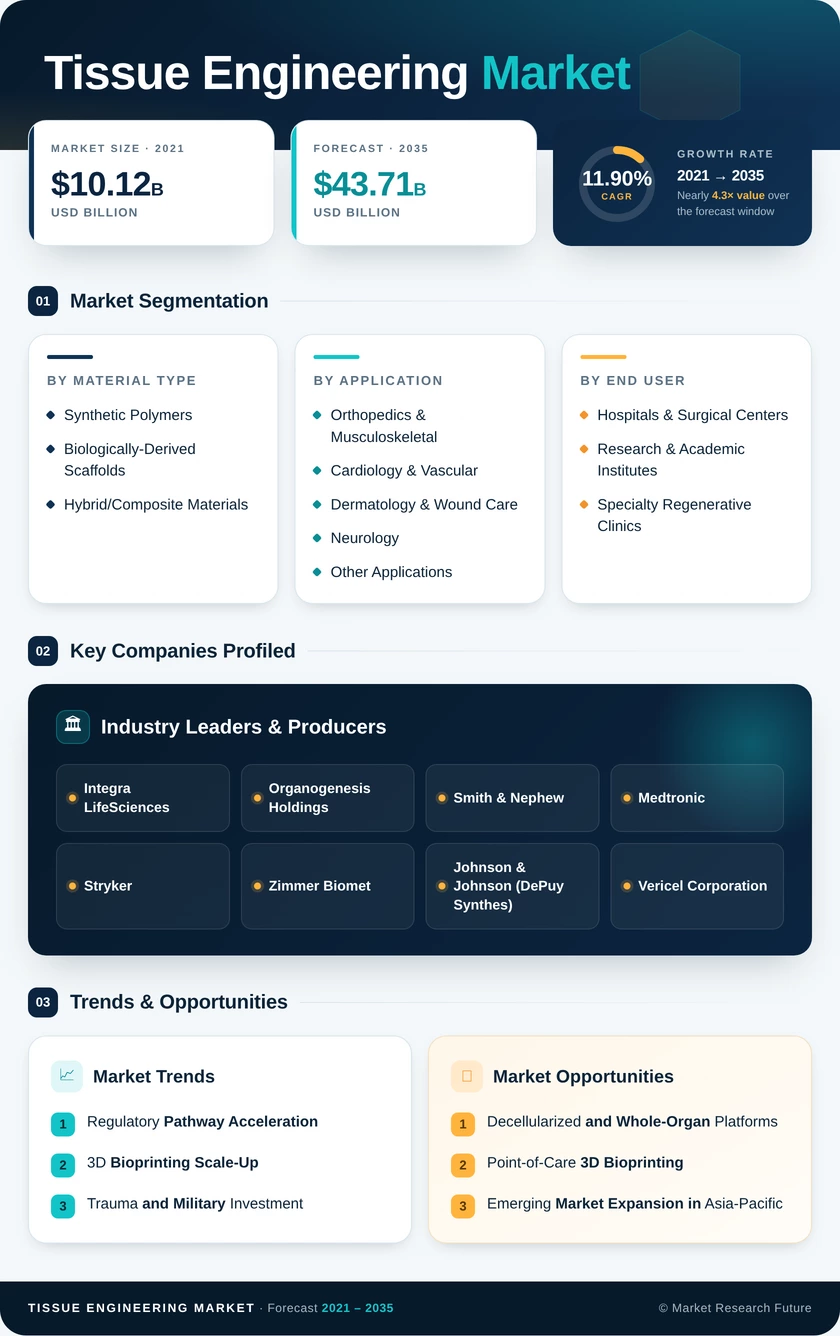
Tissue Engineering Market Research Report By Application (Orthopedics, Cardiology, Dermatology, Neurology, Dental), By Material Type (Natural Polymers, Synthetic Polymers, Ceramics, Composites, Hydrogels), By Technology (3D Bioprinting, Stem Cell Technology, Electrospinning, Decellularization), By End User (Hospitals, Research Laboratories, Biotechnology Companies, Academic Institutions) and By Regional (North America, Europe, South America, Asia Pacific, Middle East and Africa) - Industry Forecast to 2035.

Forecast Period
2026-2035
CAGR
11.90%
2025 Market Size
USD 14.21 Billion
2035 Market Size
USD 43.71 Billion
Healthcare ● Updated July 2026 Report ID: MRFR/HC/1592-CR | Pages: 200 | Author: Satyendra Maurya, Rahul Gotadki
  1. 1 Market Overview |
    1. 1.1 Study Assumptions & Market Definition |
    2. 1.2 Scope of the Study |
    3. 1.3 Research Methodology
  2. 2 Market Summary & Key Takeaways
  3. 3 Market Dynamics |
    1. 3.1 Market Drivers Analysis | |
      1. 3.1.1 Expanding RMAT and Accelerated Regulatory Pathways | |
      2. 3.1.2 Growth in Orthopedic and Sports-Medicine Procedures | |
      3. 3.1.3 3D Bioprinting Manufacturing Scale-Up | |
      4. 3.1.4 Rising Military and Civilian Trauma Caseloads | |
      5. 3.1.5 Public Investment in Regenerative Medicine R&D | |
      6. 3.1.6 Aging Population and Chronic Wound Prevalence | |
      7. 3.1.7 Hybrid Composite Scaffold Innovation |
    2. 3.2 Market Restraints Analysis | |
      1. 3.2.1 High Product Development and Manufacturing Costs | |
      2. 3.2.2 Reimbursement Uncertainty for Novel Biologics | |
      3. 3.2.3 Stringent Regulatory Compliance and EU MDR Burden | |
      4. 3.2.4 Limited Shelf Life and Cold-Chain Logistics | |
      5. 3.2.5 Ethical and Sourcing Concerns for Biological Materials |
    3. 3.3 Market Opportunity Analysis | |
      1. 3.3.1 Decellularized and Whole-Organ Platforms | |
      2. 3.3.2 Point-of-Care 3D Bioprinting | |
      3. 3.3.3 Emerging Market Expansion in Asia-Pacific | |
      4. 3.3.4 Data-Driven Scaffold Design and Digital Twins | |
      5. 3.3.5 Subscription and Service-Based Business Models |
    4. 3.4 Industry Value Chain Analysis |
    5. 3.5 Porter's Five Forces Analysis
  4. 4 Global Tissue Engineering Market Size & Forecast (2021–2035) |
    1. 4.1 Historical Market Size (2021–2025) |
    2. 4.2 Current & Forecast Market Size (2026–2035) |
    3. 4.3 Market Size by Revenue (USD Billion) |
    4. 4.4 Year-over-Year Growth Analysis
  5. 5 Segmentation Analysis |
    1. 5.1 By Material Type | |
      1. 5.1.1 Synthetic Polymers | |
      2. 5.1.2 Biologically-Derived Scaffolds | |
      3. 5.1.3 Hybrid/Composite Materials |
    2. 5.2 By Application | |
      1. 5.2.1 Orthopedics & Musculoskeletal | |
      2. 5.2.2 Cardiology & Vascular | |
      3. 5.2.3 Dermatology & Wound Care | |
      4. 5.2.4 Neurology | |
      5. 5.2.5 Other Applications |
    3. 5.3 By End User | |
      1. 5.3.1 Hospitals & Surgical Centers | |
      2. 5.3.2 Research & Academic Institutes | |
      3. 5.3.3 Specialty Regenerative Clinics
  6. 6 Regional Analysis |
    1. 6.1 North America | |
      1. 6.1.1 United States | |
      2. 6.1.2 Canada | |
      3. 6.1.3 Mexico |
    2. 6.2 Europe | |
      1. 6.2.1 Germany | |
      2. 6.2.2 United Kingdom | |
      3. 6.2.3 France | |
      4. 6.2.4 Italy | |
      5. 6.2.5 Spain | |
      6. 6.2.6 Nordic Countries | |
      7. 6.2.7 Russia | |
      8. 6.2.8 Rest of Europe |
    3. 6.3 Asia-Pacific | |
      1. 6.3.1 China | |
      2. 6.3.2 India | |
      3. 6.3.3 Japan | |
      4. 6.3.4 South Korea | |
      5. 6.3.5 ASEAN | |
      6. 6.3.6 Rest of Asia-Pacific |
    4. 6.4 South America | |
      1. 6.4.1 Brazil | |
      2. 6.4.2 Argentina | |
      3. 6.4.3 Rest of South America |
    5. 6.5 Middle East & Africa | |
      1. 6.5.1 Saudi Arabia | |
      2. 6.5.2 UAE | |
      3. 6.5.3 South Africa | |
      4. 6.5.4 Egypt | |
      5. 6.5.5 Rest of MEA
  7. 7 Competitive Landscape |
    1. 7.1 Market Share Analysis (2025) |
    2. 7.2 Competitive Benchmarking Matrix |
    3. 7.3 Company Profiles | |
      1. 7.3.1 Integra LifeSciences | |
      2. 7.3.2 Organogenesis Holdings | |
      3. 7.3.3 Smith & Nephew | |
      4. 7.3.4 Medtronic | |
      5. 7.3.5 Stryker | |
      6. 7.3.6 Zimmer Biomet | |
      7. 7.3.7 Johnson & Johnson (DePuy Synthes) | |
      8. 7.3.8 Vericel Corporation | |
      9. 7.3.9 MiMedx Group | |
      10. 7.3.10 Baxter International
  8. 8 Future Outlook & Strategic Recommendations (2026–2035) |
    1. 8.1 AI-Augmented Design and Manufacturing |
    2. 8.2 Personalized Medicine Integration |
    3. 8.3 Sustainability and Green Biomaterials |
    4. 8.4 Platform Economics and Ecosystem Consolidation
  9. 9 Recent Developments & News
  10. 10 Frequently Asked Questions (FAQs)
  11. 11 Report Scope & Methodology |
    1. 11.1 Study Period & Base Year |
    2. 11.2 Data Sources & Citations |
    3. 11.3 Abbreviations
  12. 1 LIST OF TABLES |
  13. TABLE 1 Global Tissue Engineering Market Size & Forecast, by Revenue (USD Billion), 2021–2035 |
  14. TABLE 2 Global Tissue Engineering Market — Year-over-Year Growth Analysis, 2021–2035 |
  15. TABLE 3 Global Tissue Engineering Market — Driver Impact Analysis |
  16. TABLE 4 Global Tissue Engineering Market — Restraint Impact Analysis |
  17. TABLE 5 Global Tissue Engineering Market Size, by Material Type, 2021–2035 (USD Billion) |
  18. TABLE 6 Global Tissue Engineering Market Size, by Application, 2021–2035 (USD Billion) |
  19. TABLE 7 Global Tissue Engineering Market Size, by End User, 2021–2035 (USD Billion) |
  20. TABLE 8 Global Tissue Engineering Market Size, by Region, 2021–2035 (USD Billion) |
  21. TABLE 9 North America Tissue Engineering Market Size, by Country, 2021–2035 (USD Billion) |
  22. TABLE 10 Europe Tissue Engineering Market Size, by Country, 2021–2035 (USD Billion) |
  23. TABLE 11 Asia-Pacific Tissue Engineering Market Size, by Country, 2021–2035 (USD Billion) |
  24. TABLE 12 South America Tissue Engineering Market Size, by Country, 2021–2035 (USD Billion) |
  25. TABLE 13 Middle East & Africa Tissue Engineering Market Size, by Country, 2021–2035 (USD Billion) |
  26. TABLE 14 North America Tissue Engineering Market Size, by Material Type, 2021–2035 (USD Billion) |
  27. TABLE 15 North America Tissue Engineering Market Size, by Application, 2021–2035 (USD Billion) |
  28. TABLE 16 North America Tissue Engineering Market Size, by End User, 2021–2035 (USD Billion) |
  29. TABLE 17 Europe Tissue Engineering Market Size, by Material Type, 2021–2035 (USD Billion) |
  30. TABLE 18 Europe Tissue Engineering Market Size, by Application, 2021–2035 (USD Billion) |
  31. TABLE 19 Europe Tissue Engineering Market Size, by End User, 2021–2035 (USD Billion) |
  32. TABLE 20 Asia-Pacific Tissue Engineering Market Size, by Material Type, 2021–2035 (USD Billion) |
  33. TABLE 21 Asia-Pacific Tissue Engineering Market Size, by Application, 2021–2035 (USD Billion) |
  34. TABLE 22 Asia-Pacific Tissue Engineering Market Size, by End User, 2021–2035 (USD Billion) |
  35. TABLE 23 South America Tissue Engineering Market Size, by Material Type, 2021–2035 (USD Billion) |
  36. TABLE 24 South America Tissue Engineering Market Size, by Application, 2021–2035 (USD Billion) |
  37. TABLE 25 South America Tissue Engineering Market Size, by End User, 2021–2035 (USD Billion) |
  38. TABLE 26 Middle East & Africa Tissue Engineering Market Size, by Material Type, 2021–2035 (USD Billion) |
  39. TABLE 27 Middle East & Africa Tissue Engineering Market Size, by Application, 2021–2035 (USD Billion) |
  40. TABLE 28 Middle East & Africa Tissue Engineering Market Size, by End User, 2021–2035 (USD Billion) |
  41. TABLE 29 Competitive Benchmarking Matrix — Global Tissue Engineering Market, 2025 |
  42. TABLE 30 Company Profiles — Key Players, Global Tissue Engineering Market |
  43. TABLE 31 Recent Developments & Strategic Announcements, 2023–2025 |
  44. TABLE 32 Report Scope & Methodology Summary |
  45. TABLE 33 Detailed Sources and Citations
  46. 2 LIST OF FIGURES |
  47. FIGURE 1 Global Tissue Engineering Market Dynamics — Drivers, Restraints, and Opportunities |
  48. FIGURE 2 Industry Value Chain Analysis — Tissue Engineering Market |
  49. FIGURE 3 Porter's Five Forces Analysis — Tissue Engineering Market |
  50. FIGURE 4 Global Tissue Engineering Market Size Trend (USD Billion), 2021–2035 |
  51. FIGURE 5 Global Tissue Engineering Market Share, by Material Type (%), 2025 |
  52. FIGURE 6 Global Tissue Engineering Market Share, by Application (%), 2025 |
  53. FIGURE 7 Global Tissue Engineering Market Share, by End User (%), 2025 |
  54. FIGURE 8 Global Tissue Engineering Market Share, by Region (%), 2025 |
  55. FIGURE 9 North America Tissue Engineering Market Size Trend (USD Billion), 2021–2035 |
  56. FIGURE 10 Europe Tissue Engineering Market Size Trend (USD Billion), 2021–2035 |
  57. FIGURE 11 Asia-Pacific Tissue Engineering Market Size Trend (USD Billion), 2021–2035 |
  58. FIGURE 12 South America Tissue Engineering Market Size Trend (USD Billion), 2021–2035 |
  59. FIGURE 13 Middle East & Africa Tissue Engineering Market Size Trend (USD Billion), 2021–2035 |
  60. FIGURE 14 Competitive Landscape — Market Share Distribution, 2025 |
  61. FIGURE 15 Competitive Benchmarking Radar Chart — Top 10 Players
Share::
Request Free Sample

Segmentation Quick Reference

DimensionSub-SegmentsDominant SegmentFastest Growing Segment
By Material TypeSynthetic Polymers, Biologically-Derived Scaffolds, Hybrid/Composite MaterialsSynthetic PolymersHybrid/Composite Materials
By ApplicationOrthopedics & Musculoskeletal, Cardiology & Vascular, Dermatology & Wound Care, Neurology, Other ApplicationsOrthopedics & MusculoskeletalCardiology & Vascular
By End UserHospitals & Surgical Centers, Research & Academic Institutes, Specialty Regenerative ClinicsHospitals & Surgical CentersSpecialty Regenerative Clinics


Market Segmentation Overview

By Material Type

Sub-SegmentKey Trend
Synthetic PolymersMature manufacturing base with ongoing cost optimization through automation and continuous-process extrusion
Biologically-Derived ScaffoldsGrowing clinical preference in wound care and soft-tissue reconstruction due to superior biocompatibility
Hybrid/Composite MaterialsRapid innovation driven by dual-function scaffold designs combining mechanical strength with bioactivity


Synthetic polymers continue to dominate volume production due to scalable manufacturing and regulatory familiarity. Hybrid composites are attracting disproportionate R&D investment as clinical evidence demonstrates superior integration outcomes across orthopedic and vascular indications.

By Application

Sub-SegmentKey Trend
Orthopedics & MusculoskeletalExpanding procedure volumes in joint revision, spinal fusion, and sports-medicine cartilage repair
Cardiology & VascularMilitary-funded vascular graft programs transitioning into civilian trauma and peripheral artery applications
Dermatology & Wound CareMedicare-driven adoption of advanced skin substitutes for chronic diabetic and venous ulcers
NeurologyEmerging clinical trials in spinal cord injury and peripheral nerve gap bridging
Other ApplicationsEarly-stage dental, urological, and ophthalmic tissue engineering applications


Orthopedic applications anchor the market through procedural volume, while cardiology and vascular applications are pacing the growth curve as clinical pipelines mature and trauma-care investment expands.

By End User

Sub-SegmentKey Trend
Hospitals & Surgical CentersDominance through integrated operating-room workflows and group purchasing organization contracts
Research & Academic InstitutesCritical role in translational research and clinical trial enrollment feeding the commercial pipeline
Specialty Regenerative ClinicsFastest growth driven by outpatient wound care, sports medicine, and aesthetic reconstruction


Hospitals maintain majority share through procurement scale advantages, while specialty clinics represent the frontier of adoption as regenerative procedures migrate toward ambulatory care settings.


Share::
Request Free Sample
Download PDF ×

We do not share your information with anyone. However, we may send you emails based on your report interest from time to time. You may contact us at any time to opt-out.