Tomato Seeds Market (2026 - 2035)

Tomato Seeds Market Size, Share, Industry Trend & Analysis Research Report By Breeding Technology (Hybrids, Open-Pollinated Varieties & Hybrid Derivatives), By Cultivation Mechanism (Open Field, Protected Cultivation), By Geography (North America, Europe, Asia-Pacific, South America, Middle East & Africa) - Forecast to 2035

Forecast Period
2026-2035
CAGR
6.5%
2025 Market Size
USD 1.21 Billion
2035 Market Size
USD 2.26 Billion
Agriculture ● Updated July 15, 2026 Report ID: MRFR/Agri/6726-HCR | Pages: 90 | Author: Snehal Singh

Tomato Seeds Market Summary

The global Tomato Seeds Market reached an estimated USD 1.21 billion in 2025 and is projected to grow from USD 1.28 billion in 2026 to USD 2.26 billion by 2035, advancing at a compound annual growth rate of 6.5% during the forecast period. This expansion is anchored in two structural forces: the rapid scaling of protected-cultivation acreage worldwide and breeding innovation cycles that deliver higher-yielding, stress-tolerant genetics to growers every season. Government-backed horticulture missions — particularly India's National Horticulture Mission and the EU's Farm to Fork Strategy — continue to channel subsidies and technical assistance toward improved seed adoption, pulling smallholder farmers into the commercial seed value chain [1][2].

A technological shift is reshaping how breeders develop and commercialize tomato genetics. Marker-assisted selection and genomic tools are compressing breeding cycles from eight years to as few as four, while CRISPR-based gene editing is opening regulatory windows in select markets for traits such as enhanced lycopene content and viral resistance. Multinational seed companies now allocate 12–15% of vegetable-seed revenue to R&D pipelines, with tomato lines accounting for the single largest crop category within those budgets [3][4]. The transition from traditional landrace selection to precision breeding platforms represents the defining competitive battleground for the Tomato Seeds Market through 2035.

Asia-Pacific commands the largest regional footprint, holding approximately 38.7% of global revenue in 2025, driven by China's processing-tomato belt in Xinjiang and India's fresh-market dominance in states like Maharashtra and Karnataka. North America registered the fastest regional growth trajectory with an 8.2% CAGR through 2035, fueled by controlled-environment agriculture investments in Canada and the United States [5]. Europe represents the second-largest region, contributing roughly 27.5% of global value on the strength of greenhouse-intensive production in Spain, the Netherlands, and Turkey. As climate variability intensifies and consumer demand for year-round fresh tomatoes rises, the Tomato Seeds Market is positioned for sustained, innovation-led growth.


Key Report Takeaways

• By Breeding Technology

  • Hybrids accounted for 77.3% of the Tomato Seeds Market share in 2025, reflecting grower preference for uniform yield and built-in disease packages.
  • Open-pollinated varieties and hybrid derivatives are forecast to expand at a 5.2% CAGR through 2035, sustained by organic farming mandates and seed-sovereignty movements in South Asia and sub-Saharan Africa.

• By Cultivation Mechanism

  • Open-field production held 86.5% of the Tomato Seeds Market in 2025, though its share is gradually declining as greenhouse acreage scales.
  • Protected cultivation posted the fastest segment CAGR of 9.1% through 2035, supported by vertical-farm build-outs and high-tech greenhouse clusters across North America and Northern Europe.

• By Region

  • Asia-Pacific captured 38.7% of the global Tomato Seeds Market revenue in 2025, led by China and India.
  • North America registered the highest regional CAGR of 8.2% through 2035.
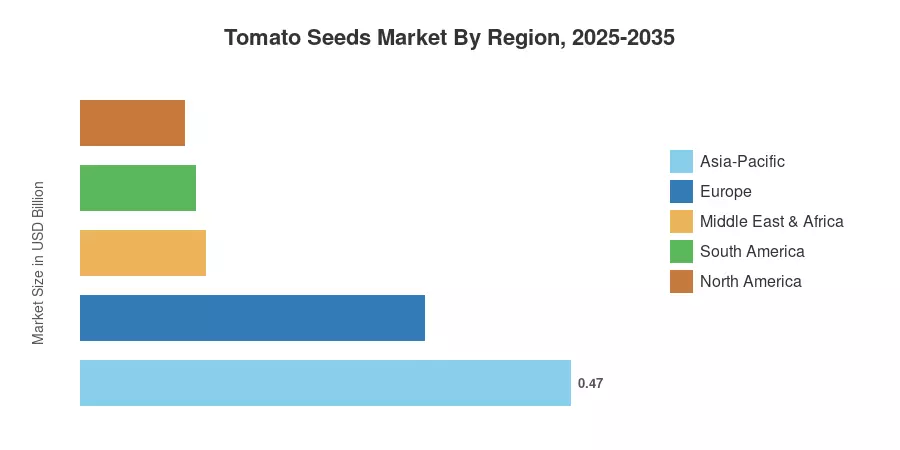
  • Europe contributed approximately USD 0.33 billion in 2025, anchored by Dutch and Spanish greenhouse corridors.


Market Size and Forecast (2021–2035)

Market Research Future's sizing methodology integrates bottom-up seed-volume estimates (metric tons sold × weighted average selling price per kilogram) with top-down revenue validation against public financial disclosures of leading breeders. Historical figures reflect actual trade and production data; forecast values apply the calibrated 6.5% CAGR for the Tomato Seeds Market while adjusting for anticipated acreage expansion, yield intensification, and pricing trends.
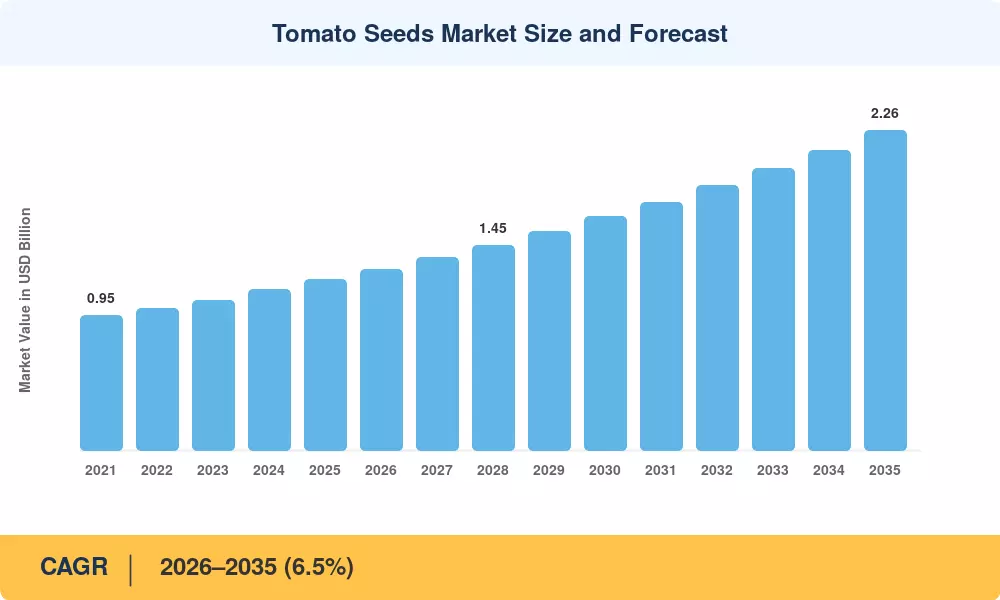
Tomato Seeds Market Size and Forecast
Our Impact
Enabled $4.3B Revenue Impact for Fortune 500 and Leading Multinationals
Partnering with 2000+ Global Organizations Each Year
30K+ Citations by Top-Tier Firms in the Industry

Driver Impact Analysis

Driver ~% Impact on CAGR Geographic Relevance Impact Timeline
Protected-cultivation acreage expansion +1.4% North America, Europe Medium-term (2–4 yr)
Breeding innovation and R&D intensification +1.2% Global Long-term (≥4 yr)
Processing-tomato industrial demand +0.9% China, Middle East Short-term (≤2 yr)
Government horticulture subsidies +0.8% India, Africa Medium-term (2–4 yr)
Organic and specialty-tomato premiums +0.6% Europe, North America Medium-term (2–4 yr)
Urbanization and fresh-produce supply chains +0.5% Asia-Pacific, South America Long-term (≥4 yr)
Climate-resilient cultivar demand +0.4% Sub-Saharan Africa Long-term (≥4 yr)


Protected-Cultivation Acreage Expansion

Controlled-environment agriculture is rewriting the seed-demand equation. Canada added over 400 hectares of high-tech greenhouse capacity between 2022 and 2024, with Mastronardi Produce and AppHarvest among the leading investors [5]. These facilities require specialized seed genetics — compact plant architectures, high light-use efficiency, and extended harvest windows — that command price premiums three to five times above open-field hybrids. The Tomato Seeds Market benefits directly because every new hectare of greenhouse translates into higher per-hectare seed expenditure.

Breeding Innovation and R&D Intensification

Global vegetable-seed R&D spending exceeded USD 2.8 billion in 2024, with tomato programs representing roughly 18% of that total [3]. Marker-assisted backcrossing now enables breeders to stack five or more resistance genes into a single commercial line within four years. Syngenta's recent introgression of Tomato brown rugose fruit virus (ToBRFV) resistance into its flagship greenhouse portfolio illustrates how pipeline velocity drives market share gains in the Tomato Seeds Market [13].

Processing-Tomato Industrial Demand

China's Xinjiang province accounts for approximately 70% of the country's processing-tomato output, and local ketchup manufacturers have increased contract acreage by 12% year-on-year since 2022 [9]. High-Brix hybrids that deliver 5.5+ soluble solids are displacing older cultivars, lifting per-hectare seed costs and accelerating replacement cycles across the Tomato Seeds Market supply chain.

Government Horticulture Subsidies

India's Rashtriya Krishi Vikas Yojana allocated INR 9,000 crore (approximately USD 1.1 billion) for horticulture development in its 2024–2025 cycle, with seed-replacement programs forming a core pillar [2]. Similar subsidy structures in Kenya and Nigeria are driving first-time hybrid adoption among smallholder growers, expanding the addressable base for the Tomato Seeds Market in frontier regions.


Restraints Impact Analysis

Restraint ~% Impact on CAGR Geographic Relevance Impact Timeline
Smallholder seed-saving practices –0.7% South Asia, Africa Persistent
Royalty inflation and IP enforcement gaps –0.5% Global Medium-term (2–4 yr)
Regulatory divergence on gene-edited traits –0.4% EU, parts of Asia Long-term (≥4 yr)
Input-cost volatility (fertilizer, energy) –0.3% Global Short-term (≤2 yr)
Climate-event crop losses reducing replant demand –0.2% Mediterranean, South America Short-term (≤2 yr)


Smallholder Seed-Saving Practices

Across South Asia and sub-Saharan Africa, an estimated 40–50% of tomato growers still save seed from their previous harvest rather than purchasing fresh commercial stock each season [14]. This practice limits the effective addressable revenue for the Tomato Seeds Market and suppresses hybrid penetration rates in precisely the geographies where acreage growth is strongest. Extension programs and demonstration plots are gradually shifting behavior, but cultural inertia remains a significant drag on revenue capture.

Royalty Inflation and IP Enforcement Gaps

In other categories, growers are increasingly dependent on trait royalties and technological fees added to basic seed prices, raising per-unit costs by 8 to 12 percent per year [15]. But while this income model allows for reinvestment in R&D, it also creates cost barriers for mid-size producers and fosters grey-market seed sales in places with inadequate intellectual property enforcement. Pricing in the Tomato Seeds Market has to be carefully balanced – it has to support innovation but not price out the volume segment.


Regulatory Divergence on Gene-Edited Traits

The European Court of Justice’s 2018 finding that gene-edited crops are classified as GMOs continues to limit the commercialization of pipeline products in the EU, but more permissive frameworks are in place in the United States, Argentina and Japan [4]. This patchwork results in duplicative registration costs and delays global introductions of superior cultivars, fragmenting the Tomato Seeds Market along regulatory lines.


Tomato Seeds Market Opportunities

Vertical Farming and Indoor-Specific Genetics

The worldwide vertical farming industry is expected to grow above USD 20 billion by 2030, and tomato is one of the top three crops for indoor production [10]. The breeders that develop small and determinate hybrids tailored to the LED spectra and hydroponic substrates will open a premium-price niche in the Tomato Seeds Market.


Digital Seed Platforms and Subscription Models

Ag-tech entrepreneurs are creating direct-to-grower digital platforms that combine seed sales with agronomic advice, weather information and crop-insurance ties. These platforms are value-add to each transaction and create proprietary field performance data that feeds back into breeding pipelines, generating a flywheel effect for the Tomato Seeds Market.


African Hybrid Adoption Runway

Sub-Saharan Africa's hybrid tomato penetration sits below 25% in most countries, compared with 75%+ in East Asia [7]. Rising urbanization, supermarket-channel growth, and NGO-backed seed-distribution programs position the continent as the largest untapped volume opportunity for the Tomato Seeds Market through 2035.

Specialty and Snacking-Tomato Premiums

Consumer demand for cocktail, grape, and heirloom-style tomatoes in retail-ready packaging has grown at double-digit rates across Western Europe and North America. Breeders commanding proprietary genetics in this segment extract margins two to three times above commodity lines, representing a high-value growth pocket within the Tomato Seeds Market.

Climate-Adaptation Trait Monetization

Heat tolerance, salinity resistance, and water-use-efficiency traits are becoming table-stakes requirements in breeding programs targeting arid and semi-arid production zones [17]. Licensing these trait packages to regional seed companies offers an IP-monetization pathway that complements direct seed sales in the Tomato Seeds Market.


Tomato Seeds Market Future Outlook

Precision Breeding and Genome-Editing Commercialization

CRISPR-Cas9 and base-editing technologies are transitioning from research labs to commercial pipelines. By 2030, an estimated 15–20 gene-edited tomato traits could reach regulatory approval in at least one major market, accelerating the Tomato Seeds Market innovation cycle [4]. Japan's Sanatech Seed has already commercialized a GABA-enriched gene-edited tomato, setting a precedent for functional-food positioning of edited varieties.

Controlled-Environment Agriculture Scale-Up

Global greenhouse and vertical-farm acreage dedicated to tomatoes is projected to double between 2025 and 2032, reaching over 600,000 hectares [10]. This structural shift rebalances the Tomato Seeds Market toward premium-priced, indoor-optimized genetics that deliver predictable performance under artificial light and soilless substrates.

Sustainability Reporting and ESG-Linked Procurement

Retail chains in Europe and North America increasingly require seed suppliers to demonstrate carbon-footprint metrics, biodiversity stewardship, and fair-trade sourcing credentials. By 2028, ESG compliance is expected to become a procurement gatekeeper for the Tomato Seeds Market, favoring integrated breeders with traceable supply chains [19].

Data-Driven Agronomy and Seed-Performance Analytics

On-farm sensor networks, satellite imagery, and AI-powered phenotyping are generating unprecedented volumes of cultivar performance data. Seed companies that integrate these data streams into their breeding decisions and grower-advisory platforms will capture disproportionate value in the Tomato Seeds Market through 2035, transforming from input suppliers into agronomic-solutions providers [20].


Tomato Seeds Market Segmentation

By Breeding Technology

Segment Key Metric Primary Demand Driver
Hybrids 77.3% market share (2025) Yield uniformity, disease-resistance stacking
Open-Pollinated Varieties & Hybrid Derivatives 5.2% CAGR (2026–2035) Organic mandates, seed-saving traditions


Hybrids dominate the Tomato Seeds Market because commercial growers prioritize the yield consistency, disease packages, and shelf-life traits that only F1 genetics reliably deliver. Leading breeders such as Syngenta, Bayer, and Rijk Zwaan refresh their hybrid portfolios every two to three years, layering resistances against evolving pathogen pressures like ToBRFV and Tomato yellow leaf curl virus.

Open-pollinated varieties retain a loyal — and growing — niche driven by organic certification requirements that restrict hybrid usage in some schemes, as well as by seed-sovereignty initiatives in South Asia and Africa. The segment's growth trajectory in the Tomato Seeds Market is supported by NGO-funded breeding programs that improve open-pollinated lines for local adaptation.

By Cultivation Mechanism

Segment Key Metric Primary Demand Driver
Open Field 86.5% market share (2025) Dominant acreage base globally
Protected Cultivation 9.1% CAGR (2026–2035) CEA investment, year-round supply mandates


Open-field production remains the volume backbone of the Tomato Seeds Market, spanning millions of hectares from India's Deccan Plateau to California's Central Valley. Seed demand here is price-sensitive and driven by replacement cycles tied to seasonal planting calendars.

Protected cultivation — encompassing greenhouses, net houses, and vertical farms — represents the high-growth frontier. Per-hectare seed expenditure in a Dutch-style glasshouse runs five to eight times higher than in open-field systems, making this segment disproportionately valuable for the Tomato Seeds Market despite its smaller acreage footprint.


Regional Market Share Analysis

Region Key Metric Primary Investment Themes
North America 8.2% CAGR (2026–2035) CEA expansion, ToBRFV-resistant genetics
Europe 27.5% revenue share (2025) Greenhouse modernization, organic mandates
Asia-Pacific 38.7% revenue share (2025) Processing-tomato scale, hybrid penetration
South America USD 0.11 Billion (2025) Fresh-export corridors, breeding localization
Middle East & Africa 9.8% revenue share (2025) Subsidy-driven hybrid adoption, arid-zone breeding
Total USD 1.21 Billion (2025)

The Tomato Seeds Market exhibits a regionally diverse demand structure shaped by cultivation intensity, processing-industry scale, and subsidy frameworks.


North America

Country Key Metric Key Driver
United States 62.4% of regional share Indoor-farming seed demand
Canada 7.8% CAGR Greenhouse cluster build-out in Ontario and BC
Mexico USD 0.04 Billion Open-field fresh-export acreage


North America's Tomato Seeds Market growth is anchored in the rapid build-out of high-tech greenhouse and vertical-farming capacity. The United States Department of Agriculture's Specialty Crop Block Grant Program disbursed over USD 85 million in 2024, with tomato genetics research among its priority areas [5]. Canadian greenhouse acreage in Leamington, Ontario, alone exceeds 1,200 hectares, creating concentrated demand for climate-controlled, specific seed portfolios.

Europe

Country Key Metric Key Driver
Germany 5.6% CAGR Organic retail channel expansion
United Kingdom USD 0.03 Billion Glasshouse modernization
France 14.2% of regional share Integrated pest management mandates
Italy USD 0.04 Billion Processing-tomato industry (San Marzano belt)
Spain 19.8% of regional share Almería greenhouse corridor
Nordic Countries 6.1% CAGR LED-lit greenhouse adoption
Russia USD 0.02 Billion Import-substitution greenhouse programs
Rest of Europe 22.3% of regional share Turkey, Netherlands, Poland


Europe's Tomato Seeds Market is defined by its greenhouse-centric production model, with Spain and the Netherlands together accounting for over 30% of regional seed demand. The EU's Farm to Fork Strategy targets a 25% organic acreage share by 2030, pushing breeders to expand their portfolios of varieties suited to low-input systems [1].

Asia-Pacific

Country Key Metric Key Driver
China 34.5% of regional share Xinjiang processing-tomato belt
India 7.4% CAGR Government horticulture missions
Japan USD 0.04 Billion High-value greenhouse production
South Korea 5.9% CAGR Smart-farm investment incentives
ASEAN USD 0.05 Billion Smallholder hybrid transition
Rest of Asia-Pacific 12.1% of regional share Central Asia processing acreage


Asia-Pacific dominates the global Tomato Seeds Market by volume and value alike. China's processing-tomato industry — centered in Xinjiang and Inner Mongolia — consumed an estimated 3,800 metric tons of hybrid seed in 2024, while India's fresh-market segment spans over 800,000 hectares with hybrid penetration rising steadily above 60% [9][2].

South America

Country Key Metric Key Driver
Brazil 58.3% of regional share São Paulo greenhouse belt
Argentina 5.1% CAGR Processing-tomato contracts
Rest of South America USD 0.02 Billion Chile and Peru fresh exports


South America's Tomato Seeds Market is concentrated in Brazil, where greenhouse expansion around São Paulo and the Cerrado region is driving demand for heat-tolerant hybrids. Argentina's processing sector in Mendoza province is a secondary demand pillar, though currency instability periodically disrupts procurement cycles [16].

Middle East & Africa

Country Key Metric Key Driver
Saudi Arabia 6.8% CAGR NEOM and Vision 2030 agri-tech
UAE USD 0.01 Billion Controlled-environment imports
South Africa 28.4% of regional share Commercial fresh-market farms
Egypt 7.2% CAGR Nile Delta greenhouse expansion
Rest of MEA USD 0.04 Billion East and West African hybrid uptake


The Middle East & Africa Tomato Seeds Market is bifurcated between capital-intensive Gulf-state greenhouse projects and volume-driven smallholder markets in sub-Saharan Africa. Saudi Arabia's NEOM agricultural zone and Egypt's 1.5 Million Feddan Project are channeling investment into high-performance seed genetics, while Kenya and Nigeria show hybrid adoption rates climbing 5–8% annually [7][18].


Tomato Seeds Market By Region, 2025-2035

Competitive Benchmarking

The Tomato Seeds Market exhibits medium concentration, with the top five players collectively holding an estimated 45–52% of global revenue. The Herfindahl-Hirschman Index sits in the moderately concentrated range, reflecting a landscape where multinational breeders compete alongside strong regional specialists. Strategic differentiation hinges on pipeline depth, disease-resistance portfolios, and geographic distribution networks.

Company Est. Revenue Share Range Key Offerings Strategic Positioning
Bayer CropScience (De Ruiter) ~10–14% Greenhouse and open-field hybrids Vertically integrated breeding and crop-protection
Syngenta Group (Vegetable Seeds) ~9–13% Fresh and processing tomato lines Global pipeline with ToBRFV resistance leads
BASF (Nunhems) ~7–10% Processing and specialty hybrids Strong Brix-focused genetics for ketchup industry
Limagrain (HM.CLAUSE) ~6–9% Mediterranean-adapted fresh varieties Regional depth in Southern Europe and North Africa
Sakata Seed Corporation ~4–7% Determinate fresh-market hybrids Asia-Pacific and Americas distribution strength
East-West Seed ~3–6% Tropical-adapted hybrids Smallholder-focused distribution in SE Asia, Africa
Rijk Zwaan ~4–7% High-wire greenhouse genetics Premium segment leadership in Northern Europe
Enza Zaden ~3–5% Specialty and snacking-tomato lines Niche positioning in cocktail and cluster types
Takii & Co. ~2–4% Heat-tolerant open-field hybrids Japan and South Asia focus
Namdhari Seeds ~1–3% India-adapted fresh hybrids Domestic leadership in Karnataka and Maharashtra


Recent News & Developments

  • Syngenta Group (March 2025): Launched its first commercially available ToBRFV high-resistance tomato hybrid for European greenhouse growers, addressing the sector's most pressing phytosanitary challenge [13].


  • Rijk Zwaan (February 2024): Introduced a suite of compact indeterminate varieties designed specifically for vertical-farm production under LED lighting [10].
  • European Commission (July 2023): Published a legislative proposal to exempt certain gene-edited crops from GMO regulations, potentially opening the EU Tomato Seeds Market to edited cultivars by 2027 [4].


Tomato Seeds Market Report Scope

Parameter Detail
Market Scope Global Tomato Seeds Market covering commercial seed sales by value (USD Billion) and volume (metric tons)
Study Period 2021–2035
CAGR Window 2026–2035 (6.5%)
Base Year 2025
Market Size — 2025 USD 1.21 Billion
Market Size — 2035 USD 2.26 Billion
Fastest Growing Segment Protected Cultivation (9.1% CAGR)
Companies Profiled 10 (Bayer, Syngenta, BASF, Limagrain, Sakata, East-West Seed, Rijk Zwaan, Enza Zaden, Takii, Namdhari)
Valuation Currency USD Billion


FAQs

How do tomato seed royalty structures differ between fresh-market and processing segments?
Fresh-market hybrids typically carry per-seed royalties 30–40% higher than processing lines because retail growers value proprietary flavor and shelf-life traits. Processing contracts often bundle royalties into volume-based licensing agreements [15].
What phytosanitary testing should buyers require before importing tomato seed lots?
Buyers should require PCR-based testing for ToBRFV, Pepino mosaic virus, and bacterial canker at minimum. Accredited third-party seed-health laboratories such as Naktuinbouw or ISTA-certified facilities provide internationally recognized certificates [13].
How does seed priming technology affect germination economics for greenhouse growers?
Primed seed delivers 15–20% faster and more uniform germination, reducing nursery cycle time and plug-tray waste. The added cost per seed is typically offset within a single cropping cycle through higher transplant survival rates [10].
What contractual risks should growers evaluate when sourcing from a single breeding company?
Sole-source reliance exposes growers to supply disruptions, abrupt variety discontinuations, and concentrated pricing leverage. Diversifying across two or three breeders mitigates these risks while maintaining access to competitive genetics [15].
How are blockchain-based traceability systems emerging in the Tomato Seeds Market?
Several multinational breeders are piloting blockchain platforms to track seed lots from breeding station to farm gate. These systems reduce counterfeiting and enable instant recall management, though adoption remains limited to premium channels [20].
What cost differential exists between coated and uncoated tomato seed for precision planters?
Coated seed typically costs 25–35% more per unit than uncoated equivalents but reduces singulation errors in mechanical and robotic planters. For greenhouse plug-tray operations, the coating premium pays back through labor savings [3].
How do public-breeding programs interact with commercial Tomato Seeds Market dynamics?
Public programs at institutions like AVRDC release improved lines that regional companies commercialize under license. This pipeline supplements private R&D and expands genetic diversity available to the broader market [14].    
Author
Author
Author Profile
Snehal Singh LinkedIn
Manager - Research
High acumen in analyzing complex macro & micro markets with more than 6 years of work experience in the field of market research. By implementing her analytical skills in forecasting and estimation into market research reports, she has expertise in Packaging, Construction, and Equipment domains. She handles a team size of 20-25 resources and ensures smooth running of the projects, associated marketing activities, and client servicing.
Share::
Request Free Sample

Research Approach


Secondary Research

The secondary research process involved comprehensive analysis of agricultural databases, peer-reviewed agronomy journals, seed technology publications, and authoritative food and agriculture organizations. Key sources included the US Department of Agriculture (USDA), Food and Agriculture Organization of the United Nations (FAO), International Union for the Protection of New Varieties of Plants (UPOV), Organisation for Economic Co-operation and Development (OECD) Seed Schemes, International Seed Federation (ISF), American Seed Trade Association (ASTA), Euroseeds (European Seed Association), National Agricultural Statistics Service (NASS), EU Eurostat Agricultural Database, International Institute of Tropical Agriculture (IITA), World Vegetable Center (AVRDC), and national ministry of agriculture reports from key producing countries. These sources were used to collect cultivation statistics, varietal registration data, crop yield studies, trade flow analysis, and market landscape data for hybrid tomato seeds, open-pollinated varieties, heirloom seeds, and treated seed technologies.


Primary Research

To gather both qualitative and quantitative information, the primary research process involved interviewing players from both the supply and demand sides. CEOs, VPs of R&D, chief breeders, managers of regulatory affairs, and commercial directors from seed distributors, biotech companies, and tomato seed manufacturers made up the supply side. In terms of demand-side sources, we have home gardening stores, agricultural cooperative procurement leaders, contract seed growers, greenhouse facility managers, and commercial farm operators. Market segmentation by seed type and cultivation method was confirmed through primary research, which also verified trait development pipelines and uncovered insights into distribution channel dynamics, pricing strategies for organic and conventional seeds, adoption patterns of determinate and indeterminate varieties, and more.

Primary Respondent Breakdown:

By Designation: C-level Primaries (32%), Director Level (30%), Others (38%)

By Region: North America (32%), Europe (30%), Asia-Pacific (28%), Rest of World (10%)


Market Size Estimation

Global market valuation was derived through revenue mapping and cultivation volume analysis. The methodology included:

Identification of 50+ key seed houses across North America, Europe, Asia-Pacific, and Latin America

Product mapping across hybrid seeds, open-pollinated varieties, heirloom seeds, and treated/untreated seed categories

Analysis of reported and modeled annual revenues specific to tomato seed portfolios

Coverage of seed manufacturers representing 75-80% of global market share in 2024

Extrapolation using bottom-up (hectarage planted × seed rate × ASP by country) and top-down (manufacturer revenue validation) approaches to derive segment-specific valuations for field cultivation, greenhouse, and container gardening applications

Share::
Request Free Sample
Download Free Sample

Kindly complete the form below to receive a free sample of this Report

Share::
Request Free Sample
Download PDF ×

We do not share your information with anyone. However, we may send you emails based on your report interest from time to time. You may contact us at any time to opt-out.
















