×
Request Free Sample ×

Kindly complete the form below to receive a free sample of this Report

* Please use a valid business email

Leading companies partner with us for data-driven Insights

clients tt-cursor
Hero Background

Torque Sensor Market

ID: MRFR/SEM/5587-CR
188 Pages
Ankit Gupta
February 2024

Torque Sensor Market Research Report Information By Type (Dynamic Torque Sensor, Joint Torque Sensor, 6 axis force/torque sensor, 4 Axis force/torque sensor, Static Torque Sensor), By Configuration (Wired Torque Sensor, and Wireless Torque Sensor), By Technology (Surface Acoustic Wave, Magnetoelastic, Optical, and Strain Gauge), By Application (Robotics, Engines, Automotive safety system, Assembly welding, Aircraft flight control, Medical devices, and Others), By Industry Vertical (Automotive, Industrial, Test & Measurement, Aerospace &... read more

Share:
Download PDF ×

We do not share your information with anyone. However, we may send you emails based on your report interest from time to time. You may contact us at any time to opt-out.

Torque Sensor Market Infographic
Purchase Options

Torque Sensor Market Summary

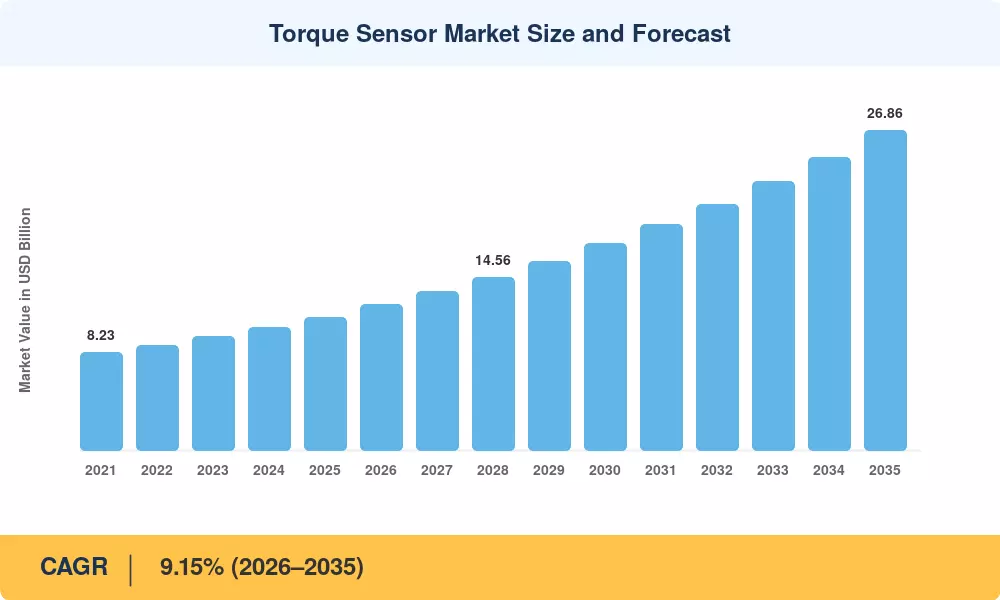
As per MRFR analysis, the Torque Sensor Market Size was estimated at 12384.31 USD Million in 2024. The Torque Sensor industry is projected to grow from 13423.6 USD Million in 2025 to 30049.86 USD Million by 2035, exhibiting a compound annual growth rate (CAGR) of 8.39 during the forecast period 2025 - 2035.

Key Market Trends & Highlights

The Torque Sensor Market is poised for substantial growth driven by technological advancements and increasing demand across various sectors.

  • The integration of smart technologies is transforming the torque sensor landscape, enhancing precision and functionality.
  • North America remains the largest market for torque sensors, while Asia-Pacific is emerging as the fastest-growing region.
  • The automotive segment continues to dominate the market, with industrial machinery showing rapid growth due to automation trends.
  • Rising demand for electric vehicles and advancements in industrial automation are key drivers propelling market expansion.

Market Size & Forecast

2024 Market Size 12384.31 (USD Million)
2035 Market Size 30049.86 (USD Million)
CAGR (2025 - 2035) 8.39%

Major Players

Honeywell (US), TE Connectivity (US), Kistler (CH), FUTEK Advanced Sensor Technology, Inc. (US), Hitec Products AS (NO), MTS Systems Corporation (US), Siemens (DE), Meggitt (GB), Mahr GmbH (DE)

Torque Sensor Market Trends

The Torque Sensor Market is currently experiencing a dynamic evolution, driven by advancements in technology and increasing demand across various industries. The integration of smart technologies and the Internet of Things (IoT) is reshaping the landscape, enabling more precise measurements and enhanced data analytics. This shift appears to be fostering greater efficiency and reliability in applications ranging from automotive to aerospace. Furthermore, the growing emphasis on automation and robotics is likely to propel the adoption of torque sensors, as these devices play a crucial role in ensuring optimal performance and safety in machinery. In addition, the Torque Sensor Market seems to be influenced by the rising focus on sustainability and energy efficiency. Industries are increasingly seeking solutions that not only improve operational performance but also minimize environmental impact. This trend may lead to innovations in sensor design and functionality, catering to the evolving needs of end-users. As the market continues to expand, it is essential for stakeholders to remain vigilant and adaptable, responding to emerging challenges and opportunities that may arise in this competitive landscape.

Integration of Smart Technologies

The incorporation of smart technologies into the Torque Sensor Market is transforming traditional measurement methods. Enhanced connectivity and data processing capabilities are enabling real-time monitoring and analysis, which could lead to improved operational efficiency.

Focus on Automation and Robotics

The increasing reliance on automation and robotics across various sectors is driving demand for torque sensors. These devices are essential for ensuring the accuracy and safety of automated systems, suggesting a robust growth trajectory for the market.

Sustainability and Energy Efficiency

A growing emphasis on sustainability is influencing the Torque Sensor Market. Companies are seeking solutions that not only enhance performance but also reduce environmental impact, potentially leading to innovative sensor designs and applications.

Torque Sensor Market Drivers

Technological Advancements

Technological advancements in sensor technology are driving the Global Torque Sensor Market Industry forward. Innovations such as wireless torque sensors and advanced data analytics capabilities enhance the functionality and application of torque sensors across various industries. These advancements enable real-time monitoring and data collection, facilitating better decision-making and operational efficiency. As industries increasingly rely on data-driven insights, the demand for sophisticated torque sensors is likely to grow. This trend may contribute to a compound annual growth rate (CAGR) of 6.5% from 2025 to 2035, indicating a robust future for the market.

Growth of Electric Vehicles

The Global Torque Sensor Market Industry is significantly influenced by the rapid growth of electric vehicles (EVs). As the automotive industry shifts towards electrification, the demand for torque sensors in EVs is expected to rise. These sensors are essential for monitoring the performance of electric motors and ensuring efficient power delivery. The increasing adoption of EVs, supported by government incentives and consumer preferences for sustainable transportation, is likely to contribute to the market's expansion. By 2035, the market could potentially reach 5000 USD Million, reflecting the critical role of torque sensors in the evolving automotive landscape.

Rising Demand for Automation

The Global Torque Sensor Market Industry experiences a surge in demand driven by the increasing automation across various sectors. Industries such as automotive, aerospace, and manufacturing are increasingly adopting automated systems to enhance efficiency and precision. This trend is expected to propel the market, as torque sensors play a crucial role in monitoring and controlling torque in automated machinery. With the market projected to reach 2500 USD Million in 2024, the integration of torque sensors in automated processes is likely to be a key driver of growth, ensuring optimal performance and safety in operations.

Expansion in Industrial Applications

The Global Torque Sensor Market Industry is witnessing expansion due to the growing applications of torque sensors in various industrial sectors. Industries such as oil and gas, aerospace, and manufacturing are increasingly utilizing torque sensors for monitoring and controlling torque in critical operations. This diversification of applications is likely to drive market growth, as companies seek to enhance operational efficiency and reduce downtime. The integration of torque sensors in diverse industrial processes may contribute to the overall market growth, aligning with the projected increase in market value to 2500 USD Million by 2024.

Increasing Focus on Safety Standards

The Global Torque Sensor Market Industry is also propelled by the increasing focus on safety standards across industries. Regulatory bodies are implementing stringent safety regulations that necessitate the use of torque sensors in machinery and equipment. These sensors help ensure that torque levels remain within safe limits, thereby preventing equipment failures and accidents. As industries prioritize safety and compliance, the demand for torque sensors is expected to rise. This trend aligns with the broader movement towards enhancing workplace safety and operational reliability, further solidifying the market's growth trajectory.

Market Segment Insights

By Application: Automotive (Largest) vs. Industrial Machinery (Fastest-Growing)

The Torque Sensor Market is significantly influenced by its diverse applications across various industries. In the automotive sector, torque sensors maintain their position as the largest segment, driven by the increasing demand for advanced driver-assistance systems and electric vehicle technologies. Meanwhile, the industrial machinery segment is rapidly gaining traction, fueled by the growth in automation and the need for precise torque measurements in manufacturing processes. The growth trends reveal a strong demand for torque sensors in industrial machinery as industries push towards enhanced efficiency and productivity. Moreover, the rapid development in robotics and automation technology contributes positively to the demand, positioning industrial machinery as a key driver for the Torque Sensor Market in the coming years.

Automotive: Dominant vs. Robotics: Emerging

The automotive sector remains the dominant application for torque sensors, owing to its critical role in improving vehicle safety and performance. As automotive manufacturers increasingly adopt electric and hybrid technologies, the need for precision torque measurement has surged. Conversely, the robotics sector is emerging as a vital application for torque sensors, driven by advancements in automation and smart technologies. Robotics applications necessitate high precision and reliability in torque measurement for optimal performance, leading to increased investments and innovations in this area. Thus, as the automotive industry focuses on sustainability, the robotics segment continues to grow rapidly, demonstrating significant potential in the Torque Sensor Market.

By End Use: Automotive Manufacturing (Largest) vs. Energy Generation (Fastest-Growing)

In the Torque Sensor Market, the end-use segment is diversified, with automotive manufacturing holding the largest market share. This segment benefits from the increasing demand for electric and hybrid vehicles, leading to enhanced performance and safety. Energy generation is also notable, capturing attention as the fastest-growing segment due to the global transition to renewable energy sources, necessitating precision sensor technologies to optimize performance and efficiency. The growth in automotive manufacturing is primarily driven by the rise in vehicle production and technological advancements in sensor systems. Meanwhile, the energy generation sector is experiencing transformation with the influx of green technologies. Factors such as government regulations promoting cleaner energy and investments in smart grid technology are propelling demand for torque sensors in this sector, presenting significant opportunities for innovation and expansion.

Automotive Manufacturing: Dominant vs. Research and Development: Emerging

The automotive manufacturing sector stands out as the dominant player in the Torque Sensor Market, leveraging heavy investment in research and development (R&D) as well as advancements in automotive technology. This sector requires high-performance sensors to ensure vehicle efficiency and safety, with torque sensors being critical for various applications including electronic stability control and traction control systems. On the other hand, the research and development segment is emerging, driven by the need for innovative solutions and enhanced testing methodologies in product development. R&D activities are crucial for advancements in sensor accuracy and reliability, paving the way for new applications in various industries. Together, these segments reflect the dynamic landscape of the Torque Sensor Market, showcasing the balance between established and emerging demands.

By Technology: Strain Gauge (Largest) vs. Magnetostrictive (Fastest-Growing)

In the Torque Sensor Market, technology segmentation reveals that Strain Gauge sensors are the largest segment, commanding a significant share due to their widespread adoption across various industries. Their reliability and accuracy make them the go-to choice for many applications, thus securing their top position. Following closely, Magnetostrictive sensors are gaining momentum, attributed to their precise sensing capabilities and innovative designs that cater to evolving industrial needs. The growth of this segment is particularly pronounced in sectors emphasizing automation and electronic precision. As industries increasingly rely on high-performance torque measurement solutions, the demand for advanced sensor technologies continues to grow. Drivers such as the ongoing push for automation, the need for more sophisticated data analysis, and technological advancements in sensor designs are accelerating the adoption of both Strain Gauge and Magnetostrictive sensors. The shift towards more intelligent and connected systems is expected to further foster market growth, with Magnetostrictive sensors poised to capture an expanding portion of the market due to their unique advantages and applications in newer technologies.

Magnetostrictive (Dominant) vs. Optical (Emerging)

In the Torque Sensor Market, Magnetostrictive sensors have emerged as a dominant technology due to their superior accuracy and robustness in harsh environments, making them ideal for various industrial applications. They utilize magnetic fields to measure torque with high precision and can operate across extensive measurement ranges. Their ability to be integrated into more complex systems is driving increased adoption. On the other hand, Optical torque sensors are considered an emerging technology, known for their ability to provide non-contact measurements and high sensitivity. While still in the early stages of market penetration, their unique advantages position them as a compelling choice for applications requiring lightweight and compact sensor solutions in advanced machinery. The contrasting characteristics and applications of these two technologies illustrate the dynamic landscape of the Torque Sensor Market.

By Type: Static Torque Sensor (Largest) vs. Dynamic Torque Sensor (Fastest-Growing)

The torque sensor market is characterized by four prominent types: Static, Dynamic, Rotary, and Reaction Torque Sensors. Among these, Static Torque Sensors hold the largest market share due to their widespread use in various industrial applications where consistent torque measurement is essential. Dynamic Torque Sensors, however, are rapidly gaining traction, driven by advancements in technology and increasing demand for real-time torque monitoring in dynamic environments, making them the fastest-growing segment in this market.

Torque Sensor Types: Static (Dominant) vs. Dynamic (Emerging)

Static Torque Sensors are foundational in many industries, providing accurate and reliable torque measurements for applications such as static testing, quality assurance, and assembly processes. They are characterized by their straightforward design and robust performance, making them a preferred choice for manufacturers looking for simplicity without compromising on precision. On the other hand, Dynamic Torque Sensors are emerging as key players in the market, thanks to innovations that allow for real-time torque measurements during moving operations. Their responsiveness to changes in torque makes them essential for modern applications in automotive and aerospace sectors, where performance and precision are critical. As industries trend towards automation and real-time data analytics, the demand for Dynamic Torque Sensors continues to grow, signaling a shift in market dynamics.

By Mounting Type: Flange Mount (Largest) vs. Inline Mount (Fastest-Growing)

In the Torque Sensor Market, the mounting type segment showcases Flange Mount as the largest segment, driven by its wide applications in industrial machinery and automotive systems. It captures a significant market share, appealing for its reliability and ease of installation. Alongside, Inline Mount is emerging as the fastest-growing segment, favored for its compact design and suitability in tight spaces, which is increasingly valued in modern engineering solutions. The market dynamics indicate a growing inclination towards Inline Mount due to evolving technology and the miniaturization of devices. Factors like higher efficiency requirements and advancements in manufacturing processes are propelling this growth. As industries push for more compact and efficient torque measurement solutions, Inline Mount's adoption is set to surge, complementing the stable demand for Flange Mount. However, both segments demonstrate a resilient presence in the industry, catering to diverse operational needs.

Flange Mount (Dominant) vs. Inline Mount (Emerging)

Flange Mount torque sensors have established themselves as the dominant type in the Torque Sensor Market due to their robust design and versatility across various applications, particularly in heavy machinery and automotive industries. These sensors are known for their ability to conduct high torque measurements accurately, making them indispensable in systems where reliability is paramount. On the other hand, Inline Mount sensors are gaining traction as an emerging option. Their design allows for easy integration into existing systems, especially where space constraints are a concern. Inline Mount torque sensors offer distinct advantages such as reduced installation time and enhanced flexibility, which are crucial in modern manufacturing environments. As technology advances, the demand for both mounting types continues to evolve, highlighting a dynamic market landscape.

Get more detailed insights about Torque Sensor Market

Regional Insights

North America : Market Leader in Torque Sensors

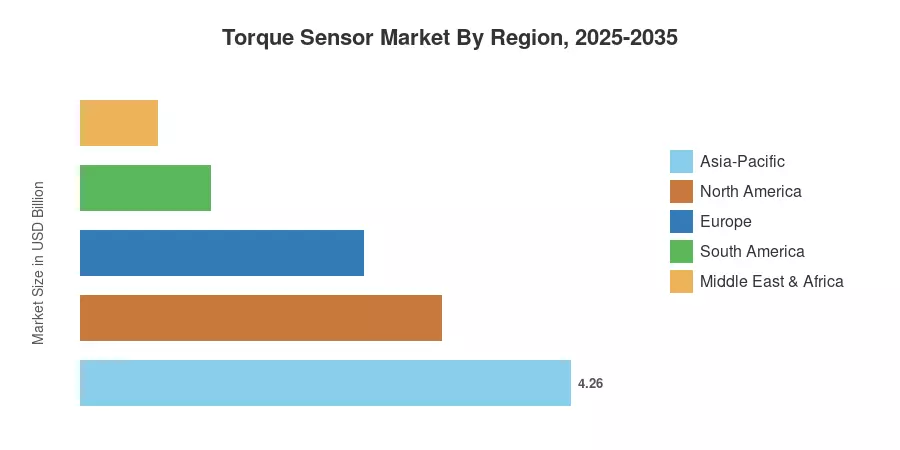
North America is poised to maintain its leadership in the torque sensor market, holding a significant share of 6200.0. The region's growth is driven by increasing demand in automotive and aerospace sectors, alongside stringent regulations promoting safety and efficiency. Technological advancements and the integration of IoT in manufacturing processes further enhance market dynamics, making it a hub for innovation. The competitive landscape is characterized by key players such as Honeywell, TE Connectivity, and MTS Systems Corporation, which are investing heavily in R&D to develop advanced torque sensing solutions. The U.S. remains the largest market, supported by a robust manufacturing base and a focus on automation. This environment fosters collaboration among industry leaders, ensuring continuous growth and adaptation to market needs.

Europe : Emerging Market with Growth Potential

Europe's torque sensor market is projected to grow significantly, with a market size of 3500.0. The region benefits from a strong automotive industry and increasing investments in renewable energy, driving demand for precision measurement tools. Regulatory frameworks aimed at enhancing safety and efficiency in manufacturing processes are also key growth catalysts, ensuring compliance and innovation in the sector. Leading countries such as Germany and the UK are at the forefront, hosting major players like Siemens and Mahr GmbH. The competitive landscape is marked by a focus on sustainability and technological advancements, with companies investing in smart sensor technologies. This positions Europe as a vital player in The Torque Sensor, fostering collaboration and innovation across industries.

Asia-Pacific : Rapid Growth in Emerging Economies

The Asia-Pacific region is experiencing rapid growth in the torque sensor market, with a market size of 2000.0. This growth is fueled by increasing industrialization, particularly in countries like China and India, where manufacturing and automotive sectors are expanding. The demand for high-precision sensors is rising, driven by the need for improved efficiency and safety in production processes, supported by favorable government policies. China stands out as a leading market, with significant investments in technology and infrastructure. The competitive landscape includes key players like Kistler and FUTEK Advanced Sensor Technology, Inc., who are focusing on innovation and local partnerships to enhance their market presence. This dynamic environment is expected to continue driving growth in the region, making it a focal point for torque sensor advancements.

Middle East and Africa : Emerging Market with Unique Challenges

The Middle East and Africa region is gradually emerging in the torque sensor market, with a market size of 684.31. Growth is primarily driven by increasing industrial activities and investments in infrastructure development. The region's unique challenges, including economic fluctuations and regulatory hurdles, necessitate innovative solutions to meet market demands and enhance operational efficiency. Countries like South Africa and the UAE are leading the way, with a growing focus on automation and smart technologies. The competitive landscape is evolving, with both local and international players seeking to establish a foothold. This presents opportunities for growth, particularly in sectors such as oil and gas, where precision measurement is critical for operational success.

Key Players and Competitive Insights

The Torque Sensor Market is currently characterized by a dynamic competitive landscape, driven by technological advancements and increasing demand across various sectors, including automotive, aerospace, and industrial automation. Key players such as Honeywell (US), TE Connectivity (US), and Kistler (CH) are strategically positioned to leverage innovation and expand their market presence. Honeywell (US) focuses on enhancing its product portfolio through continuous research and development, while TE Connectivity (US) emphasizes partnerships to integrate advanced sensor technologies into its offerings. Kistler (CH) appears to be concentrating on regional expansion, particularly in emerging markets, which collectively shapes a competitive environment that is increasingly reliant on technological differentiation and strategic collaborations.

In terms of business tactics, companies are localizing manufacturing to reduce costs and optimize supply chains, which is particularly relevant in the context of global trade dynamics. The Torque Sensor Market is moderately fragmented, with several key players exerting influence over their respective segments. This fragmentation allows for niche players to thrive, while larger corporations dominate through economies of scale and extensive distribution networks.

In November 2025, Honeywell (US) announced a strategic partnership with a leading automotive manufacturer to develop next-generation torque sensors aimed at enhancing vehicle performance and safety. This collaboration is significant as it not only reinforces Honeywell's commitment to innovation but also positions the company to capitalize on the growing trend of electric and autonomous vehicles, where precision sensing is paramount.

In October 2025, TE Connectivity (US) launched a new line of torque sensors designed for industrial applications, featuring enhanced durability and accuracy. This product introduction is crucial as it addresses the increasing demand for reliable sensors in harsh environments, thereby expanding TE Connectivity's market share and reinforcing its reputation as a leader in sensor technology.

In September 2025, Kistler (CH) expanded its operations in Asia by establishing a new manufacturing facility in India. This move is strategically important as it not only reduces production costs but also allows Kistler to better serve the rapidly growing Asian market, which is becoming a focal point for torque sensor applications in various industries.

As of December 2025, the Torque Sensor Market is witnessing trends such as digitalization, sustainability, and the integration of AI technologies. These trends are reshaping competitive dynamics, with companies increasingly forming strategic alliances to enhance their technological capabilities. The shift from price-based competition to a focus on innovation and supply chain reliability is evident, suggesting that future competitive differentiation will hinge on the ability to deliver advanced, reliable, and sustainable solutions.

Key Companies in the Torque Sensor Market market include

Industry Developments

    • In October 2023- Kistler launched a new KVC 621 SE compact automated testing system for mass-produced stamped parts. This system's width is 600 millimetres and fast throughput times. By this system, 4,000 parts passes through each minute.
    • In August 2023- ATI Industrial Automation announced that its Multi-Axis Force/Torque Sensors are compatible with FANUC's robots and Force Control Software. ATI said its F/T Sensors “provide accurate measurements of forces and torques in multiple axes, enabling robots to have a sense of touch and allowing them to perform delicate tasks with dexterity.”
    • In March 2023- Sensor Technology Ltd launched a new TorqSense SGR 510/520 torque sensor low-capacity model of Sensor Technologies. The SGR 510/520 torque sensors cover capacities from 0.2Nm to 1Nm and offer a range from 0.2Nm to 13,000Nm.
    • In October 2022- Infineon launched a new sensor kit XENSIV connected (CSK), a new IoT sensors platform for prototyping and development of customized IoT solutions. The CSK is based on a combination of XENSIV sensors with power-efficient and high-performance processing for advanced use cases based on the PSoC 6 microcontroller, this reduces the time-to-market of IoT products.

Future Outlook

Torque Sensor Market Future Outlook

The Torque Sensor Market is projected to grow at an 8.39% CAGR from 2024 to 2035, driven by advancements in automation, automotive innovations, and increasing demand for precision measurement.

New opportunities lie in:

  • Integration of torque sensors in electric vehicle powertrains
  • Development of wireless torque monitoring systems for industrial applications
  • Expansion into emerging markets with tailored torque solutions

By 2035, the Torque Sensor Market is expected to achieve substantial growth, reflecting evolving technological demands.

Market Segmentation

Torque Sensor Market Type Outlook

  • Static Torque Sensor
  • Dynamic Torque Sensor
  • Rotary Torque Sensor
  • Reaction Torque Sensor

Torque Sensor Market End Use Outlook

  • Automotive Manufacturing
  • Energy Generation
  • Manufacturing and Processing
  • Research and Development
  • Medical Devices

Torque Sensor Market Technology Outlook

  • Strain Gauge
  • Magnetostrictive
  • Optical
  • Hall Effect
  • Capacitive

Torque Sensor Market Application Outlook

  • Automotive
  • Industrial Machinery
  • Aerospace
  • Robotics
  • Consumer Electronics

Torque Sensor Market Mounting Type Outlook

  • Flange Mount
  • Inline Mount
  • Shaft Mount
  • Bracket Mount

Report Scope

MARKET SIZE 202412384.31(USD Million)
MARKET SIZE 202513423.6(USD Million)
MARKET SIZE 203530049.86(USD Million)
COMPOUND ANNUAL GROWTH RATE (CAGR)8.39% (2024 - 2035)
REPORT COVERAGERevenue Forecast, Competitive Landscape, Growth Factors, and Trends
BASE YEAR2024
Market Forecast Period2025 - 2035
Historical Data2019 - 2024
Market Forecast UnitsUSD Million
Key Companies ProfiledHoneywell (US), TE Connectivity (US), Kistler (CH), FUTEK Advanced Sensor Technology, Inc. (US), Hitec Products AS (NO), MTS Systems Corporation (US), Siemens (DE), Meggitt (GB), Mahr GmbH (DE)
Segments CoveredApplication, End Use, Technology, Type, Mounting Type
Key Market OpportunitiesIntegration of advanced wireless technologies enhances efficiency in the Torque Sensor Market.
Key Market DynamicsRising demand for precision measurement drives innovation and competition in the torque sensor market.
Countries CoveredNorth America, Europe, APAC, South America, MEA

Market Highlights

Author
Ankit Gupta
Senior Research Analyst

Ankit Gupta is an analyst in market research industry in ICT and SEMI industry. With post-graduation in "Telecom and Marketing Management" and graduation in "Electronics and Telecommunication" vertical he is well versed with recent development in ICT industry as a whole. Having worked on more than 150+ reports including consultation for fortune 500 companies such as Microsoft and Rio Tinto in identifying solutions with respect to business problems his opinions are inclined towards mixture of technical and managerial aspects.

Leave a Comment

FAQs

How much is the Torque Sensor Market?

The Torque Sensor Market size is expected to be valued at USD 12384.31 billion in 2024.

What is the growth rate of the Torque Sensor Market?

The global market is projected to grow at a CAGR of 8.39% during the forecast period, 2025 to 2035.

Which region held the largest market share in the Torque Sensor Market?

Asia Pacific had the largest share of the global market.

Who are the key players in the Torque Sensor Market?

The key players in the market are ABB, Honeywell International Inc, Infineon Technologies AG , Crane Electronics , Applied Measurements Ltd, Kistler Group , Norbar Torque Tools, Sensor Technology Ltd, and HBK

Which Type led the Torque Sensor Market?

The Dynamic Torque Sensor category dominated the market in 2022.

Download Free Sample

Kindly complete the form below to receive a free sample of this Report

Compare Licence

×
Features License Type
Single User Multiuser License Enterprise User
Price $4,950 $5,950 $7,250
Maximum User Access Limit 1 User Upto 10 Users Unrestricted Access Throughout the Organization
Free Customization
Direct Access to Analyst
Deliverable Format
Platform Access
Discount on Next Purchase 10% 15% 15%
Printable Versions