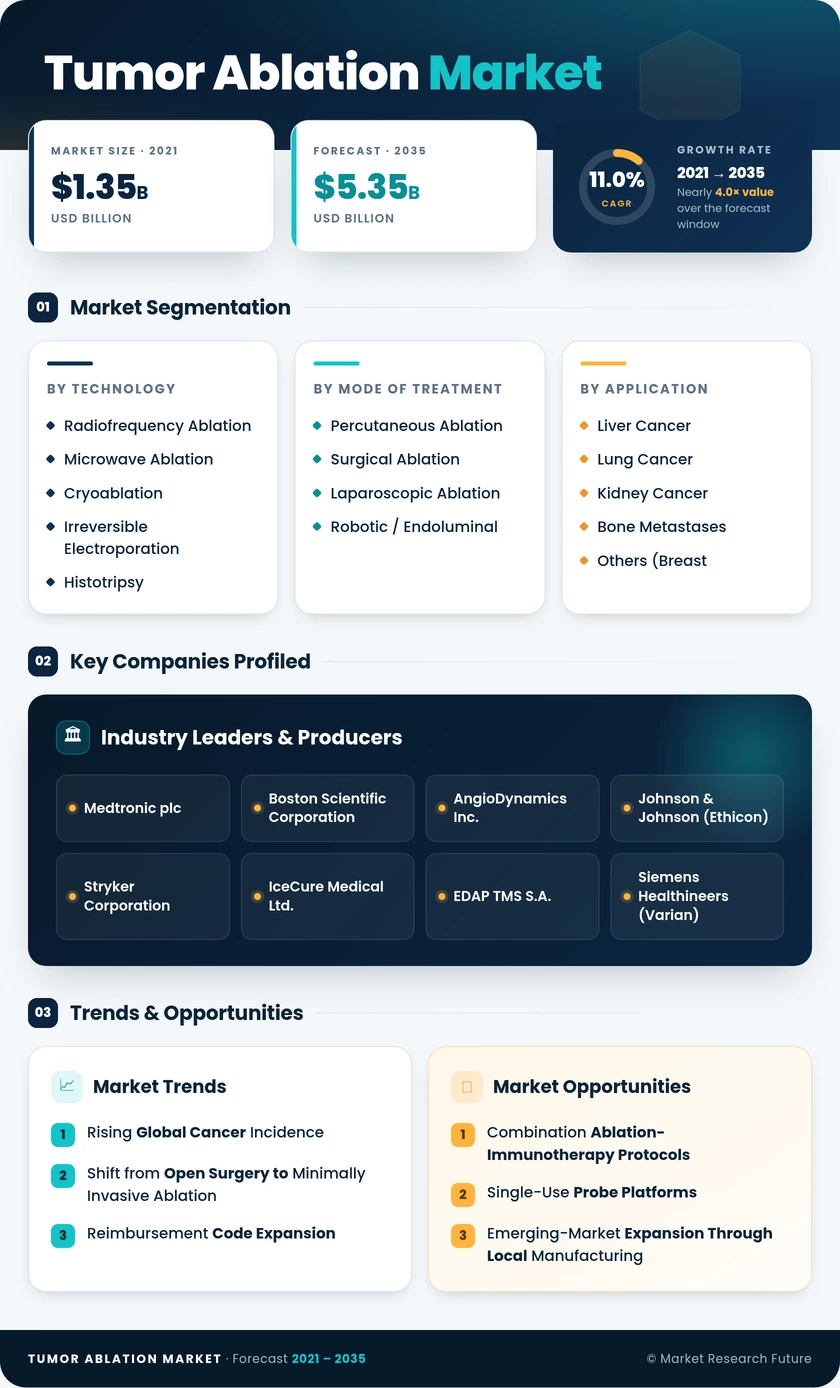
Segmentation Quick Reference
| Dimension | Sub-Segments | Dominant Segment | Fastest Growing Segment |
| Technology | Radiofrequency Ablation, Microwave Ablation, Cryoablation, Irreversible Electroporation, Histotripsy, Others (HIFU, Laser) | Radiofrequency Ablation | Histotripsy |
| Mode of Treatment | Percutaneous Ablation, Surgical Ablation, Laparoscopic Ablation, Robotic / Endoluminal | Percutaneous Ablation | Robotic / Endoluminal |
| Application | Liver Cancer, Lung Cancer, Kidney Cancer, Bone Metastases, Others (Breast, Thyroid, Prostate) | Liver Cancer | Lung Cancer |
| End User | Hospitals, Cancer Centers, Ambulatory Surgery Centers, Others (Academic, Research) | Hospitals | Cancer Centers |
| Region | North America, Europe, Asia-Pacific, South America, Middle East & Africa | North America | Asia-Pacific |
Market Segmentation Overview
By Technology
| Sub-Segment | Key Trend |
| Radiofrequency Ablation | Mature installed base; incremental innovation in electrode design and multi-tine geometry |
| Microwave Ablation | Rapid procedure times and larger ablation zones driving hospital switching |
| Cryoablation | Growing renal and musculoskeletal indications; ice-ball visibility advantage |
| Irreversible Electroporation | Non-thermal mechanism enables treatment near critical vascular structures |
| Histotripsy | First mechanical (non-thermal) modality; FDA-cleared for liver tumors in 2023 |
| Others (HIFU, Laser) | Niche applications in prostate, brain, and thyroid focal therapy |
Technology selection in the Tumor Ablation Market is increasingly driven by lesion location and proximity to heat-sensitive structures, pushing clinicians toward multi-modality suites that house both thermal and non-thermal options.
By Mode of Treatment
| Sub-Segment | Key Trend |
| Percutaneous Ablation | Outpatient-compatible; CT- and ultrasound-guided workflows dominate |
| Surgical Ablation | Combined with open hepatectomy for multifocal disease |
| Laparoscopic Ablation | Preferred when percutaneous window is anatomically limited |
| Robotic / Endoluminal | Emerging navigation-robotic platforms for lung and bile-duct access |
Percutaneous approaches remain the backbone of the Tumor Ablation Market, but robotic and endoluminal systems are redefining access for anatomically challenging lesions in the lung periphery and pancreatic head.
By Application
| Sub-Segment | Key Trend |
| Liver Cancer | Guideline-endorsed first-line therapy for early-stage HCC |
| Lung Cancer | Navigation bronchoscopy enabling transbronchial ablation |
| Kidney Cancer | Nephron-sparing alternative to partial nephrectomy |
| Bone Metastases | Pain palliation and structural stabilization |
| Others (Breast, Thyroid, Prostate) | Active clinical trial pipelines; regulatory clearances pending |
Liver cancer accounts for the largest share of the Tumor Ablation Market due to well-established treatment algorithms and high global HCC incidence linked to hepatitis B and C prevalence.
By End User
| Sub-Segment | Key Trend |
| Hospitals | Anchor purchasers with multidisciplinary oncology teams |
| Cancer Centers | Payer-credentialed interventional oncology suites driving volume |
| Ambulatory Surgery Centers | Emerging channel for same-day percutaneous procedures |
| Others (Academic, Research) | Grant-funded device evaluation and clinical trial sites |
Hospitals hold the majority of the Tumor Ablation Market by end-user share, but cancer centers are closing the gap as dedicated interventional oncology programs gain traction with commercial payers and attract higher referral volumes.