Tungsten Carbide Market

Key Players: Sandvik AB, Kennametal Inc, Xiamen Tungsten Co., Ceratizit Group, Hyperion Materials & Technologies, Mitsubishi Materials Corp., Sumitomo Electric Industries, China Minmetals Corp.

Tungsten Carbide Market

Tungsten Carbide Market Research Report Information By Application (Cemented Carbide, Coatings, Alloys, and Others), By End User (Aerospace and Defence, Automotive, Mining, and Construction, Electronics, and Others) And By Region (North America, Europe, Asia-Pacific, And Rest Of The World) –Market Forecast Till 2035
ID: MRFR/CnM/3945-HCR
137 Pages
Chitranshi Jaiswal
Last Updated: June 07, 2026
 

Tungsten Carbide Market Summary

The Tungsten Carbide Market reached an estimated USD 16.38 billion in 2025, with forecasts projecting a rise from USD 17.14 billion in 2026 to USD 25.84 billion by 2035, expanding at a CAGR of 4.62% over the forecast period. Two catalysts anchor this trajectory: first, surging capital expenditure in global mining and construction — the World Bank estimates USD 2.4 trillion in annual infrastructure spending across developing economies through 2030 [2] — and second, defense rearmament budgets that now exceed USD 2.2 trillion globally, fueling demand for high-hardness materials in munitions, armor-piercing inserts, and precision cutting equipment [3].

A technology shift is changing the way cemented carbide materials reach end customers. Legacy single-layer coated inserts are being replaced with multilayer PVD and CVD stacks, doubling or tripling tool life and halving per-unit consumption costs, even while raw carbide powder volumes increase. The 2024 Critical Minerals Strategy of the U.S. Department of Defense planned USD 439 million for local tungsten processing, reflecting a wider strategy to de-risk supply chains away from Chinese concentrate [4]. At the same time, South Korea’s Ministry of Trade established a KRW 1.2 trillion subsidy scheme for the manufacturing of wear-resistant materials and strong metal alloys through 2028 [5].

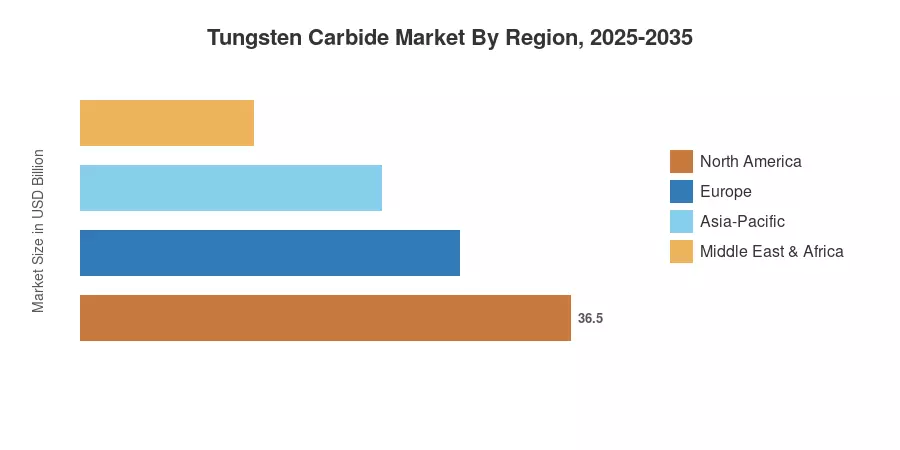
Asia-Pacific dominates around 55% of the Tungsten Carbide Market, with China alone producing more than 60% of the worldwide tungsten concentrate output. North America is the second-largest region with a share of about 19%. This growth is due to the high demand for industrial carbide tools in automotive and aerospace machining. Europe is not far behind, increasing at a competitive rate since the EU Critical Raw Materials Act demands recycling objectives for cutting tool materials exceeding 25% by 2030 [6]. In the next decade, enterprises that balance price-competitive sourcing of carbide powder with tariff-insulated, controlled supply corridors will be rewarded.

Key Report Takeaways

• By Product Type

  • Cemented carbide held approximately 64% of the Tungsten Carbide Market in 2025, reinforced by its dominance in metal machining tools and mining applications
  • Coatings are on track for the fastest growth at a 5.78% CAGR through 2035, as multilayer PVD/CVD technologies extend insert longevity for precision cutting equipment
  • Alloys contributed USD 2.14 billion in 2025, anchored in wear-resistant materials demand from oil and gas drilling

• By Application

  • Mining and construction led the Tungsten Carbide Market with a 35% share in 2025, driven by global infrastructure capex and rising hard rock extraction volumes
  • Aerospace and defense will expand at a 5.61% CAGR through 2035, supported by rearmament spending and next-generation turbine blade tooling
  • Automotive applications generated approximately USD 3.28 billion in 2025, tied to EV powertrain machining and lightweight component finishing

• By Geography

  • Asia-Pacific dominated the Tungsten Carbide Market at roughly 55% share in 2025, led by China's integrated mine-to-insert supply chain
  • North America is projected to grow at a 4.48% CAGR through 2035, spurred by reshoring initiatives and defense procurement of mining tool materials
  • Europe accounted for USD 2.79 billion in 2025, with Germany and the Nordics driving demand for high hardness materials in automotive tooling


Tungsten Carbide Market Size and Forecast (2021–2035)

Market Research Future (MRFR) market sizing involves conducting primary interviews with carbide powder manufacturers, cutting tool OEMs, and distributors of mining equipment in 22 countries. The data obtained from these interviews is validated through trade flow databases (UN Comtrade, USGS Mineral Commodity Summaries) and public financial statements of the top 15 cemented carbide material producers. Historical statistics (2021-2024) are actuals; 2025 is the base-year estimate; 2026-2035 are forecast estimates at a calibrated CAGR of 4.62%.
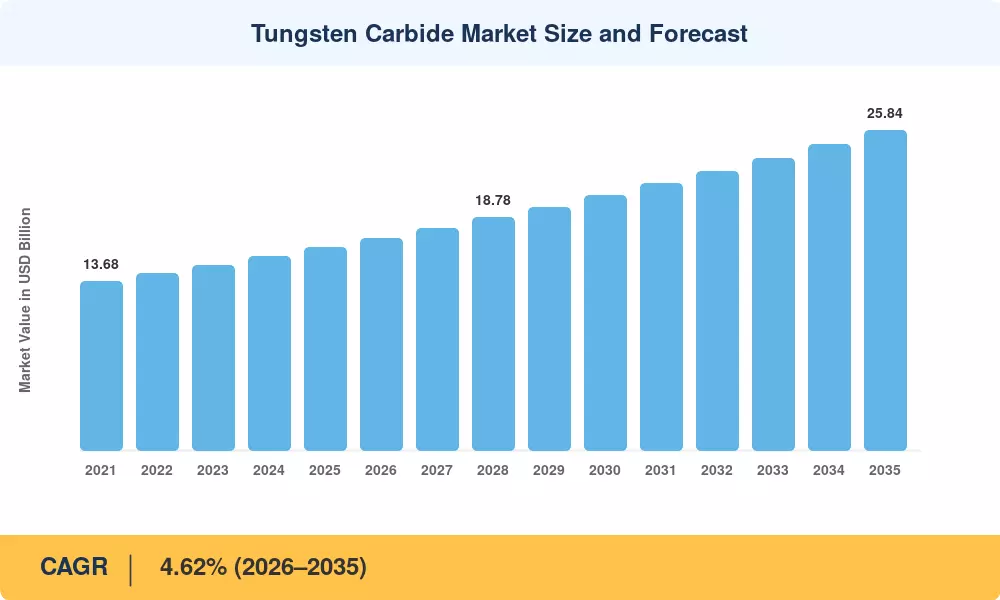
Tungsten Carbide Market Size and Forecast
Our Impact
Enabled $4.3B Revenue Impact for Fortune 500 and Leading Multinationals
Partnering with 2000+ Global Organizations Each Year
30K+ Citations by Top-Tier Firms in the Industry
 

Driver Impact Analysis

Driver ~% Impact on CAGR Geographic Relevance Impact Timeline
Mining & infrastructure capex boom ~22% Asia-Pacific, South America Short-term (≤2 yr)
Defense rearmament & munitions demand ~18% North America, Europe Medium-term (2–4 yr)
Multilayer coating technology adoption ~16% Global Medium-term (2–4 yr)
Supply-chain diversification from China ~14% North America, Europe, South Korea Long-term (≥4 yr)
EV powertrain & battery component machining ~12% Asia-Pacific, Europe Medium-term (2–4 yr)
Recycling mandates for cemented carbide ~10% Europe, North America Long-term (≥4 yr)
Electronics miniaturization & micro-tooling ~8% Asia-Pacific Long-term (≥4 yr)


Mining and Infrastructure Capital Expenditure

Global mining capital expenditure remains robust, driven by the energy transition and the demand for critical minerals such as lithium, copper, and iron ore. These sectors continue to be primary consumers of industrial cemented carbide tools. In the infrastructure sector, development agencies, including the World Bank, maintain significant funding portfolios for regional transport networks in Sub-Saharan Africa and South Asia. These projects inherently require high-performance, wear-resistant drill bits and tunnel-boring components. Furthermore, government initiatives, such as Australia’s Critical Minerals Strategy, have committed significant capital—including the AUD 6.2 billion Critical Minerals Facility—to de-risk and accelerate new mine development, directly supporting the demand for carbide powder and specialized tooling.


Defense Rearmament and Munitions Production

Global defense spending has reached record levels, with NATO members significantly increasing budget allocations to bolster security and replenish munitions stockpiles. The defense industrial base relies heavily on high-hardness materials; tungsten carbide remains a critical component for armor-piercing projectiles, shaped-charge liners, and high-velocity kinetic energy penetrators, which require Vickers hardness exceeding 1,500 HV. To meet this demand, the U.S. Department of Defense has initiated large-scale, multi-year procurement contracts for 155mm artillery shells. These production ramp-ups create a consistent, high-volume requirement for tungsten-based components throughout the ammunition manufacturing supply chain.


Multilayer Coating Technology Adoption

PVD and CVD coating stacks — particularly TiAlN/AlCrN multilayers — now extend cutting tool life by 2.5–3× compared to uncoated cemented carbide materials, according to a 2024 Fraunhofer Institute study [8]. This longevity improvement paradoxically boosts carbide powder demand: end users run inserts at higher speeds and feeds, generating more heat and accelerating substrate wear, which increases replacement frequency for precision cutting equipment. The coatings segment alone is projected to add USD 1.9 billion in incremental revenue to the Tungsten Carbide Market by 2035.

EV Powertrain and Battery Component Machining

Electric vehicle production is expected to reach 40 million units annually by 2030, per BloombergNEF [9]. Each EV requires machining of motor housings, battery enclosure plates, and gear components using metal machining tools tipped with cemented carbide. Tesla's Gigafactory Texas expansion, for instance, tripled its carbide insert procurement in 2024, reflecting the industry-wide shift toward harder, more heat-resistant cutting tool materials for aluminum and high-silicon alloy finishing.


Restraints Impact Analysis

Restraint ~% Drag on CAGR Geographic Relevance Impact Timeline
China's export controls on tungsten concentrate ~−20% Global (supply-side) Short-term (≤2 yr)
Raw material price volatility ~−18% Global Short-term (≤2 yr)
Substitution by ceramic and cermet alternatives ~−15% Europe, Japan Medium-term (2–4 yr)
Environmental regulations on mining operations ~−12% Europe, North America Long-term (≥4 yr)
High recycling process costs ~−10% Global Medium-term (2–4 yr)


China Export Controls and Supply Concentration

China produces roughly 82% of the world's tungsten concentrate, and Beijing's 2024 decision to add tungsten to its export-control list created immediate supply uncertainty [12]. Spot APT (ammonium paratungstate) prices surged 28% within three months, compressing margins for downstream carbide powder converters in Europe and North America. Western buyers are diversifying toward Vietnam, Rwanda, and Bolivia, but new mines take 5–7 years from exploration to production, leaving the Tungsten Carbide Market vulnerable to short-term supply shocks.

Substitution by Ceramic and Cermet Alternatives

Silicon nitride and TiCN-based cermets now capture approximately 8% of the high-speed finishing segment formerly dominated by cemented carbide materials [13]. Japanese toolmakers such as Kyocera and NTK Cutting Tools have commercialized ceramic inserts capable of machining hardened steel at cutting speeds exceeding 800 m/min — twice the practical limit for conventional hard metal alloys. While ceramics remain brittle in interrupted cuts, their inroads in continuous turning reduce demand for traditional industrial carbide tools in specific automotive and bearing applications.

Environmental Compliance Costs

Tungsten mining operations face tightening environmental scrutiny. The EU's Industrial Emissions Directive revision (2024) requires tailings management upgrades costing an estimated EUR 120–180 million across European mining operations by 2028 [6]. These costs propagate through the value chain, raising the floor price for ethically sourced carbide powder and wear-resistant materials, and disproportionately burdening smaller producers who lack the scale to absorb compliance expenditures.


Tungsten Carbide Market Opportunities

Recycled Tungsten Carbide as a Strategic Feedstock

Recycled scrap currently represents a vital portion of global tungsten supply, helping to stabilize the market against price volatility in virgin ore. As the industry moves toward a circular economy, regulatory pressure in regions like the EU is expected to push for higher recycled content minimums in cemented carbide products. Companies that invest in advanced recycling technologies—such as zinc-process or cold-stream recovery—can secure a cost-advantaged feedstock, often at a significant discount to virgin powder, while simultaneously improving their ESG profile and supply chain resilience.


Additive Manufacturing of Carbide Components

The additive manufacturing (AM) of tungsten carbide composites is advancing, enabling the production of custom geometries that traditional sintering cannot replicate. While major industry players have recently realigned their portfolios to focus on core industrial machining, the use of binder-jet and laser powder-bed fusion to create complex, wear-resistant components remains a high-value niche for sectors like oil and gas, medical devices, and high-precision flow control.


India's Mining and Infrastructure Expansion

India's National Infrastructure Pipeline targets USD 1.4 trillion in investment through 2030, with coal, iron ore, and limestone mining driving demand for mining tool materials at a projected 7.2% annual growth rate [2]. The country's domestic tungsten reserves in Rajasthan and Andhra Pradesh remain underdeveloped, presenting a greenfield opportunity for integrated mine-to-tool operations that bypass Chinese supply chains

Micro-Tooling for Electronics and Semiconductor Fabrication

PCB micro-drilling and wafer dicing require carbide drill bits with diameters below 0.1 mm, a niche where high-hardness materials command premium pricing of USD 8–15 per bit [10]. Global semiconductor capex exceeded USD 180 billion in 2024, and each new fab requires approximately 50,000 micro-carbide tools during equipment installation alone. This segment offers margin insulation from commodity carbide powder price swings

Data-Driven Tool Life Optimization Platforms

IoT-enabled monitoring platforms, such as Sandvik’s CoroPlus and Kennametal’s NOVO, are transforming the machining sector by providing real-time data on tool wear and performance. By moving from reactive to predictive maintenance, these platforms help manufacturers maximize throughput and reduce downtime. While these systems serve as productivity-enhancing layers rather than standalone SaaS businesses, they are increasingly vital for OEMs to differentiate their physical tool offerings and foster long-term customer loyalty in a competitive market.


Tungsten Carbide Market Future Outlook

AI-Driven Machining and Autonomous Tool Management

Machine learning algorithms integrated into CNC platforms are increasingly capable of autonomously adjusting feed rates, spindle speeds, and coolant flow based on real-time vibration and acoustic emission data. By optimizing these parameters, manufacturers are significantly reducing scrap and extending tool life. Platforms like Sandvik's CoroPlus and Kennametal's NOVO already enable predictive wear modeling that can improve tool life by approximately 10–12%, signaling a shift toward digital monetization and productivity-based service models within the tungsten carbide market.


Circular Economy and Closed-Loop Recycling

Recycling is becoming a cornerstone of supply chain resilience for critical minerals. While the IEA projects that scaling recycling could reduce the need for new mine development by up to 25–40% by mid-century, industry-specific adoption of the "zinc process" (PRZ) remains the most effective method for high-yield recovery, capturing upwards of 95% of tungsten carbide from spent tools. As primary concentrate prices remain volatile, companies that invest in this secondary-source infrastructure are effectively securing a structural cost advantage and meeting growing ESG requirements.


Electrification Supercycle and New Machining Demands

The global EV production ramp — expected to reach 55 million units annually by 2035, per BloombergNEF [9] — introduces machining challenges that favor high-hardness materials. EV motor housings require tight-tolerance boring in high-silicon aluminum alloys that rapidly abrade conventional tooling. Battery cell casing stamping dies increasingly use cemented carbide materials for longer die life, expanding the Tungsten Carbide Market into segments previously served by tool steel.

ESG Reporting and Responsible Sourcing Mandates

The EU Corporate Sustainability Due Diligence Directive (CS3D) is set to reshape supply chain transparency. As the directive begins its phased application starting in 2027, large OEMs will be required to conduct due diligence on their "chain of activities," including the identification and mitigation of environmental and human rights impacts at the mine-of-origin. This regulatory environment is likely to segment the tungsten carbide market into premium, certified-traceable tiers and commodity-grade products, incentivizing vertical integration and formalizing supply chain accountability.


Tungsten Carbide Market Segmentation

By Product Type

Segment Key Metric Primary Demand Driver
Cemented Carbide ~64% share (2025) Mining drill bits, metal machining tools, die tooling
Coatings 5.78% CAGR (2026–2035) Multilayer PVD/CVD insert life extension
Alloys USD 2.14 Billion (2025) Oil & gas drilling; wear-resistant components


Cemented carbide dominates the Tungsten Carbide Market because its combination of hardness (1,300–1,800 HV) and fracture toughness makes it irreplaceable for interrupted-cut machining, rock drilling, and stamping dies. The segment's growth tracks closely with global industrial production indices — every percentage point of GDP growth in manufacturing-heavy economies translates to roughly 0.8% additional cemented carbide materials consumption. Grades optimized for metal machining tools (ISO K, M, and P classifications) account for over half of cemented carbide volume. At the same time, mining-grade formulations with coarser grain sizes command higher per-kilogram pricing.

Coatings represent the Tungsten Carbide Market's fastest-evolving segment. Multilayer TiAlN/AlCrN stacks deposited via high-power impulse magnetron sputtering (HiPIMS) now achieve coating hardness exceeding 3,500 HV, enabling cutting tool materials to operate at temperatures above 1,100°C without delamination [8]. This performance leap is converting uncoated insert users across automotive and aerospace machining, driving the coatings segment's premium CAGR. The technology also extends to wear-resistant materials for stamping and forming operations where surface friction reduction directly translates to productivity gains.

By Application

Segment Key Metric Primary Demand Driver
Mining & Construction ~35% share (2025) Global infrastructure capex; hard-rock extraction
Automotive USD 3.28 Billion (2025) EV powertrain machining; precision component finishing
Aerospace & Defense 5.61% CAGR (2026–2035) Rearmament; turbine blade machining; MRO demand
Electronics ~9% share (2025) PCB micro-drilling; semiconductor wafer dicing
Others 3.84% CAGR (2026–2035) Medical devices; oil & gas; woodworking


Mining and construction remain the Tungsten Carbide Market's largest application, with every major commodity cycle directly translating into drill-bit and cutting-head consumption. A single large-scale copper mine consumes 50–80 metric tons of industrial carbide tools annually, and with over 400 new mining projects in the global pipeline through 2030, this segment's volume floor is well-established [2]. Construction applications — particularly tunnel boring and road milling — add incremental demand for wear-resistant materials optimized for abrasion resistance.

Aerospace and defense is the fastest-growing application for the Tungsten Carbide Market, powered by NATO rearmament and commercial aviation's post-pandemic recovery. Nickel-superalloy turbine blade machining demands cutting tool materials capable of sustained operation at cutting temperatures above 900°C, a requirement that only cemented carbide materials and advanced ceramic composites can meet [3]. Defense munitions production further accelerates demand for hard metal alloys in projectile cores and rotating bands.


Regional Market Share Analysis

Region Key Metric Primary Investment Themes
Asia-Pacific ~55% market share (2025) Integrated production; EV machining; construction capex
North America 4.48% CAGR (2026–2035) Defense reshoring; automotive tooling; recycling
Europe USD 2.79 Billion (2025) CRM Act compliance; automotive OEM demand; recycling mandates
South America ~4.8% market share (2025) Mining expansion; copper/lithium projects
Middle East & Africa 3.92% CAGR (2026–2035) Oil & gas drilling; infrastructure development
Total USD 16.38 Billion (2025)

The Tungsten Carbide Market exhibits pronounced regional asymmetry: Asia-Pacific's integrated mine-to-tool ecosystem coexists with North America's defense-driven demand and Europe's recycling-forward regulatory landscape. Each region brings distinct supply-chain dynamics for cemented carbide materials, industrial carbide tools, and wear-resistant materials.


North America

Country Key Metric Key Driver
United States ~72% of regional share Defense procurement; automotive machining
Canada 4.31% CAGR Mining capex in Ontario and British Columbia
Mexico USD 0.38 Billion (2025) Nearshoring of automotive manufacturing


The United States dominates North America's Tungsten Carbide Market, with the Department of Defense's USD 439 million Critical Minerals Strategy accelerating domestic carbide powder processing [4]. Kennametal and Hyperion Materials & Technologies operate major sintering facilities in Pennsylvania and Ohio, supplying industrial carbide tools for both defense and commercial machining. Canada's mining sector contributes to the growing demand for wear-resistant materials. At the same time, Mexico benefits from nearshoring trends as automotive OEMs relocate precision cutting equipment supply chains closer to U.S. assembly plants.

Europe

Country Key Metric Key Driver
Germany ~28% of regional share Automotive tooling; Industrie 4.0 integration
United Kingdom 4.19% CAGR Aerospace MRO and defense modernization
France USD 0.36 Billion (2025) Nuclear energy component machining
Italy ~11% of regional share Precision machinery and stone cutting
Spain 3.85% CAGR Renewable energy infrastructure
Nordic Countries USD 0.29 Billion (2025) Mining operations in Sweden and Finland
Russia ~8% of regional share Domestic mineral processing
Rest of Europe 3.72% CAGR Diversified industrial demand


Germany's automotive sector — home to BMW, Volkswagen, and Mercedes-Benz — consumes cemented carbide materials at scale for engine block boring, transmission gear cutting, and EV battery housing machining. The EU Critical Raw Materials Act mandates 25% recycled tungsten content by 2030, creating a competitive advantage for European recyclers of hard metal alloys and establishing the continent as the global leader in circular carbide powder economics [6].

Asia-Pacific

Country Key Metric Key Driver
China ~62% of regional share Integrated mine-to-insert production
India 5.38% CAGR Infrastructure Pipeline and mining expansion
Japan USD 1.22 Billion (2025) Precision tooling; electronics micro-drilling
South Korea ~8% of regional share Semiconductor and display manufacturing
ASEAN 5.14% CAGR Construction boom and manufacturing FDI
Rest of Asia-Pacific USD 0.41 Billion (2025) Emerging mining operations


China's vertically integrated tungsten industry — from Jiangxi province mines to Xiamen Tungsten's downstream products — gives the Tungsten Carbide Market in Asia-Pacific an unmatched cost advantage in carbide powder production. India's rapid infrastructure build-out is the region's fastest-growing demand source for mining tool materials, while Japan's specialty toolmakers command premium pricing in metal machining tools for semiconductor and automotive applications [10].

South America

Country Key Metric Key Driver
Brazil ~58% of regional share Iron ore and gold mining
Argentina 4.67% CAGR Lithium mining in Salta province
Rest of South America USD 0.14 Billion (2025) Copper mining in Chile and Peru


Brazil's mining sector is the continent's primary consumer of industrial carbide tools, with Vale and Anglo American driving demand for drill bits and wear-resistant materials across iron ore operations in Minas Gerais. Argentina's lithium triangle developments are creating new demand for cutting tool materials in hard-rock extraction.

Middle East & Africa

Country Key Metric Key Driver
Saudi Arabia ~31% of regional share Vision 2030 construction projects
UAE 4.05% CAGR Oil & gas downstream tooling
South Africa USD 0.19 Billion (2025) Platinum and chrome mining
Egypt ~12% of regional share Infrastructure modernization
Rest of MEA 3.68% CAGR Diversified mining and construction


Saudi Arabia's Vision 2030 infrastructure program, including NEOM and the Riyadh Metro expansion, is driving demand for high-hardness materials in tunnel boring and rock drilling. South Africa's platinum group metals mining sustains steady consumption of cemented carbide materials for underground drilling operations. At the same time, the broader MEA region benefits from expanding oil and gas exploration that requires precision cutting equipment for downhole tool manufacturing.


Tungsten Carbide Market By Region, 2025-2035
 

Competitive Benchmarking

The Tungsten Carbide Market has a medium level of market concentration with the top five companies having a revenue share of 38-44% globally (2018). The Herfindahl-Hirschman Index (HHI) of 800-1,100 indicates a competitive oligopoly of vertically integrated mining-to-tooling companies and specialist cutting tool OEMs. Competition is emerging in two areas: cost leadership in the production of carbide powder (a space controlled by Chinese companies) and technology differentiation in precision cutting equipment (driven by European and Japanese companies).

Company Est. Revenue Share Range Key Offerings for the Tungsten Carbide Market Strategic Positioning
Sandvik AB ~8–11% Cemented carbide inserts; CoroPlus digital platform; mining tool materials Technology leader in metal machining tools and digital wear monitoring
Kennametal Inc ~6–9% Industrial carbide tools; wear-resistant components; infrastructure tooling Broad portfolio across mining, aerospace, and automotive
Xiamen Tungsten Co. ~7–10% Carbide powder; cemented carbide rods; hard metal alloys Cost-leadership through vertical integration from Chinese mines
Ceratizit Group ~5–8% Cutting tool materials, wear parts, wood and stone machining European leader in high-performance cemented carbide materials
Hyperion Materials & Technologies ~4–7% Hard metal alloys; wear-resistant materials; carbide blanks Specialist in industrial wear solutions and precision tooling
Mitsubishi Materials Corp. ~4–6% Precision cutting equipment; coated inserts; electronics tooling Japanese technology differentiation in high-precision applications
Sumitomo Electric Industries ~3–5% CBN and carbide cutting tool materials; mining bits Diversified conglomerate with strong R&D in advanced coatings
China Minmetals Corp. ~4–7% Tungsten concentrate; carbide powder; cemented carbide products State-backed upstream dominance and export control influence
Wolfram Bergbau und Hütten ~2–4% APT processing; recycled carbide powder; high-purity tungsten European recycling leader with a closed-loop feedstock model
IMC Group (Iscar/TaeguTec) ~3–5% Metal machining tools; grooving and turning inserts; milling systems Aggressive pricing strategy with broad geographic distribution


Recent News & Developments

  • Sandvik AB (October 2024): Launched next-generation GC4425 coated insert series with 40% longer tool life in stainless steel machining, expanding its precision cutting equipment portfolio. [8]


  • European Commission (March 2024): Published final text of the Critical Raw Materials Act, mandating 25% recycled content for industrial carbide tools sold in the EU by 2030. [6]


  • China Ministry of Commerce (September 2023): Added tungsten to the export-control list under dual-use goods regulations, creating supply uncertainty for non-Chinese carbide powder buyers. [12]


Tungsten Carbide Market Report Scope

Parameter Detail
Market Scope Global Tungsten Carbide Market — cemented carbide, coatings, alloys across mining, automotive, aerospace, electronics, and other applications
Study Period 2021–2035
CAGR 4.62% (2026–2035)
Base Year Market Size USD 16.38 Billion (2025)
Forecast Year Market Size USD 25.84 Billion (2035)
Fastest Growing Segment Coatings (by product type); Aerospace & Defense (by application)
Companies Profiled Sandvik, Kennametal, Xiamen Tungsten, Ceratizit, Hyperion, Mitsubishi Materials, Sumitomo Electric, China Minmetals, Wolfram Bergbau, IMC Group
Valuation Currency USD Billion


FAQs

What grain size of cemented carbide is best for interrupted-cut milling operations?

Medium-grain grades (1.0–2.5 μm WC) offer the optimal balance of toughness and edge stability for interrupted cuts, resisting micro-chipping at entry and exit points. Coarser grades sacrifice edge sharpness, while sub-micron grades fracture under impact loading [18].

How do PVD and CVD coating methods differ in cost-per-insert economics?

CVD coatings cost 20–30% more per insert but deliver 2–3× longer life in continuous turning, making them cheaper per machined part. PVD suits sharp-edge geometries and lower-temperature applications where CVD's residual tensile stresses would cause premature failure [8].

What supply-chain due diligence steps should procurement teams take for tungsten sourcing?

Buyers should require OECD-aligned chain-of-custody certificates, verify smelter participation in the Responsible Minerals Initiative, and audit sub-tier suppliers annually. Conflict-affected sourcing carries reputational and regulatory risk under EU CS3D [22].

How does the Tungsten Carbide Market compare to the broader advanced ceramics market in margin structure?

Cemented carbide products typically carry gross margins of 28–35%, below advanced ceramics' 35–45% range, due to higher raw material costs. However, carbide's larger addressable volume and aftermarket replacement cycle generate superior absolute profit pools.

What role does cobalt binder content play in the Tungsten Carbide Market pricing structure?

Cobalt constitutes 6–15% of cemented carbide by weight and 18–25% of raw material cost. LME cobalt price swings directly affect insert pricing — a USD 10,000/ton cobalt increase raises finished tool costs by approximately 4–6% [7].

Can 3D-printed tungsten carbide components replace conventionally sintered parts in the Tungsten Carbide Market?

Binder-jet printing achieves 97–99% theoretical density, suitable for wear parts and nozzles but not yet for high-impact tooling. Cost parity with conventional sintering is expected by 2029 as throughput scales [15].

How do tariff structures affect the Tungsten Carbide Market for cross-border tool buyers?

U.S. Section 301 tariffs add 25% to Chinese-origin carbide imports, while EU anti-dumping duties range 17–36%. Buyers mitigate exposure by sourcing from South Korea or Israel, where FTA provisions eliminate or reduce duties [4].


Author
Author
Author Profile
Chitranshi Jaiswal LinkedIn
Team Lead - Research
Chitranshi is a Team Leader in the Chemicals & Materials (CnM) and Energy & Power (EnP) domains, with 6+ years of experience in market research. She leads and mentors teams to deliver cross-domain projects that equip clients with actionable insights and growth strategies. She is skilled in market estimation, forecasting, competitive benchmarking, and both primary & secondary research, enabling her to turn complex data into decision-ready insights. An engineer and MBA professional, she combines technical expertise with strategic acumen to solve dynamic market challenges. Chitranshi has successfully managed projects that support market entry, investment planning, and competitive positioning, while building strong client relationships. Certified in Advanced Excel & Power BI she leverages data-driven approaches to ensure accuracy, clarity, and impactful outcomes.

Research Approach


Secondary Research

The secondary research process involved comprehensive analysis of geological surveys, mining databases, industrial statistics, trade publications, and authoritative manufacturing organizations. Key sources included the US Geological Survey (USGS), National Institute of Standards and Technology (NIST), US Department of Commerce - Bureau of Industry and Security, European Commission - Directorate-General for Internal Market, Industry, Entrepreneurship and SMEs (DG GROW), International Tungsten Industry Association (ITIA), Cemented Carbide Producers Association (CCPA), American Society of Mechanical Engineers (ASME), Society of Manufacturing Engineers (SME), National Center for Science and Engineering Statistics (NCSES), World Bureau of Metal Statistics (WBMS), China Tungsten Industry Association (CTIA), Japan Cemented Carbide Tool Manufacturers' Association (JTA), EU Eurostat Industrial Production Database, International Labour Organization (ILO) - Mining Statistics, Organisation for Economic Co-operation and Development (OECD) - Industrial Production Indices, World Steel Association, International Energy Agency (IEA) - Mining and Materials, US Department of Energy - Office of Energy Efficiency & Renewable Energy, National Mining Association (NMA), and Mineral Commodity Summaries (USGS). These sources were used to collect tungsten ore reserves data, production statistics, trade flow analysis, industrial consumption patterns, pricing trends, regulatory compliance frameworks, and market landscape analysis for cemented carbide, coatings, alloys, and specialty tungsten carbide applications.


Primary Research

Qualitative and quantitative insights were obtained by interviewing supply-side and demand-side stakeholders during the primary research process. The supply-side sources consisted of CEOs, VPs of Operations, raw material procurement leaders, and R&D directors from tungsten carbide manufacturers, powder metallurgy companies, and mining conglomerates respectively. From aerospace and defense contractors, automotive OEMs, mining companies, construction equipment manufacturers, and electronics fabrication facilities, demand-side sources included chief engineers, procurement managers, tooling specialists, and operations directors. The primary research validated market segmentation, confirmed capacity expansion timelines, and collected insights on the dynamics of supply chain resilience, pricing volatility management, and raw material sourcing strategies.

Primary Respondent Breakdown:

By Designation: C-level Primaries (32%), Director Level (31%), Others (37%)

By Region: North America (32%), Europe (30%), Asia-Pacific (33%), Rest of World (5%)


Market Size Estimation

Global market valuation was derived through production volume analysis and revenue mapping across the value chain. The methodology included:

The identification of over 50 key manufacturers in North America, Europe, Asia-Pacific, and Latin America

Product mapping across cemented carbide, coatings, alloys, and other tungsten carbide categories

Analysis of reported and modeled annual revenues specific to tungsten carbide portfolios

Coverage of manufacturers representing 75-80% of global market share in 2024

Extrapolation using bottom-up (industrial consumption volume × ASP by application and region) and top-down (manufacturer revenue validation) approaches to derive segment-specific valuations for aerospace & defense, automotive, mining, construction, and electronics end-use sectors

Download Free Sample

Kindly complete the form below to receive a free sample of this Report

Download PDF ×

We do not share your information with anyone. However, we may send you emails based on your report interest from time to time. You may contact us at any time to opt-out.