×
Request Free Sample ×

Kindly complete the form below to receive a free sample of this Report

* Please use a valid business email

Leading companies partner with us for data-driven Insights

clients tt-cursor
Hero Background

UK Ai In Iot Market

ID: MRFR/ICT/63680-HCR
200 Pages
Aarti Dhapte
October 2025

UK AI in IoT Market Research Report By Component (Platforms, Software Solutions, Services), By Technologies (ML and Deep Learning, NLP), and By Vertical (Manufacturing, Energy and Utilities, Transportation and Mobility, BFSI, Government and Defense, Retail, Healthcare and Life Sciences, Telecom, Others)- Forecast to 2035

Share:
Download PDF ×

We do not share your information with anyone. However, we may send you emails based on your report interest from time to time. You may contact us at any time to opt-out.

UK Ai In Iot Market Infographic
Purchase Options

UK Ai In Iot Market Summary

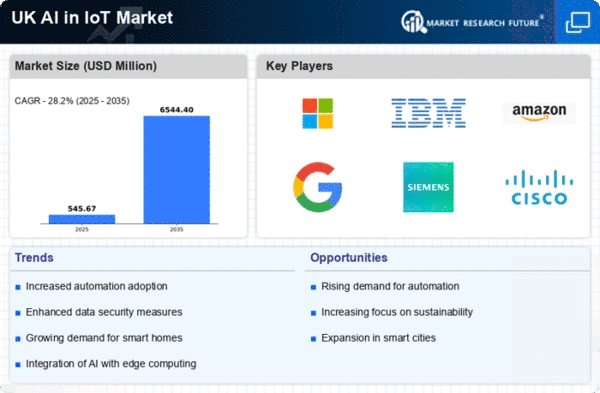
As per MRFR analysis, the UK ai in-iot market Size was estimated at 425.64 USD Million in 2024. The UK ai in-iot market is projected to grow from 545.67 USD Million in 2025 to 6544.4 USD Million by 2035, exhibiting a compound annual growth rate (CAGR) of 28.2% during the forecast period 2025 - 2035.

Key Market Trends & Highlights

The UK AI in-IoT market is poised for substantial growth driven by automation and sustainability.

  • The market is witnessing increased automation and efficiency across various sectors.
  • Enhanced data security measures are becoming a priority for businesses adopting AI in IoT solutions.
  • The largest segment in the UK AI in-IoT market is smart home devices, while industrial IoT applications are the fastest-growing segment.
  • Rising demand for smart devices and advancements in AI technologies are key drivers propelling market expansion.

Market Size & Forecast

2024 Market Size 425.64 (USD Million)
2035 Market Size 6544.4 (USD Million)
CAGR (2025 - 2035) 28.2%

Major Players

Microsoft (US), IBM (US), Amazon (US), Google (US), Siemens (DE), Cisco (US), Intel (US), General Electric (US), Honeywell (US)

UK Ai In Iot Market Trends

The ai in-iot market is currently experiencing a transformative phase, characterized by rapid advancements in technology and increasing adoption across various sectors. This evolution is driven by the integration of artificial intelligence with Internet of Things devices, which enhances data processing capabilities and enables smarter decision-making. As organizations recognize the potential of this synergy, investments in ai in-iot solutions are on the rise, fostering innovation and efficiency. The market appears poised for substantial growth, as businesses seek to leverage these technologies to optimize operations and improve customer experiences. Moreover, the regulatory landscape is evolving to support the development of the ai in-iot market. Government initiatives aimed at promoting digital transformation and smart technologies are likely to create a conducive environment for market expansion. Collaboration between public and private sectors is becoming increasingly common, facilitating the sharing of knowledge and resources. This collaborative approach may lead to the emergence of new applications and services, further driving the market forward. As the ai in-iot market continues to mature, it is expected to play a pivotal role in shaping the future of various industries, from healthcare to manufacturing.

Increased Automation and Efficiency

The ai in-iot market is witnessing a trend towards enhanced automation, where devices equipped with artificial intelligence are streamlining processes. This shift allows for real-time data analysis and decision-making, leading to improved operational efficiency. Organizations are increasingly adopting these solutions to reduce manual intervention and minimize errors.

Enhanced Data Security Measures

As the ai in-iot market expands, concerns regarding data security are becoming more pronounced. Companies are prioritizing the implementation of robust security protocols to protect sensitive information. This trend indicates a growing awareness of the importance of safeguarding data in an interconnected environment.

Focus on Sustainable Solutions

Sustainability is emerging as a key consideration within the ai in-iot market. Businesses are exploring ways to utilize these technologies to reduce their environmental impact. This trend reflects a broader commitment to sustainability, as organizations seek to align their operations with eco-friendly practices.

UK Ai In Iot Market Drivers

Advancements in AI Technologies

Technological advancements in AI are propelling the ai in-iot market forward. Innovations in machine learning, natural language processing, and computer vision are enabling IoT devices to become smarter and more autonomous. These advancements allow for real-time data processing and decision-making, which are critical for applications in sectors such as healthcare, manufacturing, and transportation. The ai in-iot market is witnessing a surge in the development of AI algorithms that enhance predictive maintenance and operational efficiency. For example, predictive analytics can reduce downtime in manufacturing by up to 30%, showcasing the tangible benefits of integrating AI with IoT. As these technologies continue to evolve, they are likely to unlock new opportunities and applications within the market.

Growing Focus on Data Analytics

The increasing emphasis on data analytics is a key driver in the ai in-iot market. As organizations in the UK generate vast amounts of data from IoT devices, the need for sophisticated analytics tools becomes paramount. Businesses are leveraging AI to extract actionable insights from this data, which can lead to improved decision-making and operational efficiencies. The ai in-iot market is responding to this trend by offering advanced analytics solutions that enable real-time monitoring and predictive insights. According to recent studies, companies that utilize data analytics can achieve a 20% increase in productivity. This growing focus on data-driven strategies is likely to propel the demand for AI-integrated IoT solutions, further enhancing the market landscape.

Rising Demand for Smart Devices

The increasing consumer demand for smart devices is a pivotal driver in the ai in-iot market. As households and businesses in the UK adopt smart technologies, the integration of AI with IoT devices becomes essential. This trend is reflected in the market, where the number of connected devices is projected to reach 1.5 billion by 2025. The ai in-iot market is responding to this demand by developing innovative solutions that enhance user experience and operational efficiency. Furthermore, the proliferation of smart home devices, such as smart thermostats and security systems, is expected to contribute to a market growth rate of approximately 25% annually. This surge in demand underscores the necessity for AI capabilities to manage and analyze the vast amounts of data generated by these devices.

Government Initiatives and Support

Government initiatives aimed at promoting digital transformation are significantly influencing the ai in-iot market. The UK government has launched various programs to encourage the adoption of AI and IoT technologies across industries. For instance, funding schemes and grants are available for businesses that integrate AI into their IoT solutions. This support is crucial as it not only fosters innovation but also enhances the competitiveness of UK firms in the global market. The ai in-iot market stands to benefit from these initiatives, as they facilitate research and development, leading to the creation of advanced AI-driven IoT applications. The government's commitment to investing £1 billion in AI research over the next five years further indicates a robust framework for growth in this sector.

Increased Investment in Smart Infrastructure

Investment in smart infrastructure is emerging as a significant driver for the ai in-iot market. The UK is witnessing a shift towards smart cities and connected infrastructure, which necessitates the integration of AI and IoT technologies. This trend is supported by substantial investments from both public and private sectors, aimed at enhancing urban living through smart transportation, energy management, and public safety systems. The ai in-iot market is poised to benefit from these developments, as smart infrastructure projects often require sophisticated AI algorithms to optimize performance and resource allocation. With an estimated £50 billion earmarked for smart city initiatives over the next decade, the potential for growth in the ai in-iot market is substantial, as these projects will drive demand for innovative AI solutions.


Market Segment Insights

By Component: Software Solutions (Largest) vs. Platforms (Fastest-Growing)

In the UK ai in-iot market, the distribution of market share among components shows that Software Solutions holds the largest share, driven by an increasing demand for intelligent applications and automation across various industries. Platforms, while currently smaller, are rapidly gaining traction as more enterprises recognize their importance in facilitating AI integration and IoT connectivity. The growth trends within this segment are noteworthy, with Platforms emerging as the fastest-growing area due to rising investments in cloud computing and IoT infrastructure. Software Solutions are expected to maintain dominance; however, the rapid evolution of technology and the need for interoperability are propelling Platforms into the spotlight, offering potential for substantial growth in the coming years.

Software Solutions: Dominant vs. Platforms: Emerging

Software Solutions serve as the backbone of many AI-driven IoT applications, providing essential functionalities such as data analytics, machine learning, and user interfacing. Their dominance can be attributed to established vendors and a broad range of applications across sectors, including healthcare, manufacturing, and smart cities. In comparison, Platforms are emerging as crucial components that facilitate seamless integration of devices and applications, enabling the effective deployment of IoT strategies. The rapid adoption of cloud-based solutions and the demand for interoperability drive interest in Platforms, positioning them as a dynamic area of growth that complements established Software Solutions.

By Technologies: ML and Deep Learning (Largest) vs. NLP (Fastest-Growing)

In the UK ai in-iot market, the distribution of market share between ML and Deep Learning and NLP showcases the dominance of ML technologies. ML and Deep Learning account for a substantial share of the market, driven by their widespread applications in data analytics, predictive maintenance, and automation. In contrast, NLP is rapidly gaining traction, appealing to businesses focused on enhancing user interaction and automating communication processes. It currently holds a smaller share but is on a swift upward trajectory due to the increasing demand for conversational AI and chatbots. The growth trends for these segments indicate a dynamic shift in the technology landscape. ML and Deep Learning technologies continue to be the backbone of many AI solutions, with businesses steadily investing in their capabilities. Conversely, the NLP segment is characterized by its rapid growth driven by advancements in machine learning algorithms and the rising importance of customer engagement strategies. This combination of established dominance and emerging growth reflects the evolving needs of the UK ai in-iot market.

Technology: ML and Deep Learning (Dominant) vs. NLP (Emerging)

ML and Deep Learning are considered the dominant forces in the UK ai in-iot market, providing robust frameworks for data processing and predictive analytics. Their applications range from optimizing supply chains to improving product quality through advanced data insights. As companies increasingly rely on data-driven decision-making, ML technologies continue to lead in market share. In contrast, NLP is positioned as an emerging segment with significant potential for growth. Its ability to interpret human language and provide intelligent responses facilitates enhanced customer interaction and engagement. The rise of chatbots and virtual assistants highlights NLP's importance, making it a focal area for future innovations in the UK ai in-iot market.

By Vertical: Manufacturing (Largest) vs. Healthcare and Life Sciences (Fastest-Growing)

The UK ai in-iot market demonstrates diverse segment distribution with Manufacturing leading in market share, signifying its extensive adoption of AI and IoT technologies for operational efficiency. Other segments such as Transportation and Mobility and Telecom also hold significant shares, but Manufacturing stands out due to its established presence and investment in automation technologies. On the other hand, Healthcare and Life Sciences is emerging as the fastest-growing segment driven by the increasing need for AI-based solutions for patient monitoring and management. Rapid advancements in technology, particularly in machine learning and data analytics, are transforming healthcare operations, making this segment highly attractive for investment and innovation.

Manufacturing: Dominant vs. Healthcare and Life Sciences: Emerging

Manufacturing takes a dominant position in the UK ai in-iot market, showcasing a robust investment in automation and smart technologies to enhance production efficiency. This segment leverages real-time data analytics and IoT connectivity to optimize supply chain processes, reduce downtime, and improve overall productivity. In contrast, Healthcare and Life Sciences, while currently smaller, is rapidly gaining traction. This segment focuses on integrating AI tools to enhance patient care, streamline administrative processes, and improve diagnostic accuracy. The increased funding and growing interest in telehealth solutions further propel its potential, indicating its emerging importance in the market.

Get more detailed insights about UK Ai In Iot Market

Key Players and Competitive Insights

The ai in-iot market is currently characterized by a dynamic competitive landscape, driven by rapid technological advancements and increasing demand for smart solutions across various sectors. Major players such as Microsoft (US), IBM (US), and Siemens (DE) are strategically positioning themselves through innovation and partnerships, which appear to be pivotal in shaping the market. Microsoft (US) focuses on enhancing its Azure IoT platform, integrating advanced AI capabilities to provide comprehensive solutions for businesses. Meanwhile, IBM (US) emphasizes its Watson IoT platform, leveraging AI to optimize industrial operations and improve decision-making processes. Siemens (DE) is also making strides by integrating AI into its automation solutions, thereby enhancing operational efficiency and sustainability in manufacturing.

The business tactics employed by these companies include localizing manufacturing and optimizing supply chains to better serve regional markets. The competitive structure of the ai in-iot market seems moderately fragmented, with a mix of established players and emerging startups. This fragmentation allows for diverse innovation pathways, although the collective influence of key players like Microsoft (US) and IBM (US) tends to dominate market trends and customer preferences.

In October 2025, Microsoft (US) announced a strategic partnership with a leading UK telecommunications provider to enhance its IoT connectivity solutions. This collaboration is expected to bolster Microsoft's presence in the UK market, enabling it to offer more robust and localized services. The strategic importance of this partnership lies in its potential to accelerate the deployment of smart city initiatives, thereby positioning Microsoft (US) as a key player in the digital transformation of urban environments.

In September 2025, IBM (US) launched a new AI-driven analytics tool designed specifically for the manufacturing sector. This tool aims to provide real-time insights into production processes, thereby facilitating better resource management and reducing operational costs. The introduction of this tool underscores IBM's commitment to leveraging AI for operational excellence, which could significantly enhance its competitive edge in the market.

In August 2025, Siemens (DE) unveiled its latest AI-enhanced automation solutions at a major industry conference in London. This launch is indicative of Siemens' focus on integrating AI into its product offerings, which may lead to improved efficiency and sustainability in industrial operations. The strategic importance of this development lies in Siemens' ability to address the growing demand for smart manufacturing solutions, thereby reinforcing its market position.

As of November 2025, current competitive trends in the ai in-iot market are heavily influenced by digitalization, sustainability, and the integration of AI technologies. Strategic alliances among key players are shaping the landscape, fostering innovation and enhancing service offerings. Looking ahead, it appears that competitive differentiation will increasingly hinge on innovation and technological advancements rather than price-based competition. Companies that prioritize supply chain reliability and invest in cutting-edge technologies are likely to emerge as leaders in this evolving market.

Key Companies in the UK Ai In Iot Market market include

Industry Developments

Oracle declared in March 2025 that it would invest $5 billion in cloud infrastructure in the UK to foster AI innovation. SPARK Matrix named PTC a leader in the worldwide Industrial IoT market in 2023. The UK's fastest AI supercomputer, "Dawn," was introduced by Dell Technologies in 2023 in partnership with Intel and UKRI to tackle computational issues in academia and industry.Siemens and IoT Tribe launched the Flywheel Program in 2023 to assist AI-powered aircraft businesses. More than 60% of generative AI firms in the UK selected Google Cloud, according to a 2023 Google research. To encourage AI innovation, the company started the 'Gemini for UK' campaign.

The strong demand for AI chip designs drove Arm Holdings' 2023 initial public offering (IPO), which valued the business at $120 billion. Accenture revealed in 2023 that more UK businesses had intentions to invest in AI, demonstrating an increasing dedication to AI adoption.Microsoft launched a £2.5 billion AI infrastructure plan in the UK in 2023, however progress of the project is being hampered by grid connection delays. These examples demonstrate how the UK is actively involved in the AI in IoT space, with large investments and programs fostering innovation and expansion.

UK AI in IoT

Future Outlook

UK Ai In Iot Market Future Outlook

The AI in IoT Market is projected to grow at 28.2% CAGR from 2024 to 2035, driven by advancements in connectivity, data analytics, and automation technologies.

New opportunities lie in:

  • Development of AI-driven predictive maintenance solutions for industrial IoT devices.
  • Integration of smart sensors in supply chain logistics for real-time tracking.
  • Creation of AI-enhanced cybersecurity frameworks for IoT networks.

By 2035, the market is expected to achieve substantial growth, driven by innovative applications and strategic investments.

Market Segmentation

UK Ai In Iot Market Vertical Outlook

  • Manufacturing
  • Energy and Utilities
  • Transportation and Mobility
  • BFSI
  • Government and Defense
  • Retail
  • Healthcare and Life Sciences
  • Telecom
  • Others (agriculture, education, telecom, and tourism and hospitality)

UK Ai In Iot Market Component Outlook

  • Platforms
  • Software Solutions
  • Services

UK Ai In Iot Market Technologies Outlook

  • ML and Deep Learning
  • NLP

Report Scope

MARKET SIZE 2024 425.64(USD Million)
MARKET SIZE 2025 545.67(USD Million)
MARKET SIZE 2035 6544.4(USD Million)
COMPOUND ANNUAL GROWTH RATE (CAGR) 28.2% (2024 - 2035)
REPORT COVERAGE Revenue Forecast, Competitive Landscape, Growth Factors, and Trends
BASE YEAR 2024
Market Forecast Period 2025 - 2035
Historical Data 2019 - 2024
Market Forecast Units USD Million
Key Companies Profiled Microsoft (US), IBM (US), Amazon (US), Google (US), Siemens (DE), Cisco (US), Intel (US), General Electric (US), Honeywell (US)
Segments Covered Component, Technologies, Vertical
Key Market Opportunities Integration of advanced analytics in the ai in-iot market enhances operational efficiency and decision-making.
Key Market Dynamics Growing integration of artificial intelligence in Internet of Things applications drives innovation and competitive differentiation.
Countries Covered UK

Leave a Comment

FAQs

What is the projected market size of the UK AI in IoT Market in 2024?

The UK AI in IoT Market is expected to be valued at 425.6 million USD in 2024.

What will be the market size of the UK AI in IoT Market by 2035?

By 2035, the UK AI in IoT Market is projected to reach a value of 1795.0 million USD.

What is the compound annual growth rate (CAGR) for the UK AI in IoT Market from 2025 to 2035?

The expected CAGR for the UK AI in IoT Market from 2025 to 2035 is 13.979%.

What are the key components of the UK AI in IoT Market?

The UK AI in IoT Market is segmented into components such as Platforms, Software Solutions, and Services.

How much will the Platforms segment be valued in 2035?

The Platforms segment of the UK AI in IoT Market is expected to be valued at 417.0 million USD in 2035.

What is the expected value of the Software Solutions segment in 2024?

The Software Solutions segment is projected to be valued at 160.0 million USD in 2024.

Which companies are major players in the UK AI in IoT Market?

Major players in the UK AI in IoT Market include Oracle, PTC, Dell Technologies, Siemens, and Google among others.

What is the anticipated value of the Services segment in 2035?

The Services segment of the UK AI in IoT Market is expected to be valued at 718.0 million USD in 2035.

How does the growth rate of the UK AI in IoT Market compare across segments?

The growth dynamics across segments show promising trends, particularly in Software Solutions and Services.

What are the key drivers for the growth of the UK AI in IoT Market?

Key growth drivers include increasing adoption of AI technologies and the demand for smart IoT solutions.

Download Free Sample

Kindly complete the form below to receive a free sample of this Report

Compare Licence

×
Features License Type
Single User Multiuser License Enterprise User
Price $4,950 $5,950 $7,250
Maximum User Access Limit 1 User Upto 10 Users Unrestricted Access Throughout the Organization
Free Customization
Direct Access to Analyst
Deliverable Format
Platform Access
Discount on Next Purchase 10% 15% 15%
Printable Versions