Download Free Sample
Kindly complete the form below to receive a free sample of this Report
UK Generative AI in Fintech Market Size, Share and Research Report By Application (Fraud Detection, Risk Management, Customer Service, Algorithmic Trading), By Technology (Natural Language Processing, Machine Learning, Deep Learning, Predictive Analytics), By Deployment Type (On-Premises, Cloud-Based, Hybrid) and By End Use (Banking, Insurance, Investment)-Forecast to 2035
As per analysis, the UK Generative Ai In Fintech Market is projected to grow from USD 124.51 Billion in 2024 to USD 1115.8 Billion by 2035, exhibiting a compound annual growth rate (CAGR) of 22.06% during the forecast period (2025 - 2035).
The UK Generative AI in Fintech market is poised for substantial growth driven by advancements in technology and evolving consumer expectations.
| 2024 Market Size | 124.51 (USD Billion) |
| 2035 Market Size | 1115.8 (USD Billion) |
| CAGR (2025 - 2035) | 22.06% |
Revolut (GB), Monzo (GB), Starling Bank (GB), TransferWise (GB), Zopa (GB), OakNorth (GB), ClearBank (GB), Curve (GB), Atom Bank (GB)
Our Impact
Enabled $4.3B Revenue Impact for Fortune 500 and Leading Multinationals
Partnering with 2000+ Global Organizations Each Year
30K+ Citations by Top-Tier Firms in the Industry
The UK Generative Ai In Fintech Market is currently experiencing a transformative phase, characterized by the integration of advanced artificial intelligence technologies into financial services. This evolution appears to be driven by the increasing demand for personalized customer experiences, enhanced operational efficiency, and improved risk management. Financial institutions in the UK are exploring generative AI applications to streamline processes, automate customer interactions, and provide tailored financial advice. As a result, the market is witnessing a surge in innovative solutions that leverage machine learning and natural language processing to meet the diverse needs of consumers and businesses alike. Moreover, regulatory frameworks in the UK are adapting to accommodate the rapid advancements in technology. The Financial Conduct Authority and other regulatory bodies are actively engaging with fintech firms to ensure that the deployment of generative AI aligns with compliance standards and consumer protection measures. This collaborative approach may foster a conducive environment for innovation while safeguarding the interests of stakeholders. As the UK Generative Ai In Fintech Market continues to evolve, it is likely to play a pivotal role in shaping the future of financial services, driving efficiency, and enhancing customer satisfaction.
The UK Generative Ai In Fintech Market is increasingly focusing on delivering personalized financial services. By utilizing generative AI, firms can analyze vast amounts of customer data to create tailored financial products and services. This trend indicates a shift towards more customer-centric approaches, where individual preferences and behaviors are taken into account, potentially leading to higher customer satisfaction and loyalty.
Another notable trend within the UK Generative Ai In Fintech Market is the enhancement of risk management practices. Financial institutions are employing generative AI to improve their predictive analytics capabilities, allowing for better identification and mitigation of risks. This development suggests a proactive approach to risk management, which could lead to more resilient financial systems.
The regulatory landscape in the UK is evolving to keep pace with advancements in generative AI technologies. Regulatory bodies are increasingly collaborating with fintech companies to establish guidelines that ensure the responsible use of AI in financial services. This trend highlights the importance of balancing innovation with consumer protection, fostering a sustainable environment for growth in the UK Generative Ai In Fintech Market.
The UK Generative Ai In Fintech Market is significantly influenced by advancements in data analytics capabilities. Generative AI technologies enable financial institutions to process vast amounts of data efficiently, uncovering insights that were previously unattainable. This capability is particularly relevant in risk assessment and fraud detection, where timely and accurate data analysis is paramount. Reports suggest that firms employing advanced data analytics can reduce fraud losses by up to 30%. Consequently, the integration of generative AI in data analytics is likely to be a key driver of innovation and growth within the UK Generative Ai In Fintech Market.
The UK Generative Ai In Fintech Market is experiencing a notable surge in demand for automation solutions. Financial institutions are increasingly adopting generative AI technologies to streamline operations, reduce costs, and enhance customer experiences. According to recent data, over 60% of UK financial firms are investing in AI-driven automation tools. This trend is driven by the need for efficiency in processing transactions and managing customer inquiries. As competition intensifies, firms that leverage generative AI for automation are likely to gain a competitive edge, thereby propelling growth in the UK Generative Ai In Fintech Market.
In the UK Generative Ai In Fintech Market, there is a pronounced emphasis on customer personalization. Financial services are increasingly utilizing generative AI to analyze customer data and tailor offerings to individual preferences. This approach not only enhances customer satisfaction but also drives loyalty. Recent statistics indicate that personalized financial products can lead to a 20% increase in customer retention rates. As firms strive to differentiate themselves in a crowded market, the ability to deliver personalized experiences through generative AI is becoming a critical driver of growth in the UK Generative Ai In Fintech Market.
The UK Generative Ai In Fintech Market is also shaped by the increasing need for regulatory compliance and risk mitigation. Financial institutions are under constant pressure to adhere to stringent regulations, and generative AI can assist in automating compliance processes. By leveraging AI technologies, firms can enhance their ability to monitor transactions and identify potential risks in real-time. This proactive approach not only ensures compliance but also minimizes financial losses. As regulatory frameworks evolve, the demand for generative AI solutions that facilitate compliance is expected to grow, further driving the UK Generative Ai In Fintech Market.
Investment in innovative financial solutions is a prominent driver within the UK Generative Ai In Fintech Market. Venture capital funding for fintech startups utilizing generative AI has seen a substantial increase, with investments reaching over 1 billion GBP in the past year alone. This influx of capital is fostering innovation and enabling the development of cutting-edge financial products and services. As investors recognize the potential of generative AI to transform the financial landscape, the resulting innovations are likely to attract more customers and enhance market competitiveness, thereby propelling growth in the UK Generative Ai In Fintech Market.
In the UK Generative AI in Fintech market, the application segment is characterized by diverse functionalities with Fraud Detection holding the largest market share. This is driven by the increasing need for financial institutions to combat sophisticated fraudulent activities. Furthermore, Risk Management and Personalized Financial Services also account for significant portions of the market, reflecting the sector's focus on enhanced client security and tailored offerings. Regulatory Compliance, while crucial, occupies a smaller share compared to the other applications.
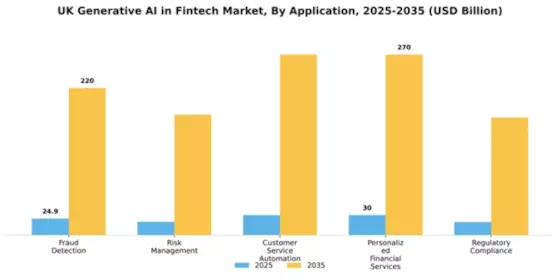
Fraud Detection (Dominant) vs. Customer Service Automation (Emerging)
Fraud Detection is the dominant application in the UK Generative AI in Fintech market, utilizing advanced algorithms and machine learning to identify and mitigate fraudulent activity in real-time. Financial institutions are investing significantly in these technologies to enhance security protocols, thus maintaining customer trust and regulatory compliance. In contrast, Customer Service Automation is emerging rapidly as businesses leverage AI-driven chatbots and virtual assistants to streamline customer interactions. This segment not only enhances operational efficiency but also improves client satisfaction. Combining these capabilities leads to a safer and more responsive financial environment.
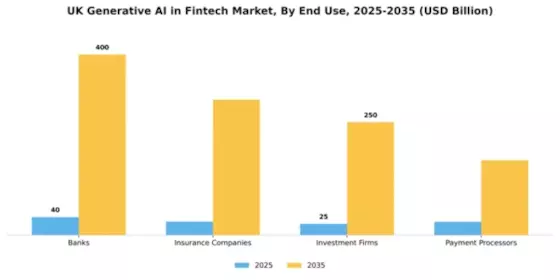
In the UK Generative AI in Fintech market, the end-use distribution reveals that banks hold the largest market share, leveraging advanced AI technologies for enhanced customer service and streamlined operations. Insurance companies also contribute significantly, using AI for risk assessment and fraud detection. Investment firms utilize AI for data analysis and investment strategies, while payment processors are emerging strongly as they integrate AI for transaction security and efficiency, reflecting an evolving competitive landscape.
Banks (Dominant) vs. Payment Processors (Emerging)
Banks are currently the dominant players in the UK's Generative AI fintech segment, utilizing AI tools to optimize operations, improve risk management, and enhance customer interactions. Their significant investment in technology positions them well within the market. In contrast, payment processors represent an emerging segment experiencing rapid growth due to increasing demand for secure and efficient transaction methods. The adoption of AI for fraud prevention, predictive analytics, and real-time processing capabilities is driving this shift. As these sectors evolve, banks and payment processors are likely to redefine their roles within the financial ecosystem.
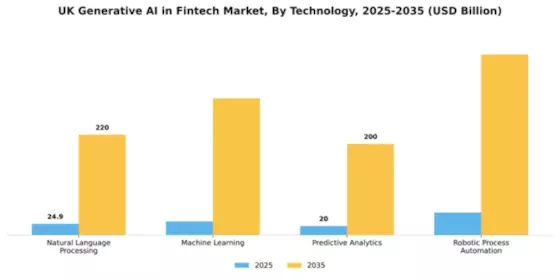
In the UK Generative AI in Fintech market, Natural Language Processing (NLP) stands as the largest technology segment, commanding a significant portion of market share. It enhances customer interactions and streamlines compliance processes by analyzing and generating human-like text responses. On the other hand, Machine Learning (ML) is rapidly gaining traction, exhibiting the fastest growth as it allows fintech companies to refine their algorithms for fraud detection and personalized financial services, attracting significant investments and innovative applications. The growth trends in this segment are driven by the increasing demand for improved customer experiences and operational efficiencies. NLP continues to evolve, integrating more seamlessly into various fintech applications, while ML is witnessing a surge in adoption due to its potential for predictive capabilities and automation. These technologies collectively facilitate enhanced decision-making and better risk management in an ever-evolving financial landscape.
Natural Language Processing: Dominant vs. Machine Learning: Emerging
Natural Language Processing (NLP) is positioned as the dominant force in the UK Generative AI in Fintech market, primarily due to its ability to interpret and generate human-like text for customer service automation, regulatory compliance, and real-time financial analysis. NLP tools help transform unstructured data into actionable insights, making them invaluable to fintech companies aiming to enhance user engagement and operational efficiency. In contrast, Machine Learning is categorized as an emerging segment, harnessing algorithms to analyze vast datasets and improve predictive analytics. While still growing, ML is essential for identifying patterns in financial transactions, enhancing fraud detection, and offering personalized insights for users. The interplay between NLP and ML is vital for driving innovation and competition within the fintech landscape.
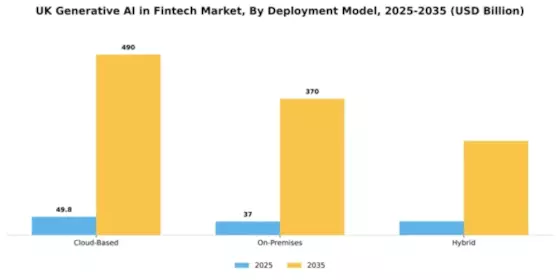
The UK Generative AI in Fintech Market showcases a diverse deployment model landscape, with Cloud-Based solutions dominating the market share. This model's extensive adoption stems from its scalability, cost-effectiveness, and the ability to access advanced tools and analytics at any location. In contrast, On-Premises models are trailing, catering to organizations with stringent data privacy requirements. The emerging Hybrid model is gaining traction due to its flexibility, combining the strengths of both Cloud-Based and On-Premises deployments.
Cloud-Based (Dominant) vs. Hybrid (Emerging)
Cloud-Based deployment in the UK Generative AI in Fintech Market is characterized by its dominance, offering seamless scalability and quick access to innovative tools. This model caters to a wide range of fintech companies looking for cost efficiency and minimal maintenance. Hybrid models, on the other hand, are considered emerging solutions that blend on-premises infrastructure with cloud capabilities. This flexibility appeals particularly to businesses that require secure data handling without sacrificing the operational efficiencies of the cloud. As regulatory pressures increase, many firms are gravitating towards hybrid strategies to ensure compliance while maximizing resource usability.
The UK Generative AI in Fintech market sees a diverse distribution among user types, with medium enterprises holding the largest share. These firms effectively leverage technology to enhance their operations, providing them a competitive edge in the finance sector. Small enterprises, while not holding the same market share, are rapidly increasing their adoption of generative AI, fueled by a growing need for innovation and efficiency in their processes. This competitive landscape indicates a shift towards technology-driven solutions within the fintech ecosystem. In recent years, medium enterprises have been the frontrunners, embracing generative AI to optimize workflows and improve customer engagement. Conversely, small enterprises are emerging as the fastest-growing segment, driven by advancements in AI accessibility and cost-effective solutions. The ability to harness generative AI enables smaller firms to compete with larger players, democratizing access to advanced technologies and reshaping the market dynamics.
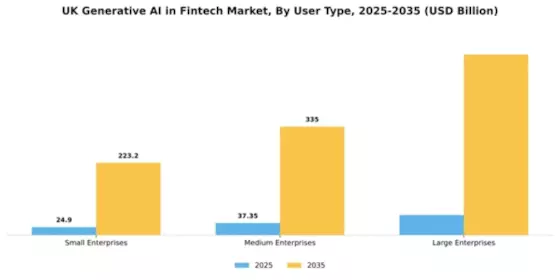
Medium Enterprises: Dominant vs. Small Enterprises: Emerging
Medium enterprises are characterized by their capacity to invest in generative AI technologies, allowing them to scale operations efficiently and respond swiftly to market changes. Their established structures provide stability and resources, enabling them to innovate continuously. In contrast, small enterprises are rapidly emerging in this market, driven by their agility and the necessity to differentiate themselves in a crowded fintech space. While they may lack the extensive resources of larger firms, their flexibility and quick adoption of cutting-edge solutions position them advantageously. The drive for digital transformation is pushing small enterprises to prioritize generative AI, showing promising growth and an impactful presence in the fintech landscape.
Get more detailed insights about UK Generative Ai Fintech Market Request Free Sample
The Generative Ai In Fintech Market is currently characterized by a dynamic competitive landscape, driven by rapid technological advancements and an increasing demand for personalized financial services. Key players such as Revolut (GB), Monzo (GB), and Starling Bank (GB) are at the forefront, leveraging innovative strategies to enhance customer experience and operational efficiency. Revolut (GB), for instance, has positioned itself as a leader in digital banking by continuously expanding its product offerings and integrating advanced AI capabilities to streamline operations and improve customer engagement. Meanwhile, Monzo (GB) focuses on community-driven banking solutions, utilizing generative AI to personalize user experiences and optimize financial advice, thereby fostering customer loyalty. Starling Bank (GB) emphasizes a robust digital transformation strategy, integrating AI to enhance risk management and fraud detection, which collectively shapes a competitive environment that prioritizes innovation and customer-centric solutions.The business tactics employed by these companies reflect a keen focus on localizing services and optimizing digital platforms to cater to diverse customer needs. The market structure appears moderately fragmented, with several players vying for market share while also collaborating on technological advancements. This collective influence of key players fosters a competitive atmosphere where agility and adaptability are paramount, allowing for rapid responses to market demands and consumer preferences.In November 2025, Revolut (GB) announced a strategic partnership with a leading AI firm to enhance its fraud detection capabilities. This move is significant as it not only strengthens Revolut's security measures but also positions the company as a pioneer in utilizing generative AI for real-time transaction monitoring, potentially reducing fraud rates by up to 30%. Such advancements are likely to attract more users seeking secure banking solutions, thereby enhancing market share.In December 2025, Monzo (GB) launched a new feature powered by generative AI that provides personalized financial insights to users based on their spending habits. This initiative is crucial as it not only differentiates Monzo in a crowded market but also aligns with the growing consumer demand for tailored financial advice. By leveraging AI, Monzo aims to deepen customer engagement and retention, which could lead to increased revenue streams through enhanced service offerings.In January 2026, Starling Bank (GB) unveiled an AI-driven tool designed to assist small businesses in managing cash flow more effectively. This strategic action is indicative of Starling's commitment to supporting SMEs, a segment that has been historically underserved. By integrating generative AI into its offerings, Starling Bank not only enhances its value proposition but also positions itself as a key player in the small business banking sector, potentially increasing its customer base significantly.As of January 2026, the competitive trends within the Generative Ai In Fintech Market are increasingly defined by digitalization, sustainability, and the integration of AI technologies. Strategic alliances among key players are shaping the landscape, fostering innovation and collaborative solutions that address evolving consumer needs. Looking ahead, it is anticipated that competitive differentiation will increasingly pivot from traditional price-based strategies to a focus on innovation, technological advancements, and supply chain reliability, thereby redefining the parameters of success in this rapidly evolving market.





































The UK Generative AI in Fintech Market has seen significant advancements recently, with many companies making strides in this domain. Palantir Technologies has enhanced its data integration solutions, catering to financial institutions looking to harness AI for better decision-making.
Meanwhile, Monzo's collaboration with Tink aims to improve personal finance management through advanced analytics. OpenAI continues to boost its offerings in natural language processing, impacting various fintech applications across the UK. In a notable acquisition, Revolut announced its purchase of a smaller fintech startup in April 2023 to strengthen its AI capabilities and product offerings.
NVIDIA has invested in AI-driven fintech solutions, affirming its commitment to powering innovations in this sector. Furthermore, growth in the overall market valuation for these companies has been driven by the rising demand for AI technologies, with valuations increasing significantly year-on-year. In the last 2-3 years, significant regulatory support from the UK Government has promoted AI development in finance. Major players like DataRobot and IBM are also focusing on scalable AI solutions tailored for financial services, indicating a robust and evolving landscape in the UK's generative AI fintech market.
The UK Generative AI in Fintech Market is poised for growth at 22.06% CAGR from 2025 to 2035, driven by technological advancements, regulatory support, and increasing demand for personalized financial services.
New opportunities lie in:
By 2035, the market is expected to be robust, reflecting substantial advancements and widespread adoption.
| MARKET SIZE 2024 | 124.51(USD Billion) |
| MARKET SIZE 2025 | 155.04(USD Billion) |
| MARKET SIZE 2035 | 1115.8(USD Billion) |
| COMPOUND ANNUAL GROWTH RATE (CAGR) | 22.06% (2024 - 2035) |
| REPORT COVERAGE | Revenue Forecast, Competitive Landscape, Growth Factors, and Trends |
| BASE YEAR | 2024 |
| Market Forecast Period | 2025 - 2035 |
| Historical Data | 2019 - 2024 |
| Market Forecast Units | USD Billion |
| Key Companies Profiled | Revolut (GB), Monzo (GB), Starling Bank (GB), TransferWise (GB), Zopa (GB), OakNorth (GB), ClearBank (GB), Curve (GB), Atom Bank (GB) |
| Segments Covered | Application, End Use, Technology, Deployment Model, User Type |
| Key Market Opportunities | Integration of Generative AI for personalized financial services enhances customer engagement in the UK Generative Ai In Fintech Market. |
| Key Market Dynamics | Growing adoption of Generative Artificial Intelligence in UK Fintech enhances customer experience and operational efficiency. |
| Countries Covered | UK |
The market valuation was 124.51 USD Billion in 2024.
The projected valuation for 2035 is 1115.8 USD Billion.
The expected CAGR during this period is 22.06%.
Key applications include Customer Service Automation and Personalized Financial Services, each valued at 270.0 USD Billion by 2035.
Banks are projected to reach a valuation of 400.0 USD Billion by 2035, leading other segments.
Robotic Process Automation is expected to dominate with a projected valuation of 395.8 USD Billion by 2035.
The Cloud-Based deployment model is anticipated to reach 490.0 USD Billion by 2035.
Large Enterprises are expected to lead with a valuation of 557.6 USD Billion by 2035.
Prominent players include Revolut, Monzo, and Starling Bank, among others.
Fraud Detection is projected to reach 220.0 USD Billion by 2035, indicating its critical role in market growth.


Kindly complete the form below to receive a free sample of this Report

“This is really good guys. Excellent work on a tight deadline. I will continue to use you going forward and recommend you to others. Nice job”


“Thanks. It’s been a pleasure working with you, please use me as reference with any other Intel employees.”


“Thanks for sending the report it gives us a good global view of the Betaïne market.”


“Thank you, this will be very helpful for OQS.”


“We found the report very insightful! we found your research firm very helpful. I'm sending this email to secure our future business.”


“I am very pleased with how market segments have been defined in a relevant way for my purposes (such as "Portable Freezers & refrigerators" and "last-mile"). In general the report is well structured. Thanks very much for your efforts.”


“I have been reading the first document or the study, ,the Global HVAC and FP market report 2021 till 2026. Must say, good info! I have not gone in depth at all parts, but got a good indication of the data inside!”


“We got the report in time, we really thank you for your support in this process. I also thank to all of your team as they did a great job.”


“The Automotive 48V ECU Components Procurement Intelligence Study” was a complex project, but the Market Research Future (MRFR) team handled it with quality, agility, and customer-centricity. They delivered all requested data on time and within the agreed scope. The team, including Shubhendra Anand and Rahul Gotadki, was always readily available to clarify questions and swiftly implement necessary adjustments, driving the project to a successful conclusion within a very demanding timeframe.
I would also like to specifically commend Akshay Agarwal for his responsiveness and support at every stage—from our initial inquiry on May 6th through to final delivery on June 18th. His dedication made the entire process seamless.”



