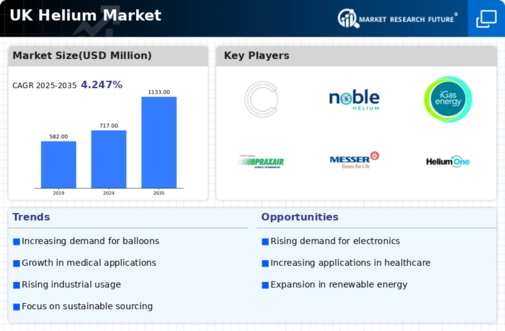
The helium market in the UK is characterized by a competitive landscape that is increasingly shaped by innovation, sustainability, and strategic partnerships. Key players such as Air Products (GB), Linde (GB), and Air Liquide (GB) are actively pursuing strategies that emphasize technological advancements and operational efficiencies. Air Products (GB) has focused on expanding its production capabilities, while Linde (GB) has been enhancing its service offerings through digital transformation initiatives. These strategies collectively contribute to a dynamic competitive environment, where companies are not only vying for market share but also striving to meet evolving customer demands for sustainable solutions.
In terms of business tactics, companies are increasingly localizing manufacturing and optimizing supply chains to enhance responsiveness and reduce costs. The market structure appears moderately fragmented, with several players holding significant shares, yet the influence of major companies is pronounced. This competitive structure allows for a diverse range of offerings, catering to various sectors such as healthcare, electronics, and aerospace, thereby driving overall market growth.
In November 2025, Air Products (GB) announced the launch of a new helium recovery system aimed at reducing waste and enhancing sustainability in its operations. This strategic move not only aligns with global sustainability goals but also positions the company as a leader in environmentally responsible practices within the helium sector. The introduction of such technology could potentially set a benchmark for competitors, emphasizing the importance of sustainable practices in attracting environmentally conscious customers.
In October 2025, Linde (GB) unveiled a partnership with a leading technology firm to develop AI-driven solutions for helium distribution. This collaboration is expected to streamline logistics and improve supply chain efficiency, thereby reducing operational costs. The integration of AI into their operations suggests a forward-thinking approach that may enhance Linde's competitive edge by enabling more precise demand forecasting and inventory management.
In September 2025, Air Liquide (GB) expanded its helium sourcing agreements with suppliers in the Middle East, thereby securing a more stable supply chain. This strategic action is indicative of the company's commitment to ensuring reliability in its helium supply, which is crucial for maintaining customer trust and satisfaction. By diversifying its sources, Air Liquide (GB) not only mitigates risks associated with supply disruptions but also positions itself favorably against competitors who may rely on fewer sources.
As of December 2025, the competitive trends in the helium market are increasingly defined by digitalization, sustainability, and the integration of advanced technologies. Strategic alliances are becoming more prevalent, as companies recognize the value of collaboration in enhancing their market positions. The shift from price-based competition to a focus on innovation and supply chain reliability is evident, suggesting that future competitive differentiation will hinge on the ability to leverage technology and sustainable practices effectively.





















Leave a Comment