Download Free Sample
Kindly complete the form below to receive a free sample of this Report
UK Hydrocephalus Market Research Report: Size, Share, Trend Analysis By Types (Congenital Hydrocephalus, Acquired Hydrocephalus, Normal-Pressure Hydrocephalus, Ex-Vacuo Hydrocephalus), By Diagnostic (CT scan – head, MRI, Head Ultrasound), By Treatment (Surgery – Shunt Insertion, Ventriculostomy, Medication), and By End-user (Hospitals & Clinics, Diagnostic Centres, Academic Institutions, Research Organizations) - Growth Outlook & Industry Forecast 2025 To 2035
As per Market Research Future analysis, the UK Hydrocephalus Market size was estimated at 21.42 USD Million in 2024. The Hydrocephalus market is projected to grow from 22.65 USD Million in 2025 to 39.66 USD Million by 2035, exhibiting a compound annual growth rate (CAGR) of 5.7% during the forecast period 2025 - 2035
The UK hydrocephalus market is experiencing growth driven by technological advancements and increased patient advocacy.
| 2024 Market Size | 21.42 (USD Million) |
| 2035 Market Size | 39.66 (USD Million) |
| CAGR (2025 - 2035) | 5.76% |
Medtronic (US), Johnson & Johnson (US), Stryker (US), B. Braun Melsungen AG (DE), Integra LifeSciences (US), Codman Neuro (US), Natus Medical Incorporated (US), NeuroPace (US)
Our Impact
Enabled $4.3B Revenue Impact for Fortune 500 and Leading Multinationals
Partnering with 2000+ Global Organizations Each Year
30K+ Citations by Top-Tier Firms in the Industry
The UK Hydrocephalus Market in the UK is currently experiencing notable developments, driven by advancements in medical technology and increasing awareness of the condition. Hydrocephalus, characterized by an accumulation of cerebrospinal fluid in the brain, necessitates effective treatment options. The rise in diagnostic capabilities, particularly through imaging techniques, has led to earlier detection and intervention, which may improve patient outcomes. Furthermore, the growing emphasis on patient-centered care is influencing treatment approaches, with a focus on personalized therapies and rehabilitation strategies. In addition, the UK healthcare system is witnessing a shift towards integrated care models, which could enhance the management of hydrocephalus. Collaboration among healthcare providers, patients, and families is becoming more prevalent, potentially leading to better resource allocation and support systems. This trend may foster a more comprehensive understanding of hydrocephalus, ultimately benefiting those affected by the condition. As the hydrocephalus market evolves, ongoing research and development efforts are likely to play a crucial role in shaping future treatment paradigms and improving quality of life for patients.
Innovations in surgical techniques and devices are transforming the hydrocephalus market. Minimally invasive procedures and advanced shunt systems are becoming more common, potentially leading to reduced recovery times and improved patient outcomes. These advancements may also enhance the precision of interventions, allowing for tailored treatment plans.
There is a growing movement towards raising awareness about hydrocephalus in the UK. Advocacy groups are actively engaging with the public and healthcare professionals, which may lead to improved understanding and recognition of the condition. This heightened awareness could result in earlier diagnosis and better access to treatment options.
The hydrocephalus market is increasingly prioritizing patient-centered approaches. This trend emphasizes the importance of involving patients and their families in treatment decisions, potentially leading to more effective management strategies. By fostering collaboration between healthcare providers and patients, the market may enhance overall care quality.
Government funding and support for research and treatment of hydrocephalus are crucial drivers of the hydrocephalus market in the UK. Initiatives aimed at improving healthcare access and funding for innovative treatments are becoming more prevalent. For instance, the UK government has allocated substantial resources to neurological research, which includes studies focused on hydrocephalus. This financial backing not only fosters innovation but also encourages collaboration between public and private sectors. As a result, the hydrocephalus market is likely to see an influx of new products and therapies, enhancing treatment options for patients and potentially increasing market size.
The emergence of patient advocacy groups dedicated to hydrocephalus is influencing the hydrocephalus market in the UK. These organizations play a vital role in raising awareness, providing education, and supporting research initiatives. By advocating for better treatment options and funding, they help to create a more informed patient population. This increased awareness can lead to earlier diagnosis and treatment, which is essential for improving patient outcomes. Consequently, the hydrocephalus market may experience growth as more individuals seek medical assistance and as healthcare providers respond to the demand for improved care and resources.
The hydrocephalus market in the UK is experiencing growth due to the rising incidence of hydrocephalus cases. Recent data indicates that approximately 1 in 1,000 live births are affected by this condition, leading to an increased demand for effective treatment options. As awareness of the condition grows, healthcare providers are more frequently diagnosing hydrocephalus, which in turn drives the need for innovative therapies and surgical interventions. The hydrocephalus market is likely to expand as more patients seek treatment, and healthcare systems adapt to accommodate this growing patient population. This trend suggests a potential increase in market revenue, as the demand for specialized medical devices and surgical procedures rises.
Innovations in surgical techniques are significantly impacting the hydrocephalus market in the UK. Minimally invasive procedures, such as endoscopic third ventriculostomy, have gained traction, offering patients safer and more effective treatment options. These advancements not only improve patient outcomes but also reduce recovery times, which is appealing to both patients and healthcare providers. The hydrocephalus market is likely to benefit from these developments, as hospitals and clinics invest in new technologies and training for medical professionals. Furthermore, the increasing success rates of these procedures may lead to a higher number of patients opting for surgical intervention, thereby driving market growth.
The integration of telemedicine into healthcare services is transforming the hydrocephalus market in the UK. Telehealth solutions enable patients to access specialist consultations and follow-up care from the comfort of their homes, which is particularly beneficial for those with mobility challenges. This shift towards remote care is likely to enhance patient engagement and adherence to treatment plans. As telemedicine becomes more widely accepted, the hydrocephalus market may see an increase in patient satisfaction and improved health outcomes. Additionally, healthcare providers may find that telemedicine reduces costs associated with in-person visits, further driving the market's growth.
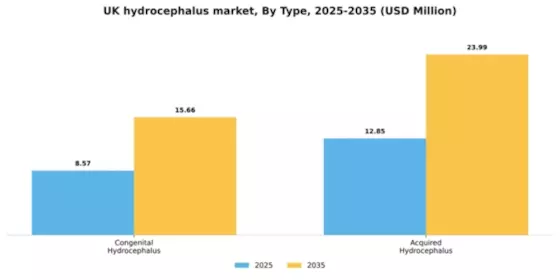
In the UK hydrocephalus market, the distribution of market share among segment values reveals that Congenital Hydrocephalus holds a significant portion of the overall market. This type is commonly observed in newborns and is often diagnosed shortly after birth, contributing to its larger market share relative to Acquired Hydrocephalus, which develops due to various external factors. While Congenital Hydrocephalus remains prevalent, the Acquired Hydrocephalus segment is capturing attention due to its increasing incidence rates in older populations and those with head injuries. The growth trends for these segments indicate that Acquired Hydrocephalus is on the rise, driven by factors such as an increase in traumatic brain injuries, an aging population, and advancements in diagnostic techniques. Conversely, Congenital Hydrocephalus continues to maintain its position due to ongoing awareness and early diagnosis strategies. The divergence in growth trends highlights a dynamic landscape where Acquired Hydrocephalus is emerging as a critical area for innovation and development in treatment options.
Congenital Hydrocephalus (Dominant) vs. Acquired Hydrocephalus (Emerging)
Congenital Hydrocephalus is characterized by an accumulation of cerebrospinal fluid due to developmental issues, often leading to increased intracranial pressure. This segment is dominant in the UK hydrocephalus market, driven by early diagnosis initiatives and healthcare support targeting newborns. On the other hand, Acquired Hydrocephalus, which stems from various causes such as tumors, infections, or trauma, is emerging rapidly. The latter is gaining traction as recognition of its effects increases, particularly in older demographics and trauma patients. As awareness grows and new technologies are developed for treatment, Acquired Hydrocephalus is expected to see significant advancements in management and care, altering the landscape of hydrocephalus treatment in the region.
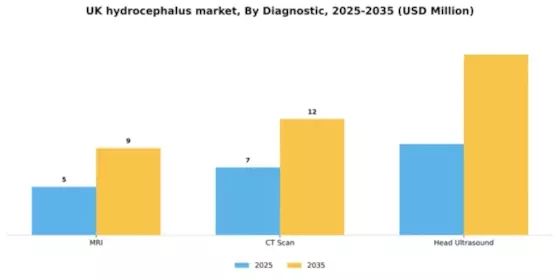
In the UK hydrocephalus market, the diagnostic segment is notably led by MRI, commanding the largest share due to its high accuracy and effectiveness in diagnosing brain abnormalities. CT Scan and Head Ultrasound follow as important modalities, with CT Scan experiencing notable interest thanks to its quicker processing abilities and advanced imaging capabilities, making it a preferred choice in urgent care settings. The growth trends in the diagnostic segment are influenced by advancements in imaging technology and an increasing prevalence of hydrocephalus among the population. The rise in awareness among healthcare professionals regarding the importance of early diagnosis also significantly drives the demand for these diagnostic modalities. Furthermore, ongoing research and development efforts aimed at improving imaging techniques will likely continue to shape the trajectory of the market.
MRI (Dominant) vs. CT Scan (Emerging)
MRI remains the dominant force within the diagnostic segment due to its unmatched imaging precision and ability to provide detailed views of neural structures, which are crucial for effective diagnosis of hydrocephalus. Its non-invasive nature and absence of ionizing radiation further enhance its appeal. In contrast, CT Scan emerges as a vital option for rapid diagnosis, especially in emergency scenarios, owing to its speed and efficiency. While both modalities are essential, the reliance on MRI for detailed imaging keeps it at the forefront of the market. However, as technology evolves, CT Scan is quickly establishing itself as an emerging competitor by offering enhanced features such as 3D reconstruction and real-time imaging capabilities.
In the UK hydrocephalus market, the Shunt Insertion Procedure holds the largest market share, making it the preferred choice for managing hydrocephalus. This procedure has established itself as a fundamental surgical intervention, thoroughly trusted by healthcare professionals for its effectiveness. On the other hand, Ventriculostomy is emerging rapidly, gaining significant traction among surgical options due to its minimally invasive approach and growing acceptance in clinical practice. The growth trends in this segment are primarily driven by advancements in surgical techniques and technologies, alongside an increasing prevalence of hydrocephalus. Innovations in shunt technology enhance treatment outcomes and patient satisfaction, supporting further adoption. Additionally, the rising awareness regarding hydrocephalus management contributes to an expanding market for both Shunt Insertion and Ventriculostomy, positioning them as key players in the surgical landscape.
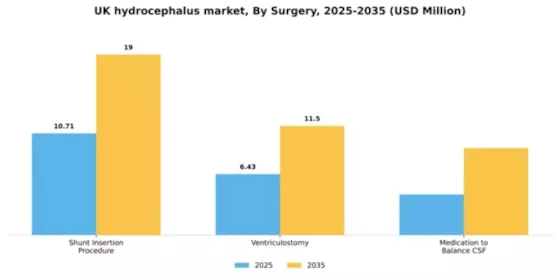
Shunt Insertion Procedure (Dominant) vs. Ventriculostomy (Emerging)
Shunt Insertion Procedures are well-established in the UK hydrocephalus market, characterized by their extensive usage for hydrocephalus management, providing effective CSF diversion. This procedure is favored for its long-standing history and proven efficacy. In contrast, Ventriculostomy represents an emerging alternative, gaining ground due to its lesser invasiveness and quicker recovery time. The rise of Ventriculostomy is supported by ongoing clinical studies highlighting its effectiveness, thereby attracting interest from both surgeons and patients. As these two options evolve, the dynamics between Shunt Insertion Procedures and Ventriculostomy are shaping the future of surgical interventions within the market.
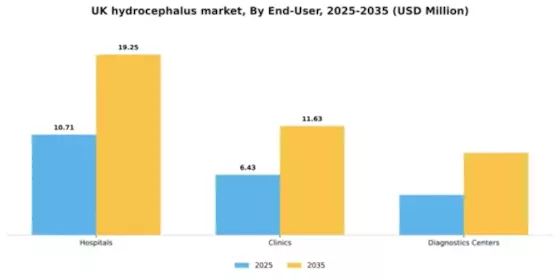
In the UK hydrocephalus market, the distribution of market share among end-users shows a clear dominance of hospitals, which account for a significant majority of the overall share. Clinics are emerging as a growing segment due to increased outpatient care and accessibility, but they still lag behind the established presence of hospitals. Diagnostics centers, while essential, contribute a smaller portion to the overall market dynamics, focusing primarily on specific testing and diagnosis rather than broader hydrocephalus treatment. Growth trends in this segment are largely driven by the rising prevalence of hydrocephalus and the subsequent demand for specialized healthcare services. Hospitals benefit from their comprehensive treatment capabilities and advanced technologies, making them the preferred choice for patients. However, clinics are rapidly evolving by incorporating innovative treatment methods and expanding their service offerings, which enhances patient access and convenience, thus positioning them as the fastest-growing segment in this market.
Hospitals (Dominant) vs. Clinics (Emerging)
Hospitals stand out as the dominant force in the UK hydrocephalus market, leveraging their extensive resources, advanced treatment technologies, and comprehensive service offerings. They are equipped to manage complex cases, which is crucial for hydrocephalus treatment. On the other hand, clinics represent an emerging segment, focusing on personalized patient care and streamlined services. Their ability to provide outpatient treatment and increase accessibility is reshaping patient choices. As clinics adopt advanced diagnostic and treatment techniques, they are gaining traction among patients seeking more localized and immediate care, positioning themselves as a key player in the future of the market.
Get more detailed insights about UK Hydrocephalus Market Request Free Sample
The hydrocephalus market exhibits a competitive landscape characterized by a blend of innovation, strategic partnerships, and regional expansion. Key players such as Medtronic (US), Johnson & Johnson (US), and Stryker (US) are at the forefront, leveraging their extensive portfolios and technological advancements to capture market share. Medtronic (US) focuses on enhancing its product offerings through continuous innovation, while Johnson & Johnson (US) emphasizes strategic acquisitions to bolster its capabilities in neurosurgery. Stryker (US) appears to be concentrating on expanding its global footprint, particularly in emerging markets, thereby intensifying competition within the sector.The market structure is moderately fragmented, with several players vying for dominance. Companies are increasingly localizing manufacturing and optimizing supply chains to enhance efficiency and reduce costs. This trend not only strengthens their competitive positions but also allows for quicker responses to market demands. The collective influence of these key players shapes a dynamic environment where innovation and operational excellence are paramount.
In September Medtronic (US) announced the launch of a new programmable valve designed to improve the management of hydrocephalus. This innovation is significant as it addresses the need for more precise control over cerebrospinal fluid flow, potentially enhancing patient outcomes. Such advancements underscore Medtronic's commitment to leading the market through technological innovation.
In August Johnson & Johnson (US) completed the acquisition of a promising neurotechnology startup, which specializes in advanced imaging techniques for hydrocephalus diagnosis. This strategic move is likely to enhance Johnson & Johnson's diagnostic capabilities, positioning the company to offer comprehensive solutions that integrate both surgical and diagnostic technologies, thereby reinforcing its competitive edge.
In October Stryker (US) expanded its product line by introducing a new minimally invasive surgical tool aimed at hydrocephalus treatment. This development not only reflects Stryker's focus on innovation but also aligns with the growing trend towards less invasive procedures, which are increasingly preferred by both patients and healthcare providers. Such advancements may significantly influence surgical practices in the treatment of hydrocephalus.
As of November the hydrocephalus market is witnessing trends such as digitalization, sustainability, and the integration of artificial intelligence (AI) into medical devices. Strategic alliances among companies are becoming more prevalent, fostering collaboration that enhances product development and market reach. The competitive differentiation is likely to evolve, shifting from price-based competition to a focus on innovation, technological advancements, and supply chain reliability. This transition suggests that companies that prioritize these aspects will be better positioned to thrive in the future.






Recent developments in the UK Hydrocephalus Market indicate an increased focus on enhancing treatment options for patients. Boston Scientific and Medtronic are actively engaging in Research and Development to advance their hydrocephalus management solutions, integrating innovative technologies into their product lines.
Current affairs reflect growing emphasis on awareness campaigns, led by various healthcare organizations, aimed at educating the public and medical communities about hydrocephalus challenges.
In terms of mergers and acquisitions, there have been no publicly reported activities involving the companies of interest, such as Stryker, Teleflex, and Integra LifeSciences, indicating a stable yet competitive landscape in the market as of October 2023.
Market valuation growth, spurred by technological advancements and improved healthcare accessibility, is positively impacting the hydrocephalus treatment sector. Over the past few years, significant moves such as notable advancements in shunt technologies were made in September 2022, further contributing to evolving patient care standards.
The UK government has been focusing on improving neurological health services, which aligns with the increasing demand for effective hydrocephalus management solutions across the healthcare system in the region.
The Hydrocephalus Market is projected to grow at a 5.76% CAGR from 2025 to 2035, driven by advancements in treatment technologies and increasing awareness.
New opportunities lie in:
By 2035, the hydrocephalus market is expected to achieve substantial growth and enhanced treatment options.
| MARKET SIZE 2024 | 21.42(USD Million) |
| MARKET SIZE 2025 | 22.65(USD Million) |
| MARKET SIZE 2035 | 39.66(USD Million) |
| COMPOUND ANNUAL GROWTH RATE (CAGR) | 5.76% (2025 - 2035) |
| REPORT COVERAGE | Revenue Forecast, Competitive Landscape, Growth Factors, and Trends |
| BASE YEAR | 2024 |
| Market Forecast Period | 2025 - 2035 |
| Historical Data | 2019 - 2024 |
| Market Forecast Units | USD Million |
| Key Companies Profiled | Medtronic (US), Johnson & Johnson (US), Stryker (US), B. Braun Melsungen AG (DE), Integra LifeSciences (US), Codman Neuro (US), Natus Medical Incorporated (US), NeuroPace (US) |
| Segments Covered | Type, Diagnostic, Surgery, End-User |
| Key Market Opportunities | Advancements in minimally invasive surgical techniques enhance treatment options in the hydrocephalus market. |
| Key Market Dynamics | Rising demand for innovative treatment options drives competition and regulatory scrutiny in the hydrocephalus market. |
| Countries Covered | UK |
The overall market valuation was $21.42 Million in 2024.
The projected valuation for 2035 is $39.66 Million.
The expected CAGR for the market during this period is 5.76%.
Key players include Medtronic, Johnson & Johnson, Stryker, B. Braun Melsungen AG, Integra LifeSciences, Codman Neuro, Natus Medical Incorporated, and NeuroPace.
The market segments include Type, Diagnostic, Surgery, and End-User.
The valuation for congenital hydrocephalus was $8.57 Million in 2024.
The projected valuation for acquired hydrocephalus by 2035 is $23.99 Million.
Diagnostic methods include MRI, CT Scan, and Head Ultrasound.
The valuation for shunt insertion procedures was $10.71 Million in 2024.
The valuation for hospitals as end-users is expected to grow from $10.71 Million in 2024 to $19.25 Million by 2035.



Kindly complete the form below to receive a free sample of this Report

“This is really good guys. Excellent work on a tight deadline. I will continue to use you going forward and recommend you to others. Nice job”


“Thanks. It’s been a pleasure working with you, please use me as reference with any other Intel employees.”


“Thanks for sending the report it gives us a good global view of the Betaïne market.”


“Thank you, this will be very helpful for OQS.”


“We found the report very insightful! we found your research firm very helpful. I'm sending this email to secure our future business.”


“I am very pleased with how market segments have been defined in a relevant way for my purposes (such as "Portable Freezers & refrigerators" and "last-mile"). In general the report is well structured. Thanks very much for your efforts.”


“I have been reading the first document or the study, ,the Global HVAC and FP market report 2021 till 2026. Must say, good info! I have not gone in depth at all parts, but got a good indication of the data inside!”


“We got the report in time, we really thank you for your support in this process. I also thank to all of your team as they did a great job.”


“The Automotive 48V ECU Components Procurement Intelligence Study” was a complex project, but the Market Research Future (MRFR) team handled it with quality, agility, and customer-centricity. They delivered all requested data on time and within the agreed scope. The team, including Shubhendra Anand and Rahul Gotadki, was always readily available to clarify questions and swiftly implement necessary adjustments, driving the project to a successful conclusion within a very demanding timeframe.
I would also like to specifically commend Akshay Agarwal for his responsiveness and support at every stage—from our initial inquiry on May 6th through to final delivery on June 18th. His dedication made the entire process seamless.”



