Download Free Sample
Kindly complete the form below to receive a free sample of this Report
UK Personal Mobility Devices Market Research Report: Size, Share, Trend Analysis By Product (Walking Aids, Wheelchairs, Scooters) and By End Users (Hospitals, Homecare, Others) - Growth Outlook & Industry Forecast 2025 To 2035
As per Market Research Future analysis, the UK personal mobility-devices market Size was estimated at 456.49 USD Million in 2024. The UK personal mobility-devices market industry is projected to grow from 484.79 USD Million in 2025 to 885.0 USD Million by 2035, exhibiting a compound annual growth rate (CAGR) of 6% during the forecast period 2025 - 2035
The UK personal mobility-devices market is experiencing a transformative shift driven by technological advancements and sustainability initiatives.
| 2024 Market Size | 456.49 (USD Million) |
| 2035 Market Size | 885.0 (USD Million) |
| CAGR (2025 - 2035) | 6.2% |
Segway (US), Xiaomi (CN), Ninebot (CN), Razor (US), InMotion (CN), Unagi (US), Boosted (US), E-Twow (FR)
Our Impact
Enabled $4.3B Revenue Impact for Fortune 500 and Leading Multinationals
Partnering with 2000+ Global Organizations Each Year
30K+ Citations by Top-Tier Firms in the Industry
The personal mobility-devices market is currently experiencing a notable transformation, driven by advancements in technology and changing consumer preferences. As individuals seek more efficient and sustainable means of transportation, the demand for various mobility devices, such as electric scooters, wheelchairs, and mobility scooters, is on the rise. This shift is further influenced by urbanization trends, where densely populated areas require innovative solutions to alleviate congestion and enhance accessibility. The integration of smart technology into these devices is also becoming increasingly prevalent, offering users enhanced features such as GPS navigation and connectivity options. Moreover, the regulatory landscape is evolving to accommodate the growing popularity of personal mobility devices. Authorities are implementing guidelines to ensure safety and promote responsible usage. This regulatory support, combined with a heightened awareness of environmental issues, suggests a promising future for the personal mobility-devices market. As consumers become more conscious of their carbon footprint, the appeal of electric and eco-friendly options is likely to expand, potentially reshaping the market dynamics in the coming years.
The personal mobility-devices market is witnessing rapid technological innovations, particularly in battery efficiency and smart features. Enhanced battery life and faster charging capabilities are making devices more user-friendly and practical for daily use. Additionally, the incorporation of smart technology, such as mobile app integration and real-time tracking, is appealing to tech-savvy consumers.
There is a growing emphasis on sustainability within the personal mobility-devices market. Consumers are increasingly prioritizing eco-friendly options, leading to a rise in the popularity of electric and hybrid devices. This trend aligns with broader environmental goals and reflects a shift towards greener transportation solutions.
The regulatory framework surrounding personal mobility devices is evolving to address safety and usage concerns. Governments are establishing guidelines to ensure safe operation in public spaces, which may enhance consumer confidence and encourage wider adoption of these devices.
The demographic shift towards an aging population in the UK significantly influences the personal mobility-devices market. As the population ages, there is a heightened need for mobility solutions that cater to the elderly, who may face challenges in traditional transportation. Personal mobility devices, such as mobility scooters and powered wheelchairs, offer independence and ease of movement for older adults. Recent statistics indicate that approximately 18% of the UK population is over 65, a figure projected to rise. This demographic trend suggests a growing market for personal mobility devices tailored to the needs of seniors, thereby driving innovation and investment in this sector.
The ongoing trend of urbanisation in the UK is a pivotal driver for the personal mobility-devices market. As more individuals migrate to urban areas, the demand for efficient and compact transportation solutions rises. Urban environments often face congestion and limited parking, making traditional vehicles less practical. Consequently, personal mobility devices, such as e-scooters and electric bikes, are becoming increasingly popular. According to recent data, urban areas in the UK have seen a 25% increase in the adoption of these devices over the past year. This shift not only addresses transportation challenges but also aligns with the growing preference for eco-friendly alternatives, further propelling the personal mobility-devices market.
An increasing awareness of health and fitness among the UK population is emerging as a significant driver for the personal mobility-devices market. Many individuals are seeking alternatives to sedentary lifestyles, leading to a surge in the use of personal mobility devices for recreational purposes. E-bikes and scooters are not only seen as convenient transportation options but also as tools for promoting physical activity. Recent surveys indicate that around 40% of UK residents are considering personal mobility devices as a means to incorporate exercise into their daily routines. This trend is likely to enhance the appeal of the personal mobility-devices market, as consumers prioritize health and wellness.
The integration of advanced technologies into personal mobility devices is a crucial driver for market growth in the UK. Innovations such as smart connectivity, GPS navigation, and enhanced battery efficiency are transforming the user experience. Consumers are increasingly attracted to devices that offer features like app integration for tracking usage and maintenance. The personal mobility-devices market is witnessing a surge in demand for tech-savvy solutions, with a reported 30% increase in sales of smart-enabled devices over the last year. This technological evolution not only enhances convenience but also aligns with the expectations of a tech-oriented consumer base.
Government initiatives aimed at promoting sustainable transportation are playing a vital role in shaping the personal mobility-devices market. The UK government has introduced various funding schemes and incentives to encourage the adoption of eco-friendly mobility solutions. These initiatives include grants for purchasing electric scooters and bikes, as well as investments in infrastructure to support their use. Recent reports indicate that government funding for personal mobility devices has increased by 15% in the past year, reflecting a commitment to reducing carbon emissions and enhancing urban mobility. Such support is likely to stimulate growth in the personal mobility-devices market, making these solutions more accessible to a broader audience.
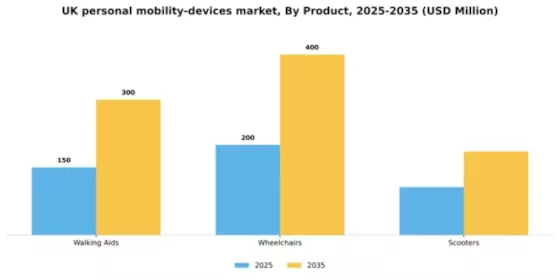
In the UK personal mobility-devices market, the distribution of market share among the product segments shows that Walking Aids lead with a substantial share, catering to a diverse user base. Meanwhile, Wheelchairs also hold a significant position, though slightly less than Walking Aids, providing essential support for various mobility challenges. Scooters, while smaller in market share compared to Walking Aids and Wheelchairs, are gaining traction as a popular mobility solution. Growth trends in the UK personal mobility-devices market are increasingly driven by technological advancements and an aging population. With a rising demand for independence among the elderly, the popularity of scooters is on the rise, making them the fastest-growing segment. This growth is supported by innovations in design, enhancing comfort and ease of use. The increasing focus on accessibility further propels the market for all product segments, including the traditional yet essential Walking Aids.
Walking Aids: Dominant vs. Scooters: Emerging
Walking Aids have established themselves as the dominant segment within the UK personal mobility-devices market due to their widespread usage and essential role in improving mobility for individuals with varying levels of mobility challenges. They encompass a range of devices such as canes and walkers, which are crucial for enhancing user independence and safety. In contrast, Scooters represent an emerging segment that is rapidly gaining popularity, especially among younger, independent users looking for efficient mobility solutions. Their appeal lies in their ability to offer both convenience and speed, making them an attractive option for those seeking portable and user-friendly mobility aids. The contrasting characteristics of these segments reflect the diverse needs and preferences of users in the mobility market.
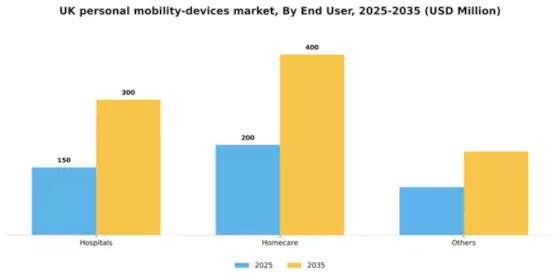
In the UK personal mobility-devices market, the distribution of market share among end users shows a significant portion attributed to hospitals, which are the largest consumers of mobility devices. They account for a substantial fraction of the market due to their extensive patient care requirements, leading to stable demand and consistent growth. Conversely, homecare services are gaining traction among users seeking mobility solutions for aging populations and individuals with disabilities, resulting in a dedicated share that has been steadily increasing. Growth trends within the end user segment are primarily driven by an increasing aging population and rising cases of mobility impairments. The push towards homecare services is indicative of a broader trend towards decentralized healthcare, emphasizing patient comfort and independence. Hospitals continue to evolve to meet higher patient care needs, while homecare's growth reflects changing societal values towards aging and health, bolstered by technological advancements and supportive government policies.
Hospitals (Dominant) vs. Homecare (Emerging)
Hospitals, as the dominant end user in the UK personal mobility-devices market, prioritize a range of mobility solutions that enhance patient care and recovery. Their focus on advanced devices enables seamless integration into medical protocols, thereby ensuring higher standards of patient management. Homecare, on the other hand, represents an emerging sector that caters to individuals who prefer or require mobility devices in their own living environments. The rise in demand for homecare solutions is a reflection of a growing desire for personalized healthcare. With advancements in technology and a shift towards rehabilitation at home, homecare devices are increasingly being tailored to meet the specific needs of users, promoting autonomy and a better quality of life.
Get more detailed insights about UK Personal Mobility Devices Market Request Free Sample
The personal mobility-devices market is currently characterized by a dynamic competitive landscape, driven by innovation, sustainability, and technological advancements. Key players such as Segway (US), Xiaomi (CN), and Razor (US) are actively shaping the market through strategic initiatives. Segway (US) focuses on enhancing its product offerings with advanced features, while Xiaomi (CN) leverages its extensive ecosystem to integrate mobility devices with smart technology. Razor (US) emphasizes affordability and accessibility, appealing to a broader consumer base. Collectively, these strategies foster a competitive environment that prioritizes innovation and consumer engagement.In terms of business tactics, companies are increasingly localizing manufacturing to mitigate supply chain disruptions and optimize costs. The market structure appears moderately fragmented, with several players vying for market share. This fragmentation allows for diverse offerings, yet the influence of major companies remains significant, as they set trends and standards that smaller firms often follow.
In October Segway (US) announced a partnership with a leading tech firm to develop AI-driven features for its scooters, aiming to enhance user experience and safety. This strategic move underscores Segway's commitment to innovation and positions it favorably against competitors. The integration of AI technology could potentially redefine user interaction with mobility devices, making them more intuitive and responsive.
In September Xiaomi (CN) launched a new line of electric scooters that incorporate smart connectivity features, allowing users to control their devices via a mobile app. This initiative not only aligns with Xiaomi's broader strategy of creating a connected ecosystem but also enhances user convenience and engagement. The introduction of such features may attract tech-savvy consumers, further solidifying Xiaomi's market position.
In August Razor (US) expanded its product line to include eco-friendly scooters made from sustainable materials. This move reflects a growing trend towards sustainability within the industry and caters to environmentally conscious consumers. By prioritizing eco-friendly practices, Razor (US) not only differentiates itself but also aligns with global sustainability goals, potentially increasing its appeal in a competitive market.
As of November the personal mobility-devices market is witnessing trends such as digitalization, sustainability, and the integration of AI technologies. Strategic alliances are becoming increasingly important, as companies collaborate to enhance their technological capabilities and market reach. Looking ahead, competitive differentiation is likely to evolve from traditional price-based competition to a focus on innovation, technology integration, and supply chain reliability. This shift suggests that companies that prioritize these aspects will be better positioned to thrive in an increasingly competitive landscape.






The UK Personal Mobility Devices Market has seen significant developments recently, particularly with innovations and regulatory adaptations focusing on enhancing mobility for individuals with disabilities and elderly populations. Companies like Drive DeVilbiss Healthcare and Invacare continue to advance their product lines, addressing the increasing demand for electric mobility scooters and powered wheelchairs. In October 2022, KYMCO Healthcare launched an upgraded version of its popular scooter, catering to both performance and comfort. Notable mergers have also occurred; for instance, PaceSaver acquired certain assets of a competitor in August 2023, enabling a broader product offering and enhanced market presence.
The valuation of firms within the market is expected to grow due to rising awareness and acceptance of mobility aids, alongside supportive government policies promoting accessibility. Furthermore, developments in artificial intelligence and battery technology promise to revolutionize product efficacy and user experience. The market anticipates ongoing growth as more companies, including Permobil and Sunrise Medical, focus on Research and Development for innovative solutions, continuously pushing the boundaries of personal mobility devices. Recent policy initiatives from the UK government underscore its commitment to fostering an inclusive environment for mobility-impaired individuals, thus supporting the industry’s ongoing evolution.
The Personal Mobility Devices Market is projected to grow at a 6.2% CAGR from 2025 to 2035, driven by technological advancements, urbanization, and increasing demand for eco-friendly transport solutions.
New opportunities lie in:
By 2035, the market is expected to achieve substantial growth, driven by innovation and evolving consumer preferences.
| MARKET SIZE 2024 | 456.49(USD Million) |
| MARKET SIZE 2025 | 484.79(USD Million) |
| MARKET SIZE 2035 | 885.0(USD Million) |
| COMPOUND ANNUAL GROWTH RATE (CAGR) | 6.2% (2025 - 2035) |
| REPORT COVERAGE | Revenue Forecast, Competitive Landscape, Growth Factors, and Trends |
| BASE YEAR | 2024 |
| Market Forecast Period | 2025 - 2035 |
| Historical Data | 2019 - 2024 |
| Market Forecast Units | USD Million |
| Key Companies Profiled | Segway (US), Xiaomi (CN), Ninebot (CN), Razor (US), InMotion (CN), Unagi (US), Boosted (US), E-Twow (FR) |
| Segments Covered | Product, End User |
| Key Market Opportunities | Integration of smart technology in personal mobility-devices enhances user experience and safety features. |
| Key Market Dynamics | Growing demand for eco-friendly personal mobility devices drives innovation and regulatory adaptations in the UK market. |
| Countries Covered | UK |
The market valuation was $456.49 Million in 2024.
The projected valuation for 2035 is $885.0 Million.
The expected CAGR during this period is 6.2%.
In 2024, the Wheelchairs segment had the highest valuation, ranging from $200.0 Million to $400.0 Million.
Key players include Segway, Xiaomi, Ninebot, Razor, InMotion, Unagi, Boosted, and E-Twow.
The Walking Aids segment had a valuation between $150.0 Million and $300.0 Million in 2024.
The Homecare end-user segment had a valuation range of $200.0 Million to $400.0 Million in 2024.
The market is expected to grow significantly, reaching $885.0 Million by 2035.
The Others end-user segment had the lowest valuation, ranging from $106.49 Million to $185.0 Million in 2024.
The Scooters product segment had a valuation range of $106.49 Million to $185.0 Million in 2024.


Kindly complete the form below to receive a free sample of this Report

“This is really good guys. Excellent work on a tight deadline. I will continue to use you going forward and recommend you to others. Nice job”


“Thanks. It’s been a pleasure working with you, please use me as reference with any other Intel employees.”


“Thanks for sending the report it gives us a good global view of the Betaïne market.”


“Thank you, this will be very helpful for OQS.”


“We found the report very insightful! we found your research firm very helpful. I'm sending this email to secure our future business.”


“I am very pleased with how market segments have been defined in a relevant way for my purposes (such as "Portable Freezers & refrigerators" and "last-mile"). In general the report is well structured. Thanks very much for your efforts.”


“I have been reading the first document or the study, ,the Global HVAC and FP market report 2021 till 2026. Must say, good info! I have not gone in depth at all parts, but got a good indication of the data inside!”


“We got the report in time, we really thank you for your support in this process. I also thank to all of your team as they did a great job.”


“The Automotive 48V ECU Components Procurement Intelligence Study” was a complex project, but the Market Research Future (MRFR) team handled it with quality, agility, and customer-centricity. They delivered all requested data on time and within the agreed scope. The team, including Shubhendra Anand and Rahul Gotadki, was always readily available to clarify questions and swiftly implement necessary adjustments, driving the project to a successful conclusion within a very demanding timeframe.
I would also like to specifically commend Akshay Agarwal for his responsiveness and support at every stage—from our initial inquiry on May 6th through to final delivery on June 18th. His dedication made the entire process seamless.”



