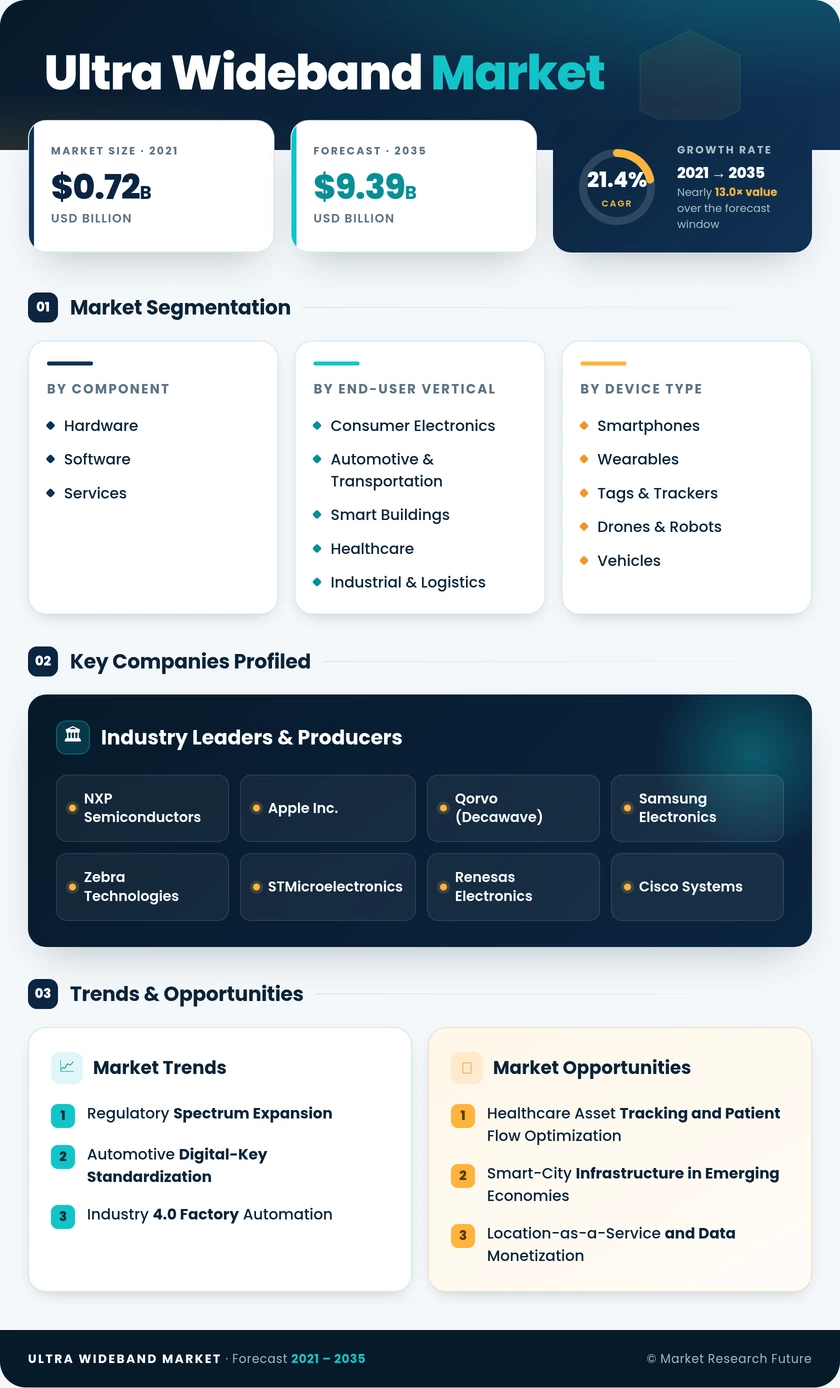
Ultra WideBand Market

ID: MRFR/ICT/1747-HCR
100 Pages
Aarti Dhapte
Last Updated: June 22, 2026
Ultra WideBand Market Size, Share and Research Report By Component (Hardware, Software, Services), By End-User Vertical (Consumer Electronics, Automotive & Transportation, Smart Buildings, Healthcare, Industrial & Logistics), By Device Type (Smartphones, Wearables, Tags & Trackers, Drones & Robots, Vehicles), By Frequency Band (6–10.6 GHz, 3.1–4.8 GHz), By Range Capability (Short-Range, Medium-Range, Long-Range), By Application (Real-Time Location Systems (RTLS), Secure Digital Keys, AR/VR Spatial Mapping, Peer-to-Peer Ranging, Data Transfer) and By Regional (North America, Europe, South America, Asia Pacific, Middle East and Africa) - Industry Forecast to 2035
Download PDF ×

We do not share your information with anyone. However, we may send you emails based on your report interest from time to time. You may contact us at any time to opt-out.

  1. 1 Market Overview |
    1. 1.1 Study Assumptions & Market Definition |
    2. 1.2 Scope of the Study |
    3. 1.3 Research Methodology
  2. 2 Market Summary & Key Takeaways
  3. 3 Market Dynamics |
    1. 3.1 Market Drivers Analysis | |
      1. 3.1.1 Regulatory Spectrum Expansion (EU, China, FCC) | |
      2. 3.1.2 Automotive Digital-Key Standardization | |
      3. 3.1.3 Industry
    2. 4.0 Factory Automation Adoption | |
      1. 3.1.4 Consumer Electronics Ecosystem Lock-In | |
      2. 3.1.5 Healthcare RTLS Regulatory Mandates | |
      3. 3.1.6 Smart-Building Energy Compliance Standards | |
      4. 3.1.7 AR/VR Spatial Computing Integration |
    3. 3.2 Market Restraints Analysis | |
      1. 3.2.1 Sub-28 nm Chip Supply Constraints | |
      2. 3.2.2 BLE Angle-of-Arrival Cost Competition | |
      3. 3.2.3 Interoperability and Certification Fragmentation | |
      4. 3.2.4 Spectrum Interference from 5G NR-U Coexistence | |
      5. 3.2.5 Enterprise Integration Complexity |
    4. 3.3 Market Opportunity Analysis | |
      1. 3.3.1 Healthcare Asset Tracking and Patient Flow Optimization | |
      2. 3.3.2 Smart-City Infrastructure in Emerging Economies | |
      3. 3.3.3 Location-as-a-Service and Data Monetization | |
      4. 3.3.4 Automotive V2X and Autonomous Parking | |
      5. 3.3.5 6G Pre-Standard Positioning Integration |
    5. 3.4 Industry Value Chain Analysis |
    6. 3.5 Porter's Five Forces Analysis
  4. 4 Global Ultra-WideBand Market Size & Forecast (2021–2035) |
    1. 4.1 Historical Market Size (2021–2025) |
    2. 4.2 Current & Forecast Market Size (2026–2035) |
    3. 4.3 Market Size by Revenue (USD Billion) |
    4. 4.4 Year-over-Year Growth Analysis
  5. 5 Segmentation Analysis |
    1. 5.1 By Component | |
      1. 5.1.1 Hardware | |
      2. 5.1.2 Software | |
      3. 5.1.3 Services |
    2. 5.2 By End-User Vertical | |
      1. 5.2.1 Consumer Electronics | |
      2. 5.2.2 Automotive & Transportation | |
      3. 5.2.3 Smart Buildings | |
      4. 5.2.4 Healthcare | |
      5. 5.2.5 Industrial & Logistics |
    3. 5.3 By Device Type | |
      1. 5.3.1 Smartphones | |
      2. 5.3.2 Wearables | |
      3. 5.3.3 Tags & Trackers | |
      4. 5.3.4 Drones & Robots | |
      5. 5.3.5 Vehicles |
    4. 5.4 By Frequency Band | |
      1. 5.4.1 6–10.6 GHz | |
    5. 3.1–4.8 GHz |
    6. 5.5 By Range Capability | |
      1. 5.5.1 Short-Range | |
      2. 5.5.2 Medium-Range | |
      3. 5.5.3 Long-Range |
    7. 5.6 By Application | |
      1. 5.6.1 Real-Time Location Systems (RTLS) | |
      2. 5.6.2 Secure Digital Keys | |
      3. 5.6.3 AR/VR Spatial Mapping | |
      4. 5.6.4 Peer-to-Peer Ranging | |
      5. 5.6.5 Data Transfer
  6. 6 Regional Analysis |
    1. 6.1 North America | |
      1. 6.1.1 United States | |
      2. 6.1.2 Canada | |
      3. 6.1.3 Mexico |
    2. 6.2 Europe | |
      1. 6.2.1 Germany | |
      2. 6.2.2 United Kingdom | |
      3. 6.2.3 France | |
      4. 6.2.4 Italy | |
      5. 6.2.5 Spain | |
      6. 6.2.6 Nordic Countries | |
      7. 6.2.7 Russia | |
      8. 6.2.8 Rest of Europe |
    3. 6.3 Asia-Pacific | |
      1. 6.3.1 China | |
      2. 6.3.2 India | |
      3. 6.3.3 Japan | |
      4. 6.3.4 South Korea | |
      5. 6.3.5 ASEAN | |
      6. 6.3.6 Rest of Asia-Pacific |
    4. 6.4 South America | |
      1. 6.4.1 Brazil | |
      2. 6.4.2 Argentina | |
      3. 6.4.3 Rest of South America |
    5. 6.5 Middle East & Africa | |
      1. 6.5.1 Saudi Arabia | |
      2. 6.5.2 UAE | |
      3. 6.5.3 South Africa | |
      4. 6.5.4 Egypt | |
      5. 6.5.5 Rest of MEA
  7. 7 Competitive Landscape |
    1. 7.1 Market Share Analysis (2025) |
    2. 7.2 Competitive Benchmarking Matrix |
    3. 7.3 Company Profiles | |
      1. 7.3.1 NXP Semiconductors | |
      2. 7.3.2 Apple Inc. | |
      3. 7.3.3 Qorvo (Decawave) | |
      4. 7.3.4 Samsung Electronics | |
      5. 7.3.5 Zebra Technologies | |
      6. 7.3.6 STMicroelectronics | |
      7. 7.3.7 Renesas Electronics | |
      8. 7.3.8 Cisco Systems | |
      9. 7.3.9 Ubisense Group | |
      10. 7.3.10 Sewio Networks
  8. 8 Future Outlook & Strategic Recommendations (2026–2035) |
    1. 8.1 AI-Driven Spatial Intelligence |
    2. 8.2 Platform Economics and Ecosystem Consolidation |
    3. 8.3 Sustainability and ESG-Driven Adoption |
    4. 8.4 6G Convergence and Next-Generation Positioning
  9. 9 Recent Developments & News
  10. 10 Frequently Asked Questions (FAQs)
  11. 11 Report Scope & Methodology |
    1. 11.1 Study Period & Base Year |
    2. 11.2 Data Sources & Citations |
    3. 11.3 Abbreviations
  12. 12 LIST OF TABLES |
  13. TABLE 1 Global Ultra-WideBand Market Size & Forecast, by Revenue (USD Billion), 2021–2035 |
  14. TABLE 2 Global Ultra-WideBand Market — Year-over-Year Growth Analysis, 2021–2035 |
  15. TABLE 3 Global Ultra-WideBand Market — Driver Impact Analysis |
  16. TABLE 4 Global Ultra-WideBand Market — Restraint Impact Analysis |
  17. TABLE 5 Global Ultra-WideBand Market Size, by Component, 2021–2035 (USD Billion) |
  18. TABLE 6 Global Ultra-WideBand Market Size, by End-User Vertical, 2021–2035 (USD Billion) |
  19. TABLE 7 Global Ultra-WideBand Market Size, by Device Type, 2021–2035 (USD Billion) |
  20. TABLE 8 Global Ultra-WideBand Market Size, by Frequency Band, 2021–2035 (USD Billion) |
  21. TABLE 9 Global Ultra-WideBand Market Size, by Range Capability, 2021–2035 (USD Billion) |
  22. TABLE 10 Global Ultra-WideBand Market Size, by Application, 2021–2035 (USD Billion) |
  23. TABLE 11 Global Ultra-WideBand Market Size, by Region, 2021–2035 (USD Billion) |
  24. TABLE 12 Regional Market Summary — Ultra-WideBand Market, 2025 |
  25. TABLE 13 North America Ultra-WideBand Market Size, by Country, 2021–2035 (USD Billion) |
  26. TABLE 14 Europe Ultra-WideBand Market Size, by Country, 2021–2035 (USD Billion) |
  27. TABLE 15 Asia-Pacific Ultra-WideBand Market Size, by Country, 2021–2035 (USD Billion) |
  28. TABLE 16 South America Ultra-WideBand Market Size, by Country, 2021–2035 (USD Billion) |
  29. TABLE 17 Middle East & Africa Ultra-WideBand Market Size, by Country, 2021–2035 (USD Billion) |
  30. TABLE 18 Competitive Benchmarking Matrix — Ultra-WideBand Market, 2025 |
  31. TABLE 19 Company Profiles — Key Players, Ultra-WideBand Market |
  32. TABLE 20 Recent Developments & Strategic Announcements, 2023–2025 |
  33. TABLE 21 Report Scope & Methodology Summary |
  34. TABLE 22 Detailed Sources and Citations |
  35. TABLE 23 North America Ultra-WideBand Market Size, by Component, 2021–2035 (USD Billion) |
  36. TABLE 24 North America Ultra-WideBand Market Size, by End-User Vertical, 2021–2035 (USD Billion) |
  37. TABLE 25 North America Ultra-WideBand Market Size, by Device Type, 2021–2035 (USD Billion) |
  38. TABLE 26 North America Ultra-WideBand Market Size, by Frequency Band, 2021–2035 (USD Billion) |
  39. TABLE 27 North America Ultra-WideBand Market Size, by Range Capability, 2021–2035 (USD Billion) |
  40. TABLE 28 North America Ultra-WideBand Market Size, by Application, 2021–2035 (USD Billion) |
  41. TABLE 29 Europe Ultra-WideBand Market Size, by Component, 2021–2035 (USD Billion) |
  42. TABLE 30 Europe Ultra-WideBand Market Size, by End-User Vertical, 2021–2035 (USD Billion) |
  43. TABLE 31 Europe Ultra-WideBand Market Size, by Device Type, 2021–2035 (USD Billion) |
  44. TABLE 32 Europe Ultra-WideBand Market Size, by Frequency Band, 2021–2035 (USD Billion) |
  45. TABLE 33 Europe Ultra-WideBand Market Size, by Range Capability, 2021–2035 (USD Billion) |
  46. TABLE 34 Europe Ultra-WideBand Market Size, by Application, 2021–2035 (USD Billion) |
  47. TABLE 35 Asia-Pacific Ultra-WideBand Market Size, by Component, 2021–2035 (USD Billion) |
  48. TABLE 36 Asia-Pacific Ultra-WideBand Market Size, by End-User Vertical, 2021–2035 (USD Billion) |
  49. TABLE 37 Asia-Pacific Ultra-WideBand Market Size, by Device Type, 2021–2035 (USD Billion) |
  50. TABLE 38 Asia-Pacific Ultra-WideBand Market Size, by Frequency Band, 2021–2035 (USD Billion) |
  51. TABLE 39 Asia-Pacific Ultra-WideBand Market Size, by Range Capability, 2021–2035 (USD Billion) |
  52. TABLE 40 Asia-Pacific Ultra-WideBand Market Size, by Application, 2021–2035 (USD Billion) |
  53. TABLE 41 South America Ultra-WideBand Market Size, by Component, 2021–2035 (USD Billion) |
  54. TABLE 42 South America Ultra-WideBand Market Size, by End-User Vertical, 2021–2035 (USD Billion) |
  55. TABLE 43 South America Ultra-WideBand Market Size, by Device Type, 2021–2035 (USD Billion) |
  56. TABLE 44 South America Ultra-WideBand Market Size, by Frequency Band, 2021–2035 (USD Billion) |
  57. TABLE 45 South America Ultra-WideBand Market Size, by Range Capability, 2021–2035 (USD Billion) |
  58. TABLE 46 South America Ultra-WideBand Market Size, by Application, 2021–2035 (USD Billion) |
  59. TABLE 47 Middle East & Africa Ultra-WideBand Market Size, by Component, 2021–2035 (USD Billion) |
  60. TABLE 48 Middle East & Africa Ultra-WideBand Market Size, by End-User Vertical, 2021–2035 (USD Billion) |
  61. TABLE 49 Middle East & Africa Ultra-WideBand Market Size, by Device Type, 2021–2035 (USD Billion) |
  62. TABLE 50 Middle East & Africa Ultra-WideBand Market Size, by Frequency Band, 2021–2035 (USD Billion) |
  63. TABLE 51 Middle East & Africa Ultra-WideBand Market Size, by Range Capability, 2021–2035 (USD Billion) |
  64. TABLE 52 Middle East & Africa Ultra-WideBand Market Size, by Application, 2021–2035 (USD Billion)
  65. 13 LIST OF FIGURES |
  66. FIGURE 1 Ultra-WideBand Market Dynamics Overview (Drivers, Restraints, Opportunities) |
  67. FIGURE 2 Industry Value Chain Analysis — Ultra-WideBand Market |
  68. FIGURE 3 Porter's Five Forces Analysis — Ultra-WideBand Market |
  69. FIGURE 4 Global Ultra-WideBand Market Size Trend & Forecast, 2021–2035 (USD Billion) |
  70. FIGURE 5 Ultra-WideBand Market Share, by Component, 2025 (%) |
  71. FIGURE 6 Ultra-WideBand Market Share, by End-User Vertical, 2025 (%) |
  72. FIGURE 7 Ultra-WideBand Market Share, by Device Type, 2025 (%) |
  73. FIGURE 8 Ultra-WideBand Market Share, by Frequency Band, 2025 (%) |
  74. FIGURE 9 Ultra-WideBand Market Share, by Range Capability, 2025 (%) |
  75. FIGURE 10 Ultra-WideBand Market Share, by Application, 2025 (%) |
  76. FIGURE 11 Ultra-WideBand Market Share, by Region, 2025 (%) |
  77. FIGURE 12 North America Ultra-WideBand Market Share, by Country, 2025 (%) |
  78. FIGURE 13 Europe Ultra-WideBand Market Share, by Country, 2025 (%) |
  79. FIGURE 14 Asia-Pacific Ultra-WideBand Market Share, by Country, 2025 (%) |
  80. FIGURE 15 South America Ultra-WideBand Market Share, by Country, 2025 (%) |
  81. FIGURE 16 Middle East & Africa Ultra-WideBand Market Share, by Country, 2025 (%) |
  82. FIGURE 17 Competitive Landscape — Ultra-WideBand Market Revenue Share Analysis, 2025

SEGMENTATION QUICK REFERENCE

DimensionSub-SegmentsDominant SegmentFastest Growing Segment
ComponentHardware, Software, ServicesHardwareServices
End-User VerticalConsumer Electronics, Automotive & Transportation, Smart Buildings, Healthcare, Industrial & LogisticsConsumer ElectronicsSmart Buildings
Device TypeSmartphones, Wearables, Tags & Trackers, Drones & Robots, VehiclesSmartphonesDrones & Robots
Frequency Band6–10.6 GHz, 3.1–4.8 GHz6–10.6 GHz3.1–4.8 GHz
Range CapabilityShort-Range, Medium-Range, Long-RangeShort-RangeLong-Range
ApplicationRTLS, Secure Digital Keys, AR/VR Spatial Mapping, Peer-to-Peer Ranging, Data TransferRTLSAR/VR Spatial Mapping


MARKET SEGMENTATION OVERVIEW

By Component

Sub-SegmentKey Trend
HardwareChipset cost reduction through 22 nm node migration; module integration with secure elements
SoftwareCloud-based location engines and SDK licensing replacing on-premise installations
ServicesLocation-as-a-service subscriptions gaining traction in mid-size enterprise deployments


Hardware remains the revenue anchor as silicon vendors scale production, but the services sub-segment is growing fastest as enterprises shift from CAPEX-heavy infrastructure purchases to managed monthly subscriptions that bundle installation, maintenance, and analytics.

By End-User Vertical

Sub-SegmentKey Trend
Consumer ElectronicsUWB chipset attach rates exceeding 45% in smartphones priced above USD 500
Automotive & TransportationCCC Digital Key 3.0 standardization driving mass OEM integration
Smart BuildingsOccupancy-based HVAC optimization linked to ESG compliance mandates
HealthcareJoint Commission asset-visibility recommendations accelerating hospital RTLS rollouts
Industrial & LogisticsSub-10 cm tracking reducing collision incidents and insurance premiums in warehouses


Consumer electronics leads by revenue, but smart buildings and healthcare are the fastest-expanding verticals as regulatory requirements for energy efficiency and patient safety create sustained institutional demand.

By Device Type

Sub-SegmentKey Trend
SmartphonesU2 and Exynos Connect chips embedded in flagship and upper-mid-range models
WearablesSmartwatch and fitness-band integration for proximity-based interactions
Tags & TrackersAirTag and Galaxy SmartTag2 ecosystem expansion driving accessory volume
Drones & RobotsCentimeter-precision coordination for AGVs and warehouse drones
VehiclesBumper-integrated UWB sensors for digital keys and autonomous parking


Smartphones dominate device-type revenue, while drones and robots are the fastest-growing category as logistics and manufacturing operators demand centimeter-level coordination for autonomous material handling.

By Frequency Band

Sub-SegmentKey Trend
6–10.6 GHzWidest regulatory approval; 500 MHz channel bandwidth enables highest accuracy
3.1–4.8 GHzSuperior wall penetration; growing adoption driven by China MIIT spectrum rules


The 6–10.6 GHz band dominates global deployments due to broader regulatory approval and channel availability, while the 3.1–4.8 GHz band is growing faster because of expanded Chinese spectrum access and better penetration through building materials.

By Range Capability

Sub-SegmentKey Trend
Short-RangeCore use in item tracking, digital keys, and peer-to-peer ranging under 10 meters
Medium-RangeEnterprise RTLS in warehouses and hospitals operating at 10–50 meter range
Long-RangeOutdoor asset tracking and port logistics exceeding 50 meters, enabled by regulatory range extensions


Short-range systems hold the largest share, driven by consumer electronics and automotive keyless entry. Long-range platforms are expanding fastest as EU and Chinese regulatory actions extend permissible outdoor transmission distances.

By Application

Sub-SegmentKey Trend
Real-Time Location Systems (RTLS)Enterprise backbone for warehouse, factory, and healthcare positioning
Secure Digital KeysAutomotive passive-entry and smart-lock authentication replacing legacy RF key fobs
AR/VR Spatial MappingSub-centimeter headset positioning for immersive experiences and enterprise training
Peer-to-Peer RangingItem finding and proximity triggers across Apple and Samsung ecosystems
Data TransferNiche high-speed short-range file sharing; smallest revenue contribution


RTLS commands the largest application-level revenue share, while AR/VR spatial mapping is the fastest-growing application as headset manufacturers integrate UWB for persistent spatial anchors and hand tracking in immersive environments.