Ultrasonic Testing Market
Ultrasonic Testing Market Summary
As per Market Research Future analysis, the Ultrasonic Testing Market Size was estimated at 2.482 USD Billion in 2024. The Ultrasonic Testing industry is projected to grow from 2.637 USD Billion in 2025 to 4.832 USD Billion by 2035, exhibiting a compound annual growth rate (CAGR) of 6.24% during the forecast period 2025 - 2035
Key Market Trends & Highlights
The Ultrasonic Testing Market is poised for substantial growth driven by technological advancements and increasing regulatory compliance.
- Technological advancements are enhancing the efficiency and accuracy of ultrasonic testing methods.
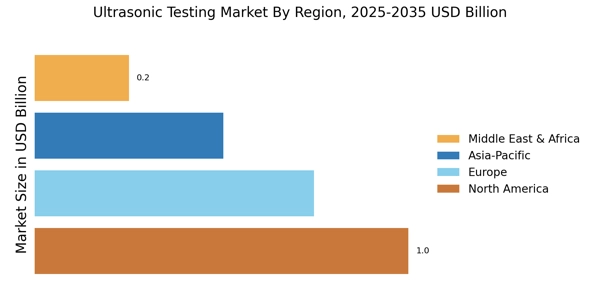
- North America remains the largest market, while Asia-Pacific is recognized as the fastest-growing region in ultrasonic testing.
- Contact testing continues to dominate the market, whereas immersion testing is emerging as the fastest-growing segment.
- The growing demand from the aerospace sector and increased regulatory compliance are key drivers propelling market expansion.
Market Size & Forecast
| 2024 Market Size | 2.482 (USD Billion) |
| 2035 Market Size | 4.832 (USD Billion) |
| CAGR (2025 - 2035) | 6.24% |
Major Players
GE Inspection Technologies (US), Olympus Corporation (JP), Sonatest Ltd (GB), Zetec Inc (US), Mistras Group Inc (US), Eddyfi Technologies (CA), NDT Global (DE), Krautkrämer (DE)
Ultrasonic Testing Market Trends
The Ultrasonic Testing Market is currently experiencing a notable evolution, driven by advancements in ultrasonic testing equipment and increasing demand for non-destructive testing methods across various industries. This market is characterized by its ability to provide precise and reliable results, which is essential for ensuring safety and quality in manufacturing processes. As industries such as aerospace, automotive, and construction continue to prioritize quality assurance, the adoption of ultrasonic testing services is likely to expand. Furthermore, the integration of automation and digital technologies into testing processes appears to enhance efficiency and accuracy, thereby attracting more stakeholders to the market for ultrasonic inspection equipment. In addition, the growing emphasis on regulatory compliance and safety standards is propelling the Ultrasonic Testing Market forward, particularly in applications involving offshore testing services for oil and gas infrastructure. Companies are increasingly recognizing the importance of maintaining high-quality standards to mitigate risks associated with product failures. This trend is further supported by the rising awareness of the benefits of ultrasonic testing, including its ability to detect internal flaws without damaging the material. As a result, the market is poised for continued growth, with innovations in equipment and methodologies likely to shape its future landscape.
Technological Advancements
The Ultrasonic Testing Market is witnessing a surge in technological innovations, particularly in the development of advanced ultrasonic test equipment. These innovations enhance the precision and efficiency of testing processes, making them more appealing to various industries. The integration of digital technologies, such as artificial intelligence and machine learning, is also transforming traditional testing methods, allowing for real-time data analysis and improved decision-making.
Increased Regulatory Compliance
There is a growing trend towards stringent regulatory frameworks across multiple sectors, which is driving the demand for reliable ultrasonic testing services. Companies are compelled to adhere to safety standards and quality assurance protocols, leading to a heightened reliance on advanced ultrasonic testing equipment manufacturers for compliant solutions.
Rising Awareness of Non-Destructive Testing
The awareness surrounding the advantages of non-destructive testing methods is on the rise, particularly in industries where safety is paramount. Ultrasonic testing is increasingly recognized for its ability to identify internal defects without compromising the integrity of materials, reinforcing demand for ultrasonic inspection equipment and professional testing solutions.
Ultrasonic Testing Market Drivers
Increased Regulatory Compliance
The Ultrasonic Testing Market is significantly influenced by the growing emphasis on regulatory compliance across various sectors. Industries such as oil and gas, aerospace, and construction are subject to stringent safety and quality standards. Compliance with these regulations necessitates the use of reliable non-destructive testing methods, including ultrasonic testing. As regulatory bodies continue to enforce stricter guidelines, companies are compelled to adopt ultrasonic testing solutions to ensure adherence. This trend is reflected in the market, which is expected to witness a steady increase in demand for ultrasonic testing services and equipment. The need for compliance not only enhances safety but also mitigates risks associated with equipment failure, thereby driving the growth of the ultrasonic testing market.
Expansion of Manufacturing Activities
The Ultrasonic Testing Market is poised for growth due to the expansion of manufacturing activities across various sectors. As industries ramp up production to meet increasing consumer demand, the need for quality assurance becomes paramount. Ultrasonic testing serves as a vital tool in the manufacturing process, enabling companies to identify defects and ensure product reliability. The rise of smart manufacturing and Industry 4.0 initiatives is further propelling the adoption of advanced ultrasonic testing technologies. With the manufacturing sector projected to grow at a CAGR of approximately 5% in the coming years, the ultrasonic testing market is likely to benefit from this trend. Companies are increasingly investing in ultrasonic testing solutions to enhance their operational efficiency and maintain competitive advantage.
Growing Demand from the Aerospace Sector
The Ultrasonic Testing Market is witnessing a notable increase in demand from the aerospace sector, which relies heavily on non-destructive testing methods to ensure the safety and reliability of aircraft components. As the aerospace industry continues to expand, driven by rising air travel and the need for maintenance of aging fleets, the demand for ultrasonic testing services is expected to grow. Ultrasonic testing is particularly valued for its ability to detect internal flaws in materials without compromising their integrity. The market for ultrasonic testing in aerospace is projected to grow at a CAGR of around 7% over the next five years, reflecting the critical role of ultrasonic testing in maintaining safety standards and regulatory compliance in this highly regulated industry.
Rising Awareness of Non-Destructive Testing
The Ultrasonic Testing Market is benefiting from a heightened awareness of non-destructive testing (NDT) methods among various stakeholders. As industries recognize the advantages of NDT, including cost-effectiveness and the ability to maintain structural integrity without causing damage, the adoption of ultrasonic testing is on the rise. Educational initiatives and training programs are being implemented to inform professionals about the benefits and applications of ultrasonic testing. This increased awareness is likely to lead to a broader acceptance of ultrasonic testing technologies across different sectors, including manufacturing, automotive, and energy. The market is projected to expand as more organizations integrate ultrasonic testing into their quality assurance processes, thereby enhancing operational efficiency and safety.
Technological Advancements in Ultrasonic Testing
The Ultrasonic Testing Market is experiencing a surge in technological advancements that enhance the efficiency and accuracy of testing processes. Innovations such as phased array ultrasonic testing (PAUT) and time-of-flight diffraction (TOFD) are becoming increasingly prevalent. These technologies allow for more detailed inspections and faster data acquisition, which is crucial in sectors like aerospace and manufacturing. The market is projected to grow at a compound annual growth rate (CAGR) of approximately 6.5% from 2025 to 2030, driven by these advancements. Furthermore, the integration of artificial intelligence and machine learning into ultrasonic testing systems is expected to improve defect detection capabilities, thereby increasing the overall reliability of inspections. As industries seek to optimize their operations, the demand for advanced ultrasonic testing solutions is likely to rise.
Market Segment Insights
By Technique: Contact Testing (Largest) vs. Immersion Testing (Fastest-Growing)
The Ultrasonic Testing Market has distinct segments that reflect the diverse application of ultrasonic inspection equipment. Currently, Contact Testing holds the largest market share, while Immersion Testing is emerging as the fastest-growing segment, supported by industrial automation and advanced ultrasonic test equipment adoption. The growth trends within this segment are underpinned by increasing industrial automation and the rising adoption of non-destructive testing methods. Immersion Testing is particularly gaining traction in sectors like aerospace and manufacturing, where precision is paramount. The continuous innovations in ultrasonic technology and the demand for seamless quality assurance further support the growth of these techniques in the testing landscape.
Technique: Contact Testing (Dominant) vs. Immersion Testing (Emerging)
Contact Testing is recognized as the dominant technique in the Ultrasonic Testing Market due to its versatility and reliability in measuring material thickness and integrity. Typically employed in various industries such as manufacturing and construction, it provides accurate results for different types of materials. On the other hand, Immersion Testing is rapidly emerging thanks to its unique capability to immerse components in a liquid medium, enabling maximum sound transmission for flaw detection. This method is particularly advantageous for testing complex shapes and materials that require in-depth inspection, marking its growing importance in sectors like aerospace and automotive engineering.
By End Use Industry: Aerospace (Largest) vs. Automotive (Fastest-Growing)
The Ultrasonic Testing Market is significantly influenced by aerospace and automotive industries. The automotive sector, supported by innovations in the automotive ultrasonic technologies market, is witnessing rapid growth due to increased use of advanced materials and automated manufacturing processes. The rising adoption of ultrasonic testing in the automotive ultrasonic technologies market is expected to further support market expansion.
Aerospace (Dominant) vs. Automotive (Emerging)
Aerospace dominates the Ultrasonic Testing Market due to its critical applications in ensuring the structural integrity of aircraft components. The industry's rigorous safety standards necessitate regular and precise testing methods, fostering a strong demand for ultrasonic testing equipment and services. Meanwhile, the automotive sector is emerging as a vital player, driven by technological advancements and innovations in manufacturing processes. The increased complexity of modern vehicles, which incorporate lightweight materials and advanced electronics, creates a pressing need for reliable testing solutions, positioning automotive applications as a key growth area in the ultrasonic testing landscape.
By Product Type: Ultrasonic Flaw Detectors (Largest) vs. Ultrasonic Thickness Gauges (Fastest-Growing)
In the Ultrasonic Testing Market, Ultrasonic Flaw Detectors dominate the product landscape due to their extensive usage across industries such as oil and gas, aerospace, and manufacturing. Meanwhile, Ultrasonic Thickness Gauges are gaining traction as industries focus on asset integrity management and optimize the cost of ultrasonic testing equipment for routine inspections.
Ultrasonic Flaw Detectors (Dominant) vs. Ultrasonic Cleaning Equipment (Emerging)
Ultrasonic Flaw Detectors have established themselves as the dominant product type within the Ultrasonic Testing Market, well-regarded for their precision and reliability in flaw detection. They are integral in industries that prioritize safety and quality assurance. Conversely, Ultrasonic Cleaning Equipment is emerging as a significant player, driven by increasing adherence to cleanliness standards in manufacturing and medical sectors. These cleaning devices, which utilize ultrasonic waves to remove contaminants, are gaining recognition for their effectiveness in ensuring product hygiene and reliability, positioning them as a compelling option for future investment.
By Application: Weld Inspection (Largest) vs. Corrosion Detection (Fastest-Growing)
In the Ultrasonic Testing Market, the application segment is characterized by diverse practices such as Weld Inspection, Material Characterization, Corrosion Detection, and Thickness Measurement. Among these, Weld Inspection remains the largest application area, supported by extensive demand for ultrasonic testing services in construction, shipbuilding, and manufacturing. Corrosion Detection is emerging rapidly, particularly in aging infrastructure and offshore environments where offshore testing services are critical.
Weld Inspection (Dominant) vs. Corrosion Detection (Emerging)
Weld Inspection stands out as a dominant application within the Ultrasonic Testing Market, primarily due to its critical role in quality assurance across various sectors including aerospace, automotive, and shipbuilding. This segment leverages advanced ultrasonic technology to evaluate weld integrity effectively, ensuring compliance with safety standards. In contrast, Corrosion Detection, classified as an emerging application, is rapidly gaining traction as industries face the pressing need to tackle corrosion-related challenges. As aging infrastructures and assets require thorough inspection to prevent failure, the demand for effective corrosion detection techniques is projected to soar, leading to innovative solutions and a robust growth trajectory in this area.
Regional Insights
North America : Innovation and Technology Leader
North America leads the Ultrasonic Testing Market, driven by the presence of major ultrasonic testing equipment manufacturers, strong regulatory frameworks, and advanced R&D capabilities. The region's growth is driven by advancements in technology, increasing demand for non-destructive testing in various industries, and stringent regulatory standards. The aerospace and automotive sectors are particularly influential, pushing for high-quality inspections to ensure safety and compliance. The United States is the leading country in this market, with significant contributions from Canada. Key players like GE Inspection Technologies and Mistras Group Inc are based here, fostering a competitive landscape. The presence of advanced research institutions and a focus on innovation further enhance the region's market position.
Europe : Regulatory Compliance and Growth
Europe benefits from stringent safety regulations and a strong base of ultrasonic inspection equipment suppliers supporting industrial compliance. The region benefits from stringent regulations and standards that mandate non-destructive testing across various sectors, including construction, automotive, and energy. The push for safety and quality assurance drives demand, alongside technological advancements in testing equipment. Germany and the United Kingdom are the leading countries in this market, with a robust presence of key players like NDT Global and Krautkrämer. The competitive landscape is characterized by innovation and collaboration among companies and research institutions, ensuring that Europe remains at the forefront of ultrasonic testing technology.
Asia-Pacific : Emerging Market with Potential
Asia-Pacific is witnessing rapid growth, driven by industrialization, infrastructure development, and expansion of the automotive ultrasonic technologies market, particularly in China, Japan, and India. The region's expansion is fueled by increasing industrialization, infrastructure development, and a growing focus on quality assurance in manufacturing processes. Countries like China and India are leading this growth, driven by their booming manufacturing sectors and investments in technology. China is the largest market in the region, with significant contributions from Japan and South Korea. The competitive landscape features both local and international players, including Olympus Corporation and Eddyfi Technologies. The region's potential for growth is substantial, as industries continue to adopt advanced testing methods to enhance safety and efficiency.
Middle East and Africa : Resource-Rich and Developing Market
The Middle East and Africa region is gradually emerging in the ultrasonic testing market, holding about 10% of the global share. Growth is primarily driven by ongoing infrastructure projects, particularly in the oil and gas sector, where non-destructive testing is crucial for safety and compliance. The region's increasing focus on quality assurance and regulatory standards is also contributing to market expansion. Countries like the United Arab Emirates and South Africa are leading the market, with a growing number of local and international players entering the space. The competitive landscape is evolving, with companies recognizing the importance of ultrasonic testing in maintaining operational efficiency and safety in various industries.
Key Players and Competitive Insights
In August Olympus Corporation (JP) announced the launch of a new line of portable ultrasonic testing devices designed for field applications. This strategic move is significant as it addresses the growing need for on-site testing solutions, particularly in industries such as oil and gas, where rapid assessments are crucial. By enhancing portability and ease of use, Olympus aims to capture a larger share of the market, appealing to customers who require flexibility in their testing processes.
In September Mistras Group Inc (US) expanded its service offerings by integrating artificial intelligence (AI) into its ultrasonic testing solutions. This integration is pivotal, as it allows for real-time data analysis and predictive maintenance, thereby improving operational efficiency for clients. The adoption of AI not only positions Mistras as a leader in technological innovation but also aligns with the industry's shift towards data-driven decision-making, enhancing its competitive edge.
In July GE Inspection Technologies (US) entered into a strategic partnership with a leading software firm to develop cloud-based ultrasonic testing solutions. This collaboration is expected to revolutionize data management in NDT, enabling seamless integration of inspection data with enterprise systems. By focusing on digital transformation, GE aims to enhance customer experience and streamline operations, which could potentially set new benchmarks in the industry.
As of October the Ultrasonic Testing Market is witnessing trends such as digitalization, sustainability, and the integration of AI technologies. These trends are reshaping competitive dynamics, as companies increasingly form strategic alliances to enhance their technological capabilities and market reach. The shift from price-based competition to a focus on innovation, technology, and supply chain reliability is becoming evident. Moving forward, competitive differentiation will likely hinge on the ability to deliver advanced, reliable, and efficient testing solutions that meet the evolving needs of diverse industries.
Key Companies in the Ultrasonic Testing Market include
Industry Developments
Recent developments in the Ultrasonic Testing Market indicate a notable expansion, driven in part by increased demand across sectors such as aerospace, automotive, and manufacturing. Companies like Sonatest and Olympus Corporation are investing heavily in research and development to enhance their non-destructive testing capabilities and to improve technology integration.
The market is witnessing a surge in partnerships as firms like TechnoSciences and Fujifilm explore collaborations to advance ultrasonic testing solutions. The acquisition activity is also on the rise, with major players such as General Electric and Mistras Group looking to broaden their service offerings, although specific merger announcements from these companies have not been disclosed recently.
Furthermore, the growth of Ultrasonic Testing Market services is expected to reflect positively on market valuations, with companies like Zetech and QSA Global adapting to evolving regulatory standards. As businesses focus on stringent safety measures, the demand for reliable testing applications is fostering innovation and competitive strategies among firms such as Ashtead Technology and GSSI.
This advancing landscape not only enhances operational efficiency but is also critical in sustaining the market's growth trajectory amidst increasing global industrial activities.
Future Outlook
Ultrasonic Testing Market Future Outlook
The Ultrasonic Testing Market is projected to grow at a 6.24% CAGR from 2025 to 2035, driven by technological advancements, increasing safety regulations, and demand for quality assurance.
New opportunities lie in:
- Development of portable ultrasonic testing devices for field applications.
- Integration of AI and machine learning for predictive maintenance solutions.
- Expansion into emerging markets with tailored ultrasonic testing services.
By 2035, the Ultrasonic Testing Market is expected to be robust, driven by innovation and expanding applications.
Market Segmentation
Ultrasonic Testing Market Technique Outlook
- Contact Testing
- Immersion Testing
- Air Coupled Testing
- Phased Array Testing
Ultrasonic Testing Market Application Outlook
- Weld Inspection
- Material Characterization
- Corrosion Detection
- Thickness Measurement
Ultrasonic Testing Market Product Type Outlook
- Ultrasonic Flaw Detectors
- Ultrasonic Thickness Gauges
- Ultrasonic Cleaning Equipment
Ultrasonic Testing Market End Use Industry Outlook
- Aerospace
- Automotive
- Oil and Gas
- Manufacturing
Report Scope
| MARKET SIZE 2024 | 2.482(USD Billion) |
| MARKET SIZE 2025 | 2.637(USD Billion) |
| MARKET SIZE 2035 | 4.832(USD Billion) |
| COMPOUND ANNUAL GROWTH RATE (CAGR) | 6.24% (2025 - 2035) |
| REPORT COVERAGE | Revenue Forecast, Competitive Landscape, Growth Factors, and Trends |
| BASE YEAR | 2024 |
| Market Forecast Period | 2025 - 2035 |
| Historical Data | 2019 - 2024 |
| Market Forecast Units | USD Billion |
| Key Companies Profiled | GE Inspection Technologies (US), Olympus Corporation (JP), Sonatest Ltd (GB), Zetec Inc (US), Mistras Group Inc (US), Eddyfi Technologies (CA), NDT Global (DE), Krautkrämer (DE) |
| Segments Covered | Technique, End Use Industry, Product Type, Application, Regional |
| Key Market Opportunities | Integration of advanced artificial intelligence in Ultrasonic Testing Market enhances defect detection and analysis capabilities. |
| Key Market Dynamics | Technological advancements in ultrasonic testing drive efficiency, enhancing inspection accuracy across various industrial applications. |
| Countries Covered | North America, Europe, APAC, South America, MEA |
FAQs
What is the projected market valuation of the Ultrasonic Testing Market by 2035?
The Ultrasonic Testing Market is projected to reach a valuation of 4.832 USD Billion by 2035.
What was the market valuation of the Ultrasonic Testing Market in 2024?
In 2024, the Ultrasonic Testing Market was valued at 2.482 USD Billion.
What is the expected CAGR for the Ultrasonic Testing Market during the forecast period 2025 - 2035?
The expected CAGR for the Ultrasonic Testing Market during the forecast period 2025 - 2035 is 6.24%.
Which companies are considered key players in the Ultrasonic Testing Market?
Key players in the Ultrasonic Testing Market include GE Inspection Technologies, Olympus Corporation, Sonatest Ltd, and others.
What are the main product types in the Ultrasonic Testing Market?
Main product types in the Ultrasonic Testing Market include Ultrasonic Flaw Detectors, Ultrasonic Thickness Gauges, and Ultrasonic Cleaning Equipment.
How does the market for Contact Testing compare to Immersion Testing in terms of valuation?
Both Contact Testing and Immersion Testing are valued at approximately 1.45 USD Billion in 2025.
What is the valuation range for Ultrasonic Flaw Detectors from 2025 to 2035?
The valuation for Ultrasonic Flaw Detectors is expected to range from 0.993 to 1.872 USD Billion during the forecast period.
Which end-use industry is expected to have the highest valuation in the Ultrasonic Testing Market?
The Automotive industry is expected to have the highest valuation, ranging from 0.745 to 1.415 USD Billion.
What applications are driving growth in the Ultrasonic Testing Market?
Applications such as Weld Inspection and Corrosion Detection are driving growth, with valuations reaching up to 1.445 USD Billion.
What is the projected valuation for Air Coupled Testing by 2035?
The projected valuation for Air Coupled Testing is expected to reach between 0.496 and 0.95 USD Billion by 2035.
Research Approach
Secondary Research
The secondary research process involved comprehensive analysis of regulatory databases, technical standards repositories, peer-reviewed engineering journals, and authoritative industry organizations. Key sources included the American Society for Nondestructive Testing (ASNT), American Society of Mechanical Engineers (ASME), International Organization for Standardization (ISO), ASTM International, British Institute of Non-Destructive Testing (BINDT), European Federation for Non-Destructive Testing (EFNDT), National Institute of Standards and Technology (NIST), Occupational Safety and Health Administration (OSHA), Federal Aviation Administration (FAA), Pipeline and Hazardous Materials Safety Administration (PHMSA), International Atomic Energy Agency (IAEA), Bureau of Industry and Security (BIS), Eurostat Industrial Production Database, World Bank Infrastructure Statistics, and national standards bodies from key markets (ANSI, DIN, JIS, GB Standards). These sources were used to collect equipment shipment data, regulatory compliance requirements, technical safety studies, industrial automation trends, and competitive landscape analysis for ultrasonic flaw detectors, thickness gauges, phased array systems, and other NDT equipment technologies.
Primary Research
In order to gather both qualitative and quantitative insights, supply-side and demand-side stakeholders were interviewed during the primary research process. CEOs, VPs of Engineering, heads of product development, and commercial directors from producers of ultrasonic testing equipment, NDT service providers, and technology integrators were examples of supply-side sources. Quality assurance managers, NDT inspectors, maintenance engineers, and procurement leads from automakers, aircraft manufacturers, oil and gas companies, power plants, and heavy industrial plants were examples of demand-side suppliers. Market segmentation, product development schedules, and information on pricing tactics, maintenance outsourcing dynamics, and technology adoption trends were all corroborated by primary research.
Primary Respondent Breakdown:
By Designation: C-level Primaries (32%), Director Level (31%), Others (37%)
By Region: North America (32%), Europe (30%), Asia-Pacific (33%), Rest of World (5%)
Market Size Estimation
Global market valuation was derived through revenue mapping and equipment deployment analysis. The methodology included:
Identification of 50+ key manufacturers across North America, Europe, Asia-Pacific, and Latin America
Product mapping across contact testing, immersion testing, phased array, air-coupled, and other ultrasonic techniques
Analysis of reported and modeled annual revenues specific to ultrasonic testing equipment portfolios
Coverage of manufacturers representing 75-80% of global market share in 2024
Extrapolation using bottom-up (equipment units × ASP by industry vertical) and top-down (manufacturer revenue validation) approaches to derive segment-specific valuations
Kindly complete the form below to receive a free sample of this Report
Customer Stories
“This is really good guys. Excellent work on a tight deadline. I will continue to use you going forward and recommend you to others. Nice job”
“Thanks. It’s been a pleasure working with you, please use me as reference with any other Intel employees.”
“Thanks for sending the report it gives us a good global view of the Betaïne market.”
“Thank you, this will be very helpful for OQS.”
“We found the report very insightful! we found your research firm very helpful. I'm sending this email to secure our future business.”
“I am very pleased with how market segments have been defined in a relevant way for my purposes (such as "Portable Freezers & refrigerators" and "last-mile"). In general the report is well structured. Thanks very much for your efforts.”
“I have been reading the first document or the study, ,the Global HVAC and FP market report 2021 till 2026. Must say, good info! I have not gone in depth at all parts, but got a good indication of the data inside!”
“We got the report in time, we really thank you for your support in this process. I also thank to all of your team as they did a great job.”