×
Request Free Sample ×

Kindly complete the form below to receive a free sample of this Report

Leading companies partner with us for data-driven Insights

clients tt-cursor
Hero Background

Underground Mining Market

ID: MRFR/CnM/37868-HCR
111 Pages
Chitranshi Jaiswal
October 2025

Underground Mining Market Research Report By Technique (Room and Pillar, Cut and Fill, Sublevel Stoping, Block Caving, Shrinkage Stoping), By Minerals Extracted (Coal, Metallic Minerals, Non-Metallic Minerals, Uranium, Rare Earth Elements), By Equipment Type (Continuous Miners, Longwall Mining Equipment, Room and Pillar Equipment, Haulage Equipment, Support Equipment), By End Use Industry (Metals and Mining, Construction, Energy, Chemical, Environmental Services) and By Regional (North America, Europe, South America, Asia Pacific, Middle Ea... read more

Share:
Download PDF ×

We do not share your information with anyone. However, we may send you emails based on your report interest from time to time. You may contact us at any time to opt-out.

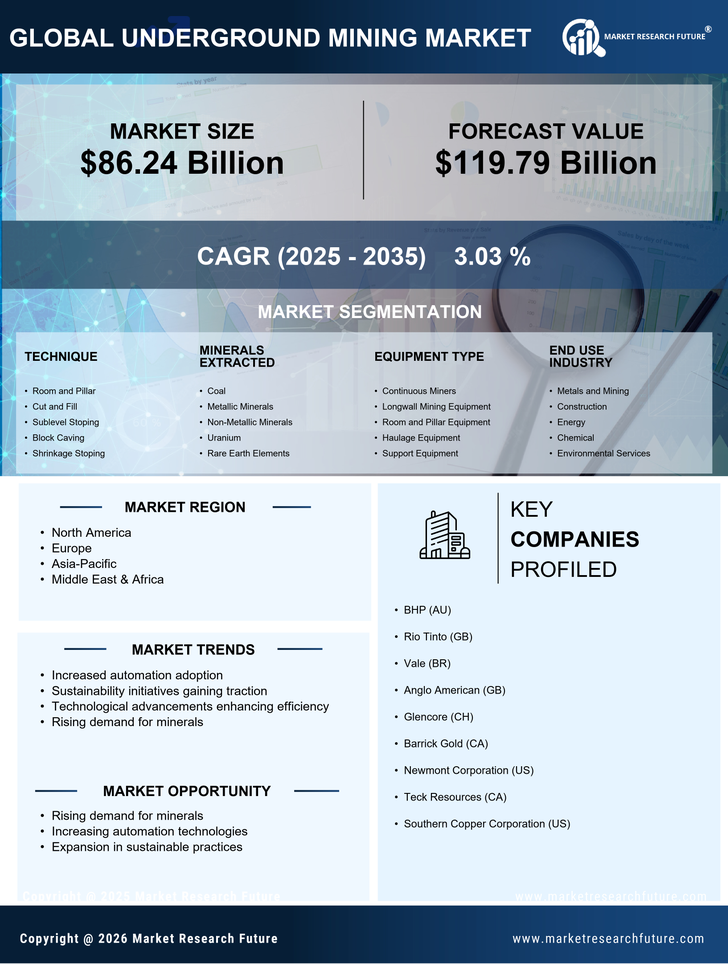
Underground Mining Market Infographic
Purchase Options

Underground Mining Market Summary

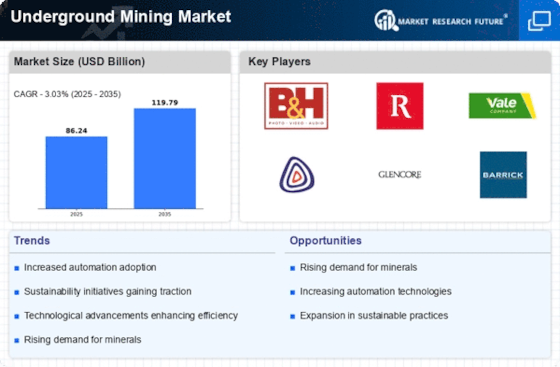
As per MRFR analysis, the Underground Mining Market Size was estimated at 86.24 USD Billion in 2024. The Underground Mining industry is projected to grow from 88.86 USD Billion in 2025 to 119.79 USD Billion by 2035, exhibiting a compound annual growth rate (CAGR) of 3.03 during the forecast period 2025 - 2035.

Key Market Trends & Highlights

The Underground Mining Market is poised for growth driven by technological advancements and sustainability initiatives.

  • Technological advancements are reshaping operational efficiencies in the Underground Mining Market, particularly in North America.
  • Sustainability initiatives are increasingly influencing mining practices, especially in the Asia-Pacific region.
  • The Room and Pillar segment remains the largest, while Block Caving is emerging as the fastest-growing method in underground mining.
  • Rising demand for minerals and increased investment in infrastructure are key drivers propelling market expansion.

Market Size & Forecast

2024 Market Size 86.24 (USD Billion)
2035 Market Size 119.79 (USD Billion)
CAGR (2025 - 2035) 3.03%

Major Players

BHP (AU), Rio Tinto (GB), Vale (BR), Anglo American (GB), Glencore (CH), Barrick Gold (CA), Newmont Corporation (US), Teck Resources (CA), Southern Copper Corporation (US)

Underground Mining Market Trends

The Underground Mining Market is currently experiencing a transformative phase, driven by advancements in technology and increasing demand for minerals and resources. As industries evolve, the need for efficient extraction methods has become paramount. Innovations such as automation and remote monitoring are reshaping operational practices, enhancing safety and productivity. Furthermore, the growing emphasis on sustainable practices is prompting companies to adopt environmentally friendly techniques, which may lead to a shift in traditional mining approaches. This evolving landscape suggests that stakeholders must remain agile to adapt to these changes and capitalize on emerging opportunities. In addition, the Underground Mining Market appears to be influenced by geopolitical factors and regulatory frameworks. As nations strive for energy independence and resource security, mining operations are often subject to stringent regulations. This dynamic environment necessitates a comprehensive understanding of local policies and international trade agreements. Consequently, companies operating in this sector may need to navigate complex legal landscapes while pursuing growth strategies. Overall, the Underground Mining Market is poised for continued evolution, with potential for both challenges and opportunities in the coming years.

Technological Advancements

The integration of cutting-edge technologies is revolutionizing the Underground Mining Market. Automation, artificial intelligence, and data analytics are enhancing operational efficiency and safety. These innovations enable real-time monitoring and predictive maintenance, which may reduce downtime and operational costs.

Sustainability Initiatives

There is a growing focus on sustainable mining practices within the Underground Mining Market. Companies are increasingly adopting eco-friendly methods to minimize environmental impact. This trend reflects a broader commitment to corporate social responsibility and may influence investment decisions.

Regulatory Changes

The Underground Mining Market is subject to evolving regulatory frameworks that can significantly impact operations. Governments are implementing stricter environmental regulations and safety standards. This trend necessitates that companies remain compliant while adapting to new legal requirements.

Underground Mining Market Drivers

Focus on Sustainability

The Underground Mining Market is increasingly aligning with sustainability initiatives, as stakeholders prioritize environmentally responsible practices. Companies are adopting measures to minimize their ecological footprint, such as reducing greenhouse gas emissions and implementing waste management strategies. The shift towards sustainable mining practices is not merely a regulatory response; it is also driven by consumer demand for ethically sourced materials. Reports indicate that sustainable mining practices can lead to cost savings and improved public perception, which are crucial for long-term viability. This focus on sustainability is likely to shape the future of the Underground Mining Market.

Technological Innovations

Technological advancements are reshaping the Underground Mining Market, enhancing efficiency and safety. Innovations such as automated drilling systems, remote monitoring, and advanced data analytics are being integrated into mining operations. These technologies not only improve productivity but also reduce operational costs. For example, the implementation of autonomous vehicles in underground mines has shown to increase output while minimizing risks to human workers. The market for mining technology is projected to grow significantly, with estimates suggesting a compound annual growth rate of over 10% in the coming years. This evolution indicates a shift towards more sophisticated and sustainable mining practices.

Rising Demand for Minerals

The Underground Mining Market is experiencing a notable increase in demand for various minerals, driven by the expanding industrial sector. As economies develop, the need for essential minerals such as copper, gold, and lithium is projected to rise. For instance, the demand for lithium, crucial for battery production, is expected to surge as electric vehicle adoption accelerates. This trend suggests that mining companies may need to enhance their underground operations to meet the growing requirements. Furthermore, the International Energy Agency indicates that mineral demand could double by 2040, emphasizing the critical role of the Underground Mining Market in supplying these resources.

Regulatory Frameworks and Compliance

The regulatory landscape surrounding the Underground Mining Market is evolving, with governments implementing stricter compliance measures. These regulations aim to enhance safety standards, protect the environment, and ensure fair labor practices. While compliance may pose challenges for mining companies, it also presents opportunities for innovation and improvement. Companies that proactively adapt to these regulations can gain a competitive edge. The market is witnessing a trend where firms invest in compliance technologies and training programs to meet these standards. This regulatory focus is expected to drive operational changes within the Underground Mining Market, influencing its growth trajectory.

Increased Investment in Infrastructure

Investment in infrastructure development is a key driver for the Underground Mining Market. Governments and private entities are allocating substantial resources to enhance transportation networks, energy supply, and communication systems, which are vital for mining operations. Improved infrastructure facilitates easier access to mining sites, thereby reducing costs and increasing efficiency. According to recent reports, infrastructure investment in mining regions is expected to reach billions of dollars over the next decade. This influx of capital not only supports existing operations but also encourages new projects, thereby expanding the overall market landscape.

Market Segment Insights

By Technique: Room and Pillar (Largest) vs. Block Caving (Fastest-Growing)

In the Underground Mining Market, the technique segment is characterized by a variety of methods including Room and Pillar, Cut and Fill, Sublevel Stoping, Block Caving, and Shrinkage Stoping. Among these, Room and Pillar holds the largest market share, favored for its effectiveness in coal and gypsum mining, while Block Caving is recognized as the fastest-growing technique, gaining traction due to its efficiency in large-scale operations. These dynamics reflect the evolving preferences within the industry as operators seek various benefits from different techniques.

Technique: Room and Pillar (Dominant) vs. Block Caving (Emerging)

Room and Pillar mining is a dominant method, particularly in relatively flat-lying ore bodies, providing substantial extraction without compromised ground stability. Its design allows for an efficient recovery of minerals with relatively low environmental impact, making it a preferred choice among miners. Block Caving is emerging as a robust alternative, especially in deeper and larger ore bodies, due to its ability to significantly reduce costs and improve recovery rates. This method utilizes gravity to break ore, making it highly efficient but requiring substantial upfront investment for infrastructure. Both techniques reflect the industry's commitment to balancing productivity and sustainability.

By Minerals Extracted: Coal (Largest) vs. Metallic Minerals (Fastest-Growing)

In the Underground Mining Market, the mineral extracted segment is diverse, with Coal holding the largest market share. Following Coal, Metallic Minerals are making significant strides, appealing to industries such as construction and technology. Non-Metallic Minerals and Uranium also contribute to the market, but to a lesser extent compared to the dominant segments. Rare Earth Elements, though smaller in share, are critical due to their applications in advanced technologies.

Coal (Dominant) vs. Metallic Minerals (Emerging)

Coal extraction remains the dominant force in the Underground Mining Market, driven by its widespread use in energy production and industrial applications. Despite environmental concerns, demand for efficient coal technologies supports its ongoing relevance. In contrast, Metallic Minerals are emerging rapidly, fueled by the demand for metals in renewable energy systems and electric vehicles. This shift towards sustainable energy solutions has invigorated metallic mining, encouraging investments in innovative extraction methods. As regulations evolve favoring greener practices, companies specializing in metallic minerals stand to enhance their market positions significantly.

By Equipment Type: Continuous Miners (Largest) vs. Haulage Equipment (Fastest-Growing)

The Underground Mining Market is characterized by a diverse range of equipment types, with Continuous Miners leading the charge in market share. This equipment type typically dominates the market due to its efficiency in cutting and gathering material in a continuous operation, which offers significant advantages over traditional mining methods. Following Continuous Miners, Longwall Mining Equipment and Room and Pillar Equipment hold substantial shares, catering to specific mining needs and methods. Meanwhile, Haulage Equipment and Support Equipment also have their roles but are comparatively smaller in share.

Continuous Miners (Dominant) vs. Haulage Equipment (Emerging)

Continuous Miners are the backbone of underground mining operations, designed for high efficiency and productivity. Their ability to continuously cut and gather rock allows for reduced operational costs and increased output. On the other hand, Haulage Equipment is experiencing rapid growth, driven by the need for efficient material transportation within mining sites. This segment is emerging due to advancements in technology and the increased need for mechanization in mining operations. While Continuous Miners remain the dominant force, the burgeoning demand for effective haulage solutions presents significant opportunities for innovation and expansion in the equipment market.

By End Use Industry: Metals and Mining (Largest) vs. Construction (Fastest-Growing)

The Underground Mining Market is significantly influenced by various end-use industries, with Metals and Mining occupying the largest share. This sector benefits from the ongoing demand for precious minerals and resources essential for technology and construction. The Construction industry follows closely, driven by increasing infrastructure activities worldwide and the need for reliable materials sourced through underground mining operations. Both sectors are critical to the market's overall dynamics, influencing investment decisions and technology deployments. Growing trends in the Underground Mining Market emphasize the transformation spurred by the rising adoption of automation and sustainable practices. The Metals and Mining segment continues to thrive, supported by technological innovations that enhance extraction efficiency and reduce environmental impacts. On the other hand, the Construction segment is emerging robustly due to a surge in urbanization and infrastructure development projects, further fueled by government initiatives aimed at economic recovery and growth in various regions.

Metals and Mining (Dominant) vs. Construction (Emerging)

The Metals and Mining segment stands as the dominant force within the Underground Mining Market, characterized by its extensive resource extraction activities that sustain various industries. This sector involves a range of mining operations aimed at extracting crucial metals like gold, copper, and iron ore. Innovation in mining technologies and sustainability practices plays a vital role in enhancing operational efficiency and minimizing environmental impacts. Conversely, the Construction segment is emerging more prominently, propelled by a global push towards infrastructure development and modernization. This emerging segment focuses on obtaining high-quality minerals that meet the stringent standards of construction projects, thereby ensuring safety and durability in the built environment. Both segments are interrelated, with growth in one often bolstering activities in the other, creating a synergistic effect in the overall underground mining landscape.

Get more detailed insights about Underground Mining Market

Regional Insights

Europe : Regulatory Framework and Innovation

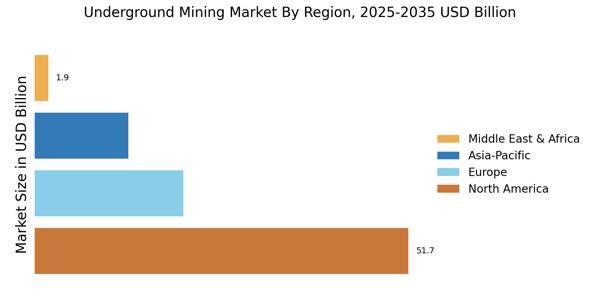
Europe's underground mining market is characterized by a strong regulatory framework aimed at promoting sustainable practices and innovation. The region is witnessing a shift towards automation and digitalization, driven by the need for efficiency and safety. Germany and Sweden are the largest markets, accounting for approximately 35% and 20% of the regional share, respectively. The European Union's Green Deal is a significant regulatory catalyst, pushing for reduced carbon emissions in mining operations. Leading countries like Finland and Norway are also making strides in sustainable mining technologies. The competitive landscape includes major players such as Anglo American and Glencore, which are adapting to regulatory changes by investing in cleaner technologies. The focus on sustainability and innovation is reshaping the mining sector, making Europe a key player in The Underground Mining Market.

Middle East and Africa : Resource-Rich Opportunities

The Middle East and Africa region is rich in mineral resources, presenting significant opportunities for growth in the underground mining market. South Africa and Zambia are the largest markets, accounting for approximately 40% and 20% of the regional share, respectively. The demand for minerals such as copper and gold is driving investments in mining projects, supported by government initiatives aimed at attracting foreign investment. Regulatory frameworks are being developed to enhance operational efficiency and sustainability. Countries like Ghana and Botswana are also emerging as key players in the mining sector, with a focus on diversifying their economies through mining. The competitive landscape includes major companies like Southern Copper Corporation and Vale, which are expanding their presence in the region. The combination of rich resources and supportive government policies positions the Middle East and Africa as a promising market for underground mining.

Underground Mining Market Regional Image

Key Players and Competitive Insights

The Underground Mining Market is currently characterized by a dynamic competitive landscape, driven by a confluence of technological advancements, sustainability initiatives, and strategic partnerships. Major players such as BHP (AU), Rio Tinto (GB), and Vale (BR) are actively reshaping their operational focus to enhance efficiency and reduce environmental impact. BHP (AU) has been particularly proactive in integrating digital technologies into its operations, which not only streamlines processes but also enhances safety measures. Meanwhile, Rio Tinto (GB) emphasizes sustainability, aiming to achieve net-zero emissions by 2050, which influences its investment strategies and operational methodologies. These collective strategies indicate a market that is increasingly oriented towards innovation and environmental responsibility, thereby intensifying competition among key players.

In terms of business tactics, companies are increasingly localizing manufacturing and optimizing supply chains to enhance resilience and responsiveness to market demands. The competitive structure of the Underground Mining Market appears moderately fragmented, with several key players exerting substantial influence. This fragmentation allows for a variety of operational strategies, as companies seek to differentiate themselves through unique value propositions, such as technological integration and sustainable practices.

In August 2025, Vale (BR) announced a significant investment in a new underground mining project in Brazil, aimed at increasing its nickel production capacity. This strategic move is crucial as it aligns with the growing demand for nickel in electric vehicle batteries, positioning Vale to capitalize on the burgeoning green energy market. The investment not only enhances Vale's production capabilities but also reinforces its commitment to sustainable mining practices, which is increasingly important in today's market.

In September 2025, Newmont Corporation (US) unveiled a partnership with a technology firm to develop AI-driven solutions for predictive maintenance in its underground operations. This initiative is indicative of a broader trend towards digital transformation within the mining sector. By leveraging AI, Newmont aims to reduce operational downtime and enhance safety, thereby improving overall efficiency. This strategic action reflects a growing recognition of the importance of technology in maintaining competitive advantage in the Underground Mining Market.

Furthermore, in July 2025, Anglo American (GB) launched a new sustainability program focused on reducing water usage in its underground mining operations. This initiative is particularly relevant given the increasing scrutiny on water resources in mining activities. By prioritizing water conservation, Anglo American not only addresses regulatory pressures but also enhances its corporate reputation, which is vital in attracting environmentally conscious investors and stakeholders.

As of October 2025, the competitive trends within the Underground Mining Market are increasingly defined by digitalization, sustainability, and the integration of advanced technologies such as AI. Strategic alliances are becoming more prevalent, as companies recognize the value of collaboration in achieving shared sustainability goals and enhancing operational efficiencies. Looking ahead, it is likely that competitive differentiation will evolve from traditional price-based competition to a focus on innovation, technological advancement, and supply chain reliability, reflecting the changing priorities of the market.

Key Companies in the Underground Mining Market market include

Industry Developments

The  Underground Mining Market has recently witnessed significant developments marked by a surge in demand for minerals and metals driven by renewable energy projects and technological advancements.

Companies such as Zijin Mining Group and Barrick Gold have expanded their exploration activities, highlighting an aggressive approach to securing mineral resources. Meanwhile, Anglo American and Rio Tinto are increasingly focusing on sustainable mining practices, aligning with  environmental standards.

In terms of mergers and acquisitions, Vale has made headlines with its strategic acquisition of mining assets that enhance its market position, while Freeport-McMoRan has actively pursued partnerships to amplify its operational capabilities.

Glencore and Teck Resources are also noted for their consolidative strategies, focusing on enhancing portfolio efficiency amidst fluctuating commodity prices. The combined market valuation of these companies has seen growth, largely influenced by increased investments in technology and sustainable practices, thus driving innovation across the sector.

Notably, Southern Copper Corporation and Newmont Corporation are optimizing their supply chains to meet burgeoning demand, further shaping the competitive landscape of the underground mining sector.

These dynamics stipulate a robust framework for future market strategies and align with  economic recovery efforts.

Future Outlook

Underground Mining Market Future Outlook

The Underground Mining Market is projected to grow at a 3.03% CAGR from 2024 to 2035, driven by technological advancements, increasing demand for minerals, and sustainability initiatives.

New opportunities lie in:

  • Development of automated underground drilling systems
  • Implementation of real-time data analytics for operational efficiency
  • Expansion of eco-friendly mining technologies and practices

By 2035, the market is expected to be robust, driven by innovation and sustainable practices.

Market Segmentation

Underground Mining Market Technique Outlook

  • Room and Pillar
  • Cut and Fill
  • Sublevel Stoping
  • Block Caving
  • Shrinkage Stoping

Underground Mining Market Equipment Type Outlook

  • Continuous Miners
  • Longwall Mining Equipment
  • Room and Pillar Equipment
  • Haulage Equipment
  • Support Equipment

Underground Mining Market End Use Industry Outlook

  • Metals and Mining
  • Construction
  • Energy
  • Chemical
  • Environmental Services

Underground Mining Market Minerals Extracted Outlook

  • Coal
  • Metallic Minerals
  • Non-Metallic Minerals
  • Uranium
  • Rare Earth Elements

Report Scope

MARKET SIZE 202486.24(USD Billion)
MARKET SIZE 202588.86(USD Billion)
MARKET SIZE 2035119.79(USD Billion)
COMPOUND ANNUAL GROWTH RATE (CAGR)3.03% (2024 - 2035)
REPORT COVERAGERevenue Forecast, Competitive Landscape, Growth Factors, and Trends
BASE YEAR2024
Market Forecast Period2025 - 2035
Historical Data2019 - 2024
Market Forecast UnitsUSD Billion
Key Companies ProfiledMarket analysis in progress
Segments CoveredMarket segmentation analysis in progress
Key Market OpportunitiesAdoption of automation and digitalization technologies enhances efficiency in the Underground Mining Market.
Key Market DynamicsTechnological advancements and regulatory changes drive efficiency and safety improvements in the underground mining sector.
Countries CoveredNorth America, Europe, APAC, South America, MEA

Leave a Comment

FAQs

What is the current valuation of the Underground Mining Market as of 2024?

The Underground Mining Market was valued at 86.24 USD Billion in 2024.

What is the projected market valuation for the Underground Mining Market in 2035?

The market is projected to reach a valuation of 119.79 USD Billion by 2035.

What is the expected CAGR for the Underground Mining Market during the forecast period 2025 - 2035?

The expected CAGR for the Underground Mining Market during the forecast period 2025 - 2035 is 3.03%.

Which techniques are leading in the Underground Mining Market and their respective valuations?

The leading techniques include Block Caving valued at 25.0 to 35.0 USD Billion and Room and Pillar valued at 20.0 to 27.0 USD Billion.

What are the primary minerals extracted in the Underground Mining Market?

The primary minerals extracted include Coal valued at 30.0 to 40.0 USD Billion and Metallic Minerals valued at 25.0 to 35.0 USD Billion.

What types of equipment dominate the Underground Mining Market?

Dominant equipment types include Continuous Miners valued at 20.0 to 27.0 USD Billion and Longwall Mining Equipment valued at 18.0 to 24.0 USD Billion.

Which end-use industries are most significant for the Underground Mining Market?

The most significant end-use industries include Metals and Mining valued at 34.0 to 46.0 USD Billion and Construction valued at 18.0 to 25.0 USD Billion.

Who are the key players in the Underground Mining Market?

Key players in the market include BHP, Rio Tinto, Vale, and Anglo American, among others.

Download Free Sample

Kindly complete the form below to receive a free sample of this Report

Compare Licence

×
Features License Type
Single User Multiuser License Enterprise User
Price $4,950 $ $7,250
Maximum User Access Limit 1 User Upto 10 Users Unrestricted Access Throughout the Organization
Free Customization
Direct Access to Analyst
Deliverable Format
Platform Access
Discount on Next Purchase 10% 15% 15%
Printable Versions