×
Request Free Sample ×

Kindly complete the form below to receive a free sample of this Report

* Please use a valid business email

Leading companies partner with us for data-driven Insights

clients tt-cursor
Hero Background

Unmanned Traffic Management Market

ID: MRFR/AD/8681-CR
128 Pages
Swapnil Palwe
October 2022

Unmanned Traffic Management (UTM) Market Research Report Information By Solution (Communication Infrastructure, Navigation Infrastructure, Surveillance Infrastructure, and Others), By End-User (Agriculture & Forestry, Logistics & Transportation, Surveillance & Monitoring, and Others), By Component (Hardware, Software, and Services), By Type (Persistent, and Non-Persistent) –Market Forecast Till 2035

Share:
Download PDF ×

We do not share your information with anyone. However, we may send you emails based on your report interest from time to time. You may contact us at any time to opt-out.

Unmanned Traffic Management Market Infographic
Purchase Options

Unmanned Traffic Management Market Summary

As per MRFR analysis, the Unmanned Traffic Management Market Size was estimated at 1610.0 USD Million in 2024. The Unmanned Traffic Management industry is projected to grow from 1927.2 USD Million in 2025 to 11639.71 USD Million by 2035, exhibiting a compound annual growth rate (CAGR) of 19.7 during the forecast period 2025 - 2035.

Key Market Trends & Highlights

The Unmanned Traffic Management Market is poised for substantial growth driven by regulatory advancements and technological innovations.

  • North America remains the largest market for unmanned traffic management solutions, reflecting robust regulatory frameworks and technological adoption.
  • Asia-Pacific is emerging as the fastest-growing region, propelled by increasing urbanization and demand for innovative air mobility solutions.
  • The traffic management segment dominates the market, while the air traffic control segment is experiencing rapid growth due to advancements in technology.
  • Key market drivers include the increased demand for drone deliveries and supportive regulatory frameworks that facilitate urban air mobility.

Market Size & Forecast

2024 Market Size 1610.0 (USD Million)
2035 Market Size 11639.71 (USD Million)
CAGR (2025 - 2035) 19.7%

Major Players

AeroVironment (US), Airbus (FR), Boeing (US), DJI (CN), Lockheed Martin (US), Northrop Grumman (US), Raytheon Technologies (US), Thales Group (FR), UAV Solutions (US)

Unmanned Traffic Management Market Trends

The Unmanned Traffic Management Market is currently experiencing a transformative phase, driven by advancements in technology and increasing demand for efficient airspace management. As the integration of unmanned aerial vehicles (UAVs) into national airspace systems becomes more prevalent, stakeholders are focusing on developing robust frameworks to ensure safety and efficiency. This market appears to be influenced by various factors, including regulatory developments, technological innovations, and the growing need for urban air mobility solutions. The collaboration between government agencies and private entities is likely to play a crucial role in shaping the future landscape of this market. Moreover, the Unmanned Traffic Management Market seems to be evolving in response to the rising interest in drone applications across multiple sectors, such as logistics, agriculture, and surveillance. As these applications expand, the demand for sophisticated traffic management systems that can handle increased UAV operations is expected to grow. This trend indicates a shift towards more integrated and automated solutions, which may enhance operational efficiency and safety. The ongoing research and development efforts in this field suggest a promising outlook for the Unmanned Traffic Management Market, as it adapts to the complexities of modern airspace utilization.

Regulatory Framework Development

The establishment of comprehensive regulatory frameworks is crucial for the Unmanned Traffic Management Market. Governments are actively working to create guidelines that ensure safe UAV operations while promoting innovation. This trend indicates a collaborative approach between regulatory bodies and industry stakeholders to address safety concerns and facilitate the integration of drones into existing air traffic systems.

Technological Advancements

Rapid technological advancements are significantly impacting the Unmanned Traffic Management Market. Innovations in artificial intelligence, machine learning, and communication technologies are enhancing the capabilities of traffic management systems. These developments may lead to more efficient monitoring and control of UAV operations, thereby improving overall airspace safety and efficiency.

Urban Air Mobility Solutions

The growing interest in urban air mobility solutions is shaping the Unmanned Traffic Management Market. As cities explore the potential of aerial transportation, the demand for effective traffic management systems is likely to increase. This trend suggests a shift towards integrating UAVs into urban infrastructure, which may revolutionize transportation and logistics in metropolitan areas.

Unmanned Traffic Management Market Drivers

Increasing Demand for Drone Deliveries

The Global Unmanned Traffic Management Market (UTM) Market Industry experiences a notable surge in demand for drone deliveries, driven by the growing e-commerce sector. As consumers increasingly expect rapid delivery services, companies are exploring drone technology to enhance logistics efficiency. In 2024, the market is valued at 1.61 USD Billion, reflecting the industry's potential to revolutionize last-mile delivery solutions. This trend is expected to continue, with projections indicating a market growth to 11.6 USD Billion by 2035, suggesting a robust compound annual growth rate (CAGR) of 19.7% from 2025 to 2035. Such growth underscores the necessity for effective UTM systems to manage the anticipated increase in drone traffic.

Market Segment Insights

By Application: Traffic Management (Largest) vs. Air Traffic Control (Fastest-Growing)

The Unmanned Traffic Management Market showcases a diverse application landscape, with Traffic Management holding a significant share. This sector is essential for ensuring safe and efficient travel for unmanned aerial vehicles (UAVs), integrating advanced technology to facilitate real-time monitoring and coordination. Meanwhile, Air Traffic Control is emerging as the fastest-growing segment, responding to increasing UAV adoption and the need for regulatory frameworks to manage airspace effectively. As the landscape for unmanned aerial systems evolves, the growth of these segments is driven by advancements in technology, urbanization, and the rising demand for aerial delivery services. Traffic Management continues to dominate due to its foundational role in safe UAV operations, while the expansion of Air Traffic Control reflects a heightened focus on regulatory compliance and safety protocols in the aviation sector.

Traffic Management (Dominant) vs. Emergency Response (Emerging)

Traffic Management is firmly established as the dominant application in the Unmanned Traffic Management Market. It encompasses the coordination and regulation necessary to ensure the seamless operation of UAVs within national airspace. Featuring robust systems equipped with real-time data analytics and decision-making tools, it plays a pivotal role in preventing collisions and optimizing flight paths. In contrast, Emergency Response is emerging as a vital segment, offering rapid and efficient solutions for crisis situations such as natural disasters or security threats. With capabilities like aerial reconnaissance and real-time information relay, it enhances response times and improves situational awareness for emergency services, ultimately showing potential for significant growth as public safety demands escalate.

By End Use: Government (Largest) vs. Commercial (Fastest-Growing)

In the Unmanned Traffic Management Market, the distribution of market share reveals that the government sector holds a significant portion, driven by regulatory needs and safety standards. Governments are increasingly prioritizing the effective management of airspace to ensure safe integration of unmanned aircraft. In contrast, the commercial sector is making noteworthy strides, demonstrating growth potential as businesses explore innovative applications for drones and other unmanned systems, thereby increasing competition and investment in this area. The growth trends within the Unmanned Traffic Management Market are characterized by the rising adoption of unmanned systems in various applications. The government sector benefits from regulatory developments and infrastructure investments for air traffic management, while the commercial sector experiences rapid expansion due to advancements in technology and rising demand for drone delivery services and aerial data collection. This dual growth in both government and commercial segments highlights a robust future for unmanned traffic management technologies.

Government: Dominant vs. Commercial: Emerging

The government sector in the Unmanned Traffic Management Market is characterized by its dominant presence, primarily focused on enhancing operational safety and compliance with regulations. It drives investments into technologies that support efficient airspace management and coordination among different unmanned aircraft. This sector's influence ensures that unmanned traffic management solutions align with national airspace policies, promoting a cohesive approach to airspace utilization. Conversely, the commercial segment is emerging rapidly as businesses increasingly incorporate unmanned systems across diverse applications like logistics and surveillance. The commercial landscape is marked by innovation and competitive dynamics, with startups and established companies seeking to leverage unmanned technologies for operational efficiencies. As a result, while the government segment maintains dominance, the commercial sector is poised for explosive growth, presenting opportunities for further technological advancements and market expansion.

By Technology: Drone Traffic Management Systems (Largest) vs. Surveillance Systems (Fastest-Growing)

The Unmanned Traffic Management Market is significantly shaped by the various technological segments, led by Drone Traffic Management Systems, which dominate the market in terms of market share. This system encompasses comprehensive frameworks for overseeing unmanned aerial vehicles (UAVs), thereby ensuring safety and efficiency in airspace utilization. In contrast, Surveillance Systems, while smaller in share, are rapidly gaining momentum as they address concerns regarding air traffic safety and security, essential for regulatory compliance and maintaining public trust in UAV operations.

Technology: Drone Traffic Management Systems (Dominant) vs. Surveillance Systems (Emerging)

Drone Traffic Management Systems represent the cornerstone of unmanned traffic infrastructure, enabling real-time operational capabilities that significantly enhance airspace reliability and safety. These systems incorporate advanced technologies like automated conflict resolution and flight planning, appealing to a growing number of commercial operators. On the other hand, Surveillance Systems are emerging as a critical technology, providing enhanced situational awareness through the use of advanced camera networks and analytics. This allows for real-time monitoring of airspace and compliance with air traffic regulations, thus fostering innovation and trust in unmanned vehicle utilization.

By Vehicle Type: Drones (Largest) vs. Autonomous Ground Vehicles (Fastest-Growing)

In the Unmanned Traffic Management Market, drones emerge as the largest segment, holding significant market share due to their widespread use in various applications such as delivery, surveillance, and agriculture. Unmanned Aerial Vehicles (UAVs) are closely connected, playing a vital role in commercial and military operations. Autonomous Ground Vehicles (AGVs) and Hybrid Vehicles follow behind, with AGVs gaining traction in logistics and delivery services, particularly in urban environments, reflecting the increasing demand for automation in ground transport.

Drones (Dominant) vs. Autonomous Ground Vehicles (Emerging)

Drones stand as the dominant vehicle type in the Unmanned Traffic Management Market, leveraging advanced technology for diverse applications, from recreational use to complex logistical solutions. Their popularity is fueled by ease of use, regulatory developments favoring integration into air traffic management, and decreasing costs. In contrast, Autonomous Ground Vehicles represent an emerging force, marked by rapid advancements in artificial intelligence and sensor technology. These vehicles are increasingly employed in parcel delivery and automated transport services, addressing urban mobility challenges. As cities evolve, AGVs are likely to witness rapid advancements, potentially reshaping urban landscapes and traffic management systems.

Get more detailed insights about Unmanned Traffic Management Market

Regional Insights

North America : Leading Market Innovators

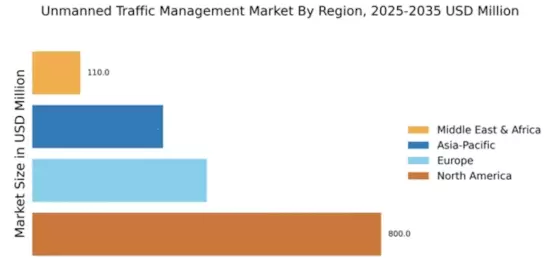
North America is poised to maintain its leadership in the Unmanned Traffic Management (UTM) market, holding a significant share of 800.0M in 2025. The region's growth is driven by advancements in drone technology, increasing demand for airspace management, and supportive regulatory frameworks. The Federal Aviation Administration (FAA) is actively working on integrating UTM systems, which further propels market expansion. The competitive landscape is robust, featuring key players such as AeroVironment, Boeing, and Lockheed Martin. The U.S. is the primary market, leveraging its technological prowess and investment in R&D. Canada is also emerging as a significant player, focusing on regulatory advancements and partnerships to enhance UTM capabilities. The presence of major companies ensures a dynamic market environment, fostering innovation and collaboration.

Europe : Emerging Regulatory Frameworks

Europe is witnessing a burgeoning Unmanned Traffic Management market, projected to reach 450.0M by 2025. The region's growth is fueled by stringent regulations aimed at ensuring safety and efficiency in airspace management. The European Union Aviation Safety Agency (EASA) is at the forefront, developing comprehensive guidelines that facilitate the integration of drones into existing air traffic systems. Leading countries like Germany, France, and the UK are investing heavily in UTM technologies, with companies such as Airbus and Thales Group leading the charge. The competitive landscape is characterized by collaborations between private firms and governmental bodies, enhancing the region's capabilities. The focus on innovation and regulatory compliance positions Europe as a key player in The Unmanned Traffic Management.

Asia-Pacific : Rapidly Growing Market Potential

Asia-Pacific is rapidly emerging as a significant player in the Unmanned Traffic Management market, with a projected size of 300.0M by 2025. The region's growth is driven by increasing urbanization, rising demand for drone deliveries, and supportive government initiatives. Countries like China and Japan are leading the charge, implementing policies that promote the safe use of drones in urban environments. The competitive landscape is diverse, with key players like DJI and various local startups innovating in UTM solutions. The presence of a large population and expanding logistics networks further enhances market potential. As regulatory frameworks evolve, the region is set to capitalize on the growing demand for efficient airspace management solutions, positioning itself as a future leader in the UTM sector.

Middle East and Africa : Untapped Market Opportunities

The Middle East and Africa region is at the nascent stage of developing its Unmanned Traffic Management market, with a projected size of 60.0M by 2025. The growth is primarily driven by increasing investments in smart city initiatives and the adoption of drone technology for various applications, including surveillance and logistics. Governments are beginning to recognize the potential of UTM systems, leading to gradual regulatory developments. Countries like the UAE and South Africa are taking the lead, with initiatives aimed at integrating drones into their airspace. The competitive landscape is still evolving, with local and international players exploring opportunities. As awareness grows and regulations mature, the region is expected to unlock significant market potential in the UTM sector.

Key Players and Competitive Insights

The Unmanned Traffic Management Market is currently characterized by a dynamic competitive landscape, driven by technological advancements and increasing demand for drone operations across various sectors. Key players such as AeroVironment (US), Airbus (FR), and DJI (CN) are strategically positioning themselves through innovation and partnerships, which collectively shape the competitive environment. For instance, AeroVironment (US) has focused on enhancing its drone capabilities for military applications, while Airbus (FR) is leveraging its expertise in aerospace to develop integrated solutions for urban air mobility, indicating a trend towards specialization in niche markets.

In terms of business tactics, companies are increasingly localizing manufacturing and optimizing supply chains to enhance operational efficiency. The market structure appears moderately fragmented, with several players vying for market share. However, the influence of major companies like Boeing (US) and Lockheed Martin (US) is substantial, as they engage in strategic collaborations and technological innovations that set industry standards.

In November 2025, Boeing (US) announced a partnership with a leading tech firm to develop AI-driven traffic management systems for drones. This strategic move is likely to enhance Boeing's capabilities in automating air traffic control, thereby improving safety and efficiency in unmanned operations. Such advancements may position Boeing as a frontrunner in the integration of AI within unmanned traffic management, reflecting a broader industry trend towards automation.

In October 2025, DJI (CN) launched a new software platform aimed at streamlining drone operations for commercial users. This platform is designed to facilitate compliance with regulatory requirements and improve operational efficiency. The introduction of this software underscores DJI's commitment to innovation and its strategic focus on expanding its market presence in the commercial sector, which is increasingly vital as drone usage expands.

In September 2025, Thales Group (FR) secured a contract to provide unmanned traffic management solutions for a major European city. This contract not only highlights Thales's expertise in urban air mobility but also signifies a growing trend towards public-private partnerships in the development of smart city infrastructure. Such initiatives are crucial for integrating unmanned systems into existing urban frameworks, thereby enhancing overall operational efficiency.

As of December 2025, current competitive trends indicate a strong emphasis on digitalization, sustainability, and AI integration within the Unmanned Traffic Management Market. Strategic alliances are increasingly shaping the landscape, as companies recognize the need for collaborative approaches to tackle complex challenges. Moving forward, competitive differentiation is likely to evolve from traditional price-based competition to a focus on innovation, advanced technology, and supply chain reliability, suggesting a transformative shift in how companies position themselves in this burgeoning market.

Key Companies in the Unmanned Traffic Management Market market include

Industry Developments

For Instance, Decebber 2021 Leonardo Electronics announced it would be building a semiconductor device fabrication facility in Oro Valley, Arizona with construction beginning in the first half of 2022.

For Instance, June 2021 Canada's air navigation service provider NAV CANADA publicly launched the 'NAV Drone' application as part of its national RPAS Traffic Management (RTM) platform supplied by Unifly.

Future Outlook

Unmanned Traffic Management Market Future Outlook

The Unmanned Traffic Management Market is projected to grow at a 19.7% CAGR from 2024 to 2035, driven by technological advancements, regulatory support, and increasing demand for drone operations.

New opportunities lie in:

  • Development of integrated UTM software solutions for urban air mobility.
  • Partnerships with logistics companies for drone delivery services.
  • Investment in AI-driven traffic management systems for real-time data analysis.

By 2035, the Unmanned Traffic Management Market is expected to be robust, reflecting substantial growth and innovation.

Market Segmentation

Unmanned Traffic Management Market End Use Outlook

  • Government
  • Commercial
  • Military
  • Research Institutions

Unmanned Traffic Management Market Technology Outlook

  • Drone Traffic Management Systems
  • Communication Networks
  • Data Analytics Platforms
  • Surveillance Systems

Unmanned Traffic Management Market Application Outlook

  • Traffic Management
  • Air Traffic Control
  • Emergency Response
  • Logistics Coordination

Unmanned Traffic Management Market Vehicle Type Outlook

  • Drones
  • Unmanned Aerial Vehicles
  • Autonomous Ground Vehicles
  • Hybrid Vehicles

Report Scope

MARKET SIZE 20241610.0(USD Million)
MARKET SIZE 20251927.2(USD Million)
MARKET SIZE 203511639.71(USD Million)
COMPOUND ANNUAL GROWTH RATE (CAGR)19.7% (2024 - 2035)
REPORT COVERAGERevenue Forecast, Competitive Landscape, Growth Factors, and Trends
BASE YEAR2024
Market Forecast Period2025 - 2035
Historical Data2019 - 2024
Market Forecast UnitsUSD Million
Key Companies ProfiledAeroVironment (US), Airbus (FR), Boeing (US), DJI (CN), Lockheed Martin (US), Northrop Grumman (US), Raytheon Technologies (US), Thales Group (FR), UAV Solutions (US)
Segments CoveredApplication, End Use, Technology, Vehicle Type
Key Market OpportunitiesIntegration of advanced artificial intelligence for real-time unmanned aerial vehicle traffic optimization.
Key Market DynamicsTechnological advancements and regulatory frameworks drive the evolution of unmanned traffic management systems worldwide.
Countries CoveredNorth America, Europe, APAC, South America, MEA

Market Highlights

Author
Swapnil Palwe
Team Lead - Research

With a technical background as Bachelor's in Mechanical Engineering, with MBA in Operations Management , Swapnil has 6+ years of experience in market research, consulting and analytics with the tasks of data mining, analysis, and project execution. He is the POC for our clients, for their consulting projects running under the Automotive/A&D domain. Swapnil has worked on major projects in verticals such as Aerospace & Defense, Automotive and many other domain projects. He has worked on projects for fortune 500 companies' syndicate and consulting projects along with several government projects.

Leave a Comment

FAQs

How much is the Unmanned Traffic Management (UTM) Market?

The Unmanned Traffic Management (UTM) Market size was valued at USD 1.35 Billion in 2023.

What is the growth rate of the Unmanned Traffic Management (UTM) Market?

The market is projected to grow at a CAGR of 19.7 % during the forecast period, 2025-2034.

Which region held the largest market share in the Unmanned Traffic Management (UTM) Market?

North America had the largest share in the market.

Who are the key players in the Unmanned Traffic Management (UTM) Market?

The key players in the market are Leonardo S.P.A. (Italy), Frequentis (Austria), Altitude Angel (UK), L3Harris Technologies Inc. (US), Skyward (US), Lockheed Martin Corporation (US), AirMap Inc. (US), Nova Systems (Australia), Thales Group (France) andUnifly (Belgium).

Which Solution led the Unmanned Traffic Management (UTM) Market?

The Communication Infrastructure category dominated the market in 2023.

Which End-User had the largest market share in the Unmanned Traffic Management (UTM) Market?

The Logistics & Transportation had the largest share in the market.

Which Component had the largest market share in the Unmanned Traffic Management (UTM) Market?

The Hardware had the largest share in the market.

Which Type had the largest market share in the Unmanned Traffic Management (UTM) Market?

The Persistent had the largest share in the market.

Download Free Sample

Kindly complete the form below to receive a free sample of this Report

Compare Licence

×
Features License Type
Single User Multiuser License Enterprise User
Price $4,950 $5,950 $7,250
Maximum User Access Limit 1 User Upto 10 Users Unrestricted Access Throughout the Organization
Free Customization
Direct Access to Analyst
Deliverable Format
Platform Access
Discount on Next Purchase 10% 15% 15%
Printable Versions