×
Request Free Sample ×

Kindly complete the form below to receive a free sample of this Report

* Please use a valid business email

Leading companies partner with us for data-driven Insights

clients tt-cursor
Hero Background

US 3D Glass market

ID: MRFR/SEM/13650-HCR
100 Pages
Garvit Vyas
October 2025

US 3D Glass Market Research Report Information by Application (Consumer Electronics, Automotive, Architecture, Aerospace, Healthcare) ,By Type (Tempered Glass, Laminated Glass, Borosilicate Glass, Acrylic Glass), By Technology (3D Printing, 3D Laser Cutting, Glass Forming), By End Use ( Residential, Commercial, Industrial), and by Region- Industry Forecast till 2035

Share:
Download PDF ×

We do not share your information with anyone. However, we may send you emails based on your report interest from time to time. You may contact us at any time to opt-out.

US 3D Glass market Infographic
Purchase Options

US 3D Glass market Summary

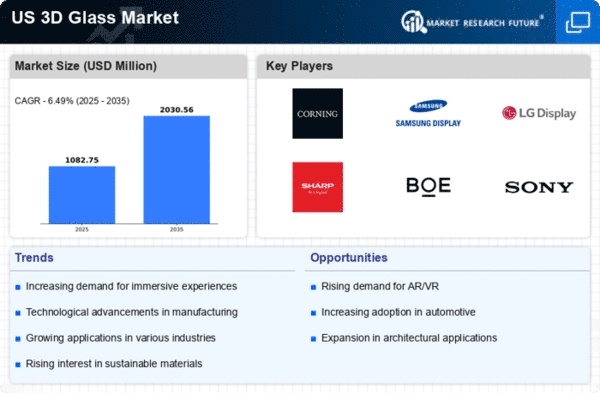
As per MRFR analysis, the US 3D Glass Market Size was estimated at 1016.76 USD Million in 2024. The US 3d glass market is projected to grow from 1082.75 USD Million in 2025 to 2030.56 USD Million by 2035, exhibiting a compound annual growth rate (CAGR) of 6.49% during the forecast period 2025 - 2035.

Key Market Trends & Highlights

The US 3D glass market is poised for substantial growth driven by technological advancements and diverse applications.

  • Technological advancements are enhancing the capabilities of 3D glass, leading to increased adoption across various sectors.
  • The electronics sector remains the largest segment, while architectural applications are emerging as the fastest-growing segment.
  • Sustainability initiatives are becoming a focal point, with manufacturers increasingly prioritizing eco-friendly production methods.
  • Rising demand for enhanced visual experiences and the expansion of the electronics sector are key drivers propelling market growth.

Market Size & Forecast

2024 Market Size 1016.76 (USD Million)
2035 Market Size 2030.56 (USD Million)
CAGR (2025 - 2035) 6.49%

Major Players

Corning Inc (US), Samsung Display Co (KR), LG Display Co (KR), Sharp Corporation (JP), BOE Technology Group Co (CN), Sony Corporation (JP), Mitsubishi Electric Corporation (JP), Harman International Industries (US)

US 3D Glass market Trends

The 3d glass market is currently experiencing notable growth, driven by advancements in technology and increasing applications across various sectors. This market encompasses a range of products, including displays, lenses, and architectural elements, which are utilized in industries such as consumer electronics, automotive, and construction. The demand for enhanced visual experiences and innovative designs appears to be a primary factor propelling this market forward. Furthermore, the integration of 3d glass in smart devices and augmented reality applications suggests a shift towards more immersive user experiences, which could further stimulate market expansion. In addition, sustainability trends are influencing the 3d glass market, as manufacturers seek to adopt eco-friendly materials and production processes. This shift not only aligns with consumer preferences for environmentally responsible products but also complies with regulatory standards aimed at reducing environmental impact. As the market evolves, it seems likely that the focus on sustainability will continue to shape product development and innovation, potentially leading to new opportunities for growth and differentiation within the sector.

Technological Advancements

Recent innovations in manufacturing techniques and materials are enhancing the capabilities of 3d glass products. These advancements allow for improved durability, clarity, and design flexibility, which are essential for meeting the demands of modern applications. As technology progresses, the potential for new uses in various industries appears to expand.

Sustainability Initiatives

The increasing emphasis on sustainability is prompting manufacturers to explore eco-friendly materials and processes in the production of 3d glass. This trend not only caters to consumer preferences for greener products but also aligns with regulatory requirements aimed at minimizing environmental impact.

Diverse Applications

The versatility of 3d glass is leading to its adoption across a wide range of sectors, including electronics, automotive, and architecture. This broad applicability suggests that as industries continue to innovate, the demand for 3d glass products may grow, creating new market opportunities.

US 3D Glass market Drivers

Expansion of the Electronics Sector

The expansion of the electronics sector in the US is significantly influencing the 3d glass market. With the proliferation of smart devices, televisions, and monitors that incorporate 3d technology, the demand for high-quality 3d glass is on the rise. Recent statistics indicate that the electronics market is expected to reach $1 trillion by 2026, with a substantial portion allocated to 3d-enabled devices. This growth is likely to create new opportunities for manufacturers within the 3d glass market, as they strive to meet the increasing requirements for durability, clarity, and performance. Furthermore, advancements in manufacturing processes are enabling the production of thinner and lighter 3d glass, which aligns with consumer preferences for sleek and modern designs, thereby further stimulating market growth.

Emergence of Smart Glass Technologies

The emergence of smart glass technologies is poised to transform the 3d glass market. Smart glass, which can change its properties in response to environmental stimuli, is gaining traction in various applications, including automotive, commercial, and residential sectors. This technology offers benefits such as energy efficiency, privacy control, and enhanced user experience. As the demand for smart solutions continues to rise, the 3d glass market is likely to benefit from the integration of smart technologies. Market analysts predict that the smart glass market will grow at a CAGR of 12% over the next five years, indicating a robust opportunity for 3d glass manufacturers to innovate and adapt their offerings to meet evolving consumer needs.

Rising Demand for Enhanced Visual Experiences

The 3d glass market is experiencing a notable surge in demand driven by the increasing consumer preference for enhanced visual experiences. Industries such as entertainment, gaming, and virtual reality are at the forefront of this trend, as they seek to provide immersive environments that captivate users. According to recent data, the market for 3d glasses in the entertainment sector is projected to grow at a CAGR of approximately 15% over the next five years. This growth is indicative of a broader shift towards high-quality visual content, which is likely to propel the 3d glass market forward. As consumers become more discerning, the need for advanced 3d glass technology that delivers superior image quality and depth perception becomes paramount, thereby driving innovation and investment in this sector.

Growing Interest in Architectural Applications

The architectural sector is increasingly recognizing the potential of 3d glass, which is contributing to the growth of the 3d glass market. Architects and designers are exploring innovative ways to incorporate 3d glass into building facades, interiors, and structural elements, enhancing aesthetic appeal and functionality. The trend towards sustainable and energy-efficient building practices is also influencing this market, as 3d glass can provide better insulation and natural lighting. Recent reports suggest that the architectural glass market is projected to grow by 10% annually, with 3d glass playing a pivotal role in this expansion. This growing interest in architectural applications is likely to create new avenues for growth and collaboration within the 3d glass market.

Increased Investment in Research and Development

Investment in research and development (R&D) within the 3d glass market is becoming increasingly critical as companies strive to innovate and differentiate their products. The competitive landscape is pushing manufacturers to explore new materials and technologies that enhance the performance and functionality of 3d glass. For instance, the integration of augmented reality (AR) and virtual reality (VR) capabilities into 3d glass products is a focal point of R&D efforts. This trend is supported by a projected increase in R&D spending in the technology sector, which is expected to reach $600 billion by 2027. Such investments are likely to yield breakthroughs that could redefine consumer expectations and expand the applications of 3d glass, thereby driving market growth.


Market Segment Insights

By Application: Consumer Electronics (Largest) vs. Automotive (Fastest-Growing)

The US 3d glass market showcases a diverse application landscape, with Consumer Electronics leading the segment shares. This category includes smartphones, tablets, and televisions, which demand high-quality glass offerings for displays. Automotive follows as a significant segment, driven by technological advancements and increasing demand for enhanced aesthetics and safety features in vehicles. The remaining segments, such as Architecture, Aerospace, and Healthcare, also play crucial roles, yet hold comparatively smaller market shares. Growth trends in the segment indicate a robust upward trajectory, particularly in Automotive applications, which are experiencing rapid expansion due to the push for electric vehicles (EVs) and integrated smart technologies. Consumer Electronics remains resilient, propelled by ongoing innovations in display technologies and consumer demand for advanced features. Other sectors, while currently smaller, are beginning to adopt 3d glass for structural and functional applications, showing promise for future growth.

Consumer Electronics: Dominant vs. Automotive: Emerging

Consumer Electronics stands out as the dominant sector in the US 3d glass market, characterized by its reliance on high-performance materials suitable for vibrant displays and durability. This segment benefits from continuous technological advancements, with manufacturers striving to produce lighter yet stronger glass solutions for portable devices and large screens. In contrast, Automotive is emerging as a key player, fueled by innovations such as augmented reality displays and smart windshield technologies. The integration of 3d glass in vehicles enhances both functionality and aesthetic appeal, leading to significant investments from automotive giants. As consumer expectations evolve toward more integrated and tech-savvy experiences, the Automotive sector is poised for substantial growth, making it an area of interest for market participants.

By Type: Tempered Glass (Largest) vs. Laminated Glass (Fastest-Growing)

In the US 3d glass market, Tempered Glass commands the largest share due to its superior strength and safety features, making it ideal for various applications, including construction and automotive. Laminated Glass follows closely, gaining traction due to its soundproofing properties and aesthetic appeal, which cater to the growing preferences of both residential and commercial sectors. Growth trends in this segment are driven by increasing demand for safety and durability in glass products, alongside the rising popularity of sustainable building materials. Additionally, innovations in manufacturing processes are enhancing the quality and performance of Laminated Glass, positioning it as the fastest-growing segment. The market showcases a positive outlook, supported by advancements in technology and changing consumer preferences.

Tempered Glass (Dominant) vs. Laminated Glass (Emerging)

Tempered Glass is known for its strength and thermal resistance, making it the dominant choice in applications that prioritize safety and durability, such as commercial buildings and vehicles. Its ability to withstand high temperatures and sudden changes in temperature gives it a considerable advantage over traditional glass. On the other hand, Laminated Glass is emerging rapidly due to its unique sound-dampening capabilities and UV resistance, appealing to architects and designers looking for innovative solutions in residential projects. This segment is increasingly recognized for its potential to enhance both comfort and energy efficiency in buildings, leading to greater adoption in the market.

By Technology: 3D Printing (Largest) vs. 3D Laser Cutting (Fastest-Growing)

In the US 3d glass market, the distribution of market share among the various technology segments reveals 3D Printing as the dominant force, leading with a significant contribution to overall revenues. 3D Laser Cutting follows, capturing a notable share yet is surpassed by the robust advancements and adoption of 3D Printing technologies. Glass Forming remains an essential segment, but its market presence pales in comparison to both printing and cutting technologies. The growth trends in the US 3d glass market indicate a robust upward trajectory for 3D Printing, driven by increasing demand in various industries including automotive and aerospace. The rising need for customization and reduced production costs are key factors propelling this segment. Meanwhile, 3D Laser Cutting is experiencing rapid growth, fueled by enhancements in technology and efficiency, making it the fastest-growing sector among the three.

Technology: 3D Printing (Dominant) vs. 3D Laser Cutting (Emerging)

3D Printing stands out in the US 3d glass market due to its dominance and versatility across multiple applications. Its ability to produce complex geometries with minimal waste makes it a preferred choice for manufacturers. Meanwhile, 3D Laser Cutting is emerging with innovative capabilities and increased efficiency in cutting various glass types. Although it holds a smaller market position compared to 3D Printing, it is gaining traction rapidly, driven by advancements in laser technology and the expanding demands of specialized markets. Together, these segments are shaping the future landscape of the glass industry, highlighting a trend towards increased automation and precision in production.

By End Use: Residential (Largest) vs. Commercial (Fastest-Growing)

The market share distribution in the US 3d glass market indicates that the residential segment holds the largest share, driven by increasing consumer demand for home improvement projects. The commercial segment follows as a fast-growing area, fueled by the expanding infrastructure and construction activities across various urban landscapes. Growth trends within this segment reveal a strong push towards sustainable and energy-efficient solutions in residential applications. As smart home technologies advance, the demand for specialized 3d glass solutions is surging. Meanwhile, the commercial sector is experiencing rapid growth due to rising investments in commercial real estate and innovations in architectural designs, which increasingly incorporate advanced glass products for aesthetic and functional benefits.

Residential: Dominant vs. Commercial: Emerging

The residential segment dominates the US 3d glass market, characterized by a robust consumer base that values aesthetics and functionality in home design. This segment often integrates advanced glass technologies into renovations and new constructions, appealing to homeowners looking to enhance energy efficiency and aesthetic appeal. On the other hand, the commercial segment is emerging rapidly, with architects and builders increasingly specifying 3d glass for its versatility in creating stunning visual effects and maximizing natural light in commercial properties. As urbanization accelerates, demand in the commercial sector is expected to rise, transitioning from traditional materials to innovative glass solutions that meet modern building standards.

Get more detailed insights about US 3D Glass market

Key Players and Competitive Insights

The 3D glass market is currently characterized by a dynamic competitive landscape, driven by technological advancements and increasing demand across various sectors, including consumer electronics and automotive industries. Key players such as Corning Inc (US), Samsung Display Co (KR), and LG Display Co (KR) are at the forefront, leveraging innovation and strategic partnerships to enhance their market positions. Corning Inc (US) focuses on developing advanced glass solutions that cater to the needs of high-performance displays, while Samsung Display Co (KR) emphasizes its leadership in OLED technology, which is integral to the 3D glass segment. Meanwhile, LG Display Co (KR) is investing heavily in research and development to improve the quality and efficiency of its 3D glass products, indicating a collective push towards innovation that shapes the competitive environment.

In terms of business tactics, companies are increasingly localizing manufacturing to reduce lead times and optimize supply chains. The market structure appears moderately fragmented, with several players vying for market share, yet the influence of major companies remains substantial. This competitive structure allows for a diverse range of products and innovations, fostering an environment where companies must continuously adapt to maintain their competitive edge.

In October 2025, Corning Inc (US) announced a partnership with a leading automotive manufacturer to develop next-generation 3D glass for vehicle displays. This collaboration is strategically significant as it positions Corning to capitalize on the growing trend of digitalization in the automotive sector, where high-quality displays are becoming essential for user experience. The partnership not only enhances Corning's product offerings but also strengthens its foothold in a rapidly evolving market.

In September 2025, Samsung Display Co (KR) unveiled its latest 3D glass technology at a major electronics trade show, showcasing advancements in durability and clarity. This launch is crucial as it reinforces Samsung's commitment to innovation and its ability to meet the increasing consumer demand for high-performance displays. By staying ahead of technological trends, Samsung is likely to maintain its competitive advantage in the market.

In August 2025, LG Display Co (KR) expanded its production capacity for 3D glass, investing approximately $500 million in new manufacturing facilities. This strategic move is indicative of LG's intent to meet the rising demand for 3D glass in various applications, particularly in the consumer electronics sector. The expansion not only enhances LG's production capabilities but also positions the company to respond swiftly to market fluctuations.

As of November 2025, current competitive trends in the 3D glass market include a strong emphasis on digitalization, sustainability, and the integration of AI technologies. Strategic alliances are increasingly shaping the landscape, enabling companies to pool resources and expertise to drive innovation. Looking ahead, competitive differentiation is expected to evolve, with a notable shift from price-based competition towards a focus on technological advancements, innovation, and supply chain reliability. This transition suggests that companies that prioritize these aspects will likely emerge as leaders in the market.

Key Companies in the US 3D Glass market market include

Future Outlook

US 3D Glass market Future Outlook

The 3D glass market is projected to grow at a 6.49% CAGR from 2024 to 2035, driven by technological advancements, increasing demand in electronics, and expanding applications in automotive sectors.

New opportunities lie in:

  • Development of customized 3D glass solutions for consumer electronics.
  • Expansion into augmented reality applications for enhanced user experiences.
  • Strategic partnerships with automotive manufacturers for integrated 3D glass components.

By 2035, the 3D glass market is expected to achieve substantial growth and innovation.

Market Segmentation

US 3D Glass market Type Outlook

  • Tempered Glass
  • Laminated Glass
  • Borosilicate Glass
  • Acrylic Glass

US 3D Glass market End Use Outlook

  • Residential
  • Commercial
  • Industrial

US 3D Glass market Technology Outlook

  • 3D Printing
  • 3D Laser Cutting
  • Glass Forming

US 3D Glass market Application Outlook

  • Consumer Electronics
  • Automotive
  • Architecture
  • Aerospace
  • Healthcare

Report Scope

MARKET SIZE 2024 1016.76(USD Million)
MARKET SIZE 2025 1082.75(USD Million)
MARKET SIZE 2035 2030.56(USD Million)
COMPOUND ANNUAL GROWTH RATE (CAGR) 6.49% (2024 - 2035)
REPORT COVERAGE Revenue Forecast, Competitive Landscape, Growth Factors, and Trends
BASE YEAR 2024
Market Forecast Period 2025 - 2035
Historical Data 2019 - 2024
Market Forecast Units USD Million
Key Companies Profiled Corning Inc (US), Samsung Display Co (KR), LG Display Co (KR), Sharp Corporation (JP), BOE Technology Group Co (CN), Sony Corporation (JP), Mitsubishi Electric Corporation (JP), Harman International Industries (US)
Segments Covered Application, Type, Technology, End Use
Key Market Opportunities Advancements in augmented reality applications drive demand in the 3d glass market.
Key Market Dynamics Technological advancements drive innovation in 3D glass applications, enhancing consumer demand and competitive dynamics.
Countries Covered US

Leave a Comment

Download Free Sample

Kindly complete the form below to receive a free sample of this Report

Compare Licence

×
Features License Type
Single User Multiuser License Enterprise User
Price $4,950 $5,950 $7,250
Maximum User Access Limit 1 User Upto 10 Users Unrestricted Access Throughout the Organization
Free Customization
Direct Access to Analyst
Deliverable Format
Platform Access
Discount on Next Purchase 10% 15% 15%
Printable Versions