×
Request Free Sample ×

Kindly complete the form below to receive a free sample of this Report

* Please use a valid business email

Leading companies partner with us for data-driven Insights

clients tt-cursor
Hero Background

US Aircraft Fairings Market

ID: MRFR/AD/17502-HCR
100 Pages
Garvit Vyas
October 2025

US Aircraft Fairings Market Research Report: By End User (OEM, Aftermarket), By Application (Cockpit, Fuselage, Engine, Landing Gear, Flight Control Surface, Wings, Nose), By Platform (Commercial, Military) and By Material (Composite, Metallic, Others) - Forecast to 2035

Share:
Download PDF ×

We do not share your information with anyone. However, we may send you emails based on your report interest from time to time. You may contact us at any time to opt-out.

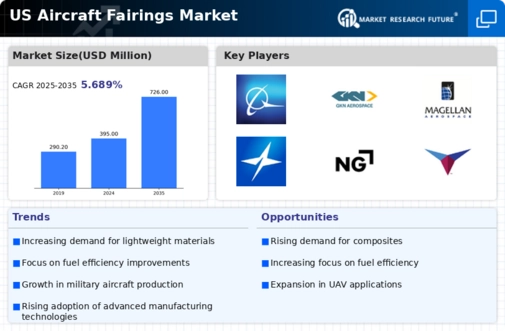
US Aircraft Fairings Market Infographic
Purchase Options

US Aircraft Fairings Market Summary

As per analysis, the US aircraft fairings market is projected to grow from USD 0.711 Million in 2025 to USD 1.23 Million by 2035, exhibiting a compound annual growth rate (CAGR) of 5.41% during the forecast period (2025 - 2035).

Key Market Trends & Highlights

The US aircraft fairings market is poised for growth driven by sustainability and technological advancements.

  • The commercial aviation segment remains the largest contributor to the US aircraft fairings market, reflecting ongoing demand for passenger aircraft.
  • Cargo aviation is identified as the fastest-growing segment, driven by the increasing need for efficient logistics and transportation solutions.
  • Composite materials dominate the market, while metallic materials are experiencing rapid growth due to their lightweight properties and cost-effectiveness.
  • Key market drivers include regulatory compliance and safety standards, alongside a heightened focus on fuel efficiency and sustainability.

Market Size & Forecast

2024 Market Size 0.686 (USD Million)
2035 Market Size 1.23 (USD Million)
CAGR (2025 - 2035) 5.41%

Major Players

Spirit AeroSystems (US), GKN Aerospace (US), Northrop Grumman (US), Boeing (US), Raytheon Technologies (US), Triumph Group (US), Hewlett Packard Enterprise (US), AeroVironment (US)

US Aircraft Fairings Market Trends

The US aircraft fairings market is currently experiencing a dynamic evolution, driven by advancements in aerospace technology and increasing demand for fuel-efficient aircraft. Fairings, which are essential components that streamline the aerodynamic profile of aircraft, play a crucial role in enhancing performance and reducing drag. As the aviation sector continues to prioritize sustainability, manufacturers are focusing on developing lightweight materials and innovative designs that not only improve efficiency but also comply with stringent regulatory standards. This shift towards eco-friendly solutions appears to be reshaping the competitive landscape, as companies strive to meet the expectations of both airlines and regulatory bodies. Moreover, the market is witnessing a notable trend towards customization and integration of advanced technologies. Aircraft manufacturers are increasingly seeking tailored fairing solutions that align with specific aircraft models and operational requirements. This trend suggests a growing collaboration between fairing producers and aircraft manufacturers, fostering innovation and enhancing product offerings. Additionally, the rise of unmanned aerial vehicles (UAVs) and electric aircraft is likely to create new opportunities within the US aircraft fairings market, as these emerging segments demand specialized fairing designs to optimize performance and functionality. Overall, the US aircraft fairings market is poised for growth, driven by technological advancements and evolving industry needs.

Sustainability Initiatives

The US aircraft fairings market is increasingly influenced by sustainability initiatives. Manufacturers are prioritizing the development of eco-friendly materials and processes to reduce environmental impact. This trend aligns with broader industry goals to minimize carbon emissions and enhance fuel efficiency, reflecting a commitment to sustainable aviation practices.

Customization and Integration

Customization is becoming a prominent trend within the US aircraft fairings market. Aircraft manufacturers are seeking bespoke fairing solutions that cater to specific design and performance requirements. This trend indicates a shift towards more integrated approaches, where fairing producers collaborate closely with aircraft builders to enhance overall product performance.

Emergence of UAVs and Electric Aircraft

The rise of unmanned aerial vehicles (UAVs) and electric aircraft is reshaping the US aircraft fairings market. These innovative segments require specialized fairing designs to optimize aerodynamics and functionality. As the demand for UAVs and electric aircraft grows, fairing manufacturers are likely to adapt their offerings to meet these new challenges.

Market Segment Insights

By Application: Commercial Aviation (Largest) vs. Cargo Aviation (Fastest-Growing)

The US aircraft fairings market showcases a diversified application segment, with commercial aviation holding the largest share. This domination stems from a robust demand for passenger air travel, where fairings play a critical role in enhancing aerodynamic efficiency. Military aviation also maintains a significant presence, focusing on specific defense requirements. However, the growth in cargo aviation is gaining momentum, leveraging increased e-commerce and logistics operations that rely on efficient aircraft systems.

Commercial Aviation (Dominant) vs. Military Aviation (Emerging)

In the context of the US aircraft fairings market, commercial aviation remains the dominant segment, driven by the consistent rise in air travel and the emphasis on fuel efficiency. Its mature infrastructure and continuous technological advancements position it as a leader in fairing applications. Conversely, military aviation serves as an emerging segment, characterized by customized solutions for specialized missions and a focus on innovation. The push for modernized defense capabilities indicates a growing market for fairings that can withstand diverse operational conditions, making it a space of noteworthy development and investment.

By Material Type: Composite Materials (Largest) vs. Metallic Materials (Fastest-Growing)

In the US aircraft fairings market, composite materials dominate the material type segment with a significant share owing to their lightweight properties and excellent strength-to-weight ratio. This segment continues to lead as manufacturers increasingly prioritize efficiency and fuel economy in aircraft design, leading to widespread adoption of composite materials like carbon fiber and glass fiber in fairing production. Conversely, metallic materials, particularly aluminum and titanium, have been experiencing rapid growth driven by their durability and cost-effectiveness compared to composites. As advancements in manufacturing processes improve the performance characteristics of metals, their application in fairings is expanding, making them a compelling choice for specific aircraft designs.

Material Type: Composite Materials (Dominant) vs. Metallic Materials (Emerging)

Composite materials are at the forefront of the US aircraft fairings market, recognized for their lightweight, high strength, and resistance to environmental factors. These materials have established a dominant position, significantly contributing to overall aircraft efficiency. On the other hand, metallic materials are emerging as a strong contender in the market due to advancements in alloy technologies that enhance their performance while maintaining cost efficiency. This duality allows manufacturers to optimize fairing designs by balancing weight savings with the robustness of metal, driving innovation and customization in aircraft structures.

By Fairing Type: Fuselage Fairings (Largest) vs. Wing Fairings (Fastest-Growing)

In the US aircraft fairings market, fuselage fairings hold the largest share due to their critical role in enhancing aerodynamic efficiency and structural integrity. By acting as a seamless transition between parts of the aircraft, they significantly reduce drag, thereby improving fuel efficiency. Conversely, wing fairings, while representing a smaller share, are on a rapid growth trajectory, driven by innovations in aviation technology and an increasing demand for fuel-efficient designs in modern aircraft. The growth of the wing fairings segment can be attributed to several factors, including advancements in composite materials that increase strength while reducing weight. Additionally, rising environmental regulations are motivating manufacturers to adopt fairing solutions that enhance fuel efficiency and reduce emissions. The ongoing trend towards aircraft modernization and the introduction of next-generation aircraft are likely to further bolster the demand for wing fairings in the coming years.

Fuselage Fairings (Dominant) vs. Nose Fairings (Emerging)

Fuselage fairings are recognized as the dominant segment in the US aircraft fairings market, primarily due to their vital function in optimizing the aircraft's aerodynamics and maintaining its structural integrity. They prevent airflow disruption while contributing significantly to fuel efficiency. In contrast, nose fairings, which are emerging in popularity, focus on reducing drag at the front of the aircraft, thus playing a crucial role in overall performance. As aircraft manufacturers increasingly prioritize design efficiency and sustainability, nose fairings are witnessing enhanced innovation and adoption, showcasing their potential to grow rapidly in response to evolving market needs.

By Manufacturing Process: Injection Molding (Largest) vs. Automated Fiber Placement (Fastest-Growing)

In the US aircraft fairings market, the manufacturing process segment is led by Injection Molding, which holds the largest market share due to its efficiency and cost-effectiveness. This process allows for the production of complex geometries, which is crucial for aircraft design. Following it is Thermoforming, while Hand Layup and Automated Fiber Placement provide niche applications tailored for specific aircraft requirements. The competitive landscape reveals that as manufacturers look to reduce turnaround times and enhance quality, Injection Molding's market position is solidified. As the industry evolves, Automated Fiber Placement is being recognized as the fastest-growing segment. This growth is driven by increasing demand for lightweight materials and higher production rates in the aerospace sector. Technological advancements in automation are enabling manufacturers to adopt this innovative approach, making it a key player in the future of aircraft fairings manufacturing.

Manufacturing Process: Injection Molding (Dominant) vs. Automated Fiber Placement (Emerging)

Injection Molding stands as the dominant manufacturing process in the US aircraft fairings market due to its ability to produce high-volume parts with intricate designs efficiently. This method excels in creating consistency in quality while being cost-effective, making it ideal for large-scale production runs. On the other hand, Automated Fiber Placement, though newer, is rapidly emerging in this market. This technology uses robotic systems to place prepreg materials, ensuring precision and reducing waste. Its ability to produce lightweight, high-strength structures aligns with the industry's push towards more efficient aircraft design, thus carving a significant niche in the competitive landscape.

By End Use: New Aircraft Manufacturing (Largest) vs. Aircraft Maintenance and Repair (Fastest-Growing)

The US aircraft fairings market shows a clear distribution among its end-use segments, with New Aircraft Manufacturing holding the largest share. This segment encompasses the design and production of fairings that enhance aerodynamic efficiency and structural integrity in new aircraft models. On the other hand, Aircraft Maintenance and Repair has been gaining traction, driven by the increasing need for upgrades and enhancements in the aging fleet of aircraft, thus contributing significantly to fairings demand in this sector. Growth trends indicate a robust future for both segments, with New Aircraft Manufacturing benefiting from advancements in aeronautical engineering and a surge in new aircraft orders. Meanwhile, the Aircraft Maintenance and Repair segment is fueled by rising safety regulations and the necessity for compliance with stringent aviation standards. As aircraft owners seek to prolong the life and efficiency of their fleets, this segment is anticipated to become the fastest-growing in the market shortly.

New Aircraft Manufacturing (Dominant) vs. Aircraft Modification (Emerging)

New Aircraft Manufacturing has established itself as the dominant segment in the US aircraft fairings market, primarily due to the ongoing evolution of aircraft designs and the emphasis on fuel efficiency and performance. Manufacturers are increasingly focusing on lightweight materials and innovative designs to improve overall aircraft performance. Conversely, the Aircraft Modification sector has emerged as a compelling segment, driven by customers looking to customize their existing aircraft to meet new operational needs or aesthetic preferences. This segment is characterized by its adaptability and responsiveness to market demands, focusing on retrofitting older aircraft models with modern fairing technologies. The continuous pursuit of optimizing aircraft performance and enhancing passenger experiences is propelling growth in this emerging segment.

Get more detailed insights about US Aircraft Fairings Market

Key Players and Competitive Insights

The aircraft fairings market is characterized by a competitive landscape that is increasingly shaped by innovation, strategic partnerships, and a focus on sustainability. Key players such as Spirit AeroSystems (US), GKN Aerospace (US), and Northrop Grumman (US) are actively pursuing strategies that enhance their market positioning. Spirit AeroSystems (US) has been focusing on expanding its product offerings through technological advancements, while GKN Aerospace (US) emphasizes sustainability in its manufacturing processes. Northrop Grumman (US) appears to be leveraging its defense capabilities to penetrate commercial markets, indicating a multifaceted approach to growth. Collectively, these strategies suggest a dynamic environment where companies are not only competing on product quality but also on their ability to innovate and adapt to changing market demands.

In terms of business tactics, localizing manufacturing and optimizing supply chains have emerged as critical strategies for success. The market structure is moderately fragmented, with several players vying for market share. However, the influence of major companies like Boeing (US) and Raytheon Technologies (US) cannot be understated, as they hold substantial market power and resources. Their ability to streamline operations and enhance production efficiency contributes to shaping the competitive dynamics within the market.

In November 2025, Spirit AeroSystems (US) announced a partnership with a leading aerospace manufacturer to develop next-generation fairings that incorporate advanced composite materials. This strategic move is likely to enhance their product portfolio and position them as a leader in innovation. The collaboration not only signifies a commitment to technological advancement but also aligns with the growing demand for lightweight and fuel-efficient aircraft components.

In October 2025, GKN Aerospace (US) unveiled its new sustainability initiative aimed at reducing carbon emissions in the production of aircraft fairings. This initiative is expected to resonate well with environmentally conscious customers and stakeholders, potentially giving GKN a competitive edge in a market that increasingly values sustainability. By prioritizing eco-friendly practices, GKN Aerospace (US) is likely to attract partnerships and contracts that emphasize corporate responsibility.

In September 2025, Northrop Grumman (US) expanded its manufacturing capabilities by investing in a state-of-the-art facility dedicated to the production of aircraft fairings. This investment not only enhances their operational efficiency but also positions them to meet the growing demand for advanced aerospace components. The establishment of this facility indicates a long-term commitment to the market and a strategic move to bolster their competitive standing.

As of December 2025, the competitive trends within the aircraft fairings market are increasingly defined by digitalization, sustainability, and the integration of AI technologies. Strategic alliances are becoming more prevalent, as companies recognize the value of collaboration in driving innovation. The shift from price-based competition to a focus on technological advancement and supply chain reliability is evident. Moving forward, competitive differentiation will likely hinge on the ability to innovate and adapt to emerging trends, suggesting a transformative phase for the market.


Key Companies in the US Aircraft Fairings Market market include

Industry Developments

The US Aircraft Fairings Market has recently witnessed significant developments, particularly with companies like Raytheon Technologies, Boeing, and Spirit AeroSystems, which are focusing on enhancing their product offerings through advanced materials and production techniques. Noteworthy is the ongoing trend of digitalization in manufacturing processes, aimed at improving efficiency. In September 2023, Boeing announced plans to increase production levels of its commercial aircraft, positively impacting the demand for fairings. Additionally, there is a growing emphasis on sustainability, ushering in innovations that minimize waste during the manufacturing process.

The market valuation is experiencing upward momentum, influenced by increased commercial and military aircraft production post-pandemic. Notably, in April 2023, Triumph Group acquired a new division to expand its capabilities in aircraft components, bolstering its position in the fairings sector. Over the last two years, US government regulations have emphasized safety standards, prompting manufacturers to invest heavily in Research and Development. In this dynamic environment, companies are leveraging collaborations and partnerships to enhance their market presence and technological advancements, signaling a promising future for the US Aircraft Fairings Market.

Future Outlook

US Aircraft Fairings Market Future Outlook

The US aircraft fairings market is projected to grow at a 5.41% CAGR from 2024 to 2035, driven by advancements in aerospace technology and increasing demand for fuel efficiency.

New opportunities lie in:

  • Development of lightweight composite fairings for enhanced fuel efficiency.
  • Integration of smart technologies for real-time monitoring and maintenance.
  • Expansion into emerging markets with tailored fairing solutions.

By 2035, the market is expected to be robust, reflecting sustained growth and innovation.

Market Segmentation

US Aircraft Fairings Market End Use Outlook

  • New Aircraft Manufacturing
  • Aircraft Maintenance and Repair
  • Aircraft Modification

US Aircraft Fairings Market Application Outlook

  • Commercial Aviation
  • Military Aviation
  • General Aviation
  • Cargo Aviation

US Aircraft Fairings Market Fairing Type Outlook

  • Nose Fairings
  • Wing Fairings
  • Fuselage Fairings
  • Tail Fairings

US Aircraft Fairings Market Material Type Outlook

  • Composite Materials
  • Metallic Materials
  • Plastic Materials
  • Ceramic Materials

US Aircraft Fairings Market Manufacturing Process Outlook

  • Injection Molding
  • Thermoforming
  • Hand Layup
  • Automated Fiber Placement

Report Scope

MARKET SIZE 20240.686(USD Million)
MARKET SIZE 20250.711(USD Million)
MARKET SIZE 20351.23(USD Million)
COMPOUND ANNUAL GROWTH RATE (CAGR)5.41% (2024 - 2035)
REPORT COVERAGERevenue Forecast, Competitive Landscape, Growth Factors, and Trends
BASE YEAR2024
Market Forecast Period2025 - 2035
Historical Data2019 - 2024
Market Forecast UnitsUSD Million
Key Companies ProfiledSpirit AeroSystems (US), GKN Aerospace (US), Northrop Grumman (US), Boeing (US), Raytheon Technologies (US), Triumph Group (US), Hewlett Packard Enterprise (US), AeroVironment (US)
Segments CoveredApplication, Material Type, Fairing Type, Manufacturing Process, End Use
Key Market OpportunitiesGrowing demand for lightweight materials enhances innovation in the US aircraft fairings market.
Key Market DynamicsTechnological advancements and regulatory changes drive innovation and competition in the US aircraft fairings market.
Countries CoveredUS

Leave a Comment

FAQs

What is the expected market size of the US Aircraft Fairings Market in 2024?

The US Aircraft Fairings Market is expected to be valued at 395.0 USD Million in 2024.

What will be the value of the US Aircraft Fairings Market by 2035?

By 2035, the market is projected to reach a value of 726.0 USD Million.

What is the expected compound annual growth rate (CAGR) for the US Aircraft Fairings Market from 2025 to 2035?

The expected CAGR for the US Aircraft Fairings Market from 2025 to 2035 is 5.689%.

Which end user segment holds a significant market share in the US Aircraft Fairings Market?

The OEM segment is expected to hold a significant share, valued at 237.0 USD Million in 2024.

What is the forecasted market size for the Aftermarket segment of the US Aircraft Fairings Market in 2035?

The Aftermarket segment is anticipated to reach a value of 300.0 USD Million by 2035.

Who are the major players in the US Aircraft Fairings Market?

Key players in the market include Raytheon Technologies, Boeing, General Dynamics, and GKN Aerospace.

How will the US Aircraft Fairings Market change by 2035 compared to 2024?

The market will experience substantial growth, with an increase from 395.0 USD Million in 2024 to 726.0 USD Million in 2035.

What opportunities and challenges does the US Aircraft Fairings Market face?

The market faces growth opportunities due to increasing demand in aviation and challenges from fluctuations in raw material prices.

What are the key applications of aircraft fairings in the aviation industry?

Aircraft fairings are primarily used for aerodynamic efficiency and structural support in the aviation industry.

How does the US Aircraft Fairings Market compare to other regional markets?

The US Aircraft Fairings Market is among the leading regions, expected to dominate due to advanced aerospace technology and strong manufacturing capabilities.

Download Free Sample

Kindly complete the form below to receive a free sample of this Report

Compare Licence

×
Features License Type
Single User Multiuser License Enterprise User
Price $4,950 $5,950 $7,250
Maximum User Access Limit 1 User Upto 10 Users Unrestricted Access Throughout the Organization
Free Customization
Direct Access to Analyst
Deliverable Format
Platform Access
Discount on Next Purchase 10% 15% 15%
Printable Versions