×
Request Free Sample ×

Kindly complete the form below to receive a free sample of this Report

* Please use a valid business email

Leading companies partner with us for data-driven Insights

clients tt-cursor
Hero Background

US Aroma Chemicals Market

ID: MRFR/CnM/14927-HCR
100 Pages
Garvit Vyas
October 2025

US Aroma Chemicals Market

Share:
Download PDF ×

We do not share your information with anyone. However, we may send you emails based on your report interest from time to time. You may contact us at any time to opt-out.

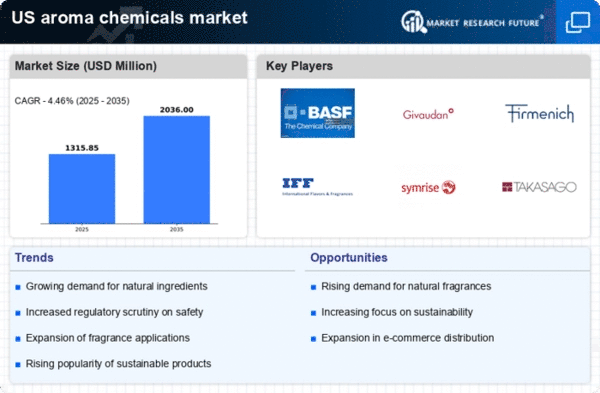
US Aroma Chemicals Market Infographic
Purchase Options

US Aroma Chemicals Market Summary

As per analysis, the US aroma chemicals market is projected to grow from USD 1.32 Billion in 2025 to USD 2.04 Billion by 2035, exhibiting a compound annual growth rate (CAGR) of 4.5% during the forecast period (2025 - 2035).

Key Market Trends & Highlights

The US aroma chemicals market is experiencing a dynamic evolution driven by consumer preferences and regulatory frameworks.

  • The fragrance segment remains the largest contributor to the aroma chemicals market, reflecting enduring consumer demand for diverse scent profiles.
  • The food and beverage segment is currently the fastest-growing area, propelled by an increasing inclination towards flavor enhancement in culinary applications.
  • Personal care products are witnessing rapid growth, indicating a shift towards customized and health-conscious formulations among consumers.
  • Key market drivers include the growing demand for fragrance in consumer products and rising awareness of health and wellness, which are shaping industry dynamics.

Market Size & Forecast

2024 Market Size 1.26 (USD Billion)
2035 Market Size 2.04 (USD Billion)
CAGR (2025 - 2035) 4.5%

Major Players

BASF (US), Dow (US), International Flavors & Fragrances (US), Givaudan (US), Symrise (US), Firmenich (US), Takasago International Corporation (US), Kraton Corporation (US), Sensient Technologies Corporation (US)

US Aroma Chemicals Market Trends

The US aroma chemicals market is currently experiencing a dynamic evolution, driven by various factors including consumer preferences, regulatory changes, and technological advancements. The demand for natural and sustainable ingredients is on the rise, as consumers increasingly seek products that align with their values. This shift is prompting manufacturers to innovate and adapt their offerings, focusing on bio-based aroma chemicals that are perceived as safer and more environmentally friendly. Additionally, the fragrance industry is witnessing a growing trend towards personalization, with consumers desiring unique scents that reflect their individual identities. This trend is influencing product development and marketing strategies across the sector. Moreover, the regulatory landscape is becoming more stringent, with increased scrutiny on chemical safety and environmental impact. This has led to a greater emphasis on compliance and transparency within the US aroma chemicals market. Companies are investing in research and development to ensure their products meet these evolving standards while also appealing to health-conscious consumers. As the market continues to mature, it appears poised for further growth, driven by innovation, sustainability, and a deeper understanding of consumer preferences. The interplay of these factors suggests a vibrant future for the US aroma chemicals market, characterized by adaptability and responsiveness to market demands.

Shift Towards Natural Ingredients

There is a noticeable trend in the US aroma chemicals market towards the use of natural ingredients. Consumers are increasingly favoring products that contain bio-based components, which are perceived as safer and more environmentally friendly. This shift is prompting manufacturers to reformulate their products and invest in sustainable sourcing practices.

Personalization of Fragrance Products

The desire for personalized fragrance experiences is gaining traction among consumers in the US aroma chemicals market. This trend is leading companies to develop unique scent profiles that cater to individual preferences, thereby enhancing customer engagement and loyalty. Brands are leveraging technology to offer customized solutions.

Regulatory Compliance and Safety Standards

The regulatory environment surrounding aroma chemicals in the US is becoming more stringent. Companies are focusing on compliance with safety standards and environmental regulations, which is influencing product development. This trend emphasizes the importance of transparency and accountability in the formulation of aroma chemicals.

Market Segment Insights

By Application: Fragrance (Largest) vs. Food & Beverages (Fastest-Growing)

In the US aroma chemicals market, the application segment showcases a diverse distribution of market shares. Fragrance remains the largest application, driven by its extensive use in perfumes, personal care, and household products. Following behind are flavors used in food and beverages, which hold significant importance, particularly in enhancing product appeal and consumer satisfaction. Additionally, cosmetics and household products exhibit a notable presence, emphasizing the essential role aroma chemicals play across various sectors.

Fragrance (Dominant) vs. Food & Beverages (Emerging)

Fragrance leads the application segment as a dominant force, fueled by consumer preference for scented products in both personal and home care categories. This segment's strength aligns with lifestyle trends emphasizing self-care and luxury experiences. In contrast, food and beverages represent an emerging application area, reflecting growing consumer demand for innovative flavors and aromas. Driven by trends towards natural ingredients, health-conscious choices, and experiential dining, food and beverages are rapidly evolving, thus contributing significantly to the growth trajectory of the aroma chemicals market.

By End Use: Food Industry (Largest) vs. Personal Care (Fastest-Growing)

In the US aroma chemicals market, the end-use segment distribution reveals a significant dominance of the food industry, which commands the largest share due to its extensive applications in flavoring, fragrance, and preservation. Following closely, personal care is rapidly gaining traction as consumers increasingly seek pleasant scents in beauty and personal hygiene products. These segments are crucial for driving competitive differentiation and brand loyalty in their respective markets. Growth trends across these segments indicate a robust expansion in personal care driven by the rising consumer demand for organic and natural products. The food industry's stability is bolstered by continual innovations in flavor enhancement and the increasing popularity of processed and packaged foods. Additionally, environmental concerns and sustainability practices are fostering growth in both segments as companies shift towards more responsible sourcing and manufacturing practices.

Food Industry: Dominant vs. Personal Care: Emerging

The food industry remains the dominant segment within the US aroma chemicals market characterized by its extensive use of flavor and aroma additives to enhance consumer enjoyment and meet regulatory standards. This sector encompasses a wide range of products from beverages to baked goods, ensuring aroma chemicals play a crucial role in product formulations. On the other hand, the personal care segment is emerging rapidly, driven by a surge in consumer preferences for premium and natural personal care products. This segment is marked by innovation, with companies continually launching new fragrances to cater to evolving consumer tastes, emphasizing sustainability and ethical sourcing of ingredients. The contrasting dynamics between these two segments underscore the diversity and complexity of the US aroma chemicals market.

By Type: Natural Aroma Chemicals (Largest) vs. Synthetic Aroma Chemicals (Fastest-Growing)

In the US aroma chemicals market, Natural Aroma Chemicals hold the largest market share, driven by increasing consumer preference for sustainable and natural products. This segment encompasses a variety of ingredients derived from natural sources, resonating well with health-conscious consumers and the clean label trend. On the other hand, Synthetic Aroma Chemicals are witnessing rapid growth, as they offer consistency and cost-effectiveness in production, attracting manufacturers aiming for scalability and reliability in their supply chains.

Natural Aroma Chemicals (Dominant) vs. Synthetic Aroma Chemicals (Emerging)

Natural Aroma Chemicals are characterized by their sourcing from botanical origins, which not only appeals to environmentally aware consumers but also often aligns with regulatory trends favoring natural ingredients. This segment includes a wide range of fragrances used in various applications, from personal care to food products. In contrast, Synthetic Aroma Chemicals present an emerging opportunity within the market, with their ability to mimic natural scents while providing unique aroma profiles that may not be readily available in nature. Their versatility and affordability make them attractive to manufacturers looking to innovate their product offerings.

By Form: Liquid (Largest) vs. Powder (Fastest-Growing)

In the US aroma chemicals market, the segment distribution is predominantly led by liquid forms, capturing a significant market share due to their versatile applications in various industries including food, cosmetics, and personal care products. Following closely are solid and powder forms, which cater to specific demands for stability and preservation in various formulations. Emulsions and gels, while crucial, hold a comparatively smaller portion of the market but contribute to specific application niches, particularly in the personal care sector. Growth trends indicate a marked increase in the demand for powder forms, which are gaining traction due to their ease of application and extended shelf life. The rise of natural and organic products has also bolstered the market share of these forms as manufacturers seek to align with consumer preferences for clean and environmentally friendly ingredients. Additionally, innovations in formulation technology are enhancing the usability and functionality of aroma chemicals, driving growth across all forms, particularly in the specialty chemical markets.

Liquid (Dominant) vs. Gel (Emerging)

Liquid aroma chemicals are the cornerstone of the US aroma chemicals market, favored for their adaptability in numerous applications ranging from fragrance manufacturing to flavor enhancements in food products. Their ability to dissolve easily and blend with other ingredients makes them the dominant form widely used by major manufacturers. Conversely, gels are an emerging segment within the market. Although they occupy a smaller market share, gels are increasingly being recognized for their unique properties, including stability and aesthetic appeal, particularly in cosmetic formulations. The rising trend of formulating innovative beauty products is aiding the growth of the gel form, attracting manufacturers looking to differentiate their offerings in a competitive landscape.

By Distribution Channel: Direct Sales (Largest) vs. Online Sales (Fastest-Growing)

In the US aroma chemicals market, the distribution of sales channels reveals a substantial inclination towards direct sales, which currently holds the largest market share. This segment benefits from established relationships between manufacturers and end-users, allowing for tailored solutions and immediate feedback. Following direct sales, retail sales and distributors play a significant role, while online sales, despite being smaller in market share, are rapidly gaining traction as consumer preferences shift towards digital platforms. Growth trends in the distribution channels of aroma chemicals are heavily influenced by changes in consumer behavior and the industry's digital evolution. Direct sales remain robust due to personalized service, whereas online sales are the fastest-growing segment, spurred on by the convenience of e-commerce, extensive product offerings, and improved logistics. Retail sales are stable, but they face competition from online services that provide faster access to products, driving innovation within this segment.

Direct Sales (Dominant) vs. Online Sales (Emerging)

In the current landscape of the US aroma chemicals market, direct sales represent the dominant approach, characterized by close relationships between producers and buyers that enable customized solutions and loyalty. This method thrives on its capacity to deliver high-quality service and immediate support. Conversely, online sales are emerging as a formidable alternative, fueled by changing consumer preferences towards convenience and speed. This segment leverages technology to offer enhanced accessibility, broader selections, and promotional opportunities, making it a critical player in the modern marketplace. Both segments reflect the ongoing evolution of distribution channels in the aroma chemicals sector, with direct sales leading in stability and online sales representing the future of growth.

Get more detailed insights about US Aroma Chemicals Market

Key Players and Competitive Insights

The aroma chemicals market is characterized by a dynamic competitive landscape, driven by innovation, sustainability, and the increasing demand for natural ingredients. Key players such as BASF (US), International Flavors & Fragrances (US), and Givaudan (US) are strategically positioned to leverage their extensive research and development capabilities. These companies focus on enhancing product offerings through technological advancements and sustainable practices, which collectively shape a competitive environment that emphasizes differentiation over price.

In terms of business tactics, companies are increasingly localizing manufacturing to reduce lead times and optimize supply chains. The market appears moderately fragmented, with a mix of large multinational corporations and smaller niche players. The collective influence of major companies like Dow (US) and Symrise (US) is significant, as they drive trends in sustainability and innovation, thereby impacting the overall market structure.

In November 2025, BASF (US) announced the launch of a new line of bio-based aroma chemicals derived from renewable resources. This strategic move underscores the company's commitment to sustainability and positions it favorably in a market that increasingly values eco-friendly products. The introduction of these bio-based alternatives is likely to enhance BASF's competitive edge and appeal to environmentally conscious consumers.

In October 2025, International Flavors & Fragrances (US) expanded its partnership with a leading natural ingredients supplier to enhance its portfolio of sustainable aroma chemicals. This collaboration is indicative of the company's strategy to integrate more natural and organic components into its offerings, aligning with consumer preferences for clean-label products. Such partnerships may strengthen IFF's market position and foster innovation in product development.

In September 2025, Givaudan (US) unveiled a new digital platform aimed at streamlining the development process for aroma chemicals. This initiative reflects the growing trend of digital transformation within the industry, allowing for faster innovation cycles and improved customer engagement. By investing in digital capabilities, Givaudan is likely to enhance its operational efficiency and responsiveness to market demands.

As of December 2025, the aroma chemicals market is witnessing trends such as digitalization, sustainability, and the integration of AI technologies. Strategic alliances are increasingly shaping the competitive landscape, enabling companies to pool resources and expertise. Looking ahead, competitive differentiation is expected to evolve, with a shift from price-based competition to a focus on innovation, technology, and supply chain reliability. This transition may redefine market dynamics, as companies strive to meet the growing demand for sustainable and high-quality aroma chemicals.

Key Companies in the US Aroma Chemicals Market market include

Future Outlook

US Aroma Chemicals Market Future Outlook

The US aroma chemicals market is projected to grow at a 4.5% CAGR from 2024 to 2035, driven by increasing consumer demand for natural fragrances and sustainable products.

New opportunities lie in:

  • Expansion into bio-based aroma chemicals to meet sustainability goals.
  • Development of customized fragrance solutions for niche markets.
  • Investment in advanced extraction technologies to enhance product quality.

By 2035, the market is expected to solidify its position as a leader in innovative aroma solutions.

Market Segmentation

US Aroma Chemicals Market Form Outlook

  • Liquid
  • Solid
  • Powder
  • Emulsion
  • Gel

US Aroma Chemicals Market Type Outlook

  • Natural Aroma Chemicals
  • Synthetic Aroma Chemicals
  • Essential Oils
  • Flavoring Agents
  • Fragrance Compounds

US Aroma Chemicals Market End Use Outlook

  • Food Industry
  • Personal Care
  • Household Care
  • Pharmaceuticals
  • Industrial

US Aroma Chemicals Market Application Outlook

  • Fragrance
  • Flavor
  • Cosmetics
  • Household Products
  • Food & Beverages

US Aroma Chemicals Market Distribution Channel Outlook

  • Direct Sales
  • Online Sales
  • Retail Sales
  • Wholesale
  • Distributors

Report Scope

MARKET SIZE 20241.26(USD Billion)
MARKET SIZE 20251.32(USD Billion)
MARKET SIZE 20352.04(USD Billion)
COMPOUND ANNUAL GROWTH RATE (CAGR)4.5% (2024 - 2035)
REPORT COVERAGERevenue Forecast, Competitive Landscape, Growth Factors, and Trends
BASE YEAR2024
Market Forecast Period2025 - 2035
Historical Data2019 - 2024
Market Forecast UnitsUSD Billion
Key Companies ProfiledBASF (US), Dow (US), International Flavors & Fragrances (US), Givaudan (US), Symrise (US), Firmenich (US), Takasago International Corporation (US), Kraton Corporation (US), Sensient Technologies Corporation (US)
Segments CoveredApplication, End Use, Type, Form, Distribution Channel
Key Market OpportunitiesGrowing demand for natural aroma chemicals driven by consumer preference for sustainable and eco-friendly products.
Key Market DynamicsRising consumer demand for natural aroma chemicals drives innovation and regulatory scrutiny in the US market.
Countries CoveredUS

Leave a Comment

FAQs

What is the projected market size of the US Aroma Chemicals Market in 2024?

The US Aroma Chemicals Market is expected to be valued at 1.08 USD Billion in 2024.

How much is the US Aroma Chemicals Market expected to grow by 2035?

By 2035, the US Aroma Chemicals Market is expected to reach a valuation of 1.95 USD Billion.

What is the expected compound annual growth rate (CAGR) for the US Aroma Chemicals Market from 2025 to 2035?

The anticipated CAGR for the US Aroma Chemicals Market from 2025 to 2035 is 5.533 percent.

Which segment of the US Aroma Chemicals Market is projected to dominate in terms of size in 2024?

In 2024, the Synthetic segment is projected to dominate the market with a valuation of 0.5 USD Billion.

What is the expected market size of the Natural Aroma Chemicals segment in 2035?

The Natural Aroma Chemicals segment is expected to reach a market size of 0.65 USD Billion by 2035.

Who are some of the key players in the US Aroma Chemicals Market?

Significant players in the market include Dow, Givaudan, IFF, BASF, and Firmenich.

What are the market size forecasts for the Natural-identical segment in 2024 and 2035?

The Natural-identical segment is forecasted to be valued at 0.23 USD Billion in 2024 and 0.3 USD Billion by 2035.

What applications are driving growth in the US Aroma Chemicals Market?

The market growth is primarily driven by applications in food and beverage, cosmetics, and personal care products.

What challenges might affect the growth of the US Aroma Chemicals Market?

Challenges such as regulatory constraints and the rising cost of raw materials may impact market growth.

How will the market trends evolve in the US Aroma Chemicals Market from 2025 to 2035?

Emerging trends such as sustainability and natural ingredient sourcing are expected to shape the market from 2025 to 2035.

Download Free Sample

Kindly complete the form below to receive a free sample of this Report

Compare Licence

×
Features License Type
Single User Multiuser License Enterprise User
Price $4,950 $5,950 $7,250
Maximum User Access Limit 1 User Upto 10 Users Unrestricted Access Throughout the Organization
Free Customization
Direct Access to Analyst
Deliverable Format
Platform Access
Discount on Next Purchase 10% 15% 15%
Printable Versions