×
Request Free Sample ×

Kindly complete the form below to receive a free sample of this Report

* Please use a valid business email

Leading companies partner with us for data-driven Insights

clients tt-cursor
Hero Background

US Ceramic Fiber Market

ID: MRFR/CnM/11326-CR
100 Pages
Garvit Vyas
December 2023

US Ceramic Fiber Market Research Report Information By Type (Refractory Ceramic Fiber And Alkaline Earth Silicone), By Product (Blankets, Rope, Paper, Board, Blocks), By End-User Industry (Refining & Petrochemical, Iron & Steel, Power Generation) And By Region (North America, Europe, Asia-Pacific, And Rest Of The World) –Market Forecast Till 2035

Share:
Download PDF ×

We do not share your information with anyone. However, we may send you emails based on your report interest from time to time. You may contact us at any time to opt-out.

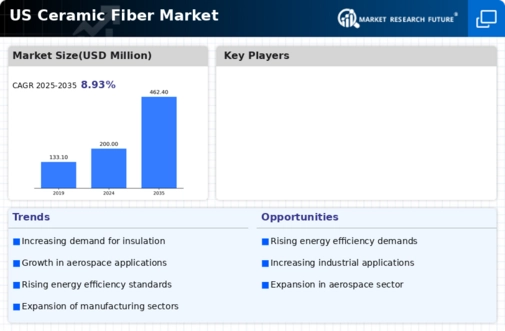
US Ceramic Fiber Market Infographic
Purchase Options

US Ceramic Fiber Market Summary

As per analysis, the US ceramic fiber market is projected to grow from USD 166.77 Million in 2025 to USD 394.89 Million by 2035, exhibiting a compound annual growth rate (CAGR) of 9.0% during the forecast period (2025 - 2035).

Key Market Trends & Highlights

The US ceramic fiber market is experiencing robust growth driven by diverse industrial applications and technological advancements.

  • The insulation segment remains the largest contributor to the US ceramic fiber market, driven by its extensive use in high-temperature applications.
  • The aerospace sector is the largest market for ceramic fibers, reflecting a rising demand for lightweight and heat-resistant materials.
  • The automotive segment is the fastest-growing area, indicating a shift towards advanced materials for improved performance and safety.
  • Key market drivers include growing industrial applications and regulatory support for energy efficiency, which are shaping the market landscape.

Market Size & Forecast

2024 Market Size 153.0 (USD Million)
2035 Market Size 394.89 (USD Million)
CAGR (2025 - 2035) 9.0%

Major Players

Unifrax LLC (US), Morgan Advanced Materials (US), RHI Magnesita (US), Isolite Insulating Products Co., Ltd. (US), Promat (US), Luyang Energy-Saving Materials Co., Ltd. (US), Shandong Luyang Share Co., Ltd. (US), Zircar Ceramics, Inc. (US)

US Ceramic Fiber Market Trends

The US ceramic fiber market is currently experiencing a notable transformation, driven by increasing demand across various industries such as aerospace, automotive, and energy. This shift appears to stem from the material's exceptional thermal resistance and lightweight properties, which make it an attractive option for high-temperature applications. Furthermore, the growing emphasis on energy efficiency and sustainability is likely to propel the adoption of ceramic fibers, as they contribute to reduced energy consumption in industrial processes. As manufacturers seek to enhance product performance while minimizing environmental impact, the US ceramic fiber market is poised for continued growth. In addition, advancements in manufacturing technologies and processes are expected to play a crucial role in shaping the market landscape. Innovations in production techniques may lead to improved material properties and cost-effectiveness, thereby expanding the potential applications of ceramic fibers. Moreover, the increasing focus on research and development initiatives within the US is likely to foster the emergence of new products tailored to meet specific industry needs. Overall, the US ceramic fiber market appears to be on a promising trajectory, characterized by evolving consumer preferences and technological advancements.

Rising Demand in Aerospace Sector

The aerospace industry in the US is increasingly adopting ceramic fibers due to their lightweight and high-temperature resistance properties. This trend suggests a shift towards materials that enhance fuel efficiency and performance in aircraft manufacturing.

Focus on Energy Efficiency

There is a growing emphasis on energy efficiency within various sectors, including manufacturing and construction. Ceramic fibers are recognized for their ability to insulate and reduce energy consumption, making them a preferred choice for companies aiming to lower operational costs.

Technological Advancements in Production

Innovations in production technologies are likely to enhance the properties of ceramic fibers, making them more versatile and cost-effective. This trend indicates a potential expansion of applications across different industries, further driving market growth.

Market Segment Insights

By Application: Insulation (Largest) vs. Fire Protection (Fastest-Growing)

The US ceramic fiber market exhibits a diverse range of application segments, with insulation leading in market share due to its extensive use in industrial applications and energy efficiency initiatives. The insulation segment capitalizes on the need for thermal management in various sectors, contributing significantly to its dominance. Fire protection is emerging as the fastest-growing segment, driven by stricter safety standards and regulations in industries such as construction and manufacturing.

Insulation (Dominant) vs. Fire Protection (Emerging)

The insulation segment stands out as a dominant force in the US ceramic fiber market, primarily due to its widespread applications in thermal insulation across industrial plants, power generation, and residential settings. Its effectiveness in energy conservation makes it a preferred choice for manufacturers and builders alike. In contrast, fire protection is rapidly gaining traction as an emerging segment, fueled by the increasing emphasis on safety measures in construction and the industrial sector. This segment is characterized by advanced ceramic fiber products that provide high-performance fire resistance, meeting stringent codes and regulations. As industries become more safety-conscious, the demand for innovative fire protection solutions is expected to continue on an upward trajectory.

By End Use Industry: Aerospace (Largest) vs. Automotive (Fastest-Growing)

The US ceramic fiber market is showing a diverse landscape characterized by a range of end-use industries. Among these, the aerospace sector holds the largest share due to its demand for high-performance thermal insulation materials that can withstand extreme temperatures. On the other hand, the automotive industry, with an increasing focus on lightweight materials for energy efficiency and performance enhancement, is rapidly gaining traction, making it a significant player in this market.

Aerospace (Dominant) vs. Automotive (Emerging)

The aerospace segment remains dominant in the US ceramic fiber market, driven by stringent safety regulations and the need for superior thermal protection in aircraft engine components. Aerospace manufacturers prioritize lightweight insulation solutions that not only enhance fuel efficiency but also meet stringent heat resistance requirements. Conversely, the automotive industry is emerging as a crucial segment, particularly with the rising trend of electric vehicles that require advanced thermal management solutions. The shift towards sustainable automotive practices is prompting manufacturers to adopt ceramic fibers to improve the performance and durability of heat shields, catalytic converters, and engine components.

By Product Type: Ceramic Fiber Blankets (Largest) vs. Ceramic Fiber Boards (Fastest-Growing)

In the US ceramic fiber market, Ceramic Fiber Blankets dominate the product type segment, accounting for a significant proportion of market share. They are widely utilized in various applications due to their superior thermal insulation properties and versatility. Following closely are Ceramic Fiber Boards, which have gained traction due to their enhanced performance in high-temperature environments and are increasingly preferred in industrial insulation applications.

Ceramic Fiber Blankets (Dominant) vs. Ceramic Fiber Modules (Emerging)

Ceramic Fiber Blankets are recognized as the dominant product type within the US ceramic fiber market, thanks to their lightweight, flexible, and durable characteristics, making them ideal for thermal insulation in various sectors such as aerospace, automotive, and manufacturing. Conversely, Ceramic Fiber Modules are emerging as a valuable alternative, due to their ease of installation and effectiveness in high-heat situations. As industries shift their focus towards more sustainable and energy-efficient solutions, the demand for both product types is expected to grow significantly in the coming years, with Ceramic Fiber Modules carving out a larger share of the market.

Get more detailed insights about US Ceramic Fiber Market

Key Players and Competitive Insights

The ceramic fiber market exhibits a dynamic competitive landscape characterized by innovation and strategic positioning among key players. Major companies such as Unifrax LLC (US), Morgan Advanced Materials (US), and RHI Magnesita (US) are at the forefront, each leveraging unique strategies to enhance their market presence. Unifrax LLC (US) focuses on expanding its product portfolio through technological advancements, while Morgan Advanced Materials (US) emphasizes sustainability in its manufacturing processes. RHI Magnesita (US) appears to be concentrating on regional expansion, particularly in North America, to capitalize on the growing demand for high-performance insulation solutions. Collectively, these strategies contribute to a competitive environment that is increasingly driven by innovation and sustainability.

Key business tactics within the ceramic fiber market include localizing manufacturing and optimizing supply chains to enhance efficiency and reduce costs. The market structure is moderately fragmented, with several players vying for market share. The collective influence of these key players shapes the competitive dynamics, as they engage in strategic collaborations and partnerships to strengthen their market positions.

In November 2025, Unifrax LLC (US) announced the launch of a new line of eco-friendly ceramic fiber products aimed at reducing environmental impact. This strategic move not only aligns with global sustainability trends but also positions Unifrax as a leader in environmentally responsible manufacturing. The introduction of these products is likely to attract environmentally conscious customers and enhance brand loyalty.

In October 2025, Morgan Advanced Materials (US) unveiled a state-of-the-art manufacturing facility in Texas, designed to increase production capacity and improve operational efficiency. This investment reflects the company's commitment to meeting the rising demand for high-performance insulation materials in the region. The facility is expected to bolster Morgan's competitive edge by enabling faster delivery times and enhanced product availability.

In September 2025, RHI Magnesita (US) entered into a strategic partnership with a leading technology firm to integrate AI-driven solutions into its production processes. This collaboration aims to optimize manufacturing efficiency and reduce waste, thereby enhancing overall productivity. The integration of AI technologies is anticipated to provide RHI Magnesita with a significant advantage in terms of operational excellence and cost-effectiveness.

As of December 2025, current trends in the ceramic fiber market are increasingly defined by digitalization, sustainability, and the integration of advanced technologies. Strategic alliances among key players are shaping the competitive landscape, fostering innovation and collaboration. Looking ahead, competitive differentiation is likely to evolve from traditional price-based competition to a focus on innovation, technology, and supply chain reliability. Companies that prioritize these aspects may gain a substantial advantage in an ever-evolving market.


Future Outlook

US Ceramic Fiber Market Future Outlook

The US ceramic fiber market is projected to grow at a 9.0% CAGR from 2024 to 2035, driven by industrial demand, energy efficiency, and technological advancements.

New opportunities lie in:

  • Expansion into high-temperature insulation applications
  • Development of eco-friendly ceramic fiber products
  • Investment in advanced manufacturing technologies for cost reduction

By 2035, the market is expected to achieve robust growth, solidifying its position in the industrial sector.

Market Segmentation

US Ceramic Fiber Market Application Outlook

  • Insulation
  • Fire Protection
  • Heat Shields
  • Refractory
  • Industrial Applications

US Ceramic Fiber Market Product Type Outlook

  • Ceramic Fiber Blankets
  • Ceramic Fiber Boards
  • Ceramic Fiber Modules
  • Ceramic Fiber Paper
  • Ceramic Fiber Ropes

US Ceramic Fiber Market End Use Industry Outlook

  • Aerospace
  • Automotive
  • Energy
  • Manufacturing
  • Construction

Report Scope

MARKET SIZE 2024153.0(USD Million)
MARKET SIZE 2025166.77(USD Million)
MARKET SIZE 2035394.89(USD Million)
COMPOUND ANNUAL GROWTH RATE (CAGR)9.0% (2024 - 2035)
REPORT COVERAGERevenue Forecast, Competitive Landscape, Growth Factors, and Trends
BASE YEAR2024
Market Forecast Period2025 - 2035
Historical Data2019 - 2024
Market Forecast UnitsUSD Million
Key Companies ProfiledUnifrax LLC (US), Morgan Advanced Materials (US), RHI Magnesita (US), Isolite Insulating Products Co., Ltd. (US), Promat (US), Luyang Energy-Saving Materials Co., Ltd. (US), Shandong Luyang Share Co., Ltd. (US), Zircar Ceramics, Inc. (US)
Segments CoveredApplication, End Use Industry, Product Type
Key Market OpportunitiesGrowing demand for energy-efficient insulation solutions in industrial applications drives the US ceramic fiber market.
Key Market DynamicsRising demand for energy-efficient insulation solutions drives innovation and competition in the US ceramic fiber market.
Countries CoveredUS

Leave a Comment

FAQs

What is the expected market size of the US Ceramic Fiber Market in 2024?

The US Ceramic Fiber Market is expected to be valued at 153.0 million USD in 2024.

What will be the market value of the US Ceramic Fiber Market by 2035?

By 2035, the market value of the US Ceramic Fiber Market is projected to reach 397.0 million USD.

What is the anticipated compound annual growth rate (CAGR) for the US Ceramic Fiber Market from 2025 to 2035?

The anticipated CAGR for the US Ceramic Fiber Market from 2025 to 2035 is 9.055%.

Which segment of the US Ceramic Fiber Market has a dominant share?

The Refractory Ceramic Fiber segment holds a significant share in the market.

How much is the Refractory Ceramic Fiber segment valued at in 2024?

The Refractory Ceramic Fiber segment is valued at 90.0 million USD in 2024.

What will the market size for the Alkaline Earth Silicone segment be in 2035?

The Alkaline Earth Silicone segment is projected to be valued at 162.0 million USD by 2035.

Who are some major players in the US Ceramic Fiber Market?

Major players in the market include Shinagawa Refractories, Kross Industries, and Unifrax.

What are the growth opportunities in the US Ceramic Fiber Market?

The growth opportunities are driven by increasing demand in high-temperature applications and energy-efficient materials.

What challenges does the US Ceramic Fiber Market face?

Challenges include strict regulations on environment and health safety concerning ceramic fiber products.

What is the expected impact of current global trends on the US Ceramic Fiber Market?

Current global trends indicate a positive impact on the growth of the US Ceramic Fiber Market driven by technological advancements.

Download Free Sample

Kindly complete the form below to receive a free sample of this Report

Compare Licence

×
Features License Type
Single User Multiuser License Enterprise User
Price $4,950 $5,950 $7,250
Maximum User Access Limit 1 User Upto 10 Users Unrestricted Access Throughout the Organization
Free Customization
Direct Access to Analyst
Deliverable Format
Platform Access
Discount on Next Purchase 10% 15% 15%
Printable Versions