×
Request Free Sample ×

Kindly complete the form below to receive a free sample of this Report

* Please use a valid business email

Leading companies partner with us for data-driven Insights

clients tt-cursor
Hero Background

US Ceramic Fiber Paper Market

ID: MRFR/CnM/18914-HCR
100 Pages
MRFR Team
October 2025

US Ceramic Fiber Market US Ceramic Fiber Market Research Report: By Type (Refractory Ceramic Fiber, Alkaline Earth Silicone), By Product (Blankets, Rope, Paper, Board, Blocks) and By End-User Industry (Refining & Petrochemical, Iron & Steel, Power Generation) - Forecast to 2035

Share:
Download PDF ×

We do not share your information with anyone. However, we may send you emails based on your report interest from time to time. You may contact us at any time to opt-out.

US Ceramic Fiber Paper Market Infographic
Purchase Options

US Ceramic Fiber Paper Market Summary

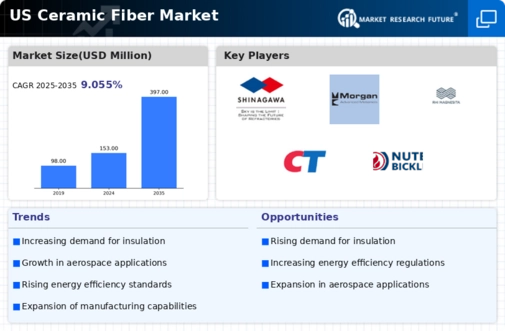
As per analysis, the US ceramic fiber paper market is projected to grow from USD 1.80 Million in 2025 to USD 2.66 Million by 2035, exhibiting a compound annual growth rate (CAGR) of 4.02% during the forecast period (2025 - 2035).

Key Market Trends & Highlights

The US ceramic fiber paper market is poised for growth driven by sustainability and technological advancements.

  • The thermal insulation segment remains the largest contributor to the US ceramic fiber paper market, reflecting a robust demand for high-temperature applications.
  • In contrast, the fire protection segment is experiencing rapid growth, driven by increasing safety regulations and standards.
  • The aerospace sector continues to dominate the market, while the automotive segment is emerging as the fastest-growing area due to innovations in lightweight materials.
  • Key market drivers include the growing demand in high-temperature applications and the expansion of the renewable energy sector, which are likely to propel market growth.

Market Size & Forecast

2024 Market Size 1.73 (USD Million)
2035 Market Size 2.66 (USD Million)
CAGR (2025 - 2035) 4.02%

Major Players

Morgan Advanced Materials (US), Unifrax LLC (US), Shawcor Ltd (US), Isolite Insulating Products Co., Ltd. (US), RHI Magnesita (US), Luyang Energy-Saving Materials Co., Ltd. (US), Nippon Steel Corporation (US), Zircar Ceramics, Inc. (US)

US Ceramic Fiber Paper Market Trends

The US ceramic fiber paper market is currently experiencing a notable evolution, driven by various factors that influence its demand and application across multiple industries. This material, known for its lightweight and high-temperature resistance, finds extensive use in sectors such as aerospace, automotive, and industrial insulation. The increasing focus on energy efficiency and sustainability appears to be propelling the adoption of ceramic fiber paper, as manufacturers seek materials that not only perform well under extreme conditions but also contribute to reducing overall energy consumption. Furthermore, the regulatory landscape in the United States is becoming more stringent, which may compel industries to transition towards safer and more environmentally friendly materials, thereby enhancing the market's growth potential. In addition to the push for sustainability, technological advancements in manufacturing processes are likely to enhance the quality and performance of ceramic fiber paper. Innovations in production techniques may lead to improved product characteristics, such as enhanced thermal stability and reduced weight, which could further broaden the scope of applications. As industries continue to evolve, the US ceramic fiber paper market seems poised for growth, with opportunities emerging in new sectors and applications. The interplay of regulatory requirements, technological progress, and market demand suggests a dynamic landscape for stakeholders in this sector.

Sustainability Initiatives

The US ceramic fiber paper market is increasingly influenced by sustainability initiatives. As industries strive to meet environmental regulations, there is a growing preference for materials that minimize ecological impact. This trend is likely to drive demand for ceramic fiber paper, which is recognized for its energy efficiency and reduced emissions during production.

Technological Advancements

Technological advancements in the production of ceramic fiber paper are shaping the market landscape. Innovations in manufacturing processes may lead to enhanced product performance, including improved thermal resistance and durability. These advancements could open new avenues for application across various sectors, particularly in high-performance environments.

Regulatory Compliance

The regulatory environment in the United States is becoming increasingly stringent, impacting the US ceramic fiber paper market. Compliance with safety and environmental standards is essential for manufacturers. This trend may encourage the adoption of ceramic fiber paper as industries seek materials that align with regulatory requirements while maintaining performance.

Market Segment Insights

By Application: Thermal Insulation (Largest) vs. Fire Protection (Fastest-Growing)

In the US ceramic fiber paper market, the application segments are notably diverse, with Thermal Insulation leading the pack in market share. This segment is favored for its ability to withstand high temperatures while providing exceptional thermal resistance. Following closely is Fire Protection, which has gained significant traction due to its crucial role in ensuring safety in various industrial applications. Acoustic Insulation, Heat Shields, and Gaskets also contribute to the market, although to a lesser extent, highlighting a well-rounded demand among different sectors.

Thermal Insulation (Dominant) vs. Fire Protection (Emerging)

Thermal Insulation is currently recognized as the dominant application segment, primarily utilized in industries requiring high-performance insulation solutions. Its key attributes include lightweight, low thermal conductivity, and high thermal stability, making it ideal for applications in power generation and industrial processes. Conversely, Fire Protection is an emerging segment, rapidly gaining importance due to the increasing regulatory reforms emphasizing safety standards in construction and manufacturing. This segment focuses on the ability of materials to withstand flames and prevent fire spread, integrating seamlessly with existing fire-resistant systems to meet modern safety requirements.

By End Use Industry: Aerospace (Largest) vs. Automotive (Fastest-Growing)

The US ceramic fiber paper market is primarily dominated by the aerospace sector, holding a significant share due to its critical applications in thermal insulation and fire protection. The automotive industry, while smaller, is emerging rapidly from the growing demand for lightweight and heat-resistant materials as manufacturers focus on enhancing fuel efficiency and vehicle performance.

Aerospace (Dominant) vs. Automotive (Emerging)

The aerospace industry is the dominant player in the US ceramic fiber paper market, leveraging advanced technology to enhance performance in high-temperature applications. This segment is characterized by strict regulatory compliance and high-quality standards, leading to increased investments in R&D for innovative materials. On the other hand, the automotive sector represents an emerging opportunity, driven by trends towards electric vehicles and lightweight materials. This segment is experiencing rapid growth as manufacturers seek to reduce emissions and improve energy efficiency, positioning ceramic fiber paper as a key component in modern vehicle design.

By Product Type: Ceramic Fiber Paper (Largest) vs. Ceramic Fiber Blanket (Fastest-Growing)

In the US ceramic fiber paper market, product type segmentation reveals that Ceramic Fiber Paper holds the largest market share, primarily driven by its wide application in industries like aerospace, automotive, and electronics. Following this, the Ceramic Fiber Blanket is gaining traction, reflecting a notable shift towards high-temperature insulation solutions that these blankets provide, specifically in industrial and commercial sectors.

Ceramic Fiber Paper (Dominant) vs. Ceramic Fiber Blanket (Emerging)

Ceramic Fiber Paper is characterized by its lightweight and flexible properties, making it an ideal choice for thermal insulation in high-temperature applications. Its dominance in the market is attributed to its versatile nature and performance across various industries. On the other hand, Ceramic Fiber Blanket is emerging as a notable alternative, known for its excellent tensile strength and lower thermal conductivity, which enhances its insulation efficiency. The growing demand for energy-efficient solutions is fueling the adoption of Ceramic Fiber Blanket, thus positioning it as a competitive player in the US market.

By Form: Rolls (Largest) vs. Custom Shapes (Fastest-Growing)

In the US ceramic fiber paper market, the distribution of market share among the segments presents a clear hierarchy. Rolls dominate the market, accounting for the largest portion due to their versatility and ease of handling, making them the preferred choice for many applications. Sheets follow, providing a significant share as well, while Custom Shapes, although a smaller segment, are gaining traction for specialized applications that require tailored solutions.

Rolls (Dominant) vs. Custom Shapes (Emerging)

Rolls represent the dominant form in the US ceramic fiber paper market, valued for their flexibility and widespread usage in various industries including aerospace and manufacturing. Their extensive applicability and cost-effectiveness ensure their continued preference by manufacturers. Conversely, Custom Shapes have emerged as a vital segment, driven by the demand for specific configurations that cater to unique industrial requirements. This growth is largely influenced by technological advancements, enabling producers to create bespoke solutions that meet exacting standards, making Custom Shapes an attractive option for niche markets.

By Thickness: Thin (Largest) vs. Medium (Fastest-Growing)

In the US ceramic fiber paper market, the thickness segment is dominated by thin options, which occupy the largest share due to their wide application in various industries such as aerospace, automotive, and construction. These thinner papers provide excellent insulation properties while being lightweight, making them a preferred choice among manufacturers and users alike. Medium thickness papers are also notable for their versatility but hold a smaller market share compared to their thinner counterparts. Despite the thin segment's dominance, the medium thickness category is experiencing rapid growth as industries seek more balanced solutions that offer durability without compromising insulation efficiency. This trend is driven by advancements in manufacturing processes and increasing demand for energy-efficient materials, positioning medium thickness ceramic fiber paper as the fastest-growing segment in the market.

Thickness: Thin (Dominant) vs. Medium (Emerging)

The dominant thin ceramic fiber paper segment is characterized by its lightweight properties and excellent thermal and acoustic insulation capabilities, making it an ideal choice in high-temperature applications across various sectors. This segment is preferred for its efficiency and effectiveness in critical applications, ensuring energy conservation and performance optimization. On the other hand, the emerging medium thickness segment is gaining traction, appealing to manufacturers looking for materials that offer a robust alternative to standard thickness variations. This middle ground allows for enhanced performance while being cost-effective, catering to a growing market niche focused on quality and efficiency. This interplay between thin and medium thickness offerings underscores the dynamic nature of the US ceramic fiber paper market.

Get more detailed insights about US Ceramic Fiber Paper Market

Key Players and Competitive Insights

The ceramic fiber paper market is characterized by a competitive landscape that is increasingly shaped by innovation, sustainability, and strategic partnerships. Key players such as Morgan Advanced Materials (US), Unifrax LLC (US), and RHI Magnesita (US) are actively pursuing strategies that enhance their market positioning. Morgan Advanced Materials (US) focuses on developing advanced materials that cater to high-temperature applications, while Unifrax LLC (US) emphasizes sustainability through its eco-friendly product lines. RHI Magnesita (US) is leveraging its global footprint to optimize supply chains and enhance operational efficiencies, thereby influencing the competitive dynamics of the market.

The market structure appears moderately fragmented, with several players vying for market share. Key business tactics include localizing manufacturing to reduce lead times and optimizing supply chains to enhance responsiveness to customer demands. This collective approach by major companies fosters a competitive environment where innovation and operational excellence are paramount, allowing them to adapt to changing market conditions effectively.

In November 2025, Unifrax LLC (US) announced the launch of a new line of ceramic fiber papers designed specifically for the aerospace industry. This strategic move not only diversifies their product offerings but also positions them to capture a growing segment that demands high-performance materials. The introduction of these specialized products is likely to enhance Unifrax's competitive edge, as it aligns with the industry's increasing focus on lightweight and heat-resistant materials.

In October 2025, Morgan Advanced Materials (US) expanded its manufacturing capabilities by investing in a new facility in Texas. This expansion is significant as it allows the company to increase production capacity and improve supply chain efficiencies. By localizing production, Morgan Advanced Materials (US) can better serve its North American customers, potentially leading to increased market share and enhanced customer satisfaction.

In September 2025, RHI Magnesita (US) entered into a strategic partnership with a leading technology firm to integrate AI into its manufacturing processes. This collaboration aims to enhance operational efficiencies and reduce production costs. The integration of AI is expected to streamline operations, allowing RHI Magnesita (US) to respond more swiftly to market demands and maintain a competitive advantage in the ceramic fiber paper market.

As of December 2025, the competitive trends in the ceramic fiber paper market are increasingly defined by digitalization, sustainability, and technological integration. Strategic alliances are becoming more prevalent, enabling companies to leverage complementary strengths and enhance their market positions. The shift from price-based competition to a focus on innovation, technology, and supply chain reliability is evident, suggesting that future competitive differentiation will hinge on these factors. Companies that prioritize these elements are likely to thrive in an evolving market landscape.


Key Companies in the US Ceramic Fiber Paper Market market include

Industry Developments

Recent developments in the US Ceramic Fiber Market include a surge in demand due to increased applications in industries such as aerospace and automotive. In September 2023, Unifrax announced plans to expand its production capacity to meet the growing needs in thermal management applications. Simultaneously, the market has witnessed notable mergers and acquisitions, particularly in April 2023, when HarbisonWalker International completed its acquisition of a subsidiary of RHI Magnesita, enhancing its product range in high-temperature insulation solutions.

Furthermore, Morgan Advanced Materials reported a substantial growth in revenue during the last fiscal year attributed to heightened demand across various industrial sectors, impacting the market valuation positively. The last two to three years have seen similar growth trends, including Ceramtec’s launch of innovative ceramic fiber products in January 2022, which strengthened its position in the market. Additionally, policy shifts towards sustainable manufacturing practices have increased the competitive landscape, prompting companies to invest in Research and Development.

The overall growth trajectory is supported by advancements in manufacturing technologies, improving both the efficiency and environmental sustainability of ceramic fiber products within the United States.

Future Outlook

US Ceramic Fiber Paper Market Future Outlook

The US ceramic fiber paper market is projected to grow at a 4.02% CAGR from 2024 to 2035, driven by increasing demand in high-temperature applications and energy efficiency initiatives.

New opportunities lie in:

  • Expansion into aerospace and automotive sectors with customized solutions.
  • Development of eco-friendly ceramic fiber paper products to meet sustainability demands.
  • Investment in advanced manufacturing technologies to enhance production efficiency.

By 2035, the market is expected to solidify its position as a leader in high-performance insulation solutions.

Market Segmentation

US Ceramic Fiber Paper Market Form Outlook

  • Rolls
  • Sheets
  • Custom Shapes

US Ceramic Fiber Paper Market Thickness Outlook

  • Thin
  • Medium
  • Thick

US Ceramic Fiber Paper Market Application Outlook

  • Thermal Insulation
  • Fire Protection
  • Acoustic Insulation
  • Heat Shields
  • Gaskets

US Ceramic Fiber Paper Market Product Type Outlook

  • Ceramic Fiber Paper
  • Ceramic Fiber Board
  • Ceramic Fiber Blanket
  • Ceramic Fiber Module

US Ceramic Fiber Paper Market End Use Industry Outlook

  • Aerospace
  • Automotive
  • Construction
  • Energy
  • Manufacturing

Report Scope

MARKET SIZE 20241.73(USD Million)
MARKET SIZE 20251.8(USD Million)
MARKET SIZE 20352.66(USD Million)
COMPOUND ANNUAL GROWTH RATE (CAGR)4.02% (2024 - 2035)
REPORT COVERAGERevenue Forecast, Competitive Landscape, Growth Factors, and Trends
BASE YEAR2024
Market Forecast Period2025 - 2035
Historical Data2019 - 2024
Market Forecast UnitsUSD Million
Key Companies ProfiledMorgan Advanced Materials (US), Unifrax LLC (US), Shawcor Ltd (US), Isolite Insulating Products Co., Ltd. (US), RHI Magnesita (US), Luyang Energy-Saving Materials Co., Ltd. (US), Nippon Steel Corporation (US), Zircar Ceramics, Inc. (US)
Segments CoveredApplication, End Use Industry, Product Type, Form, Thickness
Key Market OpportunitiesGrowing demand for lightweight, high-temperature insulation solutions in aerospace and automotive sectors.
Key Market DynamicsRising demand for lightweight, high-temperature insulation drives innovation in the US ceramic fiber paper market.
Countries CoveredUS

Leave a Comment

Download Free Sample

Kindly complete the form below to receive a free sample of this Report

Compare Licence

×
Features License Type
Single User Multiuser License Enterprise User
Price $4,950 $5,950 $7,250
Maximum User Access Limit 1 User Upto 10 Users Unrestricted Access Throughout the Organization
Free Customization
Direct Access to Analyst
Deliverable Format
Platform Access
Discount on Next Purchase 10% 15% 15%
Printable Versions