×
Request Free Sample ×

Kindly complete the form below to receive a free sample of this Report

* Please use a valid business email

Leading companies partner with us for data-driven Insights

clients tt-cursor
Hero Background

Ceramic Paper Market

ID: MRFR/CnM/27978-HCR
111 Pages
Chitranshi Jaiswal
October 2025

Ceramic Paper Market Research Report: By Technology (Conventional Ceramic Paper, Advanced Ceramic Paper), By Application (Industrial, Electronic, Medical, Aerospace & Defense), By Form (Sheets, Rolls, Laminates), By Composition (Alumina, Zirconia, Mullite, Silica), By Substrate (Glass, Metal, Polyimide, Ceramic) and By Regional (North America, Europe, South America, Asia Pacific, Middle East and Africa) - Forecast to 2035.

Share:
Download PDF ×

We do not share your information with anyone. However, we may send you emails based on your report interest from time to time. You may contact us at any time to opt-out.

Ceramic Paper Market Infographic
Purchase Options

Ceramic Paper Market Summary

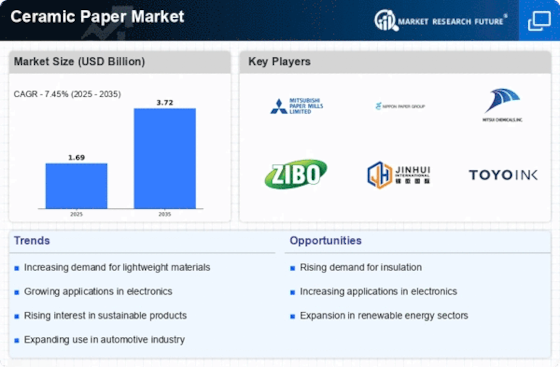
As per MRFR analysis, the Ceramic Paper Market Size was estimated at 1.687 USD Billion in 2024. The Ceramic Paper industry is projected to grow from 1.813 USD Billion in 2025 to 3.72 USD Billion by 2035, exhibiting a compound annual growth rate (CAGR) of 7.45 during the forecast period 2025 - 2035.

Key Market Trends & Highlights

The Ceramic Paper Market is poised for growth driven by technological advancements and increasing demand across various sectors.

  • North America remains the largest market for ceramic paper, driven by robust industrial applications.
  • Asia-Pacific is emerging as the fastest-growing region, fueled by rapid technological innovations and manufacturing capabilities.
  • Conventional ceramic paper continues to dominate the market, while advanced ceramic paper is witnessing the highest growth rates.
  • Key market drivers include rising demand in the electronics sector and an increased focus on fire safety regulations.

Market Size & Forecast

2024 Market Size 1.687 (USD Billion)
2035 Market Size 3.72 (USD Billion)
CAGR (2025 - 2035) 7.45%

Major Players

Mitsubishi Paper Mills Limited (JP), Nippon Paper Industries Co Ltd (JP), Mitsui Chemicals Inc (JP), Zibo Jiahua Paper Co Ltd (CN), Hunan Jinhui High-Tech Materials Co Ltd (CN), Shenzhen Huitongda Technology Co Ltd (CN), Toyo Ink SC Holdings Co Ltd (JP), Kraft Chemical Co Ltd (US)

Ceramic Paper Market Trends

The Ceramic Paper Market is currently experiencing a notable evolution, driven by advancements in technology and increasing demand across various industries. This market encompasses a range of applications, including electronics, aerospace, and automotive sectors, where the unique properties of ceramic paper, such as thermal resistance and electrical insulation, are highly valued. As industries seek materials that enhance performance while ensuring sustainability, the appeal of ceramic paper continues to grow. Furthermore, the ongoing research and development efforts aimed at improving the properties of ceramic paper suggest a promising future for this market. In addition to technological advancements, the Ceramic Paper Market is influenced by shifting consumer preferences towards eco-friendly materials. Manufacturers are increasingly focusing on sustainable production methods, which align with global trends towards environmental responsibility. This shift not only enhances the market's appeal but also encourages innovation in product offerings. As the market evolves, it appears that the integration of advanced materials and sustainable practices will play a crucial role in shaping its trajectory, potentially leading to new applications and expanded market reach.

Technological Advancements

The Ceramic Paper Market is witnessing a surge in technological innovations that enhance product performance. These advancements are likely to improve the thermal and electrical properties of ceramic paper, making it more suitable for high-demand applications in various sectors.

Sustainability Focus

There is a growing emphasis on sustainable practices within the Ceramic Paper Market. Manufacturers are increasingly adopting eco-friendly production methods, which not only meet consumer demand for greener products but also contribute to the overall reduction of environmental impact.

Diverse Applications

The versatility of ceramic paper is leading to its adoption across a wide range of industries. From electronics to automotive, the material's unique properties are being leveraged to create innovative solutions, suggesting a broadening scope for future market growth.

Ceramic Paper Market Drivers

Rising Demand in Electronics

The Ceramic Paper Market experiences a notable surge in demand driven by the electronics sector. As electronic devices become increasingly compact and efficient, the need for high-performance insulation materials rises. Ceramic paper, known for its excellent thermal stability and electrical insulation properties, is becoming a preferred choice among manufacturers. In 2025, the electronics segment is projected to account for a significant share of the market, reflecting a trend towards miniaturization and enhanced performance. This demand is likely to propel innovations in ceramic paper production, leading to improved product offerings that cater to the specific needs of the electronics industry. As a result, the Ceramic Paper Market is poised for substantial growth, with manufacturers focusing on developing advanced materials that meet the evolving requirements of electronic applications.

Growth in Renewable Energy Sector

The Ceramic Paper Market is witnessing growth fueled by the renewable energy sector. As the world shifts towards sustainable energy solutions, the demand for materials that can withstand high temperatures and provide insulation is increasing. Ceramic paper is particularly valuable in applications such as solar panels and wind turbines, where durability and thermal resistance are critical. In 2025, the renewable energy segment is expected to contribute significantly to the overall market growth, as investments in clean energy technologies continue to rise. This trend suggests that manufacturers in the Ceramic Paper Market may need to adapt their production processes to meet the specific requirements of renewable energy applications, potentially leading to innovations in product design and functionality.

Expansion of the Automotive Industry

The Ceramic Paper Market is benefiting from the expansion of the automotive sector, particularly with the increasing adoption of electric vehicles (EVs). As automakers seek lightweight and efficient materials to enhance vehicle performance, ceramic paper is gaining traction due to its thermal insulation properties. In 2025, the automotive segment is projected to represent a substantial portion of the market, driven by the need for materials that can withstand high temperatures and provide effective insulation. This growth may encourage manufacturers to innovate and develop specialized ceramic paper products tailored for automotive applications. As a result, the Ceramic Paper Market is likely to evolve, aligning its offerings with the demands of a rapidly changing automotive landscape.

Increased Focus on Fire Safety Regulations

The Ceramic Paper Market is influenced by the heightened focus on fire safety regulations across various sectors. As industries strive to comply with stringent safety standards, the demand for fire-resistant materials is on the rise. Ceramic paper, with its inherent fire-resistant properties, is becoming an essential component in construction, automotive, and aerospace applications. In 2025, the market is likely to see an uptick in demand as companies prioritize safety and compliance. This trend may drive manufacturers to enhance their product offerings, ensuring that ceramic paper meets the latest fire safety standards. Consequently, the Ceramic Paper Market could experience a shift towards more specialized products designed to address specific regulatory requirements, thereby expanding its market reach.

Technological Innovations in Manufacturing Processes

The Ceramic Paper Market is experiencing a transformation due to technological innovations in manufacturing processes. Advances in production techniques are enabling manufacturers to create high-quality ceramic paper with enhanced properties, such as improved flexibility and thermal resistance. In 2025, these innovations are expected to play a crucial role in meeting the diverse needs of various industries, including electronics, automotive, and construction. The ability to produce customized ceramic paper products may lead to increased market penetration and customer satisfaction. Furthermore, as manufacturers adopt more efficient and sustainable production methods, the Ceramic Paper Market could witness a shift towards environmentally friendly practices, aligning with global sustainability goals.


Market Segment Insights

By Technology: Conventional Ceramic Paper Market (Largest) vs. Advanced Ceramic Paper Market (Fastest-Growing)

In the Ceramic Paper Market, Conventional Ceramic Paper Market holds a significant share, attributed to its established presence and wide applications in various industries such as electronics and automotive. This segment has been a reliable choice for manufacturers due to its cost-effectiveness and consistent quality, making it the largest player in the market. Conversely, Advanced Ceramic Paper Market is gaining traction due to its enhanced properties and novel uses in high-tech applications, which are driving its growth among specialized sectors.

Technology: Conventional Ceramic Paper Market (Dominant) vs. Advanced Ceramic Paper Market (Emerging)

Conventional Ceramic Paper Market is recognized for its dominance in the market, offering reliable performance and cost advantages across traditional applications. It is widely utilized in standard insulating and electrical components, making it the go-to choice for many manufacturers. On the other hand, Advanced Ceramic Paper Market represents an emerging trend that capitalizes on cutting-edge technology, boasting superior properties such as increased thermal stability and enhanced mechanical strength. This segment is rapidly gaining popularity in high-performance applications, particularly in the aerospace and biomedicine industries, making it a promising area for future development and investment.

By Application: Industrial (Largest) vs. Electronic (Fastest-Growing)

In the Ceramic Paper Market, the application segment showcases varied distribution among Industrial, Electronic, Medical, and Aerospace Defense applications. The Industrial sector holds the largest share, driven by its extensive use in manufacturing processes, particularly in creating components for high-performance applications. In contrast, the Electronic segment is witnessing rapid growth, attributed to the rising demand for advanced materials in semiconductor and electronic device manufacturing, making it the fastest-growing area in this market. Growth trends within the Ceramic Paper Market indicate a robust demand across all applications, with the Industrial segment benefiting from the increasing need for efficient manufacturing solutions. Meanwhile, the Electronic segment is being propelled by technological advancements and the push for lighter, more efficient materials in electronic devices. This surging interest is indicative of a shift toward combining high performance with cost-effective solutions in the industry, leading to expanded applications in various sectors.

Industrial (Dominant) vs. Electronic (Emerging)

The Industrial application of ceramic paper remains dominant, fueled by its crucial role in numerous manufacturing processes including electronics, automotive, and aerospace industries. This application leverages the unique properties of ceramic papers, such as high thermal stability and insulation capabilities, making them ideal for use in various components. On the other hand, the Electronic sector represents an emerging market for ceramic papers, driven by innovative technologies, such as flexible electronics and the push for miniaturization. This application benefits from advancements in electronic design, requiring materials that can withstand high temperatures while providing excellent insulation properties. The growing reliance on IoT devices and smart applications further emphasizes the promising potential of ceramic paper in the electronic domain.

By Form: Sheets (Largest) vs. Rolls (Fastest-Growing)

In the Ceramic Paper Market, the segment distribution reveals that Sheets hold the largest market share, primarily due to their widespread use in various applications such as electronics and automotive components. Rolls trail closely, benefitting from their versatility and efficiency in manufacturing processes, while Laminates represent a smaller yet significant segment due to their specialized applications. This diverse market landscape indicates a robust demand for different ceramic paper forms, each tailored to specific industry needs.

Sheets (Dominant) vs. Rolls (Emerging)

Sheets are the dominant segment in the Ceramic Paper Market, largely attributed to their extensive applications and high demand from industries requiring precise and durable substrates. Their ease of handling and compatibility with various manufacturing techniques make them a preferred choice among producers. On the other hand, Rolls are emerging quickly, driven by the increasing need for cost-effective and time-efficient solutions in production lines. Their flexibility allows for large-scale applications that are gaining traction in sectors prioritizing sustainability and waste reduction. The presence of both segments reflects a market that is evolving, accommodating diverse customer requirements while paving the way for innovative manufacturing methodologies.

By Composition: Alumina (Largest) vs. Zirconia (Fastest-Growing)

The Ceramic Paper Market's composition segment is diverse, with Alumina leading in market share due to its exceptional thermal stability and conductivity. It remains the preferred choice in high-performance applications, accounting for a significant portion of the overall segment. In contrast, Zirconia, while currently holding a smaller share, is gaining traction as industries increasingly demand materials with enhanced toughness and resistance to thermal shock, contributing to its rapid growth rate in recent years.

Alumina (Dominant) vs. Zirconia (Emerging)

Alumina stands out as the dominant player in the Ceramic Paper Market with its robust properties, making it ideal for various applications, including electrical insulation and thermal barriers. Its longstanding reputation is built on its ability to withstand high temperatures and corrosive environments, providing reliability and performance. On the other hand, Zirconia, though newer in adoption, is emerging quickly due to its remarkable mechanical properties and thermal stability. This positions Zirconia as an attractive option for advanced applications, such as in the automotive and aerospace sectors, where performance and precision are critical.

By Substrate: Ceramic (Largest) vs. Polyimide (Fastest-Growing)

In the Ceramic Paper Market, the substrate segment is primarily composed of Ceramic, Glass, Metal, and Polyimide. Among these, Ceramic holds the largest market share due to its superior thermal properties and versatility in different applications. Polyimide, while currently smaller, is rapidly gaining traction owing to its impressive performance in high-temperature environments, indicating a shift in preferences towards more advanced materials. This performance-driven orientation suggests a dynamic distribution within the segment, leaning heavily towards Ceramic consumption. Looking forward, the growth trends in the substrate segment can be attributed to rising demand in aerospace and electronics applications where both Ceramic and Polyimide excel. The transition towards lightweight and heat-resistant materials is pushing manufacturers to innovate, leading to increased adoption of Polyimide in high-performance applications. The commitment to sustainability alongside technological advancement is reshaping this landscape, creating opportunities for both existing leaders and emerging contenders in this space.

Ceramic (Dominant) vs. Polyimide (Emerging)

Ceramic substrates are known for their thermal stability and electrical insulation properties, making them the dominant player in the ceramic paper market. Their capabilities in high-temperature applications lend them an edge over alternatives, ensuring sustained demand from industries such as electronics and automotive. On the other hand, Polyimide substrates are emerging rapidly due to their excellent performance under thermal stress and flexibility. As industries demand higher efficiency and lightweight materials, Polyimide's adaptability positions it as a favorable option. The growing technological advancements and changing regulatory landscapes are providing momentum for Polyimide, potentially reshaping the competitive dynamics within the ceramic paper market.

Get more detailed insights about Ceramic Paper Market

Regional Insights

North America : Innovation and Demand Surge

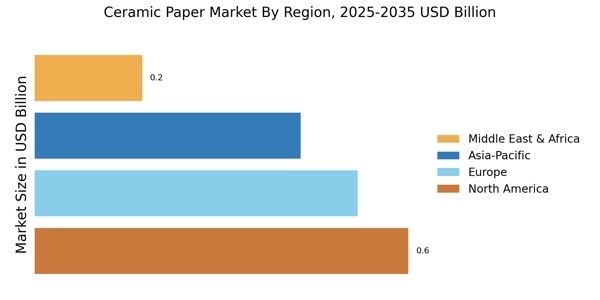
North America is witnessing significant growth in the ceramic paper market, driven by increasing demand in the electronics and automotive sectors. The region holds approximately 35% of the global market share, making it the largest market. Regulatory support for advanced materials and sustainable practices further fuels this growth. The rising trend of lightweight materials in manufacturing is also a key driver, enhancing the demand for ceramic papers. The United States and Canada are the leading countries in this region, with major players like Kraft Chemical Co Ltd and Mitsubishi Paper Mills Limited establishing a strong foothold. The competitive landscape is characterized by innovation and strategic partnerships among key players. The presence of advanced manufacturing facilities and R&D centers in these countries supports the growth of the ceramic paper market, ensuring a steady supply of high-quality products.

Europe : Sustainability and Innovation Focus

Europe is emerging as a significant player in the ceramic paper market, driven by stringent environmental regulations and a strong focus on sustainability. The region accounts for approximately 30% of the global market share, making it the second-largest market. The demand for eco-friendly materials in various industries, including construction and automotive, is propelling market growth. Regulatory frameworks promoting sustainable practices are also acting as catalysts for innovation in this sector. Leading countries in Europe include Germany, France, and the UK, where companies like Nippon Paper Industries Co Ltd and Mitsui Chemicals Inc are actively involved. The competitive landscape is marked by a mix of established players and innovative startups focusing on sustainable solutions. The presence of advanced research institutions in these countries fosters collaboration and technological advancements, further enhancing the market's growth potential.

Asia-Pacific : Rapid Expansion and Demand

Asia-Pacific is experiencing rapid growth in the ceramic paper market, driven by increasing industrialization and urbanization. The region holds approximately 25% of the global market share, with China and Japan being the largest contributors. The demand for ceramic papers in electronics, automotive, and construction sectors is on the rise, supported by favorable government policies and investments in infrastructure development. The region's focus on innovation and technology is also a significant growth driver. China is the leading country in this market, with key players like Zibo Jiahua Paper Co Ltd and Hunan Jinhui High-Tech Materials Co Ltd dominating the landscape. Japan also plays a crucial role, with companies such as Mitsubishi Paper Mills Limited and Toyo Ink SC Holdings Co Ltd contributing to market growth. The competitive environment is characterized by a mix of local and international players, fostering innovation and enhancing product offerings.

Middle East and Africa : Emerging Market Potential

The Middle East and Africa region is gradually emerging in the ceramic paper market, driven by increasing demand in construction and automotive sectors. The region holds approximately 10% of the global market share, with significant growth potential. Factors such as urbanization, infrastructure development, and a growing focus on sustainable materials are contributing to market expansion. Government initiatives aimed at boosting manufacturing capabilities are also playing a crucial role in this growth. Leading countries in this region include South Africa and the UAE, where local players are beginning to establish a presence in the ceramic paper market. The competitive landscape is still developing, with opportunities for both local and international companies to enter the market. As the region continues to invest in infrastructure and industrialization, the demand for ceramic papers is expected to rise, creating new avenues for growth.

Ceramic Paper Market Regional Image

Key Players and Competitive Insights

The Ceramic Paper Market is currently characterized by a dynamic competitive landscape, driven by increasing demand for high-performance materials across various industries, including electronics, aerospace, and automotive. Key players such as Mitsubishi Paper Mills Limited (Japan), Nippon Paper Industries Co Ltd (Japan), and Zibo Jiahua Paper Co Ltd (China) are strategically positioning themselves through innovation and regional expansion. Mitsubishi Paper Mills Limited (Japan) focuses on enhancing its product offerings through advanced manufacturing techniques, while Nippon Paper Industries Co Ltd (Japan) emphasizes sustainability in its operations, aiming to reduce environmental impact. Zibo Jiahua Paper Co Ltd (China) appears to be leveraging its local market knowledge to optimize supply chains and enhance customer relationships, collectively shaping a competitive environment that prioritizes quality and sustainability.

The business tactics employed by these companies reflect a trend towards localizing manufacturing and optimizing supply chains to meet the growing demand for ceramic paper. The market structure is moderately fragmented, with several players vying for market share, yet the influence of key players remains substantial. This competitive structure allows for a diverse range of products and innovations, fostering an environment where companies must continuously adapt to maintain their competitive edge.

In August 2025, Mitsubishi Paper Mills Limited (Japan) announced a significant investment in a new production facility aimed at increasing its capacity for high-performance ceramic paper. This strategic move is likely to enhance the company's ability to meet rising demand, particularly in the electronics sector, where precision and quality are paramount. The investment underscores the company's commitment to innovation and its proactive approach to capturing market opportunities.

In September 2025, Nippon Paper Industries Co Ltd (Japan) launched a new line of eco-friendly ceramic paper products designed to cater to environmentally conscious consumers. This initiative not only aligns with global sustainability trends but also positions the company as a leader in the green materials segment. By focusing on sustainable product development, Nippon Paper Industries Co Ltd (Japan) is likely to attract a broader customer base and strengthen its market position.

In July 2025, Zibo Jiahua Paper Co Ltd (China) entered into a strategic partnership with a leading technology firm to integrate AI-driven solutions into its manufacturing processes. This collaboration aims to enhance production efficiency and reduce waste, reflecting a growing trend towards digital transformation in the industry. The integration of AI technologies may provide Zibo Jiahua Paper Co Ltd (China) with a competitive advantage, enabling it to respond more swiftly to market demands and improve overall operational performance.

As of October 2025, the Ceramic Paper Market is witnessing significant trends such as digitalization, sustainability, and the integration of advanced technologies like AI. Strategic alliances among key players are shaping the competitive landscape, fostering innovation and collaboration. The shift from price-based competition to a focus on technological advancement and supply chain reliability is becoming increasingly evident. Moving forward, companies that prioritize innovation and sustainability are likely to differentiate themselves in a market that is evolving rapidly.

Key Companies in the Ceramic Paper Market market include

Industry Developments

The growth of the market is attributed to the increasing demand for ceramic paper in various end-use industries, such as electronics, automotive, and aerospace.Key market trends include the rising adoption of ceramic paper in flexible electronics, the growing demand for lightweight and durable materials in the automotive industry, and the increasing use of ceramic paper in aerospace applications.Major players in the ceramic paper market include 3M, Kyocera, and Ibiden.

These companies are investing in research and development to develop new and innovative ceramic paper products.The ceramic paper market is expected to witness significant growth in the coming years, driven by the increasing demand for advanced materials in various industries.

Future Outlook

Ceramic Paper Market Future Outlook

The Ceramic Paper Market is projected to grow at a 7.45% CAGR from 2024 to 2035, driven by advancements in technology and increasing demand in various industries.

New opportunities lie in:

  • Development of high-temperature resistant ceramic papers for aerospace applications.
  • Expansion into emerging markets with tailored product offerings.
  • Investment in R&D for innovative ceramic paper applications in electronics.

By 2035, the Ceramic Paper Market is expected to achieve substantial growth, reflecting evolving industry needs.

Market Segmentation

Ceramic Paper Market Form Outlook

  • Sheets
  • Rolls
  • Laminates

Ceramic Paper Market Substrate Outlook

  • Glass
  • Metal
  • Polyimide
  • Ceramic

Ceramic Paper Market Technology Outlook

  • Conventional Ceramic Paper
  • Advanced Ceramic Paper

Ceramic Paper Market Application Outlook

  • Industrial
  • Electronic
  • Medical
  • Aerospace Defense

Ceramic Paper Market Composition Outlook

  • Alumina
  • Zirconia
  • Mullite
  • Silica

Report Scope

MARKET SIZE 20241.687(USD Billion)
MARKET SIZE 20251.813(USD Billion)
MARKET SIZE 20353.72(USD Billion)
COMPOUND ANNUAL GROWTH RATE (CAGR)7.45% (2024 - 2035)
REPORT COVERAGERevenue Forecast, Competitive Landscape, Growth Factors, and Trends
BASE YEAR2024
Market Forecast Period2025 - 2035
Historical Data2019 - 2024
Market Forecast UnitsUSD Billion
Key Companies ProfiledMarket analysis in progress
Segments CoveredMarket segmentation analysis in progress
Key Market OpportunitiesGrowing demand for lightweight, high-temperature resistant materials in aerospace and automotive sectors drives Ceramic Paper Market expansion.
Key Market DynamicsRising demand for lightweight, high-performance materials drives innovation and competition in the Ceramic Paper Market.
Countries CoveredNorth America, Europe, APAC, South America, MEA

Leave a Comment

FAQs

What is the current valuation of the Ceramic Paper Market as of 2024?

The Ceramic Paper Market was valued at 1.687 USD Billion in 2024.

What is the projected market size for the Ceramic Paper Market in 2035?

The market is projected to reach 3.72 USD Billion by 2035.

What is the expected CAGR for the Ceramic Paper Market during the forecast period 2025 - 2035?

The expected CAGR for the Ceramic Paper Market during 2025 - 2035 is 7.45%.

Which companies are considered key players in the Ceramic Paper Market?

Key players include Mitsubishi Paper Mills Limited, Nippon Paper Industries Co Ltd, and Mitsui Chemicals Inc.

What are the main segments of the Ceramic Paper Market?

The main segments include Technology, Application, Form, Composition, and Substrate.

How does the valuation of Conventional Ceramic Paper compare to Advanced Ceramic Paper?

In 2024, Conventional Ceramic Paper was valued at 0.845 USD Billion, while Advanced Ceramic Paper was valued at 0.842 USD Billion.

What is the projected valuation for the Industrial application segment by 2035?

The Industrial application segment is projected to reach 1.5 USD Billion by 2035.

What are the expected valuations for the Sheets and Rolls forms of Ceramic Paper in 2035?

By 2035, Sheets are expected to be valued at 1.5 USD Billion, while Rolls are projected at 1.2 USD Billion.

Download Free Sample

Kindly complete the form below to receive a free sample of this Report

Compare Licence

×
Features License Type
Single User Multiuser License Enterprise User
Price $4,950 $ $7,250
Maximum User Access Limit 1 User Upto 10 Users Unrestricted Access Throughout the Organization
Free Customization
Direct Access to Analyst
Deliverable Format
Platform Access
Discount on Next Purchase 10% 15% 15%
Printable Versions