×
Request Free Sample ×

Kindly complete the form below to receive a free sample of this Report

* Please use a valid business email

Leading companies partner with us for data-driven Insights

clients tt-cursor
Hero Background

US Construction Composites Market

ID: MRFR/CnM/16896-HCR
100 Pages
Garvit Vyas
October 2025

US Construction 4.0 Market Research Report By Building Type (Residential, Non-Residential), By Solution (Hardware, Software, Services), By Technology (IoT, Artificial Intelligence, Industrial Robots, Others) – Forecast to 2035

Share:
Download PDF ×

We do not share your information with anyone. However, we may send you emails based on your report interest from time to time. You may contact us at any time to opt-out.

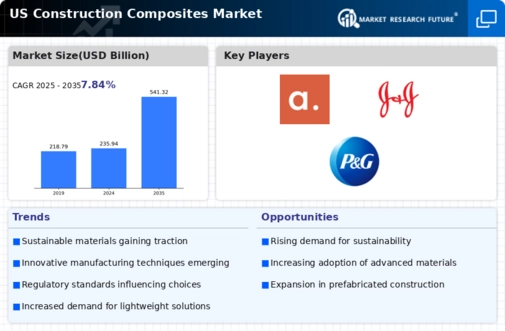
US Construction Composites Market Infographic
Purchase Options

US Construction Composites Market Summary

As per analysis, the US construction composites market is projected to grow from USD 10.48 Billion in 2024 to USD 11.06 Billion in 2025, exhibiting a compound annual growth rate (CAGR) of 5.5% during the forecast period (2025 - 2035).

Key Market Trends & Highlights

The US construction composites market is poised for growth driven by sustainability and technological advancements.

  • The market is increasingly characterized by a strong sustainability focus, influencing material choices and construction practices.
  • Structural composites remain the largest segment, while insulation composites are recognized as the fastest-growing segment in the market.
  • Fiber reinforced polymers dominate the market, whereas wood plastic composites are emerging as the fastest-growing category.
  • Key market drivers include regulatory support and economic growth, which are fostering innovation and infrastructure development.

Market Size & Forecast

2024 Market Size 10.48 (USD Billion)
2035 Market Size 18.89 (USD Billion)
CAGR (2025 - 2035) 5.5%

Major Players

DuPont (US), BASF (US), Owens Corning (US), 3M (US), Huntsman Corporation (US), Sika AG (US), GAF Materials Corporation (US), Johns Manville (US), Solvay (US)

US Construction Composites Market Trends

The US construction composites market is currently experiencing a notable transformation, driven by advancements in material technology and a growing emphasis on sustainability. As the construction industry increasingly seeks to reduce its environmental footprint, composite materials, which often combine the benefits of strength and lightweight properties, are gaining traction. This shift is further supported by regulatory frameworks that encourage the use of eco-friendly materials, thereby fostering innovation within the sector. Additionally, the integration of smart technologies into construction processes is likely to enhance the performance and functionality of composite materials, making them more appealing to builders and architects alike. Moreover, the demand for durable and low-maintenance building materials is propelling the adoption of composites in various applications, including residential, commercial, and infrastructure projects. The versatility of these materials allows for their use in a wide range of structural components, from beams to facades. As the US construction composites market continues to evolve, it appears poised for growth, with stakeholders increasingly recognizing the potential of composites to meet modern construction challenges. This trend suggests a promising future for the industry, as it aligns with broader goals of efficiency and sustainability in construction practices.

Sustainability Focus

The US construction composites market is witnessing a pronounced shift towards sustainable practices. This trend is characterized by the increasing use of recycled materials and bio-based composites, which align with environmental regulations and consumer preferences for greener building solutions. Stakeholders are prioritizing materials that minimize ecological impact, thereby enhancing the market's appeal.

Technological Integration

Advancements in technology are significantly influencing the US construction composites market. The incorporation of smart technologies, such as sensors and IoT devices, into composite materials is enhancing their functionality and performance. This integration allows for real-time monitoring of structural integrity, which could lead to improved safety and longevity of construction projects.

Versatile Applications

The versatility of composite materials is driving their adoption across various sectors within the US construction composites market. These materials are increasingly utilized in diverse applications, including residential, commercial, and infrastructure projects. Their lightweight yet durable nature makes them suitable for a wide range of structural components, thereby expanding their market presence.

Market Segment Insights

By Application: Structural Composites (Largest) vs. Insulation Composites (Fastest-Growing)

In the US construction composites market, Structural Composites hold the largest market share, driven by their extensive application in building and infrastructure projects. Non-Structural Composites and Insulation Composites follow, catering to specific needs in construction. Reinforcement Composites, while significant, contribute less to the overall share compared to their counterparts, highlighting the skewed distribution of market dominance towards structural applications.

Structural Composites (Dominant) vs. Insulation Composites (Emerging)

Structural Composites are integral in modern construction, providing strength and durability. They are widely utilized in beams, columns, and other load-bearing elements, reflecting their dominant position in the market. On the other hand, Insulation Composites are emerging rapidly due to increasing energy efficiency regulations and the demand for sustainable building materials. These composites are used in various applications, including thermal insulation and sound-proofing, allowing them to capture a growing segment of the market as builders seek innovative solutions to enhance energy performance.

By Material Type: Fiber Reinforced Polymer (Largest) vs. Wood Plastic Composite (Fastest-Growing)

In the US construction composites market, Fiber Reinforced Polymer (FRP) holds the largest share due to its superior strength-to-weight ratio, corrosion resistance, and versatility in various applications. Wood Plastic Composite (WPC), while smaller in comparison, is rapidly gaining ground among environmentally-conscious builders looking for sustainable materials, creating a competitive landscape. As builders and contractors increasingly seek to optimize performance and reduce costs, FRP's established presence is complemented by WPC's innovative approach in the market. Growth trends for these materials are influenced by several factors, including evolving building codes that favor high-performance materials, increasing demand for lightweight and durable solutions, and the push for sustainability in construction practices. The innovation in manufacturing processes has also enhanced the properties of both FRP and WPC, thus allowing them to penetrate new segments of the construction industry, which is expected to drive further adoption over the coming years.

Fiber Reinforced Polymer (Dominant) vs. Wood Plastic Composite (Emerging)

Fiber Reinforced Polymer (FRP) stands as the dominant material in the US construction composites market, known for its exceptional durability, resistance to chemical exposure, and lightweight nature. It is extensively utilized in demanding applications like bridge and building construction, making it a preferred choice among engineers and architects. In contrast, Wood Plastic Composite (WPC) has emerged as a significant player, appealing particularly to the residential market due to its aesthetic appeal and need for sustainable options. WPC is gaining traction because of its recycled content and lower environmental impact compared to traditional materials, positioning it well in a market increasingly responsive to green building practices. As the trend towards innovative construction materials continues, both FRP and WPC are poised for transformative roles.

By End Use Industry: Residential Construction (Largest) vs. Infrastructure Development (Fastest-Growing)

In the US construction composites market, the 'End Use Industry' segment is dominated by residential construction, which holds the largest share. This segment is driven by increasing housing demands, fueled by population growth and a shift towards urban living. Conversely, infrastructure development is emerging as the fastest-growing segment, supported by government initiatives and investment in public infrastructure projects aiming to enhance connectivity and modernize aging facilities.

Residential Construction (Dominant) vs. Infrastructure Development (Emerging)

Residential construction continues to be the dominant segment in the US construction composites market, characterized by high demand for sustainable and energy-efficient building materials. This segment is primarily driven by the increasing appetite for residential housing due to urbanization and demographic changes. In contrast, infrastructure development is recognized as an emerging segment, experiencing rapid growth due to substantial governmental investment in infrastructure upgrade initiatives. This segment focuses on the creation and maintenance of critical structures like roads, bridges, and utilities, making it pivotal for the market's overall development and responsiveness to societal needs.

Get more detailed insights about US Construction Composites Market

Key Players and Competitive Insights

The construction composites market is currently characterized by a dynamic competitive landscape, driven by innovation, sustainability, and strategic partnerships. Key players such as DuPont (US), BASF (US), and Owens Corning (US) are actively shaping the market through their distinct operational focuses. DuPont (US) emphasizes innovation in material science, particularly in developing high-performance composites that cater to the growing demand for sustainable building solutions. Meanwhile, BASF (US) is leveraging its extensive research capabilities to enhance product performance and reduce environmental impact, positioning itself as a leader in eco-friendly construction materials. Owens Corning (US) is focusing on expanding its product portfolio through strategic acquisitions, thereby enhancing its market presence and operational capabilities. Collectively, these strategies contribute to a competitive environment that prioritizes technological advancement and sustainability.

In terms of business tactics, companies are increasingly localizing manufacturing to reduce lead times and optimize supply chains. This approach not only enhances operational efficiency but also aligns with the growing consumer preference for locally sourced materials. The market structure appears moderately fragmented, with several key players exerting considerable influence. The collective actions of these companies suggest a trend towards consolidation, as firms seek to enhance their competitive edge through mergers and acquisitions.

In November 2025, DuPont (US) announced a partnership with a leading architectural firm to develop a new line of bio-based composites aimed at reducing carbon footprints in construction. This strategic move underscores DuPont's commitment to sustainability and positions it favorably in a market increasingly driven by environmental considerations. The collaboration is expected to yield innovative products that not only meet regulatory standards but also appeal to eco-conscious consumers.

In October 2025, BASF (US) launched a new digital platform designed to streamline the procurement process for construction materials. This initiative reflects BASF's focus on digital transformation, enabling customers to access a wider range of products and services more efficiently. The platform is anticipated to enhance customer engagement and drive sales growth, particularly in a market that is becoming more reliant on digital solutions.

In September 2025, Owens Corning (US) completed the acquisition of a regional composite manufacturer, significantly expanding its operational footprint. This acquisition is strategically important as it allows Owens Corning to diversify its product offerings and strengthen its supply chain capabilities. The integration of the new company is expected to enhance operational synergies and improve market responsiveness.

As of December 2025, the competitive trends in the construction composites market are increasingly defined by digitalization, sustainability, and the integration of advanced technologies such as AI. Strategic alliances are becoming more prevalent, as companies recognize the value of collaboration in driving innovation and enhancing market reach. Looking ahead, competitive differentiation is likely to evolve from traditional price-based competition to a focus on innovation, technological advancement, and supply chain reliability. This shift suggests that companies that prioritize these aspects will be better positioned to thrive in an increasingly complex market.


Key Companies in the US Construction Composites Market market include

Future Outlook

US Construction Composites Market Future Outlook

The US construction composites market is projected to grow at a 5.5% CAGR from 2024 to 2035, driven by sustainability trends, technological advancements, and increasing infrastructure investments.

New opportunities lie in:

  • Development of bio-based composite materials for eco-friendly construction
  • Integration of smart technology in composite manufacturing processes
  • Expansion of composite applications in modular construction techniques

By 2035, the market is expected to be robust, driven by innovation and sustainable practices.

Market Segmentation

US Construction Composites Market Application Outlook

  • Structural Composites
  • Non-Structural Composites
  • Insulation Composites
  • Reinforcement Composites

US Construction Composites Market Material Type Outlook

  • Fiber Reinforced Polymer
  • Wood Plastic Composite
  • Concrete Composite
  • Metal Composite

US Construction Composites Market End Use Industry Outlook

  • Residential Construction
  • Commercial Construction
  • Infrastructure Development
  • Industrial Construction

Report Scope

MARKET SIZE 202410.48(USD Billion)
MARKET SIZE 202511.06(USD Billion)
MARKET SIZE 203518.89(USD Billion)
COMPOUND ANNUAL GROWTH RATE (CAGR)5.5% (2024 - 2035)
REPORT COVERAGERevenue Forecast, Competitive Landscape, Growth Factors, and Trends
BASE YEAR2024
Market Forecast Period2025 - 2035
Historical Data2019 - 2024
Market Forecast UnitsUSD Billion
Key Companies ProfiledDuPont (US), BASF (US), Owens Corning (US), 3M (US), Huntsman Corporation (US), Sika AG (US), GAF Materials Corporation (US), Johns Manville (US), Solvay (US)
Segments CoveredApplication, Material Type, End Use Industry
Key Market OpportunitiesGrowing demand for sustainable materials in the US construction composites market presents significant opportunities.
Key Market DynamicsGrowing demand for sustainable materials drives innovation and competition in the US construction composites market.
Countries CoveredUS

Leave a Comment

FAQs

What is the expected market size of the US Construction Composites Market in 2024?

The US Construction Composites Market is expected to be valued at 10.5 billion USD in 2024.

What will the market size of the US Construction Composites Market be by 2035?

By 2035, the market is projected to reach a value of 18.9 billion USD.

What is the expected compound annual growth rate (CAGR) for the US Construction Composites Market from 2025 to 2035?

The expected CAGR for the market is 5.489 percent during the forecast period from 2025 to 2035.

What are the major resin types in the US Construction Composites Market?

The market comprises several resin types including Polyester Resin, Vinyl Ester, Polyethylene, Polypropylene, and Epoxy Resin.

How much is the Polyester Resin segment projected to be worth in 2035?

The Polyester Resin segment is expected to be valued at 5.5 billion USD in 2035.

Who are the key players in the US Construction Composites Market?

Key players include BASF Corporation, Celanese Corporation, Owens Corning, and DuPont de Nemours among others.

What will be the value of the Vinyl Ester segment in 2024?

The Vinyl Ester segment is projected to be valued at 2.0 billion USD in 2024.

Which resin type is expected to grow the fastest in the US Construction Composites Market?

The Polyethylene resin type is anticipated to show significant growth, valued at 4.5 billion USD by 2035.

What are the implications of current global scenarios on the US Construction Composites Market?

Current global scenarios could impact raw material costs and supply chain stability within the market.

What is the market size for the Epoxy Resin segment in 2024?

The Epoxy Resin segment is projected to be valued at 1.4 billion USD in 2024.

Download Free Sample

Kindly complete the form below to receive a free sample of this Report

Compare Licence

×
Features License Type
Single User Multiuser License Enterprise User
Price $4,950 $5,950 $7,250
Maximum User Access Limit 1 User Upto 10 Users Unrestricted Access Throughout the Organization
Free Customization
Direct Access to Analyst
Deliverable Format
Platform Access
Discount on Next Purchase 10% 15% 15%
Printable Versions