×
Request Free Sample ×

Kindly complete the form below to receive a free sample of this Report

* Please use a valid business email

Leading companies partner with us for data-driven Insights

clients tt-cursor
Hero Background

Automotive Carbon Fiber Composites Market

ID: MRFR/CnM/2243-HCR
110 Pages
Anshula Mandaokar
October 2025

Automotive Carbon Fiber Composites Market, By Production Type (Hand Layup, Resin Transfer Molding, Vacuum Infusion Processing, Injection Molding, Compression Molding), By Application (Structural Assembly, Power Train Components, Interior, Exterior and other) and Region- Forecast 2032

Share:
Download PDF ×

We do not share your information with anyone. However, we may send you emails based on your report interest from time to time. You may contact us at any time to opt-out.

Automotive Carbon Fiber Composites Market Infographic
Purchase Options

Automotive Carbon Fiber Composites Market Summary

As per MRFR analysis, the Automotive Carbon Fiber Composites Market Size was estimated at 7.12 USD Million in 2024. The Automotive Carbon Fiber Composites industry is projected to grow from 7.58 in 2025 to 14.35 by 2035, exhibiting a compound annual growth rate (CAGR) of 6.58 during the forecast period 2025 - 2035.

Key Market Trends & Highlights

The Automotive Carbon Fiber Composites Market is poised for substantial growth driven by sustainability and technological advancements.

  • North America remains the largest market for automotive carbon fiber composites, reflecting a strong demand for lightweight materials.
  • Asia-Pacific is emerging as the fastest-growing region, propelled by increasing automotive production and innovation.
  • Structural components dominate the market, while chassis components are witnessing the fastest growth due to evolving design requirements.
  • Sustainability initiatives and consumer preferences for performance enhancement are key drivers influencing market dynamics.

Market Size & Forecast

2024 Market Size 7.12 (USD Million)
2035 Market Size 14.35 (USD Million)
CAGR (2025 - 2035) 6.58%

Major Players

Toray Industries (JP), SGL Carbon (DE), Teijin Limited (JP), Hexcel Corporation (US), Mitsubishi Chemical Corporation (JP), Solvay S.A. (BE), BASF SE (DE), Zoltek Companies, Inc. (US), Formosa Plastics Corporation (TW)

Automotive Carbon Fiber Composites Market Trends

The Automotive Carbon Fiber Composites Market is currently experiencing a notable transformation, driven by the increasing demand for lightweight materials in vehicle manufacturing. This shift is largely influenced by the automotive industry's focus on enhancing fuel efficiency and reducing emissions. As manufacturers seek to comply with stringent environmental regulations, carbon fiber composites emerge as a viable solution due to their superior strength-to-weight ratio. Furthermore, advancements in production techniques and a growing understanding of the material's benefits are likely to propel its adoption across various vehicle segments. In addition to regulatory pressures, consumer preferences are evolving, with a marked inclination towards high-performance vehicles that utilize advanced materials. The Automotive Carbon Fiber Composites Market appears poised for growth as automakers invest in research and development to innovate and integrate these composites into their designs. This trend is further supported by collaborations between automotive manufacturers and material suppliers, fostering a more robust supply chain. Overall, the market's trajectory suggests a promising future, characterized by increased utilization of carbon fiber composites in the automotive sector, potentially reshaping vehicle design and performance standards.

Sustainability Initiatives

The Automotive Carbon Fiber Composites Market is increasingly influenced by sustainability initiatives. Manufacturers are prioritizing eco-friendly materials and processes, aligning with global efforts to reduce carbon footprints. This trend indicates a shift towards more sustainable production methods, which may enhance the appeal of carbon fiber composites in the automotive sector.

Technological Advancements

Technological advancements in manufacturing processes are significantly impacting the Automotive Carbon Fiber Composites Market. Innovations such as automated production techniques and improved resin systems are likely to enhance the efficiency and cost-effectiveness of carbon fiber composite applications. This evolution may lead to broader adoption across various vehicle types.

Performance Enhancement

The demand for enhanced vehicle performance is driving interest in the Automotive Carbon Fiber Composites Market. As automakers strive to improve speed, handling, and overall driving experience, carbon fiber composites offer a compelling solution. Their lightweight nature and strength could potentially redefine performance standards in the automotive industry.

Automotive Carbon Fiber Composites Market Drivers

Market Growth Projections

The Global Automotive Carbon Fiber Composites Market Industry is poised for substantial growth, with projections indicating a market size of 24.2 USD Billion in 2024 and an anticipated increase to 45.2 USD Billion by 2035. This growth trajectory reflects a compound annual growth rate of 5.85% from 2025 to 2035. The increasing adoption of carbon fiber composites in various automotive applications, driven by factors such as lightweighting, performance enhancement, and sustainability, underscores the market's potential. As the automotive industry continues to evolve, the integration of advanced materials like carbon fiber composites is likely to play a pivotal role in shaping the future of vehicle design and manufacturing.

Government Initiatives and Regulations

Government initiatives and regulations aimed at reducing carbon emissions and promoting sustainable practices significantly impact the Global Automotive Carbon Fiber Composites Market Industry. Many countries are implementing stringent emission standards that compel automotive manufacturers to explore innovative materials that align with these regulations. Carbon fiber composites, with their lightweight properties, are increasingly recognized as a viable solution to meet these standards. As governments worldwide continue to advocate for greener technologies, the demand for carbon fiber composites is expected to rise, further driving market growth. This regulatory landscape creates a favorable environment for the adoption of advanced materials in the automotive sector.

Increasing Electric Vehicle Production

The rise in electric vehicle (EV) production serves as a critical driver for the Global Automotive Carbon Fiber Composites Market Industry. As automakers pivot towards sustainable transportation solutions, the need for lightweight materials becomes paramount to enhance battery efficiency and overall vehicle performance. Carbon fiber composites are particularly advantageous in EV applications, as they contribute to weight reduction without compromising structural integrity. This trend aligns with the global push for greener technologies, further propelling market growth. The anticipated increase in EV production is expected to significantly impact the market, as manufacturers seek to incorporate carbon fiber composites into their designs.

Growing Demand for Lightweight Materials

The Global Automotive Carbon Fiber Composites Market Industry experiences a surge in demand for lightweight materials, driven by the automotive sector's focus on enhancing fuel efficiency and reducing emissions. Carbon fiber composites, known for their high strength-to-weight ratio, are increasingly utilized in vehicle manufacturing. As regulations tighten globally regarding emissions, automakers are compelled to adopt materials that contribute to lighter vehicle designs. This shift is reflected in the market's projected growth, with an expected valuation of 24.2 USD Billion in 2024 and a further increase to 45.2 USD Billion by 2035, indicating a robust compound annual growth rate of 5.85% from 2025 to 2035.

Technological Advancements in Manufacturing

Technological advancements in manufacturing processes significantly influence the Global Automotive Carbon Fiber Composites Market Industry. Innovations such as automated fiber placement and resin transfer molding enhance production efficiency and reduce costs associated with carbon fiber components. These advancements not only streamline the manufacturing process but also improve the quality and consistency of the final products. As manufacturers adopt these technologies, the accessibility of carbon fiber composites increases, allowing for broader applications in the automotive sector. This trend is likely to bolster market growth, as companies seek to leverage these technologies to meet the rising demand for high-performance automotive materials.

Rising Consumer Preference for Premium Vehicles

Consumer preferences are shifting towards premium vehicles that offer enhanced performance, safety, and aesthetics, thereby driving the Global Automotive Carbon Fiber Composites Market Industry. High-end automotive manufacturers increasingly utilize carbon fiber composites to differentiate their products in a competitive market. The lightweight nature of these materials not only improves performance but also enhances the visual appeal of vehicles. As consumers become more discerning, the demand for luxury vehicles equipped with advanced materials is likely to rise. This trend suggests a promising future for the market, as manufacturers respond to consumer demands by integrating carbon fiber composites into their offerings.

Market Segment Insights

By Application: Structural Components (Largest) vs. Chassis Components (Fastest-Growing)

In the Automotive Carbon Fiber Composites Market, Structural Components hold the largest market share as they are critical for enhancing vehicle strength and safety. They are predominant in various automotive applications due to their lightweight nature and superior mechanical properties. Meanwhile, Chassis Components are gaining traction, driven by the increasing demand for lightweight materials that contribute to improved fuel efficiency and performance. Over recent years, growth trends indicate a rising preference for carbon fiber in the automotive sector, particularly in Chassis Components. As manufacturers increasingly focus on sustainability and performance, the adoption of carbon fiber composites is accelerating. Innovations in manufacturing processes and high-performance applications are expected to propel the Chassis Components segment as the fastest-growing sector within the automotive composites landscape.

Structural Components (Dominant) vs. Chassis Components (Emerging)

Structural Components are the dominant force in the Automotive Carbon Fiber Composites Market, primarily used in the frame and body of vehicles where strength and durability are paramount. Their ability to withstand high stress while being lightweight makes them invaluable for modern automotive designs. Chassis Components, on the other hand, are emerging as a vital sector, reflecting a shift toward materials that enhance vehicle agility and reduce overall weight. These components are increasingly utilized in high-performance vehicles where optimization and efficiency are crucial, driven by the need for enhanced fuel economy and reduced emissions. This trend illustrates a broader movement within the industry toward utilizing advanced materials to meet stringent regulatory standards.

By End Use: Passenger Vehicles (Largest) vs. Electric Vehicles (Fastest-Growing)

The Automotive Carbon Fiber Composites Market exhibits a diverse distribution among various end-use segments. Passenger vehicles hold the largest share, driven by increasing consumer demand for lightweight materials that enhance fuel efficiency and performance. In contrast, electric vehicles are rapidly gaining traction, fueled by the industry's shift towards sustainable transport solutions. Commercial vehicles also contribute significantly to the market, yet their growth is slower compared to the burgeoning electric segment.

Passenger Vehicles (Dominant) vs. Electric Vehicles (Emerging)

Passenger vehicles remain the dominant segment in the automotive carbon fiber composites market, recognized for their established demand and preference for lightweight materials that improve performance and fuel efficiency. The focus on reducing emissions and enhancing aesthetics further strengthens this segment's position. Conversely, electric vehicles stand out as the emerging segment, rapidly gaining attention due to their sustainable appeal. As manufacturers invest in advanced materials to improve battery efficiency and performance, electric vehicles are likely to drive innovation and growth in the sector, pushing the demand for carbon fiber composites.

By Manufacturing Process: Prepreg Layup (Largest) vs. Resin Transfer Molding (Fastest-Growing)

In the Automotive Carbon Fiber Composites Market, the manufacturing process is critical to efficiency and product quality. Prepreg Layup remains the largest segment, driven by its efficiency and material consistency. This process dominates due to its ability to produce high-strength, lightweight components that meet the automotive industry's stringent standards. Resin Transfer Molding, on the other hand, has emerged as the fastest-growing manufacturing process; its capability for large-scale production and inherent cost-effectiveness appeals to automotive manufacturers looking to optimize their supply chains.

Prepreg Layup (Dominant) vs. Filament Winding (Emerging)

Prepreg Layup is characterized by its use of pre-impregnated composite material, which ensures that manufacturers produce components with precise strength-to-weight ratios. This method is widely adopted in high-performance automotive applications, given its ability to create complex geometries with high structural integrity. In contrast, Filament Winding, while emerging, represents a promising technology due to its efficiency in producing hollow, cylindrical components. Its capacity to efficiently create lightweight structures that reduce the overall weight of vehicles offers an attractive alternative for manufacturers focused on sustainability and performance enhancement. As the automotive sector steers towards innovation, both methods are poised to play crucial roles in advancing composite technology.

By Fiber Type: Carbon Fiber (Largest) vs. Glass Fiber (Fastest-Growing)

The Automotive Carbon Fiber Composites market reveals a clear distribution of market share among three key fiber types: Carbon Fiber, Glass Fiber, and Hybrid Fiber. Carbon Fiber dominates this segment due to its exceptional strength-to-weight ratio and superior mechanical properties, making it the preferred choice for high-performance automotive applications. Glass Fiber, while traditionally less expensive, is showing significant growth as it provides an attractive balance of performance and cost, particularly in the mid-range vehicle segment. Hybrid Fiber is also gaining traction, particularly in innovative applications where a combination of properties is desired. In terms of growth trends, Carbon Fiber remains the benchmark for performance, but the rising popularity of Glass Fiber showcases a shift towards cost-effective materials without a substantial sacrifice in quality. Factors driving this growth include increasing automotive manufacturers' focus on weight reduction to enhance fuel efficiency and stringent regulations promoting the use of lightweight materials. The rising demand for electric and hybrid vehicles is further pushing the adoption of advanced composite materials, reflecting a larger trend towards sustainability in the automotive sector.

Carbon Fiber (Dominant) vs. Glass Fiber (Emerging)

Carbon Fiber is traditionally regarded as the dominant player in the Automotive Carbon Fiber Composites Market, prized for its lightweight nature and exceptional tensile strength, making it ideal for high-performance vehicles. It enables manufacturers to produce cars that accelerate faster and consume less fuel, thus appealing to both enthusiasts and eco-conscious consumers. In contrast, Glass Fiber, while less prestigious, is emerging rapidly as a viable alternative due to its lower cost and decent mechanical properties. Its ability to be molded into various shapes and retain structural integrity at a lower price point is attracting OEMs, especially in the production of electric vehicles. As the automotive industry evolves, the competition between these two fiber types will shape future innovations.

By Resin Type: Epoxy Resin (Largest) vs. Vinyl Ester Resin (Fastest-Growing)

The Automotive Carbon Fiber Composites Market showcases a competitive landscape among various resin types, with epoxy resin leading the segment due to its superior mechanical properties and strong adhesion. Epoxy resin's market share is significant, driven primarily by its extensive use in automotive applications where durability and performance are paramount. On the other hand, polyester resin and vinyl ester resin are also gaining traction, particularly vinyl ester resin, which has carved a niche due to its impressive chemical resistance and performance in demanding environments.

Resin Type: Epoxy (Dominant) vs. Vinyl Ester (Emerging)

Epoxy resin dominates the Automotive Carbon Fiber Composites Market owing to its unparalleled performance characteristics, including high tensile strength and excellent thermal stability. This makes it particularly favorable for high-performance automotive components. Conversely, vinyl ester resin is emerging as a strong contender, offering notable advantages such as superior corrosion resistance and ease of processing. This combination makes it appealing for manufacturers seeking lightweight composite solutions that require robust performance under various conditions. The shift toward sustainability and the need for lighter vehicles play a crucial role in boosting the demand for these resins, positioning them strategically in the automotive market.

Get more detailed insights about Automotive Carbon Fiber Composites Market

Regional Insights

North America : Market Leader in Composites

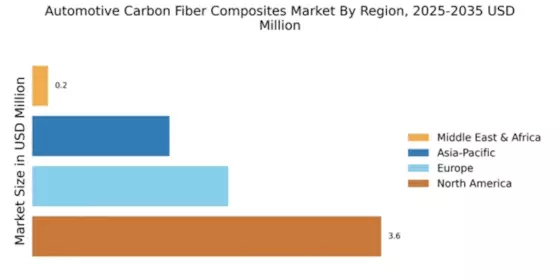
North America is poised to maintain its leadership in the Automotive Carbon Fiber Composites Market, holding a significant market share of 3.5 in 2024. The region's growth is driven by increasing demand for lightweight materials to enhance fuel efficiency and reduce emissions. Regulatory support for sustainable automotive practices further catalyzes this trend, as manufacturers seek to comply with stringent environmental standards. The competitive landscape is robust, with key players such as Hexcel Corporation and Toray Industries leading the charge. The U.S. and Canada are the primary markets, benefiting from advanced manufacturing capabilities and strong R&D investments. The presence of major automotive manufacturers fosters collaboration with composite suppliers, ensuring a steady demand for innovative carbon fiber solutions.

Europe : Innovation and Sustainability Focus

Europe is emerging as a significant player in the Automotive Carbon Fiber Composites Market, with a market size of 2.0. The region's growth is fueled by a strong emphasis on sustainability and innovation, as automotive manufacturers increasingly adopt lightweight materials to meet EU regulations on emissions. The push for electric vehicles (EVs) also drives demand for carbon fiber composites, which enhance performance and efficiency. Leading countries such as Germany, France, and the UK are at the forefront of this transition, supported by key players like SGL Carbon and BASF SE. The competitive landscape is characterized by strategic partnerships and investments in R&D, aimed at developing advanced composite solutions. As the automotive sector evolves, Europe is set to play a crucial role in shaping the future of carbon fiber applications in vehicles.

Asia-Pacific : Emerging Market Potential

Asia-Pacific is witnessing rapid growth in the Automotive Carbon Fiber Composites Market, with a market size of 1.4. The region's expansion is driven by increasing automotive production and a rising focus on lightweight materials to improve fuel efficiency. Countries like Japan and China are leading this trend, supported by government initiatives promoting advanced manufacturing technologies and sustainable practices. The competitive landscape features key players such as Teijin Limited and Mitsubishi Chemical Corporation, who are investing heavily in R&D to innovate carbon fiber solutions. As the automotive industry in Asia-Pacific continues to evolve, the demand for high-performance composites is expected to surge, positioning the region as a vital player in the global market.

Middle East and Africa : Untapped Market Opportunities

The Middle East and Africa region represents an untapped market for Automotive Carbon Fiber Composites, with a market size of 0.22. While growth has been slow, there is increasing interest in lightweight materials driven by the automotive sector's need for improved fuel efficiency and performance. Government initiatives aimed at diversifying economies and promoting local manufacturing are expected to catalyze market development in the coming years. Countries like South Africa and the UAE are beginning to explore the potential of carbon fiber composites in automotive applications. However, the competitive landscape remains limited, with fewer key players compared to other regions. As awareness of the benefits of carbon fiber grows, the region may see increased investments and partnerships to enhance its market presence.

Key Players and Competitive Insights

The Automotive Carbon Fiber Composites Market is currently characterized by a dynamic competitive landscape, driven by increasing demand for lightweight materials that enhance fuel efficiency and performance in vehicles. Key players such as Toray Industries (Japan), SGL Carbon (Germany), and Hexcel Corporation (US) are strategically positioned to leverage innovation and technological advancements. Toray Industries (Japan) focuses on expanding its product portfolio through research and development, while SGL Carbon (Germany) emphasizes sustainability in its manufacturing processes. Hexcel Corporation (US) is actively pursuing partnerships to enhance its market reach, indicating a collective strategy among these companies to shape a competitive environment that prioritizes innovation and sustainability.

In terms of business tactics, companies are increasingly localizing manufacturing to reduce lead times and optimize supply chains. The market appears moderately fragmented, with several key players exerting influence over their respective segments. This fragmentation allows for a diverse range of offerings, yet the collective strategies of major companies create a competitive structure that is both dynamic and responsive to market demands.

In November 2025, Toray Industries (Japan) announced a collaboration with a leading automotive manufacturer to develop next-generation carbon fiber composites aimed at electric vehicles. This strategic move underscores Toray's commitment to innovation and positions it favorably within the growing electric vehicle segment, which is expected to drive demand for lightweight materials.

In October 2025, SGL Carbon (Germany) unveiled a new production facility dedicated to sustainable carbon fiber manufacturing. This facility is expected to enhance SGL's production capacity while aligning with global sustainability goals. The establishment of this facility not only strengthens SGL's operational capabilities but also reflects a broader industry trend towards environmentally friendly manufacturing practices.

In September 2025, Hexcel Corporation (US) entered into a strategic partnership with a technology firm to integrate AI-driven analytics into its production processes. This initiative aims to optimize manufacturing efficiency and reduce waste, highlighting Hexcel's focus on digital transformation. The integration of AI is likely to enhance Hexcel's competitive edge by improving operational efficiency and product quality.

As of December 2025, the competitive trends in the Automotive Carbon Fiber Composites Market are increasingly defined by digitalization, sustainability, and technological integration. Strategic alliances among key players are shaping the landscape, fostering innovation and enhancing supply chain reliability. The shift from price-based competition to a focus on technological advancement and sustainable practices is evident, suggesting that future competitive differentiation will hinge on the ability to innovate and adapt to evolving market demands.

Key Companies in the Automotive Carbon Fiber Composites Market market include

Industry Developments

The global market players in the carbon fiber composites market adopt strategies such as expansion, mergers & acquisitions, supply, and distribution agreements, and new product launches to maintain their market dominance and increase their global presence. For instance, in November 2017, one of the prominent company - Solvay, which is the parent company of Cytec, acquired European Carbon Fiber GmbH ("ECF"). This company is a major manufacturer of high-quality precursors for large tow (50K) polyacrylonitrile carbon fibers.

Stringent regulations imposed by the government of Europe, such as the European Automotive Manufacturers Association (ACEA) and the European Union Automotive Fuel Economy standard, have set limits for carbon emission, which has put pressure on automakers. For instance, the European Union Commission (E.C.) has enforced increasing the E.U.'s GHG reduction target for 2032- from a 40% cut in CO2 emission to a 50 or 55% cut. Therefore, increasing fuel efficiency requirements and the lightweight nature of vehicles have enforced the use of automotive composites in automotive applications driving the demand for a product in the region.

The exterior application of automotive composites accounted for 55%, in terms of value and 50% in terms of volume, of the overall market in 2019. Exterior application contributes a significant share of the automotive carbon fiber composites market. Significant components of a car body, such as bumper beam, fender, front end module, door panels, and hood, are made of composite materials. Furthermore, the use of composites in the exterior parts such as fenders, hoods, bumper beams, deck lids, and others added to the durability of cars, ensuring a long lifecycle and lowering maintenance costs.

The automotive carbon fiber composites market report has been prepared to understand the dynamics available to the market during the period ending in 2027. The report highlights the impact of the pandemic outbreak on the market, followed by the growing reasons that enhance the global market competition. The global automotive carbon fiber composites market report highlights the recent developments undertaken by the market players during the period that have an impact on the investment and buying decisions for the continuous period.

In February 2024, inventors at the Department of Energy's Oak Ridge National Laboratory achieved a significant breakthrough in chemistry. They successfully developed a closed-loop process for creating an extremely durable carbon-fiber-reinforced polymer (CFRP) and subsequently recovering all of the initial components used in its synthesis. CFRP, a composite material that is lightweight, durable, and resilient, is highly advantageous in terms of reducing the weight and enhancing the fuel efficiency of automobiles, airplanes, and spacecraft. Nevertheless, traditional carbon fiber reinforced polymers (CFRPs) pose challenges when it comes to recycling.

The majority of these materials have been designed for one-time usage, resulting in a substantial carbon impact. A standard thermoset material undergoes permanent crosslinking. Once the material is synthesized, cured, molded, and shaped, it becomes irreparable and cannot be reprocessed. Conversely, the technique developed by ORNL introduces dynamic chemical groups to both the polymer matrix and the carbon fibers that are embedded within it. The polymer matrix and carbon fibers may endure numerous reprocessing cycles without experiencing any degradation in mechanical qualities, such as strength and toughness.

Thermoset epoxies, which are conventional polymers, are commonly employed to permanently join various materials like metal, carbon, concrete, glass, ceramic, and plastic.

Automotive Carbon Fiber Composites Market Industry Developments

  • Q2 2024: Lotus Unveils Eletre Carbon, Ultra-Luxury Electric Hyper-SUV with Extensive Carbon Fiber Design In April 2024, Lotus launched the Eletre Carbon, a new electric hyper-SUV variant featuring extensive use of carbon fiber composites in both exterior and interior components, marking the debut of Lotus's new performance SUV lineage.
  • Q1 2024: Mitsubishi Rayon Carbon Fibre and Composites (MRCFAC) Established Following Acquisition of SGL Carbon’s North American Business Mitsubishi Chemical Group completed the acquisition of SGL Carbon’s North American carbon fiber business and established a new entity, MRCFAC, to expand its carbon fiber composites production capacity and market presence in the automotive sector.

Future Outlook

Automotive Carbon Fiber Composites Market Future Outlook

The Automotive Carbon Fiber Composites Market is projected to grow at a 6.58% CAGR from 2024 to 2035, driven by advancements in lightweight materials and increasing demand for fuel efficiency.

New opportunities lie in:

  • Development of carbon fiber recycling technologies for cost reduction.
  • Expansion into electric vehicle components to capture emerging markets.
  • Strategic partnerships with automotive manufacturers for integrated solutions.

By 2035, the market is expected to solidify its position as a leader in automotive materials.

Market Segmentation

Automotive Carbon Fiber Composites Market End Use Outlook

  • Passenger Vehicles
  • Commercial Vehicles
  • Electric Vehicles
  • Luxury Vehicles

Automotive Carbon Fiber Composites Market Fiber Type Outlook

  • Carbon Fiber
  • Glass Fiber
  • Hybrid Fiber

Automotive Carbon Fiber Composites Market Resin Type Outlook

  • Epoxy Resin
  • Polyester Resin
  • Vinyl Ester Resin

Automotive Carbon Fiber Composites Market Application Outlook

  • Structural Components
  • Interior Components
  • Exterior Components
  • Chassis Components

Automotive Carbon Fiber Composites Market Manufacturing Process Outlook

  • Prepreg Layup
  • Resin Transfer Molding
  • Compression Molding
  • Filament Winding

Report Scope

MARKET SIZE 20247.12(USD Million)
MARKET SIZE 20257.58(USD Million)
MARKET SIZE 203514.35(USD Million)
COMPOUND ANNUAL GROWTH RATE (CAGR)6.58% (2024 - 2035)
REPORT COVERAGERevenue Forecast, Competitive Landscape, Growth Factors, and Trends
BASE YEAR2024
Market Forecast Period2025 - 2035
Historical Data2019 - 2024
Market Forecast UnitsUSD Million
Key Companies ProfiledToray Industries (JP), SGL Carbon (DE), Teijin Limited (JP), Hexcel Corporation (US), Mitsubishi Chemical Corporation (JP), Solvay S.A. (BE), BASF SE (DE), Zoltek Companies, Inc. (US), Formosa Plastics Corporation (TW)
Segments CoveredApplication, End Use, Manufacturing Process, Fiber Type, Resin Type
Key Market OpportunitiesGrowing demand for lightweight materials enhances opportunities in the Automotive Carbon Fiber Composites Market.
Key Market DynamicsRising demand for lightweight materials drives innovation and competition in the automotive carbon fiber composites sector.
Countries CoveredNorth America, Europe, APAC, South America, MEA

Market Highlights

Author
Anshula Mandaokar
Team Lead - Research

Anshula Mandaokar holds an academic degree in Chemical Engineering and has been contributing to the field for more than 5 years. She has expertise in Market Research and Business Consulting and serves as a Team Lead for a reputed Market Research firm under the Chemicals and Materials domain spectrum. She has worked on multiple projects, generating explicit results in a quick turnaround time. Her understanding of data interpretation justifies her role as a leader.

Leave a Comment

FAQs

What is the CAGR anticipated to be detected in the automotive carbon fiber composites market?

A 6.4% CAGR is expected to set the market on a favorable course of development.

Who are the adversaries in the automotive carbon fiber composites market?

HITCO Carbon Composites Inc (U.S.), Owens Corning (U.S.), and Mitsubishi Rayon Carbon Fiber and Composites, Inc. (U.S.) are influencing the market growth.

What revenues are projected to be seen in the global automotive carbon fiber composites market?

A promising revenue level is expected to transform the market’s growth potential.

What are the elements contributing to the momentum of the automotive carbon fiber composites market?

The augmented inclination towards carbon fiber-reinforced plastics, especially in luxury and race cars, is expected to benefit the market.

Which regions are expected to acquire prominence in the global automotive carbon fiber composites market?

The dominance of the APAC region is expected to visible in the market.

Download Free Sample

Kindly complete the form below to receive a free sample of this Report

Compare Licence

×
Features License Type
Single User Multiuser License Enterprise User
Price $4,950 $5,950 $7,250
Maximum User Access Limit 1 User Upto 10 Users Unrestricted Access Throughout the Organization
Free Customization
Direct Access to Analyst
Deliverable Format
Platform Access
Discount on Next Purchase 10% 15% 15%
Printable Versions