×
Request Free Sample ×

Kindly complete the form below to receive a free sample of this Report

* Please use a valid business email

Leading companies partner with us for data-driven Insights

clients tt-cursor
Hero Background

US Hybrid Composites Market

ID: MRFR/CnM/15495-HCR
100 Pages
Garvit Vyas
October 2025

US Hybrid Composites Market Research Report By Fiber Type (Carbon/Glass, Carbon/Aramid), By Resin Type (Thermoplastic, Thermosetting), By End-Use Industry (Aerospace & Defense, Building & Construction, Automotive & Transportation) – Forecast to 2035

Share:
Download PDF ×

We do not share your information with anyone. However, we may send you emails based on your report interest from time to time. You may contact us at any time to opt-out.

US Hybrid Composites Market Infographic
Purchase Options

US Hybrid Composites Market Summary

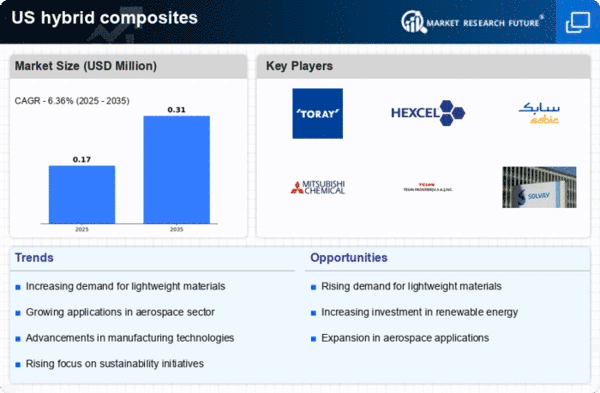
As per MRFR analysis, the US hybrid composites market size was estimated at 0.156 USD Million in 2024. The US hybrid composites market is projected to grow from 0.166 USD Million in 2025 to 0.308 USD Million by 2035, exhibiting a compound annual growth rate (CAGR) of 6.36% during the forecast period 2025 - 2035.

Key Market Trends & Highlights

The US hybrid composites market is experiencing robust growth driven by sustainability and technological innovation.

  • The market is increasingly focused on sustainability, with a notable shift towards eco-friendly materials.
  • Technological advancements are enhancing the performance and applications of hybrid composites across various industries.
  • The aerospace segment remains the largest, while the automotive segment is identified as the fastest-growing in the hybrid composites market.
  • Key drivers include the growing demand for lightweight materials and increased investment in research and development.

Market Size & Forecast

2024 Market Size 0.156 (USD Million)
2035 Market Size 0.308 (USD Million)
CAGR (2025 - 2035) 6.36%

Major Players

Toray Industries (JP), Hexcel Corporation (US), SABIC (SA), Mitsubishi Chemical Corporation (JP), Teijin Limited (JP), Solvay SA (BE), BASF SE (DE), 3M Company (US), DuPont de Nemours (US)

US Hybrid Composites Market Trends

The hybrid composites market is currently experiencing a notable transformation. This change is driven by advancements in material science and increasing demand across various sectors. Industries such as aerospace, automotive, and construction are increasingly adopting hybrid composites due to their superior strength-to-weight ratio and enhanced durability. This shift appears to be influenced by the need for more sustainable and efficient materials, as manufacturers seek to reduce their environmental footprint while maintaining high performance. Furthermore, the integration of innovative technologies in the production processes is likely to enhance the properties of these composites, making them more appealing to end-users. In addition, the regulatory landscape is evolving, with government initiatives promoting the use of advanced materials in manufacturing. This trend suggests a growing recognition of the benefits that hybrid composites can offer, particularly in terms of energy efficiency and resource conservation. As industries continue to explore the potential of these materials, the hybrid composites market is poised for significant growth. The ongoing research and development efforts are expected to yield new applications and improve existing products, further solidifying the position of hybrid composites in the market.

Sustainability Focus

There is a marked emphasis on sustainability within the hybrid composites market, as industries strive to adopt eco-friendly materials. This trend is driven by regulatory pressures and consumer demand for greener products. Manufacturers are increasingly exploring bio-based resins and recycled fibers, which could reduce the environmental impact of composite production.

Technological Advancements

Innovations in manufacturing techniques are reshaping the hybrid composites market. Advanced processes such as additive manufacturing and automated fiber placement are enhancing production efficiency and material performance. These technological developments may lead to the creation of composites with tailored properties, catering to specific industry needs.

Diverse Applications

The hybrid composites market is witnessing a diversification of applications across various sectors. From aerospace to automotive and construction, the versatility of these materials is becoming more apparent. This trend indicates a growing recognition of the benefits that hybrid composites can provide, such as weight reduction and improved mechanical properties.

US Hybrid Composites Market Drivers

Expansion of End-Use Industries

The hybrid composites market is poised for growth due to the expansion of end-use industries such as construction, sports equipment, and renewable energy. As these sectors evolve, the demand for advanced materials that offer superior strength-to-weight ratios and durability is increasing. In the construction industry, for example, hybrid composites are being utilized in structural applications, providing enhanced performance and longevity. Similarly, the sports equipment sector is adopting hybrid composites to create lighter and more resilient products. The renewable energy sector is also exploring the use of hybrid composites in wind turbine blades, where weight reduction can lead to improved efficiency. This diversification across various industries is likely to drive the hybrid composites market, as manufacturers seek to capitalize on new opportunities.

Growing Demand for Lightweight Materials

The hybrid composites market is experiencing a surge in demand for lightweight materials, particularly in the aerospace and automotive sectors. As manufacturers strive to enhance fuel efficiency and reduce emissions, the adoption of hybrid composites is becoming increasingly prevalent. In the aerospace industry, for instance, the use of hybrid composites can lead to weight reductions of up to 20%, which directly translates to lower operational costs. The automotive sector is also witnessing a shift, with hybrid composites being utilized to create lighter vehicles that meet stringent fuel economy standards. This growing emphasis on lightweight materials is likely to drive the hybrid composites market, as companies seek innovative solutions to improve performance while adhering to regulatory requirements.

Regulatory Support for Advanced Materials

The hybrid composites market is benefiting from increasing regulatory support aimed at promoting the use of advanced materials. In the US, various government agencies are implementing policies that encourage the adoption of lightweight and durable materials in manufacturing processes. For instance, the Federal Aviation Administration (FAA) has established guidelines that facilitate the use of composite materials in aircraft design, thereby enhancing safety and performance. Such regulatory frameworks not only support innovation but also create a favorable environment for the hybrid composites market to thrive. As regulations continue to evolve, they are likely to stimulate demand for hybrid composites, particularly in sectors where compliance with safety and environmental standards is critical.

Increased Investment in Research and Development

Investment in research and development (R&D) within the hybrid composites market is on the rise, as companies aim to innovate and enhance product offerings. This trend is particularly evident in the US, where government initiatives and private sector funding are fostering advancements in composite materials. For example, the US Department of Energy has allocated substantial funds to projects focused on developing advanced composite materials for various applications. This influx of investment is expected to lead to breakthroughs in hybrid composite technologies, improving their mechanical properties and expanding their applicability across industries. As R&D efforts continue to evolve, the hybrid composites market is likely to benefit from enhanced product performance and new market opportunities.

Rising Consumer Awareness of Environmental Impact

Consumer awareness regarding the environmental impact of products is influencing the hybrid composites market. As sustainability becomes a priority for many consumers, manufacturers are increasingly seeking materials that align with eco-friendly practices. Hybrid composites, known for their potential to reduce waste and enhance recyclability, are gaining traction among environmentally conscious consumers. This shift in consumer preferences is prompting companies to invest in hybrid composite technologies that not only meet performance standards but also address sustainability concerns. Consequently, the hybrid composites market is likely to see growth as businesses adapt to changing consumer demands and prioritize environmentally responsible materials in their product lines.


Key Players and Competitive Insights

The hybrid composites market is currently characterized by a dynamic competitive landscape. This landscape is driven by increasing demand for lightweight materials across various industries, including aerospace, automotive, and construction. Key players such as Hexcel Corporation (US), Toray Industries (JP), and BASF SE (DE) are strategically positioned to leverage their technological expertise and extensive product portfolios. Hexcel Corporation (US) focuses on innovation in advanced composite materials, while Toray Industries (JP) emphasizes sustainability in its manufacturing processes. BASF SE (DE) is actively pursuing partnerships to enhance its product offerings, indicating a collective strategy among these companies to foster innovation and meet evolving market demands.

In terms of business tactics, companies are increasingly localizing manufacturing to reduce lead times and optimize supply chains. The market structure appears moderately fragmented, with several key players exerting significant influence. This fragmentation allows for niche players to emerge, yet the collective strength of major companies shapes competitive dynamics, often leading to strategic collaborations and joint ventures aimed at enhancing market reach and technological capabilities.

In October 2025, Hexcel Corporation (US) announced a partnership with a leading aerospace manufacturer to develop next-generation composite materials aimed at reducing aircraft weight and improving fuel efficiency. This strategic move underscores Hexcel's commitment to innovation and positions it favorably within the aerospace sector, where lightweight materials are critical for performance and sustainability.

In September 2025, Toray Industries (JP) launched a new line of bio-based hybrid composites designed for automotive applications. This initiative not only aligns with global sustainability trends but also enhances Toray's competitive edge by appealing to environmentally conscious consumers and manufacturers. The introduction of these materials reflects a broader industry shift towards sustainable practices, which is becoming increasingly important in the hybrid composites market.

In August 2025, BASF SE (DE) expanded its production capabilities in North America by investing in a new facility dedicated to hybrid composite materials. This expansion is indicative of BASF's strategy to strengthen its market presence and respond to growing demand in the region. By enhancing its production capacity, BASF aims to improve supply chain reliability and meet the needs of its customers more effectively.

As of November 2025, current competitive trends in the hybrid composites market are heavily influenced by digitalization, sustainability, and the integration of AI technologies. Strategic alliances are becoming increasingly prevalent, as companies recognize the value of collaboration in driving innovation and enhancing product offerings. Looking ahead, competitive differentiation is likely to evolve, shifting from traditional price-based competition to a focus on technological advancements, sustainable practices, and supply chain resilience. This transition suggests that companies that prioritize innovation and reliability will be better positioned to thrive in the evolving market landscape.

Key Companies in the US Hybrid Composites Market market include

Future Outlook

US Hybrid Composites Market Future Outlook

The hybrid composites market is projected to grow at a 6.36% CAGR from 2024 to 2035, driven by advancements in material technology and increasing demand in aerospace and automotive sectors.

New opportunities lie in:

  • Development of lightweight hybrid composite materials for electric vehicles
  • Integration of smart sensors in hybrid composites for real-time monitoring
  • Expansion of recycling programs for hybrid composite waste management

By 2035, the hybrid composites market is expected to achieve substantial growth and innovation.

Market Segmentation

US Hybrid Composites Market Fiber Type Outlook

  • Carbon/Glass
  • Carbon/Aramid

US Hybrid Composites Market Resin Type Outlook

  • Thermoplastic
  • Thermosetting

US Hybrid Composites Market End Use Industry Outlook

  • Aerospace & Defense
  • Building & Construction
  • Automotive & Transportation

Report Scope

MARKET SIZE 20240.156(USD Million)
MARKET SIZE 20250.166(USD Million)
MARKET SIZE 20350.308(USD Million)
COMPOUND ANNUAL GROWTH RATE (CAGR)6.36% (2024 - 2035)
REPORT COVERAGERevenue Forecast, Competitive Landscape, Growth Factors, and Trends
BASE YEAR2024
Market Forecast Period2025 - 2035
Historical Data2019 - 2024
Market Forecast UnitsUSD Million
Key Companies Profiled["Toray Industries (JP)", "Hexcel Corporation (US)", "SABIC (SA)", "Mitsubishi Chemical Corporation (JP)", "Teijin Limited (JP)", "Solvay SA (BE)", "BASF SE (DE)", "3M Company (US)", "DuPont de Nemours (US)"]
Segments CoveredFiber Type, Resin Type, End Use Industry
Key Market OpportunitiesGrowing demand for lightweight materials in automotive and aerospace sectors drives hybrid composites market expansion.
Key Market DynamicsRising demand for lightweight materials drives innovation and competition in the hybrid composites market.
Countries CoveredUS

Leave a Comment

Download Free Sample

Kindly complete the form below to receive a free sample of this Report

Compare Licence

×
Features License Type
Single User Multiuser License Enterprise User
Price $4,950 $5,950 $7,250
Maximum User Access Limit 1 User Upto 10 Users Unrestricted Access Throughout the Organization
Free Customization
Direct Access to Analyst
Deliverable Format
Platform Access
Discount on Next Purchase 10% 15% 15%
Printable Versions