Download Free Sample
Kindly complete the form below to receive a free sample of this Report
United States Infection Control Market Research Report: Size, Share, Trend Analysis By Types (Disinfectants, Infection Control Supplies, Sterilization Equipment, Personal Protective Equipment) By End-User (Healthcare, Commercial, Residential) By Applications (Hospitals, Pharmaceuticals, Research Laboratories, Food Industry) By Distribution Channel (Online, Offline, Direct Sales) - Growth Outlook & Industry Forecast 2025 To 2035
As per Market Research Future analysis, the US infection control market Size was estimated at 12.46 USD Billion in 2024. The US infection control market is projected to grow from 13.16 USD Billion in 2025 to 22.69 USD Billion by 2035, exhibiting a compound annual growth rate (CAGR) of 5% during the forecast period 2025 - 2035
The US infection control market is experiencing a robust transformation driven by technological advancements and heightened awareness of infection prevention.
| 2024 Market Size | 12.46 (USD Billion) |
| 2035 Market Size | 22.69 (USD Billion) |
| CAGR (2025 - 2035) | 5.6% |
3M (US), Johnson & Johnson (US), Ecolab (US), Becton Dickinson (US), Medline Industries (US), Steris (US), PDI (US), Halyard Health (US), Kimberly-Clark (US)
Our Impact
Enabled $4.3B Revenue Impact for Fortune 500 and Leading Multinationals
Partnering with 2000+ Global Organizations Each Year
30K+ Citations by Top-Tier Firms in the Industry
The infection control market is currently experiencing a dynamic evolution, driven by heightened awareness of hygiene practices and the necessity for effective infection prevention strategies. This market encompasses a wide array of products and services, including disinfectants, sterilization equipment, and personal protective equipment (PPE). As healthcare facilities increasingly prioritize patient safety, the demand for innovative solutions continues to rise. Regulatory bodies are also playing a crucial role in shaping market trends, as they establish stringent guidelines to ensure compliance and enhance safety standards. In addition, technological advancements are reshaping the landscape of the infection control market. The integration of automation and digital solutions is becoming more prevalent, allowing for improved monitoring and management of infection control protocols. This shift not only enhances operational efficiency but also supports healthcare providers in maintaining high standards of cleanliness and safety. As the market adapts to these changes, stakeholders are likely to explore new opportunities for growth and collaboration, ultimately contributing to a more robust infection control framework.
There is a noticeable shift towards the adoption of advanced disinfectants that offer enhanced efficacy against a broader spectrum of pathogens. This trend is largely influenced by the need for more effective infection control measures in various settings, including hospitals and outpatient facilities. Manufacturers are responding by developing products that not only meet regulatory standards but also provide longer-lasting protection.
The integration of automation technologies in infection control practices is gaining traction. Automated systems for disinfection and monitoring are being implemented to streamline processes and reduce human error. This trend reflects a broader movement towards efficiency and precision in healthcare environments, where maintaining high hygiene standards is paramount.
There is an increasing focus on education and training programs aimed at healthcare professionals regarding infection control practices. This trend underscores the importance of knowledge dissemination in ensuring compliance with established protocols. Enhanced training initiatives are likely to improve overall infection prevention efforts and foster a culture of safety within healthcare organizations.
The emergence of infectious diseases continues to be a driving force in the infection control market. With the increasing incidence of antibiotic-resistant pathogens and new viral outbreaks, healthcare facilities are compelled to enhance their infection control measures. This trend is likely to result in a surge in demand for advanced disinfectants and sterilization technologies. In 2025, the market for infection control products is expected to grow by over 10%, as healthcare providers seek to implement robust infection prevention strategies. The ongoing threat of emerging infectious diseases underscores the necessity for effective infection control solutions, thereby propelling the market forward and encouraging innovation within the industry.
The infection control market is experiencing growth driven by rising healthcare expenditures in the US. As healthcare facilities allocate larger budgets towards infection prevention measures, the demand for advanced disinfectants and sterilization equipment increases. In 2025, healthcare spending is projected to reach approximately $4.5 trillion, with a significant portion directed towards infection control initiatives. This trend indicates a heightened awareness of the importance of maintaining sterile environments, particularly in hospitals and clinics. Consequently, manufacturers are likely to innovate and expand their product lines to meet the evolving needs of healthcare providers. The focus on infection control is expected to remain a priority, as facilities strive to enhance patient safety and reduce healthcare-associated infections, thereby propelling the infection control market forward.
Regulatory compliance and standards are critical drivers of the infection control market. In the US, organizations such as the Centers for Disease Control and Prevention (CDC) and the Occupational Safety and Health Administration (OSHA) set stringent guidelines for infection prevention in healthcare settings. Compliance with these regulations is essential for healthcare facilities to avoid penalties and ensure patient safety. As a result, there is a growing demand for products and services that help organizations meet these standards. The infection control market is likely to benefit from this trend, as manufacturers develop solutions that align with regulatory requirements. In 2025, it is estimated that compliance-related expenditures will account for a substantial portion of the overall infection control budget, further driving market growth.
Increased awareness of infection prevention among healthcare professionals and the general public is significantly influencing the infection control market. Educational campaigns and training programs are being implemented to promote best practices in infection control. This heightened awareness is leading to a greater demand for infection control products, including personal protective equipment (PPE) and disinfectants. In 2025, the market for PPE is projected to grow by approximately 15%, reflecting the ongoing emphasis on safety and hygiene. As healthcare facilities prioritize infection prevention strategies, the infection control market is expected to expand, driven by the need for effective solutions that protect both patients and healthcare workers.
Technological advancements are playing a pivotal role in shaping the infection control market. Innovations such as ultraviolet (UV) light disinfection systems and automated cleaning robots are gaining traction in healthcare settings. These technologies not only improve the efficiency of infection control practices but also reduce the reliance on manual cleaning methods. In 2025, the market for UV disinfection equipment is anticipated to grow by over 20%, reflecting the increasing adoption of these technologies. As healthcare facilities seek to enhance their infection control protocols, the integration of advanced technologies is likely to become a standard practice. This shift towards automation and technology-driven solutions is expected to significantly impact the infection control market, driving growth and improving overall patient outcomes.
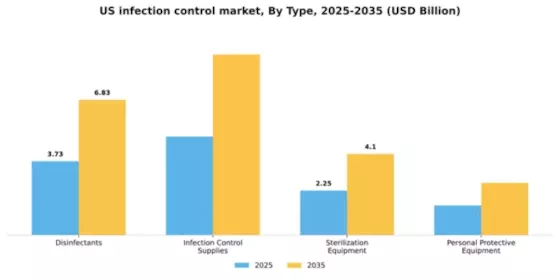
In the US infection control market, the segment of disinfectants holds the largest market share, significantly contributing to the overall demand for infection control products. Personal protective equipment (PPE) follows, showing substantial growth as healthcare providers increasingly prioritize safety and infection prevention strategies. The market distribution indicates a robust demand for both disinfectants and PPE, resulting in a dynamic competitive landscape among suppliers. Growth trends illustrate a rising emphasis on infection prevention measures, driven by increasing awareness and regulatory mandates. The surge in healthcare expenses and the need for stringent infection control protocols have propelled the demand for disinfectants, while the PPE segment has quickly emerged as a necessary component for frontline healthcare professionals. This dual trend underscores a pivotal shift towards enhanced safety and hygiene practices across various healthcare settings.
Disinfectants: Dominant vs. Personal Protective Equipment: Emerging
Disinfectants are currently positioned as the dominant force in the US infection control market, acclaimed for their extensive application across healthcare facilities. The market is characterized by a variety of products, including surface disinfectants and hand sanitizers, which are essential for maintaining sanitary conditions. Conversely, personal protective equipment has gained traction as an emerging segment due to its critical role in safeguarding healthcare workers and patients. As the focus on personal safety intensifies, PPE such as masks, gloves, and gowns become increasingly vital, reflecting a responsive adaptation to heightened infection control demands. Together, these segments shape a comprehensive approach to infection management, highlighting both traditional and innovative strategies in healthcare.
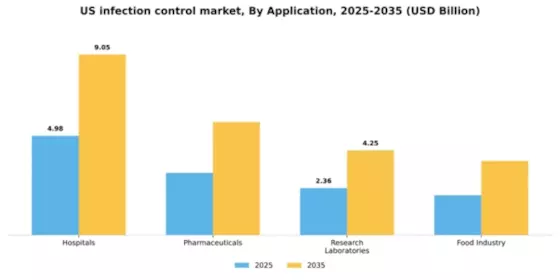
The market share distribution among the application segments in the US infection control market highlights Hospitals as the largest segment, driven by the increasing need for stringent infection control measures in healthcare facilities. Pharmaceuticals follow closely, showcasing a significant portion of the market as the demand for pharmaceutical manufacturing and distribution continues to rise globally. Research Laboratories and the Food Industry are also crucial, yet they represent smaller shares in comparison. Growth trends within the application segment indicate a robust expansion for Pharmaceuticals, which is becoming the fastest-growing category as innovation in drug development and manufacturing amplifies. The heightened focus on hygiene and safety in Hospitals is expected to maintain its dominance, while changing regulatory stipulations, the rise of infectious diseases, and heightened public awareness further fuel demand in Research Laboratories and the Food Industry.
Hospitals (Dominant) vs. Research Laboratories (Emerging)
Hospitals are positioned as the dominant application within the US infection control market, playing a critical role in implementing infection prevention protocols crucial for patient safety. The extensive infrastructure in hospitals, coupled with an increasing patient influx, necessitates the adoption of advanced infection control measures. On the other hand, Research Laboratories are emerging as a vital segment, driven by the need for ensuring sterile environments for research activities. This segment taps into advanced technologies and innovations aimed at preventing contamination during experiments, thus highlighting its growing importance in the regulatory landscape and reinforcing the value of effective infection control measures in scientific research.
In the US infection control market, healthcare continues to dominate the end-use segment, capturing a significant share due to the ongoing demand for effective infection prevention measures in hospitals and clinics. This sector's growth is supported by heightened awareness of hygiene practices and regulatory compliance, ensuring that healthcare facilities prioritize infection control solutions. On the other hand, the commercial segment is emerging rapidly, driven by increasing hygiene standards across various industries including hospitality and food services. As businesses focus more on health safety, the demand for infection control products is expected to surge, marking commercial applications as the fastest-growing segment in the market.
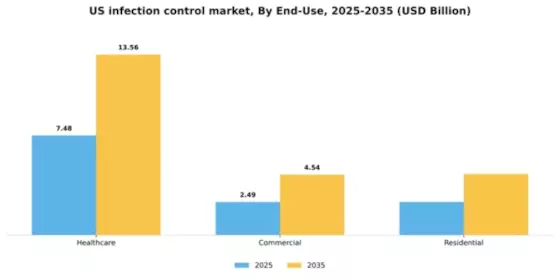
Healthcare: Dominant vs. Commercial: Emerging
The healthcare segment remains the cornerstone of the US infection control market, primarily due to the stringent regulatory environment and the critical need for maintaining sterile environments in healthcare facilities. This segment is characterized by a wide range of infection control solutions, including antiseptics, disinfectants, and sterilization equipment, tailored to meet the diverse needs of hospitals and clinics. In contrast, the commercial segment, while currently smaller, is rapidly gaining traction as businesses adopt more rigorous health protocols. This segment includes various industries such as food service, education, and retail, where the focus on customer safety is driving demand for innovative infection control strategies. Together, these segments highlight the varying but interconnected needs across the market.
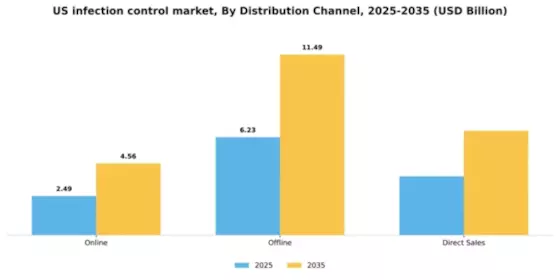
The distribution of market share among the different channels in the US infection control market reveals a significant preference for online sales, which captures the largest share. This popularity is driven by the convenience and accessibility offered by online platforms, allowing healthcare providers to purchase infection control products with ease. Conversely, offline channels are gaining traction, particularly as consumers seek personalized service or immediate product availability in physical locations. This dynamic creates a competitive environment that influences buying behavior. Growth trends in the distribution channel segment indicate a notable rise in online sales, propelled by advancements in technology and shifts in purchasing behaviors post-pandemic. The offline channel, while experiencing slower growth, benefits from increasing investments in brick-and-mortar facilities that cater to a demand for instant access to products. Direct sales are maintaining relevance, particularly for specialized services, as companies focus on building relationships with healthcare institutions.
Online (Dominant) vs. Offline (Emerging)
The online distribution channel in the US infection control market stands out as the dominant force, leveraging technology to enhance customer engagement and streamline purchasing processes. It offers a vast array of products and services, accommodating the diverse needs of healthcare providers. On the other hand, the offline distribution channel is identified as an emerging segment, focusing on establishing a presence in local markets and offering personalized service. This traditional method allows for immediate product access, encouraging customer loyalty and trust. The contrasting strategies of these channels highlight the evolving landscape of healthcare procurement, where speed and service play crucial roles in shaping consumer preferences.
Get more detailed insights about US Infection Control Market Request Free Sample
The infection control market is characterized by a dynamic competitive landscape, driven by increasing awareness of hygiene and infection prevention across various sectors, including healthcare, food safety, and pharmaceuticals. Key players such as 3M (US), Johnson & Johnson (US), and Ecolab (US) are strategically positioned to leverage innovation and technological advancements. 3M (US) focuses on developing advanced antimicrobial products, while Johnson & Johnson (US) emphasizes its extensive portfolio of surgical and infection prevention solutions. Ecolab (US) is enhancing its digital capabilities to provide comprehensive infection prevention services, indicating a collective shift towards integrated solutions that address complex infection control challenges. The market structure appears moderately fragmented, with several players competing on various fronts, including product innovation and service delivery. Companies are increasingly localizing manufacturing to reduce supply chain vulnerabilities and enhance responsiveness to market demands. This tactic not only optimizes operational efficiency but also aligns with sustainability goals, as firms seek to minimize their carbon footprints while meeting regulatory requirements. In October 2025, 3M (US) announced the launch of a new line of surface disinfectants that utilize advanced technology to enhance efficacy against a broader spectrum of pathogens. This strategic move is significant as it positions 3M (US) to capture a larger market share in the disinfectant segment, responding to the growing demand for effective infection control solutions in both healthcare and public spaces. The introduction of these products is likely to strengthen 3M's (US) competitive edge by reinforcing its reputation for innovation. In September 2025, Johnson & Johnson (US) expanded its partnership with a leading healthcare technology firm to integrate AI-driven analytics into its infection prevention protocols. This collaboration aims to enhance real-time monitoring and response capabilities in healthcare settings. The strategic importance of this partnership lies in its potential to improve patient outcomes and operational efficiencies, thereby solidifying Johnson & Johnson's (US) position as a leader in infection control solutions. In August 2025, Ecolab (US) unveiled a new digital platform designed to streamline infection prevention processes for healthcare facilities. This platform incorporates data analytics and machine learning to provide actionable insights for infection control. The launch of this platform reflects Ecolab's (US) commitment to digital transformation, which is increasingly vital in a market that demands rapid adaptation to emerging health threats. As of November 2025, current trends in the infection control market include a pronounced focus on digitalization, sustainability, and the integration of AI technologies. Strategic alliances among key players are shaping the competitive landscape, fostering innovation and enhancing service delivery. Looking ahead, it is anticipated that competitive differentiation will increasingly pivot from price-based strategies to those centered on technological innovation and supply chain reliability. This evolution underscores the necessity for companies to invest in R&D and forge strategic partnerships to remain competitive in a rapidly changing environment.
The Infection Control Market is projected to grow at a 5.6% CAGR from 2025 to 2035, driven by technological advancements, regulatory changes, and increasing healthcare expenditures.
New opportunities lie in:
By 2035, the infection control market is expected to achieve robust growth, driven by innovation and strategic investments.
| MARKET SIZE 2024 | 12.46(USD Billion) |
| MARKET SIZE 2025 | 13.16(USD Billion) |
| MARKET SIZE 2035 | 22.69(USD Billion) |
| COMPOUND ANNUAL GROWTH RATE (CAGR) | 5.6% (2025 - 2035) |
| REPORT COVERAGE | Revenue Forecast, Competitive Landscape, Growth Factors, and Trends |
| BASE YEAR | 2024 |
| Market Forecast Period | 2025 - 2035 |
| Historical Data | 2019 - 2024 |
| Market Forecast Units | USD Billion |
| Key Companies Profiled | 3M (US), Johnson & Johnson (US), Ecolab (US), Becton Dickinson (US), Medline Industries (US), Steris (US), PDI (US), Halyard Health (US), Kimberly-Clark (US) |
| Segments Covered | Type, Application, End-Use, Distribution Channel |
| Key Market Opportunities | Integration of advanced technologies in infection control solutions enhances efficacy and compliance in healthcare settings. |
| Key Market Dynamics | Rising regulatory scrutiny drives innovation and competition in the infection control market. |
| Countries Covered | US |
The US infection control market was valued at 12.46 USD Billion in 2024.
The market is projected to reach 22.69 USD Billion by 2035.
The expected CAGR for the market during 2025 - 2035 is 5.6%.
In 2024, the Infection Control Supplies segment had the highest valuation at 4.98 USD Billion.
Key applications include Hospitals, Pharmaceuticals, Research Laboratories, and the Food Industry.
The Offline distribution channel is expected to show significant growth, with a valuation of 6.23 USD Billion in 2024.
Key players include 3M, Johnson & Johnson, Ecolab, Becton Dickinson, and Medline Industries.
The Disinfectants segment was valued at 3.73 USD Billion in 2024.
The Personal Protective Equipment segment was valued at 1.5 USD Billion in 2024, indicating a smaller share compared to others.
The Healthcare end-use segment is expected to grow from 7.48 USD Billion in 2024 to a higher valuation by 2035.


Kindly complete the form below to receive a free sample of this Report

“This is really good guys. Excellent work on a tight deadline. I will continue to use you going forward and recommend you to others. Nice job”


“Thanks. It’s been a pleasure working with you, please use me as reference with any other Intel employees.”


“Thanks for sending the report it gives us a good global view of the Betaïne market.”


“Thank you, this will be very helpful for OQS.”


“We found the report very insightful! we found your research firm very helpful. I'm sending this email to secure our future business.”


“I am very pleased with how market segments have been defined in a relevant way for my purposes (such as "Portable Freezers & refrigerators" and "last-mile"). In general the report is well structured. Thanks very much for your efforts.”


“I have been reading the first document or the study, ,the Global HVAC and FP market report 2021 till 2026. Must say, good info! I have not gone in depth at all parts, but got a good indication of the data inside!”


“We got the report in time, we really thank you for your support in this process. I also thank to all of your team as they did a great job.”


“The Automotive 48V ECU Components Procurement Intelligence Study” was a complex project, but the Market Research Future (MRFR) team handled it with quality, agility, and customer-centricity. They delivered all requested data on time and within the agreed scope. The team, including Shubhendra Anand and Rahul Gotadki, was always readily available to clarify questions and swiftly implement necessary adjustments, driving the project to a successful conclusion within a very demanding timeframe.
I would also like to specifically commend Akshay Agarwal for his responsiveness and support at every stage—from our initial inquiry on May 6th through to final delivery on June 18th. His dedication made the entire process seamless.”



