×
Request Free Sample ×

Kindly complete the form below to receive a free sample of this Report

* Please use a valid business email

Leading companies partner with us for data-driven Insights

clients tt-cursor
Hero Background

US Light Field Market

ID: MRFR/SEM/12779-HCR
200 Pages
Garvit Vyas
October 2025

US Light Field Market Research Report: By Technology (Software, Hardware, Light Field Displays, Imaging Solutions) and By Verticals (Defense, Industrial, Media & Entertainment, Healthcare, Architecture) - Forecast to 2035

Share:
Download PDF ×

We do not share your information with anyone. However, we may send you emails based on your report interest from time to time. You may contact us at any time to opt-out.

US Light Field Market Infographic
Purchase Options

US Light Field Market Summary

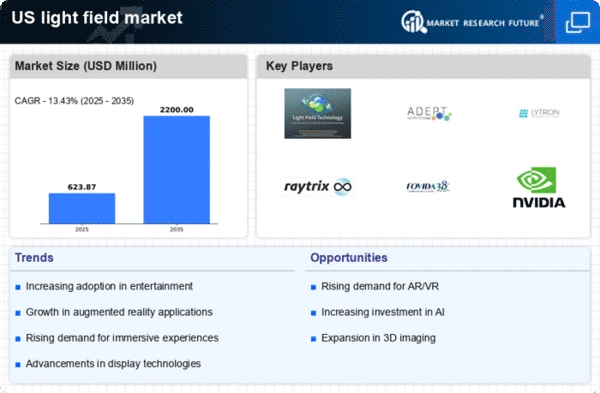
As per MRFR analysis, the US light field market Size was estimated at 550.0 USD Million in 2024. The US light field market is projected to grow from 623.87 USD Million in 2025 to 2200.0 USD Million by 2035, exhibiting a compound annual growth rate (CAGR) of 13.43% during the forecast period 2025 - 2035.

Key Market Trends & Highlights

The US light field market is poised for substantial growth driven by technological advancements and increasing demand for immersive experiences.

  • Advancements in imaging technology are enhancing the quality and accessibility of light field applications.
  • The integration of light field technology with virtual and augmented reality is transforming user experiences across various sectors.
  • The entertainment and media segment is the largest, while educational applications are emerging as the fastest-growing segment in the market.
  • Technological innovations in light field capture and rising adoption in entertainment are key drivers propelling market expansion.

Market Size & Forecast

2024 Market Size 550.0 (USD Million)
2035 Market Size 2200.0 (USD Million)
CAGR (2025 - 2035) 13.43%

Major Players

Light Field Technologies (US), Adept Technology (US), Lytro (US), Raytrix (DE), FoVI 3D (US), NVIDIA Corporation (US), Google LLC (US), Apple Inc. (US)

US Light Field Market Trends

The light field market is currently experiencing a transformative phase, driven by advancements in imaging technology and increasing applications across various sectors. This market encompasses a range of products and services that utilize light field technology, which captures and reproduces light in a way that allows for more immersive visual experiences. As industries such as entertainment, healthcare, and education explore the potential of this technology, the demand for innovative solutions continues to rise. The integration of light field technology into virtual reality (VR) and augmented reality (AR) applications is particularly noteworthy, as it enhances user engagement and interaction. Furthermore, the growing interest in 3D visualization and holography is likely to propel the market forward, suggesting a robust future for light field applications. In addition to technological advancements, the light field market is also influenced by shifts in consumer preferences and the increasing need for high-quality visual content. As businesses seek to differentiate themselves in a competitive landscape, the ability to deliver captivating visual experiences becomes paramount. This trend is evident in sectors such as advertising and marketing, where immersive content can significantly enhance brand storytelling. Moreover, the ongoing development of more affordable and accessible light field solutions may broaden the market's reach, allowing smaller enterprises to leverage this technology. Overall, the light field market appears poised for growth, driven by innovation and evolving consumer demands.

Advancements in Imaging Technology

Recent innovations in imaging technology are reshaping the light field market. Enhanced sensors and processing capabilities enable more accurate light capture and rendering, leading to improved visual fidelity. This trend is particularly relevant in sectors such as entertainment and gaming, where high-quality visuals are essential for user engagement.

Integration with Virtual and Augmented Reality

The convergence of light field technology with virtual and augmented reality applications is a prominent trend. This integration allows for more immersive experiences, enhancing user interaction and engagement. As these technologies continue to evolve, the demand for light field solutions in VR and AR is expected to grow.

Growing Demand for Immersive Content

There is an increasing demand for immersive content across various industries, driving interest in the light field market. Businesses are recognizing the value of captivating visual experiences in marketing and advertising. This trend suggests that companies will increasingly invest in light field technology to enhance their brand storytelling.

US Light Field Market Drivers

Rising Adoption in Entertainment and Media

The light field market is witnessing a notable increase in adoption within the entertainment and media sectors. With the growing demand for high-quality visual content, filmmakers and game developers are increasingly utilizing light field technology to create immersive experiences. The ability to capture and display scenes with depth and realism is transforming storytelling in cinema and interactive media. According to recent estimates, the entertainment sector is expected to account for over 40% of the light field market by 2026. This trend suggests that as more creators recognize the potential of light field technology, the industry will likely expand, leading to further innovations and applications in the light field market.

Growing Interest in Educational Applications

The light field market is increasingly being recognized for its potential in educational applications. Institutions are beginning to adopt light field technology to create interactive learning environments that enhance student engagement and understanding. By providing immersive visual experiences, educators can facilitate better comprehension of complex subjects, particularly in fields such as science and engineering. As educational institutions invest in advanced technologies, the light field market is likely to see a rise in demand for educational tools and resources. This shift could lead to a substantial increase in market share, as educational applications become a key segment of the light field market.

Increased Investment in Research and Development

Investment in research and development is a critical driver for the light field market. Companies are allocating substantial resources to explore new applications and improve existing technologies. This focus on R&D is fostering innovation, leading to the development of more efficient light field systems and applications. For instance, recent funding rounds have seen investments exceeding $100 million in startups focused on light field technology. Such financial backing is likely to accelerate advancements in the field, enhancing the capabilities of light field systems and expanding their applicability across various industries. Consequently, this trend is expected to bolster the light field market significantly.

Technological Innovations in Light Field Capture

The light field market is experiencing a surge in technological innovations that enhance the capture and rendering of three-dimensional images. Advanced algorithms and improved sensor technologies are enabling more accurate light field data acquisition, which is crucial for applications in entertainment and medical imaging. The integration of machine learning techniques is also facilitating real-time processing of light field data, thereby improving user experience. As a result, the market is projected to grow at a CAGR of approximately 25% over the next five years. This growth is indicative of the increasing adoption of light field technology across various sectors, including gaming, film, and healthcare, thereby driving the light field market forward.

Expansion of Consumer Electronics Featuring Light Field Technology

The light field market is poised for growth due to the expansion of consumer electronics that incorporate light field technology. With advancements in display technologies, manufacturers are increasingly integrating light field capabilities into devices such as smartphones, tablets, and televisions. This trend is driven by consumer demand for enhanced visual experiences, including 3D viewing without glasses. Market analysts predict that by 2027, light field-enabled consumer electronics could capture a market share of approximately 30%. This expansion not only signifies a shift in consumer preferences but also indicates a broader acceptance of light field technology in everyday applications, thereby propelling the light field market.


Market Segment Insights

By Technology: Software (Largest) vs. Imaging solutions (Fastest-Growing)

In the technology segment of the US light field market, software holds the largest share, currently driving significant adoption due to its versatility and integration capabilities with existing systems. Hardware, while still important, sees a smaller portion of the market, focusing on essential components such as sensors and optics. Light field displays serve as a niche area, with imaging solutions rapidly gaining traction owing to advancements in processing technology and visual fidelity that appeal to consumers and professionals alike. The growth of the technology segment is propelled by increasing demand for high-quality imaging and display solutions in various applications, including virtual reality and augmented reality. Innovations in software capabilities enhance user experiences, while imaging solutions benefit from escalating investments in R&D. Furthermore, partnerships between technology providers and content creators are fostering an environment ripe for expanding market opportunities, making this segment vibrant and competitive.

Technology: Software (Dominant) vs. Imaging solutions (Emerging)

Software is a dominant force in the technology segment, providing critical functionalities that optimize the performance of light field systems. Its adaptability allows for seamless integration with various hardware, enhancing user experiences across numerous applications. Meanwhile, imaging solutions represent an emerging trend in the market, characterized by advanced capabilities in capturing and processing visual data. They are evolving quickly due to technological advancements, making them highly desirable for sectors such as entertainment and medical imaging. The competition intensifies as more players enter the field, striving to innovate and capture consumer interest, thus positioning imaging solutions as a vital aspect of future growth.

By Vertical: Media & Entertainment (Largest) vs. Defense (Fastest-Growing)

In the US light field market, the Media & Entertainment segment commands the largest market share, largely driven by the increasing demand for immersive visual experiences and advances in display technologies. This segment significantly influences market dynamics, supported by a robust consumer base that seeks innovative content delivery methods. On the other hand, the Defense segment is emerging as the fastest-growing sector within the market. The rising focus on advanced surveillance systems and training solutions is propelling this growth. Additionally, government investments in defense technologies are fostering innovation and adoption of light field solutions, making it a crucial domain for future advancements.

Media & Entertainment: Dominant vs. Defense: Emerging

The Media & Entertainment segment remains the dominant force in the US light field market, characterized by its substantial investment in content creation and distribution technologies. Companies within this sector are leveraging light field technology to enhance viewer engagement, offering 3D experiences that resonate with audiences. Conversely, the Defense segment is quickly becoming an emerging player, focusing on high-stakes applications such as simulation and reconnaissance. This sector is adapting light field technologies for improved situational awareness, driving rapid innovation. As these segments evolve, collaboration between media creators and defense contractors is anticipated, potentially leading to groundbreaking applications that redefine user experiences across various platforms.

Get more detailed insights about US Light Field Market

Key Players and Competitive Insights

The light field market is currently characterized by a dynamic competitive landscape, driven by rapid technological advancements and increasing applications across various sectors, including entertainment, healthcare, and automotive. Key players such as Light Field Technologies (US), Lytro (US), and NVIDIA Corporation (US) are at the forefront, each adopting distinct strategies to enhance their market positioning. Light Field Technologies (US) focuses on innovation in imaging technology, while Lytro (US) emphasizes partnerships with content creators to expand its ecosystem. NVIDIA Corporation (US) leverages its expertise in graphics processing to integrate light field technology into its existing platforms, thereby shaping a competitive environment that prioritizes technological superiority and collaborative growth.

In terms of business tactics, companies are increasingly localizing manufacturing and optimizing supply chains to enhance efficiency and responsiveness to market demands. The competitive structure of the light field market appears moderately fragmented, with several players vying for market share. However, the collective influence of major companies is significant, as they drive innovation and set industry standards, thereby shaping the overall market dynamics.

In October 2025, Lytro (US) announced a strategic partnership with a leading virtual reality company to develop immersive light field experiences. This collaboration is poised to enhance Lytro's product offerings and expand its reach into the burgeoning VR market, indicating a strategic pivot towards immersive technologies that could redefine user engagement in digital content.

In September 2025, NVIDIA Corporation (US) unveiled a new software suite designed to optimize light field rendering for gaming applications. This move not only reinforces NVIDIA's commitment to enhancing user experience but also positions the company as a leader in integrating light field technology into mainstream gaming, potentially attracting a broader audience and increasing market penetration.

In August 2025, Light Field Technologies (US) secured a multi-million dollar investment to expand its R&D capabilities. This funding is expected to accelerate the development of next-generation light field imaging solutions, suggesting a strong focus on innovation that could lead to significant advancements in the field and enhance the company's competitive edge.

As of November 2025, current trends in the light field market are heavily influenced by digitalization, sustainability, and the integration of artificial intelligence. Strategic alliances are increasingly shaping the competitive landscape, as companies recognize the value of collaboration in driving innovation. Looking ahead, it is likely that competitive differentiation will evolve, shifting from price-based competition to a focus on technological innovation, reliability in supply chains, and the ability to deliver unique user experiences. This transition underscores the importance of adaptability and forward-thinking strategies in maintaining a competitive advantage.

Key Companies in the US Light Field Market market include

Industry Developments

The US Light Field Market has seen significant developments recently, particularly in the realm of autonomous vehicles and advanced sensing technologies. Companies like Cruise and Waymo continue to enhance their self-driving systems, leveraging advanced lidar technologies from providers like Velodyne Lidar and Luminar Technologies. In October 2023, Ouster announced a partnership with other technology providers to improve safety and efficiency in autonomous delivery services. Additionally, in September 2023, Innovation Technologies expanded its market footprint through a new product launch aimed at enhancing automotive safety features.

Notably, Aeva and Cepton have reported increases in their market valuations due to rising demand in the automotive sector. 

In terms of mergers and acquisitions, November 2022 witnessed Cepton's acquisition of a small lidar development firm, bolstering its R&D capabilities. In 2021, Velodyne Lidar acquired a sensor technology start-up to expand its capabilities. The overall growth in the US Light Field Market reflects a broader trend towards autonomous systems and real-time perception solutions, revealing increasing investments and collaboration among key players in the industry.

Future Outlook

US Light Field Market Future Outlook

The light field market is projected to grow at a 13.43% CAGR from 2024 to 2035, driven by advancements in imaging technology and increasing demand for immersive experiences.

New opportunities lie in:

  • Development of advanced light field display technologies for virtual reality applications.
  • Integration of light field imaging in medical diagnostics for enhanced visualization.
  • Expansion of light field solutions in automotive industries for improved driver assistance systems.

By 2035, the light field market is expected to achieve substantial growth, driven by innovative applications and technological advancements.

Market Segmentation

US Light Field Market Vertical Outlook

  • Defense
  • Industrial
  • Media & Entertainment
  • Healthcare
  • Architecture

US Light Field Market Technology Outlook

  • Software
  • Hardware
  • Light field displays
  • Imaging solutions

Report Scope

MARKET SIZE 2024 550.0(USD Million)
MARKET SIZE 2025 623.87(USD Million)
MARKET SIZE 2035 2200.0(USD Million)
COMPOUND ANNUAL GROWTH RATE (CAGR) 13.43% (2024 - 2035)
REPORT COVERAGE Revenue Forecast, Competitive Landscape, Growth Factors, and Trends
BASE YEAR 2024
Market Forecast Period 2025 - 2035
Historical Data 2019 - 2024
Market Forecast Units USD Million
Key Companies Profiled Light Field Technologies (US), Adept Technology (US), Lytro (US), Raytrix (DE), FoVI 3D (US), NVIDIA Corporation (US), Google LLC (US), Apple Inc. (US)
Segments Covered Technology, Vertical
Key Market Opportunities Advancements in augmented reality applications drive demand in the light field market.

Key Market Dynamics Technological advancements drive innovation in light field applications, enhancing consumer experiences and market competitiveness.
Countries Covered US

Leave a Comment

FAQs

What is the expected market size of the US Light Field Market in 2024?

The US Light Field Market is expected to be valued at approximately 470.92 million USD in 2024.

What is the projected market size for the US Light Field Market in 2035?

By 2035, the US Light Field Market is projected to reach approximately 1197.15 million USD.

What is the expected compound annual growth rate (CAGR) for the US Light Field Market between 2025 and 2035?

The expected CAGR for the US Light Field Market from 2025 to 2035 is approximately 8.852%.

Which segment of the US Light Field Market is anticipated to hold the largest value in 2024?

In 2024, the Software segment of the US Light Field Market is anticipated to hold the largest value at 150.0 million USD.

What is the market value of the Hardware segment in 2024?

The Hardware segment of the US Light Field Market is valued at approximately 120.0 million USD in 2024.

Who are the key players in the US Light Field Market?

Key players in the US Light Field Market include XenomatiX, Cruise, RoboSense, Zoox, and Velodyne Lidar.

How much is the Light Field Displays segment valued at in 2024?

The Light Field Displays segment is valued at approximately 80.0 million USD in 2024.

What is the expected market value for Imaging Solutions in 2035?

The Imaging Solutions segment is expected to reach approximately 298.81 million USD by 2035.

What are the growth drivers for the US Light Field Market?

The growth drivers for the US Light Field Market include advancements in technology and increasing applications across various industries.

What challenges could impact the growth of the US Light Field Market?

Potential challenges for the US Light Field Market could involve technical limitations and market competition among key players.

Download Free Sample

Kindly complete the form below to receive a free sample of this Report

Compare Licence

×
Features License Type
Single User Multiuser License Enterprise User
Price $4,950 $5,950 $7,250
Maximum User Access Limit 1 User Upto 10 Users Unrestricted Access Throughout the Organization
Free Customization
Direct Access to Analyst
Deliverable Format
Platform Access
Discount on Next Purchase 10% 15% 15%
Printable Versions