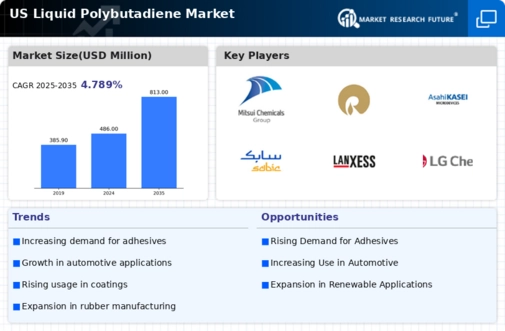
The liquid polybutadiene market is currently characterized by a competitive landscape that is both dynamic and multifaceted. Key growth drivers include the increasing demand for high-performance materials in automotive and industrial applications, alongside a growing emphasis on sustainability. Major players such as Kraton Corporation (US), BASF Corporation (US), and Dow Inc. (US) are strategically positioned to leverage these trends. Kraton Corporation (US) focuses on innovation in bio-based products, while BASF Corporation (US) emphasizes digital transformation and sustainability in its operations. Dow Inc. (US) is actively pursuing regional expansion and partnerships to enhance its market presence, collectively shaping a competitive environment that is increasingly focused on technological advancement and sustainable practices.
In terms of business tactics, companies are localizing manufacturing to reduce lead times and optimize supply chains. The market structure appears moderately fragmented, with several key players exerting considerable influence. This fragmentation allows for niche players to thrive, while larger corporations leverage their scale to optimize production and distribution efficiencies. The collective influence of these key players fosters a competitive atmosphere where innovation and operational excellence are paramount.
In November 2025, Kraton Corporation (US) announced a strategic partnership with a leading automotive manufacturer to develop advanced materials aimed at enhancing vehicle performance and sustainability. This collaboration is significant as it aligns with the growing trend towards eco-friendly automotive solutions, positioning Kraton as a leader in sustainable material innovation.
In October 2025, BASF Corporation (US) unveiled a new digital platform designed to streamline its supply chain operations, enhancing transparency and efficiency. This initiative is crucial as it reflects the industry's shift towards digitalization, enabling BASF to respond more swiftly to market demands and improve customer service.
In September 2025, Dow Inc. (US) expanded its production capacity for liquid polybutadiene at its facility in Texas, a move that underscores its commitment to meeting rising demand in the automotive sector. This expansion is likely to bolster Dow's competitive edge by ensuring a reliable supply of high-quality materials to its customers, thereby enhancing customer loyalty and market share.
As of December 2025, current competitive trends are increasingly defined by digitalization, sustainability, and the integration of AI technologies. Strategic alliances are becoming more prevalent, allowing companies to pool resources and expertise to drive innovation. The competitive differentiation is expected to evolve, shifting from traditional price-based competition to a focus on innovation, technology, and supply chain reliability. This transition suggests that companies that prioritize these aspects will likely emerge as leaders in the liquid polybutadiene market.


















Leave a Comment