×
Request Free Sample ×

Kindly complete the form below to receive a free sample of this Report

* Please use a valid business email

Leading companies partner with us for data-driven Insights

clients tt-cursor
Hero Background

US Metal Replacement Market

ID: MRFR/CnM/16901-HCR
111 Pages
Chitranshi Jaiswal
October 2025

US Metal Replacement Market Research Report: By End Use (Automotive, Aerospace & Defense, Construction, Healthcare, Others) and By Type (Engineering Plastics, Composites) - Forecast to 2035.

Share:
Download PDF ×

We do not share your information with anyone. However, we may send you emails based on your report interest from time to time. You may contact us at any time to opt-out.

US Metal Replacement Market Infographic
Purchase Options

US Metal Replacement Market Summary

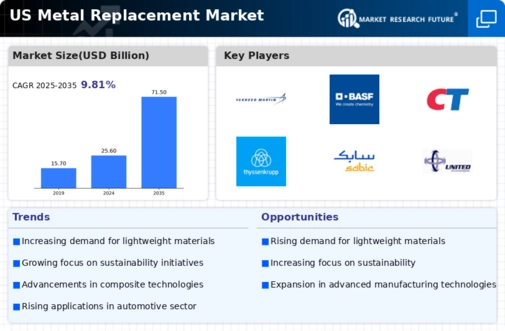
As per analysis, the US metal replacement market is projected to grow from USD 23.09 Billion in 2024 to USD 62.66 Billion by 2035, exhibiting a compound annual growth rate (CAGR) of 9.5% during the forecast period (2025 - 2035).

Key Market Trends & Highlights

The US metal replacement market is poised for growth driven by sustainability and technological advancements.

  • The automotive segment remains the largest contributor to the metal replacement market, reflecting a strong demand for lightweight materials.
  • The aerospace segment is currently the fastest-growing area, indicating a shift towards advanced materials for improved performance.
  • Aluminum continues to dominate the market, while magnesium is emerging as the fastest-growing material due to its lightweight properties.
  • Key market drivers include sustainability initiatives and technological advancements, which are shaping the future of metal replacement.

Market Size & Forecast

2024 Market Size 23.09 (USD Billion)
2035 Market Size 62.66 (USD Billion)
CAGR (2025 - 2035) 9.5%

Major Players

Alcoa Inc (US), BASF SE (DE), Hexcel Corporation (US), Mitsubishi Chemical Corporation (JP), Solvay SA (BE), Teijin Limited (JP), Toray Industries Inc (JP), Victrex PLC (GB)

US Metal Replacement Market Trends

The US metal replacement market is currently experiencing a notable transformation, driven by advancements in materials science and engineering. This sector encompasses a variety of applications, including automotive, aerospace, and consumer goods, where traditional metals are increasingly substituted with innovative materials such as composites and polymers. These alternatives often provide enhanced performance characteristics, such as reduced weight, improved corrosion resistance, and greater design flexibility. As industries strive for sustainability and efficiency, the demand for metal replacement solutions appears to be on the rise, reflecting a broader trend towards eco-friendly manufacturing practices. Moreover, the ongoing evolution of manufacturing technologies, including additive manufacturing and advanced machining techniques, is likely to further propel the US metal replacement market. These innovations enable the production of complex geometries and customized components that were previously unattainable with conventional metalworking methods. Consequently, businesses are increasingly adopting these materials to meet stringent regulatory requirements and consumer preferences for lighter, more efficient products. The interplay of these factors suggests a dynamic landscape for the US metal replacement market, with potential for continued growth and diversification in the coming years.

Sustainability Initiatives

The US metal replacement market is witnessing a shift towards sustainable practices, as companies increasingly prioritize eco-friendly materials. This trend is driven by regulatory pressures and consumer demand for greener products. Manufacturers are exploring alternatives that minimize environmental impact, such as bio-based composites and recycled materials, which align with broader sustainability goals.

Technological Advancements

Innovations in manufacturing technologies are reshaping the US metal replacement market. Techniques such as additive manufacturing and advanced machining are enabling the production of complex components with enhanced performance characteristics. These advancements allow for greater design flexibility and efficiency, making metal alternatives more appealing to various industries.

Customization and Lightweighting

The demand for customized solutions is growing within the US metal replacement market. Industries are increasingly seeking lightweight materials that can be tailored to specific applications. This trend is particularly evident in sectors like aerospace and automotive, where reducing weight can lead to improved fuel efficiency and overall performance.

Market Segment Insights

By Application: Automotive (Largest) vs. Aerospace (Fastest-Growing)

In the US metal replacement market, the application segments showcase distinct distribution patterns, with the automotive sector commanding the largest share. This dominance is attributed to the high demand for lightweight materials that enhance fuel efficiency and overall vehicle performance. Following automotive, sectors like aerospace and construction maintain significant positions, reflecting the versatile nature of metal replacement applications across various industries. The growth trends in the application segment indicate a surge in emerging sectors, particularly aerospace, which is registering as the fastest-growing area. Factors such as advancements in technology, increasing regulatory pressures for fuel efficiency, and a heightened focus on sustainable practices are propelling the demand for metal replacements, particularly in aircraft manufacturing and maintenance activities.

Automotive: Dominant vs. Aerospace: Emerging

The automotive sector stands out as a dominant force within the US metal replacement market, leveraging its extensive demand for innovative materials to improve vehicle efficiency and performance. Steel and aluminum alternatives are increasingly favored to reduce weight and enhance fuel economy. Conversely, the aerospace sector is celebrated as an emerging player, driven by technological advancements and a growing emphasis on sustainability. Lightweight composites and high-strength materials are vital for modern aircraft, addressing both performance and regulatory compliance. As the aerospace industry continues to evolve, its need for cutting-edge metal replacements positions it for significant growth, potentially rivaling the automotive sector under future market conditions.

By Material Type: Aluminum (Largest) vs. Magnesium (Fastest-Growing)

The US metal replacement market showcases a diverse segmentation in material types, primarily led by aluminum, which holds the largest share due to its lightweight properties and strength. Magnesium has entered the spotlight as a fast-growing segment, appealing to industries focused on reducing weight and enhancing fuel efficiency. Composites, plastics, and ceramics also have notable shares, catering to various applications across automotive and aerospace sectors, albeit at a smaller scale than aluminum and magnesium. The growth of aluminum can be attributed to its versatility, cost-effectiveness, and recyclable nature, while magnesium’s rapid growth is driven by increasing demand in electric vehicles and the aerospace industry that seeks lighter materials. Composites, often utilized in high-performance applications, are also witnessing growth due to technological advancements, though they face competition from alternatives like plastics and ceramics that fulfill specific niche requirements.

Material Type: Aluminum (Dominant) vs. Magnesium (Emerging)

Aluminum dominates the US metal replacement market due to its impressive combination of lightweight, strength, and corrosion resistance, making it suited for a variety of applications in automotive and aerospace industries. Its recyclability further enhances its appeal, fitting well within sustainable practices. On the other hand, magnesium is emerging swiftly as a viable alternative, particularly in applications requiring lower weight without sacrificing performance. The automotive industry increasingly adopts magnesium for components such as engine blocks and transmission housings, reinforcing its position as a material of choice in the quest for fuel efficiency. While aluminum may currently dominate in volume, magnesium is gaining traction due to its unique advantages, positioning it as a competitive emerging material.

By End Use Industry: Transportation (Largest) vs. Healthcare (Fastest-Growing)

The US metal replacement market is significantly shaped by its end-use industries, with transportation accounting for the largest share. This sector utilizes metal replacements extensively for weight reduction, enhanced performance, and fuel efficiency in vehicles, especially as regulations on emissions become more stringent. Following closely is industrial manufacturing, which relies on these materials for machinery and equipment, along with electronics, healthcare, and energy sectors that contribute to overall market dynamics.

Transportation: Dominant vs. Healthcare: Emerging

In the US metal replacement market, the transportation sector stands out as the dominant force, leveraging metal replacements to improve vehicle performance and reduce emissions. Key materials employed here include advanced composites and lightweight alloys that provide strength without compromising weight. Conversely, the healthcare sector has emerged rapidly, driven by the demand for biocompatible materials in medical devices and implants. As this industry embraces innovation, metal replacements play a critical role in advancing medical technologies, making them an exciting area of growth in the market.

Get more detailed insights about US Metal Replacement Market

Key Players and Competitive Insights

The metal replacement market is currently characterized by a dynamic competitive landscape, driven by the increasing demand for lightweight materials and the push for sustainability across various industries. Key players such as Alcoa Inc (US), BASF SE (DE), and Hexcel Corporation (US) are strategically positioning themselves through innovation and partnerships. Alcoa Inc (US) focuses on developing advanced aluminum alloys that offer superior performance, while BASF SE (DE) emphasizes the integration of sustainable practices in its production processes. Hexcel Corporation (US) is leveraging its expertise in composite materials to cater to the aerospace and automotive sectors, thereby shaping a competitive environment that prioritizes technological advancement and environmental responsibility.

In terms of business tactics, companies are increasingly localizing manufacturing to enhance supply chain efficiency and reduce lead times. The market structure appears moderately fragmented, with several players vying for market share. However, the collective influence of major companies is significant, as they drive innovation and set industry standards. This competitive structure fosters an environment where collaboration and strategic partnerships are essential for growth and market penetration.

In November 2025, Alcoa Inc (US) announced a partnership with a leading automotive manufacturer to develop lightweight aluminum components aimed at reducing vehicle weight and improving fuel efficiency. This collaboration is strategically important as it aligns with the automotive industry's shift towards electrification and sustainability, potentially positioning Alcoa as a key supplier in the evolving market.

In October 2025, BASF SE (DE) launched a new line of bio-based polymers designed for use in various applications, including automotive and consumer goods. This initiative reflects BASF's commitment to sustainability and innovation, suggesting that the company is keen on capturing a growing segment of environmentally conscious consumers and industries.

In September 2025, Hexcel Corporation (US) expanded its production capabilities by investing in a new facility dedicated to advanced composite materials. This strategic move is likely to enhance Hexcel's competitive edge in the aerospace sector, where demand for lightweight and high-performance materials continues to rise, thereby solidifying its market position.

As of December 2025, current trends in the metal replacement market indicate a strong emphasis on digitalization, sustainability, and the integration of AI technologies. Strategic alliances are increasingly shaping the competitive landscape, as companies recognize the value of collaboration in driving innovation. The shift from price-based competition to a focus on technological advancement and supply chain reliability is evident, suggesting that future differentiation will hinge on the ability to innovate and adapt to changing market demands.


Key Companies in the US Metal Replacement Market market include

Industry Developments

In recent months, the US Metal Replacement Market has seen significant advancements and developments. Companies like Dow, Alcoa Corporation, and Lockheed Martin have been focused on enhancing their product offerings to meet industry demands, particularly in aerospace and automotive sectors where lightweight and high-strength materials are increasingly necessary. Furthermore, BASF and Thyssenkrupp are emphasizing innovation in polymer materials to replace traditional metals, capitalizing on their Research and Development capabilities.

A notable development in the sector is the acquisition of Aleris Corporation by Novelis in October 2020, which strengthened Novelis’ position in aluminum flat rolled products, impacting competition in the metal replacement space. Additionally, in March 2021, DuPont announced a partnership with Archer Aviation to develop advanced materials for urban air mobility, highlighting the trend towards integrating new technologies in transportation. The market has been experiencing growth, with analysts projecting a compound annual growth rate as industries increasingly shift to lighter, more efficient materials.

Kaiser Aluminum and Honeywell have also been making strides to adapt to these changing demands, increasing their market share as they innovate in metal alternatives. Overall, these developments underscore a robust evolution in the US Metal Replacement Market landscape.

Future Outlook

US Metal Replacement Market Future Outlook

The US metal replacement market is projected to grow at a 9.5% CAGR from 2024 to 2035, driven by technological advancements, sustainability initiatives, and increasing demand for lightweight materials.

New opportunities lie in:

  • Development of advanced composite materials for automotive applications.
  • Expansion of metal replacement solutions in aerospace manufacturing.
  • Integration of smart technologies in metal replacement products.

By 2035, the market is expected to be robust, driven by innovation and increased adoption across various industries.

Market Segmentation

US Metal Replacement Market Application Outlook

  • Automotive
  • Aerospace
  • Construction
  • Consumer Electronics
  • Medical Devices

US Metal Replacement Market Material Type Outlook

  • Aluminum
  • Magnesium
  • Composites
  • Plastics
  • Ceramics

US Metal Replacement Market End Use Industry Outlook

  • Transportation
  • Industrial Manufacturing
  • Electronics
  • Healthcare
  • Energy

Report Scope

MARKET SIZE 202423.09(USD Billion)
MARKET SIZE 202525.28(USD Billion)
MARKET SIZE 203562.66(USD Billion)
COMPOUND ANNUAL GROWTH RATE (CAGR)9.5% (2024 - 2035)
REPORT COVERAGERevenue Forecast, Competitive Landscape, Growth Factors, and Trends
BASE YEAR2024
Market Forecast Period2025 - 2035
Historical Data2019 - 2024
Market Forecast UnitsUSD Billion
Key Companies ProfiledAlcoa Inc (US), BASF SE (DE), Hexcel Corporation (US), Mitsubishi Chemical Corporation (JP), Solvay SA (BE), Teijin Limited (JP), Toray Industries Inc (JP), Victrex PLC (GB)
Segments CoveredApplication, Material Type, End Use Industry
Key Market OpportunitiesGrowing demand for lightweight materials in automotive and aerospace sectors drives US metal replacement market expansion.
Key Market DynamicsGrowing demand for lightweight materials drives innovation and competition in the US metal replacement market.
Countries CoveredUS

Leave a Comment

FAQs

What is the projected market size of the US Metal Replacement Market in 2024?

The US Metal Replacement Market is expected to be valued at 25.55 billion USD in 2024.

What will be the market value of the US Metal Replacement Market by 2035?

By 2035, the market is projected to reach a value of 71.52 billion USD.

What is the expected CAGR for the US Metal Replacement Market from 2025 to 2035?

The market is anticipated to grow at a CAGR of 9.81 percent during the period from 2025 to 2035.

Which sector is the largest in the US Metal Replacement Market by end use?

The automotive sector holds the largest market share, valued at 10.25 billion USD in 2024.

What is the market value for the aerospace and defense sector in 2024?

The aerospace and defense sector is valued at 6.2 billion USD in 2024 within the US Metal Replacement Market.

How much is the construction sector expected to be worth in 2035?

The construction sector is projected to reach 13.7 billion USD by 2035.

Who are the key players in the US Metal Replacement Market?

Major players include companies such as Dow, Alcoa Corporation, and Lockheed Martin.

What is the projected value of the healthcare segment in 2035?

The healthcare segment is expected to be valued at 7.84 billion USD by 2035.

What are the main drivers for growth in the US Metal Replacement Market?

Key growth drivers include advancements in technology and the increasing demand for lightweight materials.

What challenges does the US Metal Replacement Market face currently?

Challenges include fluctuations in raw material prices and environmental regulations impacting production processes.

Download Free Sample

Kindly complete the form below to receive a free sample of this Report

Compare Licence

×
Features License Type
Single User Multiuser License Enterprise User
Price $4,950 $5,950 $7,250
Maximum User Access Limit 1 User Upto 10 Users Unrestricted Access Throughout the Organization
Free Customization
Direct Access to Analyst
Deliverable Format
Platform Access
Discount on Next Purchase 10% 15% 15%
Printable Versions