Download Free Sample
Kindly complete the form below to receive a free sample of this Report
US Pharmacy Management System Market Research Report: Size, Share, Trend Analysis By Solution Type (Pharmacy Inventory Management System, Pharmacy Data Management System, Pharmacy Compounding Software System, Pharmacy Benefits Management System, Pharmacy Revenue Cycle Management System, Others), By Component (Software, Hardware, Services), By Deployment Mode (Web-Based, On-Premise) and By End Users (Inpatient Pharmacies, Outpatient Pharmacies) - Growth Outlook & Industry Forecast 2025 To 2035
As per analysis, the US Pharmacy Management System Market is projected to grow from USD 18.95 Billion in 2025 to USD 47.19 Billion by 2035, exhibiting a compound annual growth rate (CAGR) of 9.65% during the forecast period (2025 - 2035).
The US Pharmacy Management System Market is experiencing a transformative shift driven by technological advancements and evolving patient care needs.
| 2024 Market Size | 17.12 (USD Billion) |
| 2035 Market Size | 47.19 (USD Billion) |
| CAGR (2025 - 2035) | 9.65% |
McKesson Corporation (US), CVS Health Corporation (US), Walgreens Boots Alliance (US), Cardinal Health, Inc. (US), OptumRx (US), Cerner Corporation (US), Epic Systems Corporation (US), Allscripts Healthcare Solutions, Inc. (US)
Our Impact
Enabled $4.3B Revenue Impact for Fortune 500 and Leading Multinationals
Partnering with 2000+ Global Organizations Each Year
30K+ Citations by Top-Tier Firms in the Industry
The US Pharmacy Management System Market is currently experiencing a transformative phase, driven by advancements in technology and the increasing demand for efficient healthcare solutions. As pharmacies strive to enhance operational efficiency, the integration of automated systems appears to be a focal point. These systems not only streamline inventory management but also facilitate better patient care through improved prescription accuracy and medication management. Furthermore, the emphasis on regulatory compliance and data security is becoming more pronounced, as pharmacies navigate the complexities of healthcare regulations. This evolving landscape suggests that stakeholders must remain agile and responsive to emerging trends and technologies. In addition, the growing trend towards telepharmacy is reshaping the way pharmacies operate. This model allows for remote consultations and prescription services, thereby expanding access to pharmaceutical care. As the US population continues to age, the demand for such services is likely to increase, prompting pharmacies to adapt their management systems accordingly. Overall, the US Pharmacy Management System Market is poised for growth, with innovations and regulatory changes driving the need for more sophisticated management solutions.
The incorporation of artificial intelligence in pharmacy management systems is becoming increasingly prevalent. AI technologies can enhance decision-making processes, optimize inventory management, and improve patient engagement. By analyzing data patterns, these systems may predict medication needs and streamline operations, thereby reducing costs and improving service delivery.
As pharmacies handle sensitive patient information, the emphasis on data security and compliance with regulations is intensifying. Pharmacy management systems are evolving to incorporate advanced security measures, ensuring that patient data is protected. This trend reflects a broader commitment to maintaining trust and integrity within the healthcare system.
Telepharmacy is gaining traction as a viable alternative to traditional pharmacy services. This trend allows pharmacists to provide consultations and medication management remotely, thereby increasing accessibility for patients. As the demand for convenient healthcare solutions grows, pharmacy management systems are adapting to support telepharmacy functionalities.
The US Pharmacy Management System Market is witnessing a paradigm shift towards patient-centric care, which is reshaping pharmacy operations. As healthcare moves towards a more holistic approach, pharmacies are increasingly focusing on personalized services and patient engagement. Pharmacy management systems are being designed to facilitate better communication between pharmacists and patients, enabling tailored medication management and counseling. This trend is supported by data indicating that patient satisfaction and adherence rates improve when pharmacies adopt patient-centric practices. Consequently, the emphasis on patient-centric care is likely to drive the adoption of advanced pharmacy management systems, further influencing the dynamics of the US Pharmacy Management System Market.
The US Pharmacy Management System Market is experiencing a notable shift towards automation, driven by the need for efficiency and accuracy in pharmacy operations. Automation technologies, such as robotic dispensing systems and automated inventory management, are being increasingly adopted to reduce human error and streamline workflows. According to recent data, the market for pharmacy automation is projected to grow significantly, with estimates suggesting a compound annual growth rate (CAGR) of over 10% through 2026. This trend indicates that pharmacies are prioritizing automation to enhance service delivery and patient safety, thereby transforming the operational landscape of the US Pharmacy Management System Market.
The rising prevalence of chronic diseases in the United States is significantly impacting the US Pharmacy Management System Market. With chronic conditions such as diabetes, hypertension, and cardiovascular diseases on the rise, pharmacies are becoming essential players in managing these health issues. Pharmacy management systems are being tailored to support medication therapy management (MTM) and patient adherence programs, which are crucial for improving health outcomes. Data indicates that the market for chronic disease management solutions within pharmacy systems is expanding, as pharmacies seek to provide comprehensive care and support to patients. This trend underscores the evolving role of pharmacies in the healthcare continuum and their contribution to the US Pharmacy Management System Market.
The US Pharmacy Management System Market is heavily influenced by stringent regulatory requirements and the push for standardization. Compliance with regulations set forth by the Food and Drug Administration (FDA) and the Drug Enforcement Administration (DEA) is paramount for pharmacies. These regulations necessitate the implementation of robust management systems that ensure accurate record-keeping, secure medication dispensing, and adherence to safety protocols. As a result, pharmacies are increasingly investing in management systems that facilitate compliance, which is expected to drive market growth. The emphasis on standardization also promotes interoperability among systems, further enhancing the efficiency of pharmacy operations in the US.
Technological advancements are reshaping the US Pharmacy Management System Market, with innovative software solutions enhancing operational capabilities. The integration of cloud-based systems, mobile applications, and advanced analytics is enabling pharmacies to optimize their services and improve patient engagement. For instance, cloud-based pharmacy management systems allow for real-time data access and collaboration among healthcare providers, which is increasingly vital in today's interconnected healthcare environment. The market for pharmacy software is projected to witness substantial growth, driven by the demand for enhanced functionalities and user-friendly interfaces. These advancements are likely to play a pivotal role in the future of the US Pharmacy Management System Market.
In the US Pharmacy Management System Market, the application segment showcases a diverse distribution where Retail Pharmacy holds the largest market share, indicating its vital role in the healthcare ecosystem. Hospital Pharmacy is rapidly gaining traction as the fastest-growing segment driven by the need for enhanced pharmacy operations and improved patient outcomes.
Pharmacy Application: Retail (Dominant) vs. Hospital (Emerging)
Retail Pharmacy stands as the dominant force in the US pharmacy management landscape, characterized by its well-established infrastructure and extensive customer base, enabling seamless pharmaceutical services. Conversely, Hospital Pharmacy is emerging as a crucial player, driven by the increasing demand for personalized medicine and complex drug therapies within hospital settings. This segment focuses on streamlining medication management processes and improving clinical outcomes through advanced pharmacy systems. As healthcare providers continuously seek innovative solutions to enhance efficiency, Hospital Pharmacy's growth trajectory highlights the shift towards more integrated pharmacy services.
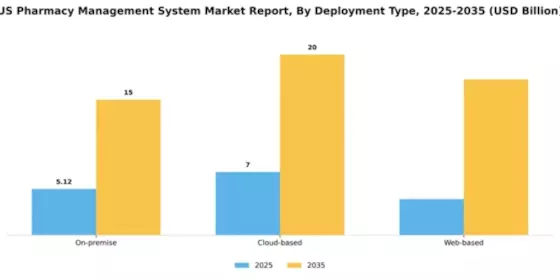
In the US Pharmacy Management System Market, the deployment type segment is characterized by significant dynamics, with the cloud-based solution leading in market share. Its robust capabilities and accessibility have made it increasingly popular among pharmacies, allowing for efficient management and streamlined operations. The on-premise solution, although historically favored, is undergoing a transformation as more facilities recognize the advantages of cloud technology. The web-based option also holds a competitive stance, gaining traction but still lagging behind the leaders in terms of overall market acceptance. Examining growth trends, cloud-based deployment is driven by the increasing demand for remote access and data security, contributing to its widespread adoption. On-premise systems, on the other hand, are witnessing a revival as businesses seek more control over their data and processes. The debate between these deployment types is heightened as pharmacies assess their specific needs against market offerings, creating a dynamic landscape that continues to evolve with technological advancements.
Cloud-based (Dominant) vs. On-premise (Emerging)
The cloud-based segment represents the dominant force in the US Pharmacy Management System Market, characterized by its scalability, cost-effectiveness, and comprehensive features. Pharmacies adopting cloud solutions benefit from real-time data access, essential for fast-paced environments, and automatic updates that ensure compliance with regulations. Conversely, the on-premise segment is emerging, driven by organizations desiring greater control and customization over their software solutions. This deployment type appeals primarily to larger chains with established IT infrastructure, emphasizing robustness and security. As both deployment types evolve, pharmacies are faced with the challenge of balancing their operational needs against the benefits offered by each solution.
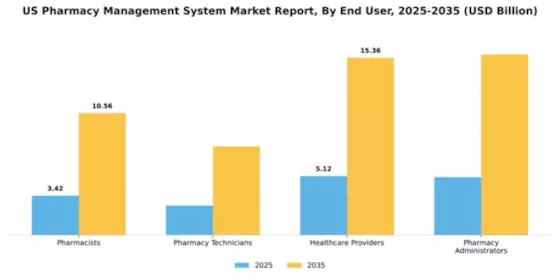
In the US Pharmacy Management System Market, pharmacists represent the largest segment, significantly influencing the overall market landscape. Their role is critical as they not only dispense medications but also provide patient education and manage patient safety. Pharmacy technicians follow closely as a vital support system, enabling pharmacists to focus on high-value activities. This distribution indicates a strong reliance on pharmacists within the healthcare framework. On the growth front, pharmacy technicians are emerging as the fastest-growing segment. The increasing complexity of medication management and the rising demand for pharmaceutical services are leading to an expanded role for pharmacy technicians in the US healthcare system. Factors such as technological advancements, improved training programs, and an uptick in healthcare services are propelling this growth.
Pharmacists (Dominant) vs. Pharmacy Technicians (Emerging)
Pharmacists hold a dominant position in the US Pharmacy Management System Market as they orchestrate a wide range of patient care services. Their extensive education and expertise allow them to act as the main point of medication management, enhancing patient outcomes and safety. They are deeply involved in clinical decision-making, offering valuable insights that ensure effective treatment. On the other hand, pharmacy technicians represent an emerging segment, increasingly recognized for their contribution to operational efficiency in pharmacies. With evolving responsibilities that include managing inventory and assisting with medication preparation, they serve as critical support to pharmacists. This evolving dynamic highlights a shift toward more collaborative pharmacy practices, enhancing service delivery while addressing the growing demand in the healthcare sector.
The US Pharmacy Management System Market showcases a diverse range of features, with Inventory Management currently holding the largest share. This feature is essential for pharmacies to maintain optimal stock levels and reduce wastage, establishing its dominance in the market. Meanwhile, Reporting and Analytics is emerging as a powerful tool, helping pharmacies make data-driven decisions and enhance operational efficiency, thus gaining traction among healthcare providers.
Inventory Management (Dominant) vs. Reporting and Analytics (Emerging)
Inventory Management plays a pivotal role in the US Pharmacy Management System Market by ensuring that pharmacies can efficiently track their drug supplies, minimizing overstock and shortages. This feature supports pharmacies in adhering to regulatory compliance and enhancing patient safety. On the other hand, Reporting and Analytics is rapidly emerging as an essential feature, allowing pharmacies to analyze sales trends, track performance metrics, and generate reports that inform critical business decisions. As healthcare moves toward value-based care, the demand for data analytics tools is rising, positioning Reporting and Analytics as a vital component of modern pharmacy management.
In the US Pharmacy Management System Market, the integration segment serves as a critical pillar with various technologies contributing to its overall performance. Electronic Health Records (EHRs) dominate the market share, driven by the widespread adoption of digital health records and regulatory support. In contrast, Laboratory Information Systems (LIS) are emerging as one of the fastest-growing components, highlighting an increased focus on laboratory efficiencies and patient care outcomes. As healthcare providers seek more data integration across systems, these segments are expected to evolve significantly, shaping industry dynamics.
EHR (Dominant) vs. LIS (Emerging)
Electronic Health Records (EHR) systems represent the dominant force in the integration segment, revolutionizing how patient data is stored, accessed, and utilized across pharmacies and healthcare settings. Their widespread adoption stems from a need for improved patient care, streamlined workflows, and enhanced compliance with regulatory requirements. Conversely, Laboratory Information Systems (LIS) are recognized as an emerging force, providing analytical data management and integration solutions that facilitate timely decision-making in clinical settings. As laboratories harnes technology to optimize processes and improve service delivery, their rapid growth underscores a shift towards integrated pharmacy practices where laboratory data plays an essential role in patient management.
Get more detailed insights about US Pharmacy Management System Market Request Free Sample
The Pharmacy Management System Market is characterized by a dynamic competitive landscape, driven by technological advancements and the increasing demand for efficient healthcare solutions. Key players such as McKesson Corporation (US), CVS Health Corporation (US), and Walgreens Boots Alliance (US) are at the forefront, each adopting distinct strategies to enhance their market positioning. McKesson Corporation (US) focuses on digital transformation and supply chain optimization, aiming to streamline operations and improve service delivery. In contrast, CVS Health Corporation (US) emphasizes integrated healthcare services, leveraging its pharmacy management systems to enhance patient care and operational efficiency. Walgreens Boots Alliance (US) appears to be pursuing a strategy of regional expansion, seeking to increase its footprint in underserved markets, thereby enhancing its competitive edge.The market structure is moderately fragmented, with several players vying for market share. This fragmentation is indicative of the diverse needs of healthcare providers and patients, necessitating tailored solutions. Key players are increasingly localizing their manufacturing and optimizing supply chains to respond swiftly to market demands. The collective influence of these companies shapes a competitive environment where innovation and operational efficiency are paramount.In December 2025, McKesson Corporation (US) announced a strategic partnership with a leading AI firm to enhance its pharmacy management systems through advanced analytics. This collaboration is expected to improve inventory management and patient engagement, positioning McKesson as a leader in leveraging technology for operational excellence. The strategic importance of this move lies in its potential to reduce costs and improve service delivery, thereby enhancing customer satisfaction.In November 2025, CVS Health Corporation (US) launched a new telepharmacy service aimed at expanding access to medications in rural areas. This initiative not only aligns with the company's mission to provide comprehensive healthcare solutions but also addresses the growing demand for remote healthcare services. The strategic significance of this service lies in its ability to tap into a previously underserved market, potentially increasing CVS's customer base and revenue streams.In October 2025, Walgreens Boots Alliance (US) acquired a regional pharmacy chain, enhancing its market presence and operational capabilities. This acquisition is likely to bolster Walgreens' ability to offer localized services and improve its supply chain efficiency. The strategic importance of this move is underscored by the need for pharmacies to adapt to changing consumer preferences and the increasing demand for personalized healthcare solutions.As of January 2026, current trends in the Pharmacy Management System Market are heavily influenced by digitalization, sustainability, and AI integration. Strategic alliances are becoming increasingly vital, as companies seek to enhance their technological capabilities and operational efficiencies. The competitive differentiation is expected to evolve from traditional price-based competition to a focus on innovation, technology, and supply chain reliability. This shift indicates a transformative phase in the market, where companies that prioritize technological advancements and sustainable practices are likely to emerge as leaders.


































The US Pharmacy Management System Market has recently seen significant developments, with companies like CVS Health and Walgreens Boots Alliance focusing on expanding their digital health services to improve patient outcomes and streamline operations. In August 2023, Humana announced its strategic partnership with Surescripts to enhance prescription drug delivery through advanced technology integration.
Additionally, in September 2023, Cigna completed its acquisition of Express Scripts, increasing its capabilities in the automated pharmacy management sector. In terms of market valuation, McKesson Corporation and Cardinal Health reported substantial revenue growth in their quarterly earnings, reflecting an increased demand for efficient pharmacy operations. Notably, the Centers for Medicare and Medicaid Services (CMS) has emphasized adopting technology in pharmacies to enhance medication management, driving innovation in Pharmacy Management Systems.
Over the past two years, the market has also witnessed heightened competition due to the increased adoption of telehealth services, especially during the COVID-19 pandemic, compared to pre-pandemic figures. The demand for integrated solutions is expected to continue rising as healthcare providers seek to optimize workflows and improve patient care.
The US Pharmacy Management System Market is projected to grow at a 9.65% CAGR from 2025 to 2035, driven by technological advancements, regulatory changes, and increasing demand for efficient pharmacy operations.
New opportunities lie in:
By 2035, the market is expected to be robust, driven by innovation and enhanced operational efficiencies.
| MARKET SIZE 2024 | 17.12(USD Billion) |
| MARKET SIZE 2025 | 18.95(USD Billion) |
| MARKET SIZE 2035 | 47.19(USD Billion) |
| COMPOUND ANNUAL GROWTH RATE (CAGR) | 9.65% (2024 - 2035) |
| REPORT COVERAGE | Revenue Forecast, Competitive Landscape, Growth Factors, and Trends |
| BASE YEAR | 2024 |
| Market Forecast Period | 2025 - 2035 |
| Historical Data | 2019 - 2024 |
| Market Forecast Units | USD Billion |
| Key Companies Profiled | McKesson Corporation (US), CVS Health Corporation (US), Walgreens Boots Alliance (US), Cardinal Health, Inc. (US), OptumRx (US), Cerner Corporation (US), Epic Systems Corporation (US), Allscripts Healthcare Solutions, Inc. (US) |
| Segments Covered | Application, Deployment Type, End User, Features, Integration |
| Key Market Opportunities | Integration of artificial intelligence to enhance operational efficiency in the US Pharmacy Management System Market. |
| Key Market Dynamics | Growing adoption of advanced technologies in the US Pharmacy Management System Market enhances operational efficiency and patient care. |
| Countries Covered | US |
The market valuation was 17.12 USD Billion in 2024.
The projected valuation for 2035 is 47.19 USD Billion.
The expected CAGR for the market from 2025 to 2035 is 9.65%.
Key players include McKesson Corporation, CVS Health Corporation, Walgreens Boots Alliance, Cardinal Health, Inc., OptumRx, Cerner Corporation, Epic Systems Corporation, and Allscripts Healthcare Solutions, Inc.
The retail pharmacy segment was valued at 5.12 USD Billion in 2024 and is projected to reach 13.19 USD Billion by 2035.
The hospital pharmacy segment was valued at 4.0 USD Billion in 2024 and is expected to grow to 10.5 USD Billion by 2035.
The cloud-based deployment segment was valued at 6.0 USD Billion in 2024 and is anticipated to reach 18.0 USD Billion by 2035.
The reporting and analytics feature was valued at 6.45 USD Billion in 2024 and is projected to grow to 18.69 USD Billion by 2035.
Pharmacy technicians contributed a valuation of 2.56 USD Billion in 2024, with expectations to reach 6.75 USD Billion by 2035.
The electronic health records integration segment was valued at 5.12 USD Billion in 2024 and is expected to grow to 13.19 USD Billion by 2035.



Kindly complete the form below to receive a free sample of this Report

“This is really good guys. Excellent work on a tight deadline. I will continue to use you going forward and recommend you to others. Nice job”


“Thanks. It’s been a pleasure working with you, please use me as reference with any other Intel employees.”


“Thanks for sending the report it gives us a good global view of the Betaïne market.”


“Thank you, this will be very helpful for OQS.”


“We found the report very insightful! we found your research firm very helpful. I'm sending this email to secure our future business.”


“I am very pleased with how market segments have been defined in a relevant way for my purposes (such as "Portable Freezers & refrigerators" and "last-mile"). In general the report is well structured. Thanks very much for your efforts.”


“I have been reading the first document or the study, ,the Global HVAC and FP market report 2021 till 2026. Must say, good info! I have not gone in depth at all parts, but got a good indication of the data inside!”


“We got the report in time, we really thank you for your support in this process. I also thank to all of your team as they did a great job.”


“The Automotive 48V ECU Components Procurement Intelligence Study” was a complex project, but the Market Research Future (MRFR) team handled it with quality, agility, and customer-centricity. They delivered all requested data on time and within the agreed scope. The team, including Shubhendra Anand and Rahul Gotadki, was always readily available to clarify questions and swiftly implement necessary adjustments, driving the project to a successful conclusion within a very demanding timeframe.
I would also like to specifically commend Akshay Agarwal for his responsiveness and support at every stage—from our initial inquiry on May 6th through to final delivery on June 18th. His dedication made the entire process seamless.”



