Download Free Sample
Kindly complete the form below to receive a free sample of this Report
US Phosphate Fertilizer Market Size, Share, Industry Trend & Analysis Research Report: By Product (Monoammonium Phosphate (MAP), Diammonium Phosphate (DAP), Single Superphosphate (SSP), Triple Superphosphate (TSP), Others) andBy Application (Cereals & Grains, Oilseeds & Pulses, Fruits & Vegetables, Others)- Forecast to 2035
As per Market Research Future analysis, the US phosphate fertilizer market Size was estimated at 12.19 USD Billion in 2024. The US phosphate fertilizer market is projected to grow from 12.97 USD Billion in 2025 to 24.0 USD Billion by 2035, exhibiting a compound annual growth rate (CAGR) of 6.3% during the forecast period 2025 - 2035
The US phosphate fertilizer market is experiencing a shift towards sustainable practices and technological advancements.
| 2024 Market Size | 12.19 (USD Billion) |
| 2035 Market Size | 24.0 (USD Billion) |
| CAGR (2025 - 2035) | 6.35% |
Nutrien (CA), OCP Group (MA), PhosAgro (RU), Mosaic Company (US), Yara International (NO), CF Industries (US), ICL Group (IL), K+S AG (DE), EuroChem Group (RU)
Our Impact
Enabled $4.3B Revenue Impact for Fortune 500 and Leading Multinationals
Partnering with 2000+ Global Organizations Each Year
30K+ Citations by Top-Tier Firms in the Industry
The phosphate fertilizer market is currently experiencing notable shifts driven by various factors, including agricultural practices, environmental regulations, and technological advancements. As farmers increasingly seek to enhance crop yields, the demand for phosphate fertilizers appears to be on the rise. This trend is likely influenced by the need for sustainable farming methods that optimize nutrient use while minimizing environmental impact. Furthermore, the ongoing development of precision agriculture technologies may contribute to more efficient application of phosphate fertilizers, thereby improving overall productivity in the sector. In addition, regulatory frameworks surrounding fertilizer use are evolving, which could impact the phosphate fertilizer market. Stricter environmental policies may necessitate changes in production processes and formulations, pushing manufacturers to innovate. The interplay between these regulations and market demand suggests a complex landscape where stakeholders must navigate both opportunities and challenges. As the industry adapts to these dynamics, the phosphate fertilizer market is poised for transformation, potentially leading to new product offerings and enhanced sustainability practices.
There is a growing emphasis on sustainable agricultural practices within the phosphate fertilizer market. Farmers are increasingly adopting methods that reduce environmental impact while maintaining productivity. This shift is likely driven by consumer demand for sustainably sourced food and regulatory pressures.
Advancements in technology are reshaping the phosphate fertilizer market. Precision agriculture tools are being integrated to optimize fertilizer application, which may enhance efficiency and reduce waste. These innovations could lead to improved crop yields and better resource management.
The phosphate fertilizer market is influenced by evolving regulatory frameworks. Stricter environmental regulations may require manufacturers to adapt their processes and products. This could lead to the development of new formulations that align with sustainability goals.
There is a growing awareness among farmers and agricultural stakeholders regarding the importance of soil health, which is significantly influencing the phosphate fertilizer market. Healthy soils are vital for sustainable crop production, and phosphate fertilizers are integral to maintaining soil fertility. The phosphate fertilizer market is witnessing an increase in demand as farmers recognize the need to replenish soil nutrients to enhance productivity. According to recent studies, approximately 40% of US farmers are now prioritizing soil health in their farming practices, leading to a projected increase in phosphate fertilizer usage by 2-4% annually. This trend suggests that as more farmers adopt practices that focus on soil health, the phosphate fertilizer market will likely experience sustained growth, driven by the need for effective nutrient management.
The phosphate fertilizer market is experiencing a shift in dynamics due to increasing export opportunities. The US is one of the leading producers of phosphate fertilizers, and the demand from international markets is on the rise. Countries in Asia and South America are particularly interested in importing US-made phosphate fertilizers to meet their agricultural needs. The phosphate fertilizer market is poised to benefit from this trend, as exports are projected to grow by approximately 5% annually over the next few years. This growth is driven by the need for high-quality fertilizers that can enhance crop yields in regions with limited access to domestic production. As global agricultural demands evolve, the US phosphate fertilizer market is likely to expand its footprint in international markets.
The increasing The phosphate fertilizer market. In the US, agricultural production is expected to grow by approximately 1.5% annually, necessitating enhanced fertilizer application to maintain soil fertility and crop yields. Phosphate fertilizers play a crucial role in this context, as they are essential for plant growth and development. The phosphate fertilizer market is likely to benefit from this trend, as farmers seek to optimize their yields to meet the growing food requirements. Furthermore, the USDA projects that the demand for phosphate fertilizers will increase by around 3% over the next five years, indicating a robust market outlook. This demand is further fueled by the need for sustainable agricultural practices that ensure food security while minimizing environmental impact.
Government initiatives aimed at promoting sustainable agriculture practices are influencing the phosphate fertilizer market. In the US, various programs and subsidies are designed to encourage farmers to adopt environmentally friendly practices, including the responsible use of fertilizers. The phosphate fertilizer market is likely to benefit from these policies, as they often include financial incentives for farmers to utilize phosphate fertilizers in a sustainable manner. For instance, the USDA has allocated significant funding to support research and development in sustainable farming techniques, which may lead to increased phosphate fertilizer usage. This support is expected to drive market growth, as farmers seek to align with government regulations and consumer preferences for sustainable food production.
Technological advancements in fertilizer application methods are reshaping the phosphate fertilizer market. Innovations such as precision agriculture and variable rate technology allow farmers to apply fertilizers more efficiently, optimizing nutrient use and minimizing waste. The phosphate fertilizer market is adapting to these changes, as farmers increasingly invest in technologies that enhance application efficiency. Reports indicate that the adoption of precision agriculture techniques could lead to a 10-15% reduction in fertilizer usage while maintaining crop yields. This shift not only supports environmental sustainability but also improves the economic viability of farming operations. As these technologies become more accessible, the phosphate fertilizer market is expected to expand, driven by the need for efficient nutrient management solutions.
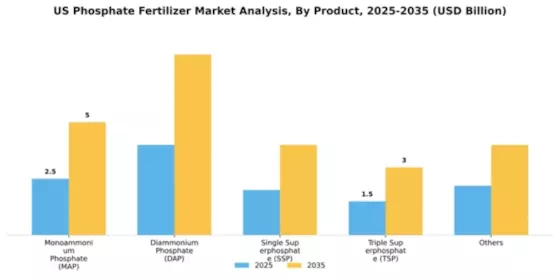
The market share distribution in the US phosphate fertilizer market indicates that Diammonium Phosphate (DAP) holds the largest share, driven by its broad application in various crops and high nutrient content. Following closely, Monoammonium Phosphate (MAP) is emerging rapidly, appealing to farmers looking for efficient nutrient delivery methods. Other products like Single Superphosphate (SSP) and Triple Superphosphate (TSP) make up a smaller yet significant portion of the market, catering to specific agricultural needs. Growth trends in this segment are largely influenced by increasing demand for high-yielding crops and sustainable agricultural practices. The expansion of precision agriculture and advancements in fertilizer formulations support the rising adoption of MAP, which is particularly favored for its faster nutrient uptake by plants. Meanwhile, DAP’s consistent performance ensures its dominance as farmers value reliability in their nutrient supply, leading to stable growth projections for this product.
Diammonium Phosphate (DAP) (Dominant) vs. Monoammonium Phosphate (MAP) (Emerging)
Diammonium Phosphate (DAP) is considered the dominant player in the US phosphate fertilizer market due to its high phosphorus and nitrogen content, making it a preferred choice for various crops, especially cereals and legumes. Its versatility and effectiveness in enhancing soil fertility establish a strong market presence. Conversely, Monoammonium Phosphate (MAP) is recognized as an emerging product, increasingly favored for its ability to promote early root development and overall plant vigor. With a focus on efficiency, MAP also supports modern agricultural practices, thus capturing the interest of farmers seeking alternatives that align with crop management strategies. As both segments evolve, their distinct characteristics will continue to shape the market dynamics.
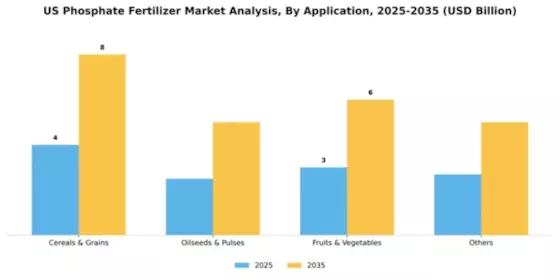
In the US phosphate fertilizer market, the application segment is predominantly driven by cereals & grains, which hold the largest market share. This segment benefits from high demand due to the need for staple food production. Following closely are oilseeds & pulses, while fruits & vegetables and others make up smaller portions of the market share. The increasing consumption of plant-based diets further influences these dynamics, contributing to shifts in application preferences. Growth trends in the application segment indicate that while cereals & grains remain strong, fruits & vegetables are emerging as the fastest-growing category. The rise in organic farming and consumer preference for fresh produce drive this growth. Additionally, technological advancements in farming practices are enabling more efficient fertilizer use, benefiting all segments and enhancing overall market growth.
Cereals & Grains (Dominant) vs. Fruits & Vegetables (Emerging)
Cereals & grains dominate the US phosphate fertilizer market, largely due to their critical role in food security and staple diets. This segment's consistent demand is supported by large-scale agricultural practices focused on maximizing yield. Conversely, the fruits & vegetables segment is increasingly recognized as an emerging market, driven by health trends promoting fresh produce. This segment is characterized by innovative farming techniques and growing consumer interest in organic options. The shift towards more sustainable and diversified crop production is paving the way for both segments to thrive, with cereals & grains maintaining their prominence while fruits & vegetables rapidly gain ground.
Get more detailed insights about US Phosphate Fertilizer Market Request Free Sample
The phosphate fertilizer market is currently characterized by a competitive landscape that is both dynamic and multifaceted. Key growth drivers include increasing agricultural productivity demands, sustainability initiatives, and technological advancements in fertilizer application. Major players such as Mosaic Company (US), Nutrien (CA), and CF Industries (US) are strategically positioned to leverage these trends. Mosaic Company (US) focuses on enhancing its operational efficiency through digital transformation and sustainable practices, while Nutrien (CA) emphasizes innovation in product development and regional expansion to meet diverse agricultural needs. CF Industries (US) is also investing in supply chain optimization and sustainability, collectively shaping a competitive environment that prioritizes efficiency and environmental responsibility.In terms of business tactics, companies are increasingly localizing manufacturing to reduce transportation costs and enhance supply chain resilience. The market structure appears moderately fragmented, with a few dominant players exerting considerable influence. This fragmentation allows for niche players to thrive, yet the collective strategies of major companies like Mosaic Company (US) and Nutrien (CA) create a competitive dynamic that drives innovation and efficiency across the sector.
In October Mosaic Company (US) announced a significant investment in a new production facility aimed at increasing its phosphate output by 15%. This strategic move is likely to enhance its market share and meet the growing demand for phosphate fertilizers, particularly in the Midwest region of the US. The investment underscores Mosaic's commitment to scaling operations while adhering to sustainable practices, which may set a benchmark for industry standards.
In September Nutrien (CA) launched a new line of precision fertilizers designed to optimize nutrient delivery based on soil health data. This initiative reflects Nutrien's focus on innovation and technology integration, potentially positioning the company as a leader in sustainable agricultural solutions. By leveraging data analytics, Nutrien aims to enhance crop yields while minimizing environmental impact, which could resonate well with environmentally conscious consumers and farmers alike.
In August CF Industries (US) entered into a strategic partnership with a technology firm to develop AI-driven solutions for fertilizer application. This collaboration is indicative of a broader trend towards digitalization within the industry, as companies seek to enhance operational efficiency and reduce waste. The integration of AI technologies may not only streamline processes but also provide farmers with tailored solutions that improve crop productivity.
As of November current competitive trends are increasingly defined by digitalization, sustainability, and technological integration. Strategic alliances are becoming more prevalent, as companies recognize the need to collaborate in order to innovate and meet evolving market demands. The competitive differentiation is likely to shift from traditional price-based competition to a focus on innovation, technology, and supply chain reliability. This evolution suggests that companies that prioritize sustainable practices and technological advancements will be better positioned to thrive in the future.

In recent developments within the US Phosphate Fertilizer Market, companies such as The Mosaic Company and CF Industries have reported significant financial growth due to rising agricultural demands and global supply chain constraints, with Mosaic's revenue jumping to over $3 billion in Q2 2023. Additionally, J.R. Simplot Company has expanded its production capabilities to enhance supply amidst increasing fertilizer rates driven by global market conditions. In terms of market stability, Nutrien has heightened its focus on sustainability initiatives, working with local governments to promote responsible phosphate use.
Notably, in July 2023, Yara International announced plans for a joint venture with Stoller USA aimed at developing innovative phosphate solutions tailored for US farmers, providing competitive advantages. The landscape has also seen intensified merger and acquisition activity, including the acquisition of several smaller firms by ICL Group in August 2023, aiming to strengthen market presence. Increased domestic production capacity, coupled with investment in new technologies, reflects ongoing trends aimed at meeting escalating food security challenges.
Over the past two years, factors such as heightened tariffs and environmental regulations have also played critical roles, shaping investment strategies and market positioning among key players in the industry.
The Phosphate Fertilizer Market is projected to grow at a 6.35% CAGR from 2025 to 2035, driven by increasing agricultural demand and sustainable farming practices.
New opportunities lie in:
By 2035, the phosphate fertilizer market is expected to achieve robust growth and increased sustainability.
| MARKET SIZE 2024 | 12.19(USD Billion) |
| MARKET SIZE 2025 | 12.97(USD Billion) |
| MARKET SIZE 2035 | 24.0(USD Billion) |
| COMPOUND ANNUAL GROWTH RATE (CAGR) | 6.35% (2025 - 2035) |
| REPORT COVERAGE | Revenue Forecast, Competitive Landscape, Growth Factors, and Trends |
| BASE YEAR | 2024 |
| Market Forecast Period | 2025 - 2035 |
| Historical Data | 2019 - 2024 |
| Market Forecast Units | USD Billion |
| Key Companies Profiled | Nutrien (CA), OCP Group (MA), PhosAgro (RU), Mosaic Company (US), Yara International (NO), CF Industries (US), ICL Group (IL), K+S AG (DE), EuroChem Group (RU) |
| Segments Covered | Product, Application |
| Key Market Opportunities | Adoption of precision agriculture technologies enhances efficiency in phosphate fertilizer application and usage. |
| Key Market Dynamics | Rising environmental regulations drive innovation and sustainability in phosphate fertilizer production and usage. |
| Countries Covered | US |
The market valuation of the US phosphate fertilizer market was $12.19 Billion in 2024.
The projected market valuation for the US phosphate fertilizer market is $24.0 Billion by 2035.
The expected CAGR for the US phosphate fertilizer market during the forecast period 2025 - 2035 is 6.35%.
The product segment with the highest valuation in 2024 was Diammonium Phosphate (DAP), valued at $4.0 Billion.
The projected valuation range for Monoammonium Phosphate (MAP) by 2035 is $5.0 Billion.
The application segment of Cereals & Grains is expected to grow the most, with a projected valuation of $8.0 Billion by 2035.
Key players in the US phosphate fertilizer market include Nutrien (CA), Mosaic Company (US), and CF Industries (US), among others.
The valuation of the Single Superphosphate (SSP) segment in 2024 was $2.0 Billion.
The projected valuation for the 'Others' product segment by 2035 is $4.0 Billion.
In 2024, the valuation of the Fruits & Vegetables application segment was $3.0 Billion, compared to $2.5 Billion for Oilseeds & Pulses.



Kindly complete the form below to receive a free sample of this Report

“This is really good guys. Excellent work on a tight deadline. I will continue to use you going forward and recommend you to others. Nice job”


“Thanks. It’s been a pleasure working with you, please use me as reference with any other Intel employees.”


“Thanks for sending the report it gives us a good global view of the Betaïne market.”


“Thank you, this will be very helpful for OQS.”


“We found the report very insightful! we found your research firm very helpful. I'm sending this email to secure our future business.”


“I am very pleased with how market segments have been defined in a relevant way for my purposes (such as "Portable Freezers & refrigerators" and "last-mile"). In general the report is well structured. Thanks very much for your efforts.”


“I have been reading the first document or the study, ,the Global HVAC and FP market report 2021 till 2026. Must say, good info! I have not gone in depth at all parts, but got a good indication of the data inside!”


“We got the report in time, we really thank you for your support in this process. I also thank to all of your team as they did a great job.”


“The Automotive 48V ECU Components Procurement Intelligence Study” was a complex project, but the Market Research Future (MRFR) team handled it with quality, agility, and customer-centricity. They delivered all requested data on time and within the agreed scope. The team, including Shubhendra Anand and Rahul Gotadki, was always readily available to clarify questions and swiftly implement necessary adjustments, driving the project to a successful conclusion within a very demanding timeframe.
I would also like to specifically commend Akshay Agarwal for his responsiveness and support at every stage—from our initial inquiry on May 6th through to final delivery on June 18th. His dedication made the entire process seamless.”



