Download Free Sample
Kindly complete the form below to receive a free sample of this Report
US Steel Market US Steel Market Size, Share, Industry Trend & Analysis Research Report: By Steel Type Outlook (Flat, Long), By Steel Product Outlook (Structural Steel, Prestressing Steel) andBy Steel Application Outlook (Building & Construction, Automotive, Electrical Appliance)- Forecast to 2035
As per analysis, the US Stainless Steel Fermenter Market is projected to grow from USD 201.04 Million in 2024 to USD 395.49 Million by 2035, exhibiting a compound annual growth rate (CAGR) of 6.34% during the forecast period (2025 - 2035).
The US Stainless Steel Fermenter Market is experiencing robust growth driven by evolving consumer preferences and technological advancements.
| 2024 Market Size | 201.04 (USD Million) |
| 2035 Market Size | 395.49 (USD Million) |
| CAGR (2025 - 2035) | 6.34% |
GEA Group (US), Praxair Technology Inc (US), Parker Hannifin Corporation (US), Thermo Fisher Scientific Inc (US), Alfa Laval (US), SPX Flow Inc (US), Krones AG (US), Ziemann Holvrieka (US)
Our Impact
Enabled $4.3B Revenue Impact for Fortune 500 and Leading Multinationals
Partnering with 2000+ Global Organizations Each Year
30K+ Citations by Top-Tier Firms in the Industry
The US Stainless Steel Fermenter Market is currently experiencing a notable evolution, driven by the increasing demand for high-quality fermentation equipment across various sectors, including food and beverage, pharmaceuticals, and biotechnology. This market appears to be influenced by a growing preference for stainless steel due to its durability, resistance to corrosion, and ease of cleaning. As industries strive for efficiency and sustainability, the adoption of stainless steel fermenters is likely to rise, reflecting a shift towards more hygienic and reliable production processes. Furthermore, the trend towards craft brewing and artisanal food production seems to bolster the market, as smaller producers seek equipment that meets their specific needs while ensuring product quality. In addition, the US Stainless Steel Fermenter Market may witness advancements in technology, with manufacturers focusing on innovative designs and features that enhance fermentation processes. Automation and smart technology integration could play a crucial role in optimizing production efficiency and monitoring fermentation conditions. As environmental concerns gain prominence, the market might also see a push towards energy-efficient and eco-friendly fermenters, aligning with broader sustainability goals. Overall, the landscape of the US Stainless Steel Fermenter Market appears dynamic, with various factors shaping its trajectory in the coming years.
The US Stainless Steel Fermenter Market is experiencing a notable surge due to the growing craft beverage sector. As consumer preferences shift towards artisanal and locally produced beverages, the demand for stainless steel fermenters has escalated. In 2025, the craft beer market alone was valued at approximately 26 billion USD, indicating a robust growth trajectory. This trend is not limited to beer; craft spirits and wines are also gaining traction, further driving the need for high-quality fermentation equipment. Stainless steel fermenters are favored for their durability, ease of cleaning, and ability to maintain temperature control, which are essential for producing high-quality beverages. As the craft beverage industry continues to expand, the US Stainless Steel Fermenter Market is likely to benefit significantly from this trend.
The US Stainless Steel Fermenter Market is witnessing an increased focus on quality and safety standards in beverage production. Consumers are becoming more discerning about the products they consume, leading manufacturers to prioritize high-quality fermentation processes. Stainless steel fermenters are preferred due to their non-reactive nature, which ensures that the final product remains uncontaminated. Furthermore, compliance with food safety regulations necessitates the use of materials that are easy to clean and maintain. As the industry adapts to these heightened quality expectations, the demand for stainless steel fermenters is expected to grow. This trend underscores the importance of quality assurance in the US Stainless Steel Fermenter Market.
Sustainability is becoming a central theme in the US Stainless Steel Fermenter Market. As environmental concerns rise, manufacturers are increasingly seeking eco-friendly production methods. Stainless steel is favored for its recyclability and lower environmental impact compared to other materials. The push for sustainable practices is not only driven by consumer demand but also by regulatory pressures aimed at reducing carbon footprints. Companies that adopt sustainable manufacturing processes are likely to gain a competitive edge in the market. This trend suggests that the US Stainless Steel Fermenter Market will continue to evolve towards more sustainable practices, potentially leading to innovations in product design and manufacturing techniques.
The US Stainless Steel Fermenter Market is benefiting from favorable regulatory frameworks that support craft production. Various state and federal policies are being implemented to promote small-scale breweries and distilleries, which often require stainless steel fermenters for their operations. For example, the Small Business Administration has programs aimed at assisting small beverage producers, which indirectly boosts the demand for fermentation equipment. Additionally, regulations that encourage sustainable practices in production are leading to a preference for stainless steel fermenters, known for their recyclability and longevity. As these supportive policies continue to evolve, they are likely to create a conducive environment for the growth of the US Stainless Steel Fermenter Market.
Technological advancements are playing a pivotal role in shaping the US Stainless Steel Fermenter Market. Innovations such as automated fermentation systems and advanced temperature control mechanisms are enhancing the efficiency and precision of the fermentation process. These technologies not only improve product quality but also reduce production time and costs. For instance, the integration of IoT in fermentation systems allows for real-time monitoring and adjustments, which can lead to better fermentation outcomes. As manufacturers increasingly adopt these technologies, the demand for stainless steel fermenters equipped with such features is expected to rise. This trend indicates a shift towards more sophisticated fermentation solutions, positioning the US Stainless Steel Fermenter Market for substantial growth in the coming years.
In the US Stainless Steel Fermenter Market, the application segment is primarily dominated by the Food and Beverage sector, which significantly surpasses other applications. The use of stainless steel fermenters in food and beverage production allows for efficient fermentation processes, ensuring product quality and safety, critical factors for manufacturers. In contrast, the Pharmaceutical application is gaining traction due to its stringent requirements for hygiene and contamination control, thereby steadily increasing its market share.
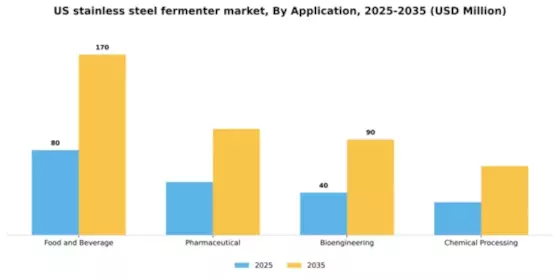
Food and Beverage (Dominant) vs. Pharmaceutical (Emerging)
The Food and Beverage sector stands as the dominant player in the US Stainless Steel Fermenter Market, characterized by its extensive use in brewing, winemaking, and dairy production. This application leverages stainless steel's corrosion resistance and easy maintenance, resulting in optimal fermentation conditions. The Pharmaceutical sector, emerging as a significant player, is propelled by the demand for biopharmaceutical production, emphasizing the need for strict regulatory compliance and high-quality standards. The increasing focus on biopharmaceuticals drives innovation and investment in this segment, leading to enhanced production capabilities and custom-designed fermenters tailored to specific pharmaceutical applications.
In the US Stainless Steel Fermenter Market, the craft breweries segment holds the largest share, driven by the increasing popularity of artisan and craft beverages. This segment is characterized by smaller production volumes but enjoys strong consumer loyalty, making it a significant player in the fermenter market. Meanwhile, large-scale breweries, though initially seen as dominant in volume, are rapidly adapting innovative techniques and technologies to maintain competitiveness, leading to their status as the fastest-growing segment in recent years.
End Use: Craft Breweries (Dominant) vs. Distilleries (Emerging)
Craft breweries dominate the US market for stainless steel fermenters due to consumer preference for unique, locally brewed beers. These breweries typically rely on mid-sized fermenters that allow for flexibility in production and creative experimentation with flavors. They cater to a niche market willing to pay a premium for quality. In contrast, while distilleries are an emerging segment, they are capitalizing on the craft movement. Distilleries are increasingly adopting stainless steel fermenters to enhance production efficiency, attract a wide array of customers with diverse spirit offerings, and leverage trends toward artisanal and craft spirits, positioning themselves as significant contributors to market innovation.
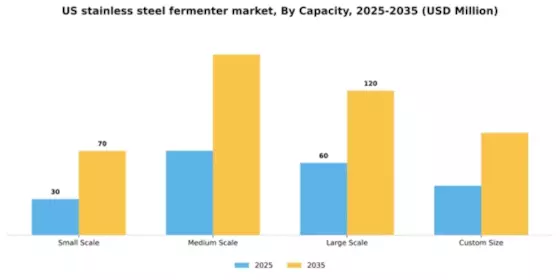
In the US Stainless Steel Fermenter Market, the capacity segment is mainly divided into small scale, medium scale, large scale, and custom size configurations. Among these, the large scale fermenters hold the largest share due to their widespread adoption in commercial brewing and industrial applications. Conversely, small scale fermenters are gaining traction as craft breweries and home brewers seek flexible and affordable options, making them a significant contender in the market. As consumer preferences shift towards artisanal and locally produced beverages, the demand for small scale fermenters is on the rise. These fermenters appeal to smaller businesses and hobbyists who prioritize quality and customization over volume. The trend indicates robust growth opportunities, driven by innovation in design and functionality that caters to this burgeoning audience of craft beverage makers.
Large Scale (Dominant) vs. Small Scale (Emerging)
The large scale segment of the US Stainless Steel Fermenter Market is characterized by its robust capacity to meet the high demands of large-scale breweries and industrial producers. These fermenters are designed for efficiency and durability, facilitating the production of significant quantities of fermented beverages, including beer and spirits. Their market dominance stems from established relationships with major breweries and the need for consistent and quality output in mass production. In contrast, small scale fermenters are increasingly recognized for their ability to cater to the growing craft beverage movement. They offer flexibility and customization for smaller producers and are particularly appealing to startups and homebrewers. These units emphasis portability, ease of use, and adaptability. As more consumers opt for artisanal products, the small scale fermenter segment is positioned as an emerging powerhouse within the market, capturing the interest of innovative creators.
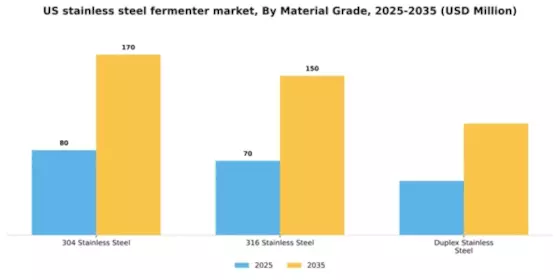
In the US Stainless Steel Fermenter Market, 304 Stainless Steel holds a dominant market share due to its excellent corrosion resistance and affordability, making it the preferred choice for a variety of fermentation applications. Meanwhile, 316 Stainless Steel, known for its enhanced resistance to pitting and crevice corrosion, is rapidly gaining traction, particularly in more demanding applications. The increase in regulatory standards and the need for more robust materials in fermentation processes are driving its growth.
304 Stainless Steel (Dominant) vs. 316 Stainless Steel (Emerging)
304 Stainless Steel is characterized by its high chromium and nickel content, offering excellent weldability and resistance to oxidation, which makes it ideal for general fermentation equipment. Its widespread use as a reliable and cost-effective option ensures it remains a dominant force in the market. In contrast, 316 Stainless Steel is designed for superior saltwater and acidic resistance, rendering it suitable for high-end fermenting processes. This material is increasingly favored in specialized applications, such as pharmaceuticals and biotechnology, where purity and durability are paramount, signaling its emergence as a significant player.
In the US stainless steel fermenter market, the design type segment showcases a diverse landscape with conical fermenters holding the largest market share. These fermenters are preferred for their efficient design, which promotes better fermentation processes. Horizontal fermenters follow closely, with a growing inclination among producers aiming for improved operational efficiency and space optimization. Vertical fermenters, while valuable, comprise a smaller portion of the market, primarily utilized in niche applications.
Conical Fermenters (Dominant) vs. Horizontal Fermenters (Emerging)
Conical fermenters dominate the US stainless steel market due to their effectiveness in yeast management and fermentation control, making them a staple for breweries and wineries. Their cone-shaped design facilitates sediment removal, resulting in higher quality outputs, which is crucial for producers. In contrast, horizontal fermenters are emerging rapidly, driven by the need for maximizing space and operational efficiency in production facilities. Their growing popularity is attributed to advancements that allow better temperature control and ease of cleaning, positioning them as a formidable contender in the market.
Get more detailed insights about US Stainless Steel Fermenter Market Request Free Sample
The Stainless Steel Fermenter Market is characterized by a competitive landscape that is increasingly shaped by innovation, sustainability, and strategic partnerships. Key players such as GEA Group (US), Thermo Fisher Scientific Inc (US), and Alfa Laval (US) are actively pursuing strategies that emphasize technological advancements and operational efficiencies. GEA Group (US) has positioned itself as a leader in the market by focusing on the development of energy-efficient fermenters, which aligns with the growing demand for sustainable production methods. Meanwhile, Thermo Fisher Scientific Inc (US) has been enhancing its product offerings through digital transformation initiatives, thereby improving customer engagement and operational effectiveness. These strategies collectively contribute to a dynamic competitive environment where companies are not only vying for market share but also striving to meet evolving consumer expectations.
In terms of business tactics, companies are increasingly localizing manufacturing and optimizing supply chains to enhance responsiveness and reduce costs. The market appears to be moderately fragmented, with several key players exerting influence over various segments. This fragmentation allows for niche players to thrive, while larger companies leverage their scale to implement comprehensive strategies that can dominate market trends.
In December 2025, GEA Group (US) announced the launch of a new line of stainless steel fermenters designed specifically for the craft brewing industry. This strategic move is significant as it targets a rapidly growing segment, allowing GEA Group (US) to capitalize on the increasing popularity of craft beverages. By tailoring their products to meet the specific needs of craft brewers, GEA Group (US) enhances its competitive edge and expands its market reach.
In November 2025, Thermo Fisher Scientific Inc (US) entered into a partnership with a leading biotechnology firm to co-develop advanced fermentation technologies. This collaboration is indicative of a broader trend towards strategic alliances that enhance innovation capabilities. By pooling resources and expertise, both companies are likely to accelerate the development of next-generation fermenters, thereby positioning themselves favorably in a competitive market.
In October 2025, Alfa Laval (US) unveiled a new sustainability initiative aimed at reducing the carbon footprint of its fermenters. This initiative not only aligns with global sustainability goals but also responds to increasing regulatory pressures and consumer demand for environmentally friendly products. By prioritizing sustainability, Alfa Laval (US) is likely to strengthen its brand reputation and appeal to a more environmentally conscious customer base.
As of January 2026, the competitive trends in the Stainless Steel Fermenter Market are increasingly defined by digitalization, sustainability, and the integration of AI technologies. Strategic alliances are becoming more prevalent, allowing companies to leverage shared expertise and resources. The competitive landscape is shifting from traditional price-based competition to a focus on innovation, technology, and supply chain reliability. This evolution suggests that companies that can effectively differentiate themselves through advanced technologies and sustainable practices will likely emerge as leaders in the market.




In recent developments within the US Steel Market, notable companies such as Nucor Corporation and Steel Dynamics have experienced significant growth, with Nucor reporting a record net earnings in the second quarter of 2023. ClevelandCliffs announced plans to invest heavily in expanding steel production capabilities to meet increasing demand in the automotive sector. In July 2023, United States Steel Corporation unveiled a strategic shift towards more sustainable practices with plans to reduce carbon footprints in alignment with government initiatives for cleaner steel production.
Additionally, Commercial Metals Company holds a growing stance in the rebar market, which is critical as infrastructure projects ramp up nation-wide. In terms of mergers and acquisitions, the industry witnessed Steel Dynamics acquiring a controlling interest in a Texas steel processing facility in March 2023, enhancing their position in the market. Over the past couple of years, key events such as the implementation of tariffs and trade policies by the US government have shaped the dynamics and competitive landscape of these companies, influencing pricing and market valuations significantly.
The overall market has seen an uptick due to increasing domestic demand and infrastructure development focusing on sustainability.
The US Stainless Steel Fermenter Market is projected to grow at a 6.34% CAGR from 2025 to 2035, driven by increasing demand for high-quality fermentation processes and sustainable production methods.
New opportunities lie in:
By 2035, the market is expected to solidify its position as a leader in fermentation technology.
| MARKET SIZE 2024 | 201.04(USD Million) |
| MARKET SIZE 2025 | 217.42(USD Million) |
| MARKET SIZE 2035 | 395.49(USD Million) |
| COMPOUND ANNUAL GROWTH RATE (CAGR) | 6.34% (2024 - 2035) |
| REPORT COVERAGE | Revenue Forecast, Competitive Landscape, Growth Factors, and Trends |
| BASE YEAR | 2024 |
| Market Forecast Period | 2025 - 2035 |
| Historical Data | 2019 - 2024 |
| Market Forecast Units | USD Million |
| Key Companies Profiled | GEA Group (US), Praxair Technology Inc (US), Parker Hannifin Corporation (US), Thermo Fisher Scientific Inc (US), Alfa Laval (US), SPX Flow Inc (US), Krones AG (US), Ziemann Holvrieka (US) |
| Segments Covered | Application, End Use, Capacity, Material Grade |
| Key Market Opportunities | Growing demand for sustainable brewing practices drives innovation in the US Stainless Steel Fermenter Market. |
| Key Market Dynamics | Rising demand for sustainable brewing practices drives innovation in the US Stainless Steel Fermenter Market. |
| Countries Covered | US |
As of 2024, the market valuation was 201.04 USD Million.
The market is projected to reach a valuation of 395.49 USD Million by 2035.
The expected CAGR for the market from 2025 to 2035 is 6.34%.
Key players include GEA Group, Praxair Technology Inc, Parker Hannifin Corporation, and Thermo Fisher Scientific Inc.
Primary applications include Food and Beverage, Pharmaceutical, Biofuel Production, and Chemical Processing.
The market segments by end use include Craft Breweries, Large Scale Breweries, Distilleries, and Research Laboratories.
Capacity segments include Small Scale, Medium Scale, Large Scale, and Custom Size fermenters.
Common material grades include 304 Stainless Steel, 316 Stainless Steel, Duplex Stainless Steel, and Other Alloys.
In 2024, the Food and Beverage segment was valued at 80.0 to 160.0 USD Million.
The market is expected to grow steadily, with a projected valuation increase to 395.49 USD Million by 2035.



Kindly complete the form below to receive a free sample of this Report

“This is really good guys. Excellent work on a tight deadline. I will continue to use you going forward and recommend you to others. Nice job”


“Thanks. It’s been a pleasure working with you, please use me as reference with any other Intel employees.”


“Thanks for sending the report it gives us a good global view of the Betaïne market.”


“Thank you, this will be very helpful for OQS.”


“We found the report very insightful! we found your research firm very helpful. I'm sending this email to secure our future business.”


“I am very pleased with how market segments have been defined in a relevant way for my purposes (such as "Portable Freezers & refrigerators" and "last-mile"). In general the report is well structured. Thanks very much for your efforts.”


“I have been reading the first document or the study, ,the Global HVAC and FP market report 2021 till 2026. Must say, good info! I have not gone in depth at all parts, but got a good indication of the data inside!”


“We got the report in time, we really thank you for your support in this process. I also thank to all of your team as they did a great job.”


“The Automotive 48V ECU Components Procurement Intelligence Study” was a complex project, but the Market Research Future (MRFR) team handled it with quality, agility, and customer-centricity. They delivered all requested data on time and within the agreed scope. The team, including Shubhendra Anand and Rahul Gotadki, was always readily available to clarify questions and swiftly implement necessary adjustments, driving the project to a successful conclusion within a very demanding timeframe.
I would also like to specifically commend Akshay Agarwal for his responsiveness and support at every stage—from our initial inquiry on May 6th through to final delivery on June 18th. His dedication made the entire process seamless.”



