×
Request Free Sample ×

Kindly complete the form below to receive a free sample of this Report

* Please use a valid business email

Leading companies partner with us for data-driven Insights

clients tt-cursor
Hero Background

US Structural Steel Market

ID: MRFR/CnM/11526-CR
100 Pages
Garvit Vyas
December 2023

US Structural Steel Market Research Report Information By Product (Heavy Sectional Steel, Light Sectional Steel, Rebar), By Application (Residential, Non-Residential, Infrastructure), And By Region (North America, Europe, Asia-Pacific, And Rest Of The World) –Market Forecast Till 2035

Share:
Download PDF ×

We do not share your information with anyone. However, we may send you emails based on your report interest from time to time. You may contact us at any time to opt-out.

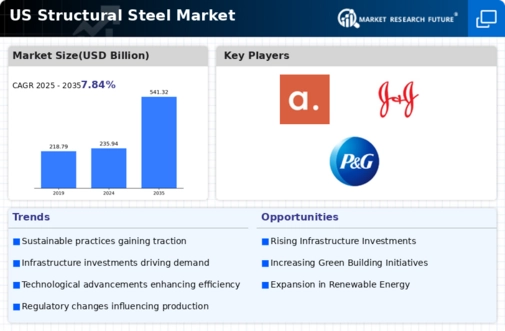
US Structural Steel Market Infographic
Purchase Options

US Structural Steel Market Summary

As per analysis, the US structural steel market is projected to grow from USD 19.39 Billion in 2024 to USD 20.56 Billion in 2025, exhibiting a compound annual growth rate (CAGR) of 6.05% during the forecast period (2025 - 2035).

Key Market Trends & Highlights

The US structural steel market is poised for growth driven by sustainability and technological advancements.

  • The construction segment remains the largest contributor to the US structural steel market, reflecting robust demand across various projects.
  • Modular construction is experiencing significant growth, indicating a shift towards more efficient building practices.
  • The residential segment continues to dominate, while the commercial segment is recognized as the fastest-growing area within the market.
  • Infrastructure investment and green building regulations are key drivers propelling the market forward.

Market Size & Forecast

2024 Market Size 19.39 (USD Billion)
2035 Market Size 37.0 (USD Billion)
CAGR (2025 - 2035) 6.05%

Major Players

Nucor Corporation (US), Steel Dynamics, Inc. (US), United States Steel Corporation (US), Commercial Metals Company (US), Gerdau Ameristeel Corporation (US), TimkenSteel Corporation (US), Harsco Corporation (US), Cleveland-Cliffs Inc. (US)

US Structural Steel Market Trends

The US structural steel market is currently experiencing a dynamic phase characterized by evolving demands and innovative applications. The construction sector, particularly in commercial and industrial projects, drives the need for high-quality structural steel. This material is favored for its strength, durability, and versatility, making it a preferred choice among architects and engineers. Additionally, sustainability considerations are increasingly influencing material selection, as stakeholders seek to minimize environmental impacts. The integration of advanced technologies in manufacturing processes further enhances the efficiency and quality of steel production, aligning with contemporary construction practices. Moreover, the US structural steel market is witnessing a shift towards prefabrication and modular construction techniques. These methods not only expedite project timelines but also optimize resource utilization. As urbanization continues to rise, the demand for infrastructure development, including bridges, high-rise buildings, and transportation systems, remains robust. This trend suggests a promising outlook for the market, as investments in infrastructure are likely to persist. Overall, the US structural steel market appears poised for growth, driven by innovation, sustainability, and a commitment to meeting the evolving needs of the construction industry.

Sustainability Initiatives

The US structural steel market is increasingly influenced by sustainability initiatives. Stakeholders are prioritizing eco-friendly practices, such as recycling and reducing carbon footprints. This trend reflects a broader commitment to environmental stewardship, as companies seek to align with regulatory standards and consumer preferences for sustainable materials.

Technological Advancements

Technological advancements are reshaping the US structural steel market. Innovations in manufacturing processes, such as automation and digital fabrication, enhance production efficiency and quality. These developments enable manufacturers to meet the growing demands of the construction sector while maintaining competitive pricing.

Modular Construction Growth

The rise of modular construction is significantly impacting the US structural steel market. This approach allows for off-site fabrication of steel components, leading to faster assembly and reduced waste. As the construction industry embraces this method, the demand for structural steel is expected to increase, reflecting a shift towards more efficient building practices.

Market Segment Insights

By Application: Construction (Largest) vs. Infrastructure (Fastest-Growing)

In the US structural steel market, the application segment displays a dynamic distribution of market share. The construction sector remains the largest contributor, driven by both residential and commercial building projects. This enduring demand stems from the growing urbanization rates and extensive infrastructural development initiatives across the nation. Meanwhile, the infrastructure segment is witnessing rapid expansion as governments allocate more resources towards enhancing transport networks, bridges, and public utilities, catering to the increasing demands of the population. Growth trends within the structural steel application segment are primarily boosted by technological advancements and sustainable building practices. The construction industry is adapting to innovative techniques that promote efficiency and cost-effectiveness. Simultaneously, the infrastructure sector is benefitting from strategic federal investments which prioritize the modernization of aging infrastructure, indicating a robust growth trajectory in the years to come.

Construction: Dominant vs. Infrastructure: Emerging

The construction application of structural steel in the US market continues to dominate largely due to its essential role in commercial and residential buildings. The use of steel in this application facilitates swift construction times, flexibility in design, and long-lasting structural integrity. It is characterized by a robust demand driven by ongoing urbanization and the need for new housing and commercial space. On the other hand, the infrastructure segment is emerging as a critical player, supported by increased federal spending and a renewed focus on repairing and upgrading transportation systems. This sector embraces innovation, integrating smart technologies that enhance operational performance and sustainability. The growing emphasis on eco-friendly infrastructure further elevates its significance, paving the way for future opportunities.

By End Use: Residential (Largest) vs. Commercial (Fastest-Growing)

In the US structural steel market, the end-use segment is characterized by several critical categories, primarily Residential, Commercial, Industrial, Institutional, and Transportation. Among these, the Residential sector holds the largest market share, as increasing urbanization and population growth continue to drive demand for new housing developments. Conversely, the Commercial sector has emerged as the fastest-growing segment, propelled by the revitalization of urban areas and growing retail establishments that demand innovative building designs and sustainable construction practices. As the US economy recovers and expands, the growth trends in the structural steel market reflect significant investments in infrastructure and commercial projects. The driving forces behind these trends include technological advancements in construction methods, a shift towards environmentally friendly building materials, and government incentives for infrastructure development. Furthermore, the rising emphasis on energy-efficient and sustainable designs continues to promote the use of steel in various construction applications.

Residential (Dominant) vs. Transportation (Emerging)

The Residential segment remains the dominant force in the US structural steel market, driven by strong demand for single-family homes and multi-family units. As urbanization accelerates, builders increasingly favor structural steel for its durability, cost-effectiveness, and aesthetic appeal. This segment benefits from ongoing trends in modern architecture that prioritize open spaces and flexible layouts. In contrast, the Transportation segment is emerging as a key area of growth, particularly in the development of infrastructure projects such as bridges, railways, and airports. With the need to upgrade aging transport networks, municipalities are exploring innovative steel solutions that enhance safety and longevity. Both segments play crucial roles in shaping the future of the structural steel landscape, with differing demands and growth trajectories.

By Product Type: Hot Rolled Steel (Largest) vs. Cold Rolled Steel (Fastest-Growing)

In the US structural steel market, Hot Rolled Steel holds the largest market share due to its wide applicability in construction and manufacturing. This product type serves as a foundational material for various infrastructures, making it a popular choice among builders and contractors. In contrast, Cold Rolled Steel, known for its enhanced surface finish and precise dimensions, is gaining traction rapidly, driven by the increasing demand for quality and durability in structural applications.

Steel Plates (Dominant) vs. Galvanized Steel (Emerging)

Steel Plates possess a strong market position, providing essential components for construction and manufacturing due to their thickness and versatility in applications. They are often utilized in large-scale projects, offering strength and reliability. Galvanized Steel, on the other hand, is emerging in the structural steel market as industries seek corrosion-resistant solutions. This product type is essential for outdoor applications where it faces environmental exposure, thus driving its increasing demand and adoption in various sectors.

By Material Type: Carbon Steel (Largest) vs. Stainless Steel (Fastest-Growing)

In the US structural steel market, carbon steel holds the dominant position, accounting for a significant portion of the market share. Its widespread application across various industries, including construction and manufacturing, solidifies its status as the leading material type. Conversely, stainless steel is emerging as the fastest-growing segment, driven by increased demand for corrosion-resistant materials in sectors such as automotive and construction. The versatility and aesthetic appeal of stainless steel further enhance its attractiveness, resulting in a notable increase in market share.

Carbon Steel (Dominant) vs. Stainless Steel (Emerging)

Carbon steel is the backbone of the US structural steel market, known for its strength and affordability. It is widely utilized in construction projects, machinery, and automotive industries due to its favorable mechanical properties. Stainless steel, on the other hand, is gaining traction rapidly, valued for its corrosion resistance and durability. It is increasingly being adopted in high-end architectural applications and infrastructure projects, where aesthetics and longevity are critical. As sustainability becomes a priority, both materials are witnessing innovations, but carbon steel remains crucial for traditional industrial applications, while stainless steel is projected to capture a growing niche market.

By Fabrication Method: Welding (Largest) vs. Cutting (Fastest-Growing)

In the US structural steel market, the fabrication methods showcase distinct shares and dynamics. Welding dominates the market due to its extensive use in structural applications requiring high strength and durability. Cutting, although smaller in share, presents a rapidly growing opportunity driven by advancements in technology and efficiency that support precise fabrication. Other methods like bending and machining also contribute but are overshadowed by these two key segments.

Welding (Dominant) vs. Cutting (Emerging)

Welding stands as the dominant fabrication method in the US structural steel market, revered for its ability to join metal components with strength and reliability, thus ensuring the structural integrity of constructions. This method is pivotal in large-scale projects, particularly in the construction of bridges, buildings, and industrial facilities. On the other hand, cutting is perceived as an emerging trend, propelled by the need for customized solutions and innovations in cutting technologies. This method’s ability to adapt to specific project requirements makes it increasingly relevant, catering to demand for precision and efficiency in the design and production of steel structures.

Get more detailed insights about US Structural Steel Market

Key Players and Competitive Insights

The structural steel market in the US is characterized by a competitive landscape that is both dynamic and multifaceted. Key growth drivers include increasing infrastructure investments, a surge in construction activities, and a growing emphasis on sustainable building practices. Major players such as Nucor Corporation (US), Steel Dynamics, Inc. (US), and United States Steel Corporation (US) are strategically positioned to leverage these trends. Nucor Corporation (US) focuses on innovation and sustainability, investing heavily in electric arc furnace technology to reduce carbon emissions. Steel Dynamics, Inc. (US) emphasizes regional expansion and operational efficiency, while United States Steel Corporation (US) is actively pursuing digital transformation initiatives to enhance productivity and reduce costs. Collectively, these strategies shape a competitive environment that is increasingly focused on sustainability and technological advancement.

Key business tactics within the market include localizing manufacturing to reduce transportation costs and optimizing supply chains to enhance efficiency. The competitive structure appears moderately fragmented, with several key players holding significant market shares. This fragmentation allows for a diverse range of offerings and competitive strategies, which can be advantageous in meeting the varied demands of customers across different sectors.

In November 2025, Nucor Corporation (US) announced a partnership with a leading technology firm to develop advanced steel production methods that utilize artificial intelligence for process optimization. This strategic move is likely to enhance Nucor's operational efficiency and position it as a leader in sustainable steel production, aligning with the industry's shift towards greener practices.

In October 2025, Steel Dynamics, Inc. (US) expanded its operations by acquiring a regional steel mill, which is expected to increase its production capacity by 15%. This acquisition not only strengthens its market position but also allows for greater supply chain control, enabling the company to respond more effectively to market demands.

In September 2025, United States Steel Corporation (US) launched a new line of eco-friendly steel products aimed at the construction sector, which is increasingly prioritizing sustainability. This initiative reflects a broader trend within the industry towards environmentally responsible practices and positions the company favorably among environmentally conscious consumers.

As of December 2025, current competitive trends in the structural steel market are heavily influenced by digitalization, sustainability, and the integration of AI technologies. Strategic alliances are becoming increasingly important, as companies seek to pool resources and expertise to enhance their competitive edge. Looking ahead, it is anticipated that competitive differentiation will evolve from traditional price-based competition to a focus on innovation, technological advancements, and supply chain reliability. This shift underscores the importance of adaptability and forward-thinking strategies in navigating the complexities of the market.


Key Companies in the US Structural Steel Market market include

Future Outlook

US Structural Steel Market Future Outlook

The US structural steel market is projected to grow at a 6.05% CAGR from 2024 to 2035, driven by infrastructure investments, urbanization, and sustainable construction practices.

New opportunities lie in:

  • Expansion into prefabricated steel components for rapid construction
  • Development of advanced steel recycling technologies
  • Investment in smart steel solutions for enhanced structural integrity

By 2035, the market is expected to be robust, driven by innovation and increased demand.

Market Segmentation

US Structural Steel Market End Use Outlook

  • Residential
  • Commercial
  • Industrial
  • Institutional
  • Transportation

US Structural Steel Market Application Outlook

  • Construction
  • Infrastructure
  • Manufacturing
  • Energy
  • Transportation

US Structural Steel Market Product Type Outlook

  • Hot Rolled Steel
  • Cold Rolled Steel
  • Galvanized Steel
  • Structural Steel Shapes
  • Steel Plates

US Structural Steel Market Material Type Outlook

  • Carbon Steel
  • Alloy Steel
  • Stainless Steel
  • Reinforced Steel
  • Tool Steel

US Structural Steel Market Fabrication Method Outlook

  • Welding
  • Cutting
  • Bending
  • Machining
  • Assembling

Report Scope

MARKET SIZE 202419.39(USD Billion)
MARKET SIZE 202520.56(USD Billion)
MARKET SIZE 203537.0(USD Billion)
COMPOUND ANNUAL GROWTH RATE (CAGR)6.05% (2024 - 2035)
REPORT COVERAGERevenue Forecast, Competitive Landscape, Growth Factors, and Trends
BASE YEAR2024
Market Forecast Period2025 - 2035
Historical Data2019 - 2024
Market Forecast UnitsUSD Billion
Key Companies ProfiledNucor Corporation (US), Steel Dynamics, Inc. (US), United States Steel Corporation (US), Commercial Metals Company (US), Gerdau Ameristeel Corporation (US), TimkenSteel Corporation (US), Harsco Corporation (US), Cleveland-Cliffs Inc. (US)
Segments CoveredApplication, End Use, Product Type, Material Type, Fabrication Method
Key Market OpportunitiesAdoption of advanced manufacturing techniques enhances efficiency in the US structural steel market.
Key Market DynamicsRising demand for sustainable construction materials drives innovation in the US structural steel market.
Countries CoveredUS

Leave a Comment

FAQs

What is the projected market size of the US Structural Steel Market in 2024?

The US Structural Steel Market is projected to be valued at 15.5 billion USD in 2024.

What is the expected market value of the US Structural Steel Market by 2035?

By 2035, the US Structural Steel Market is anticipated to reach a value of 30.5 billion USD.

What is the expected CAGR for the US Structural Steel Market from 2025 to 2035?

The expected compound annual growth rate for the US Structural Steel Market from 2025 to 2035 is 6.347%.

Which segment is valued highest in the US Structural Steel Market for 2024?

In 2024, the Light Sectional Steel segment is valued the highest at 6.0 billion USD.

What will be the market size of Heavy Sectional Steel by 2035?

The Heavy Sectional Steel segment is projected to be valued at 11.0 billion USD by 2035.

Which major players dominate the US Structural Steel Market?

Major players in the US Structural Steel Market include Nucor, CMC Steel, and United States Steel Corporation among others.

What is the market value of Rebar in 2024?

The Rebar segment is expected to be valued at 4.0 billion USD in the year 2024.

What applications primarily drive growth in the US Structural Steel Market?

The construction and infrastructure sectors are the primary applications driving growth in the US Structural Steel Market.

What are the growth prospects for the US Structural Steel Market post-2025?

The US Structural Steel Market is poised for significant growth, driven by a forecasted CAGR of 6.347% from 2025 to 2035.

How does the US Structural Steel Market compare regionally in terms of growth potential?

The US Structural Steel Market shows strong growth potential across various regions, particularly in areas with increasing construction activity.

Download Free Sample

Kindly complete the form below to receive a free sample of this Report

Compare Licence

×
Features License Type
Single User Multiuser License Enterprise User
Price $4,950 $5,950 $7,250
Maximum User Access Limit 1 User Upto 10 Users Unrestricted Access Throughout the Organization
Free Customization
Direct Access to Analyst
Deliverable Format
Platform Access
Discount on Next Purchase 10% 15% 15%
Printable Versions