Utility Scale Power Optimizer Market
Utility Scale Power Optimizer Market Summary
As per Market Research Future analysis, the Utility-scale Power Optimizer Market Size was estimated at 10.12 USD Billion in 2024. The Utility-scale Power Optimizer industry is projected to grow from 11.72 USD Billion in 2025 to 50.73 USD Billion by 2035, exhibiting a compound annual growth rate (CAGR) of 15.78% during the forecast period 2025 - 2035
Key Market Trends & Highlights
The Utility-scale Power Optimizer Market is poised for substantial growth driven by technological advancements and increasing demand for renewable energy.
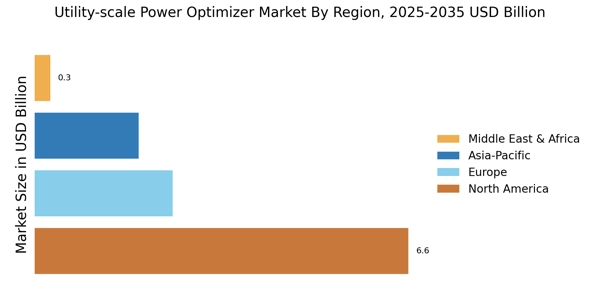
- North America remains the largest market for utility-scale power optimizers, driven by robust investments in renewable energy infrastructure.
- Asia-Pacific is emerging as the fastest-growing region, with a notable increase in the adoption of distributed power optimizers.
- Centralized power optimizers continue to dominate the market, while distributed power optimizers are gaining traction due to their flexibility and efficiency.
- Key market drivers include the increasing demand for renewable energy and government incentives promoting energy efficiency.
Market Size & Forecast
| 2024 Market Size | 10.12 (USD Billion) |
| 2035 Market Size | 50.73 (USD Billion) |
| CAGR (2025 - 2035) | 15.78% |
Major Players
SMA Solar Technology AG (DE), Enphase Energy Inc (US), SolarEdge Technologies Inc (IL), Trina Solar Limited (CN), Canadian Solar Inc (CA), First Solar Inc (US), JinkoSolar Holding Co Ltd (CN), LONGi Green Energy Technology Co Ltd (CN), Risen Energy Co Ltd (CN)
Utility Scale Power Optimizer Market Trends
The Utility-scale Power Optimizer Market is currently experiencing a transformative phase, driven by the increasing demand for renewable energy solutions and the need for enhanced efficiency in energy generation. As global energy policies shift towards sustainability, utility-scale power optimizers are becoming essential components in large-scale solar installations. These devices optimize the performance of solar panels, ensuring maximum energy output while minimizing losses due to shading and other factors. The market appears to be expanding as more stakeholders recognize the benefits of integrating advanced optimization technologies into their energy systems. Moreover, the growing emphasis on energy storage solutions and smart grid technologies is likely to further propel the Utility-scale Power Optimizer Market. As utilities and energy providers seek to enhance grid reliability and manage energy distribution more effectively, the role of power optimizers becomes increasingly critical. This trend suggests a potential for innovation and collaboration among technology providers, utilities, and regulatory bodies. The future landscape of this market may be characterized by advancements in artificial intelligence and machine learning, which could lead to even more sophisticated optimization strategies, thereby enhancing overall system performance and sustainability.
Integration with Energy Storage Systems
The Utility-scale Power Optimizer Market is witnessing a trend towards the integration of power optimizers with energy storage systems. This synergy enhances the overall efficiency of energy generation and consumption, allowing for better management of energy supply and demand. As storage technologies advance, the combination with power optimizers may lead to more resilient energy infrastructures.
Adoption of Smart Grid Technologies
There is a noticeable shift towards the adoption of smart grid technologies within the Utility-scale Power Optimizer Market. These technologies facilitate real-time monitoring and control of energy systems, improving operational efficiency. The integration of power optimizers into smart grids may enable utilities to optimize energy distribution and enhance grid stability.
Focus on Sustainability and Regulatory Compliance
The Utility-scale Power Optimizer Market is increasingly influenced by a focus on sustainability and regulatory compliance. As governments implement stricter environmental regulations, the demand for efficient energy solutions rises. Power optimizers play a crucial role in helping utilities meet these regulatory requirements while promoting sustainable energy practices.
Utility Scale Power Optimizer Market Drivers
Government Incentives and Policies
Government incentives and supportive policies are pivotal in shaping the Utility-scale Power Optimizer Market. Many countries are implementing favorable regulations and financial incentives to promote renewable energy adoption. For instance, tax credits, grants, and feed-in tariffs are being utilized to encourage investments in utility-scale solar and wind projects. These initiatives not only lower the cost of capital for developers but also enhance the economic viability of power optimization technologies. As a result, the Utility-scale Power Optimizer Market is expected to benefit from increased investments driven by these supportive frameworks, fostering a more robust market environment.
Growing Focus on Energy Efficiency
The growing focus on energy efficiency is a significant driver for the Utility-scale Power Optimizer Market. As energy costs continue to rise, utility operators are increasingly prioritizing solutions that enhance energy output while reducing operational costs. Power optimizers are designed to improve the performance of solar panels and other renewable energy systems, ensuring that they operate at peak efficiency. This focus on efficiency is further supported by various energy efficiency programs and initiatives that encourage the adoption of advanced technologies. Consequently, the Utility-scale Power Optimizer Market is likely to experience sustained growth as more operators seek to implement energy-efficient solutions.
Increasing Demand for Renewable Energy
The rising demand for renewable energy sources is a primary driver for the Utility-scale Power Optimizer Market. As nations strive to meet ambitious climate goals, the transition from fossil fuels to renewable energy sources such as solar and wind is accelerating. This shift is evidenced by the International Energy Agency, which reported that renewable energy capacity is expected to grow significantly in the coming years. Utility-scale power optimizers play a crucial role in enhancing the efficiency of these renewable installations, thereby making them more attractive to investors and operators. The increasing deployment of solar farms and wind parks necessitates advanced optimization technologies to maximize energy output and minimize losses, further propelling the Utility-scale Power Optimizer Market.
Rising Investment in Smart Grid Infrastructure
The rising investment in smart grid infrastructure is a crucial driver for the Utility-scale Power Optimizer Market. As utilities modernize their grid systems to accommodate renewable energy sources, the integration of power optimizers becomes essential. Smart grids facilitate better energy management, demand response, and integration of distributed energy resources. According to industry reports, investments in smart grid technologies are projected to reach substantial figures in the coming years. This trend not only enhances grid reliability but also creates a favorable environment for the deployment of utility-scale power optimizers, thereby driving growth in the Utility-scale Power Optimizer Market.
Technological Advancements in Power Optimization
Technological advancements are significantly influencing the Utility-scale Power Optimizer Market. Innovations in power electronics, data analytics, and artificial intelligence are enabling more sophisticated optimization solutions. These technologies allow for real-time monitoring and control of energy production, which enhances the overall efficiency of utility-scale projects. According to recent data, the integration of advanced power optimizers can lead to efficiency improvements of up to 20% in solar installations. As utility operators seek to maximize returns on investment, the demand for cutting-edge optimization technologies is likely to increase, thereby driving growth in the Utility-scale Power Optimizer Market.
Market Segment Insights
By Technology: Centralized Power Optimizers (Largest) vs. Distributed Power Optimizers (Fastest-Growing)
In the Utility-scale Power Optimizer Market, the primary segment is centralized power optimizers, which traditionally hold a substantial market share. These optimizers are favored for their ability to control multiple inverters from a single point, leading to improved efficiency and performance in large-scale energy projects. On the other hand, distributed power optimizers are gaining traction as they provide enhanced flexibility and resilience, which are crucial in modern energy systems that prioritize decentralized generation and grid integration.
Technology: Centralized Power Optimizers (Dominant) vs. Distributed Power Optimizers (Emerging)
Centralized power optimizers are characterized by their ability to manage and optimize the performance of entire solar plant systems from a centralized location. This technology is widely regarded for its ability to streamline operations, reduce downtime, and ensure consistent energy output across multiple inverters. Conversely, distributed power optimizers are emerging as a preferred choice in situations that require modularity and adaptability. With their integration capabilities alongside advanced technologies like artificial intelligence and machine learning, distributed power optimizers are positioned to capture new market segments, especially in the growing renewable energy landscape.
By Power Rating: 1-5 MW (Largest) vs. Above 10 MW (Fastest-Growing)
In the Utility-scale Power Optimizer Market, the 1-5 MW segment holds the largest market share, primarily driven by the demand for flexible energy solutions across various industries. This range is favored for its balance between scalability and efficiency, catering to both commercial and industrial applications. Meanwhile, the Above 10 MW segment is gaining traction as large-scale renewable projects—such as solar farms and wind installations—increase in number. As energy providers aim for reduced operational costs, the demand for more extensive power optimization solutions is escalating. The growth of these segments is influenced by several factors. The increased focus on renewable energy adoption and global energy policies supporting sustainability are major drivers for the 1-5 MW segment. Simultaneously, the Above 10 MW segment is expected to grow rapidly due to advancements in technology and the need for enhanced grid stability. With larger capacities, these solutions are designed to accommodate the rising complexity of energy management in Utility-scale settings, making them essential for future energy systems.
1-5 MW (Dominant) vs. Above 10 MW (Emerging)
The 1-5 MW power rating segment is currently dominant in the Utility-scale Power Optimizer Market due to its widespread applicability in various commercial and industrial settings. This range offers optimal scalability, enabling energy producers to tailor their power solutions to meet specific demands without oversizing their investments. Additionally, the efficiency of these optimizers leads to improved energy management, reducing operational costs significantly. In contrast, the Above 10 MW segment is emerging rapidly, fueled by the increasing implementation of large-scale renewable projects. These systems are designed to handle more complex energy management needs and offer advanced features that cater to large operations. As grid requirements evolve, the Above 10 MW solutions will play a crucial role in enhancing energy efficiency and stability for energy providers.
By Input Voltage Range: 200-480 VAC (Largest) vs. 480-600 VAC (Fastest-Growing)
In the Utility-scale Power Optimizer Market, the input voltage range from 200-480 VAC holds the largest market share, largely due to its widespread adoption in various renewable energy projects. This range is particularly favored for its efficiency in optimizing power extraction from solar panels and its compatibility with a broad range of inverter technologies, leading to significant utilization in utility-scale applications. On the other hand, the 480-600 VAC range is identified as the fastest-growing segment, fueled by the increasing demand for higher capacity and efficiency in power distribution systems. The push for enhanced performance in energy conversion and grid integration is driving this growth, as power system operators seek to utilize optimizers capable of handling larger voltage inputs while maintaining high efficiency and reliability.
Input Voltage: 200-480 VAC (Dominant) vs. 600-900 VAC (Emerging)
The 200-480 VAC input voltage range is a dominant player in the utility-scale power optimizer market, largely due to its established presence and proven technology. This segment benefits from its versatility and the ability to integrate seamlessly with existing infrastructure, making it a preferred choice for many solar power projects. In contrast, the 600-900 VAC segment is emerging as a significant contender, characterized by its appeal to high-capacity installations that demand superior performance and efficiency. This range is increasingly adopted due to its potential for improved energy yield and reduced losses, as larger utility-scale projects seek to maximize their output while adhering to stringent regulatory standards.
By Application: Photovoltaic Systems (Largest) vs. Battery Energy Storage Systems (Fastest-Growing)
The Utility-scale Power Optimizer Market shows a significant distribution of market share among its application segments, with Photovoltaic Systems leading as the dominant application. The integration of solar energy on a large scale has driven this segment's prevalence and acceptance in the market. Following closely, Wind Power Systems and Battery Energy Storage Systems hold notable shares, with Battery Energy Storage Systems rapidly gaining traction for their crucial role in energy management and grid stability. Microgrids, while smaller in market share, contribute to the diversification of applications in this sector.
Energy Storage: Battery Energy Storage Systems (Emerging) vs. Microgrids (Dominant)
Battery Energy Storage Systems are emerging as critical components in the Utility-scale Power Optimizer Market. Their ability to facilitate renewable energy integration, enhance grid stability, and optimize energy use positions them as a growing need in the sector. With an increasing focus on sustainability and energy independence, these systems enable efficient storage and distribution of energy. Conversely, Microgrids are established as dominant players, providing localized energy solutions that improve reliability and resilience for communities. They play a pivotal role in enabling renewable energy adoption, effectively managing energy supply and demand while reducing losses and enhancing overall system efficiency.

Regional Insights
The market is segmented into various regions, including North America, Europe, APAC, South America, and MEA. North America is expected to hold the largest market share in 2023, followed by Europe and APAC. The growth in North America is attributed to the increasing adoption of renewable energy sources, such as solar and wind power. Europe is also witnessing a growing demand for utility-scale power optimizers due to the rising awareness of energy efficiency and the need to reduce carbon emissions.
The APAC region is expected to emerge as a key growth market, driven by the increasing demand for electricity and the growing adoption of solar power. South America and MEA are expected to contribute to the overall growth of the market with increasing investments in renewable energy projects.
Key Players and Competitive Insights
Key Companies in the Utility Scale Power Optimizer Market include
Industry Developments
The Utility-scale Power Optimizer Market is anticipated to expand significantly from 2025 to 2034. This growth is attributed to the increasing deployment of renewable energy sources, such as solar and wind power, which require power optimizers to maximize energy efficiency. Technological advancements, such as the development of multi-channel and high-power optimizers, are also driving market growth. Furthermore, government initiatives and policies that promote the adoption of renewable energy are expected to positively impact market demand. Recent developments include strategic partnerships between key players to enhance product offerings and expand market reach.
The market is expected to witness increased adoption in emerging regions, where there is a growing need for reliable and cost-effective energy solutions.
Future Outlook
Utility Scale Power Optimizer Market Future Outlook
The Utility-scale Power Optimizer Market is projected to grow at a 15.78% CAGR from 2025 to 2035, driven by technological advancements, increasing energy demand, and sustainability initiatives.
New opportunities lie in:
- Integration of AI-driven analytics for performance optimization
- Development of modular power optimizer solutions for scalability
- Expansion into emerging markets with tailored financing options
By 2035, the market is expected to be robust, driven by innovation and strategic investments.
Market Segmentation
Utility Scale Power Optimizer Market Technology Outlook
- Centralized Power Optimizers
- Distributed Power Optimizers
- Communication Protocols (Zigbee, Wi-Fi, Ethernet, etc.)
Utility Scale Power Optimizer Market Application Outlook
- Photovoltaic Systems
- Wind Power Systems
- Battery Energy Storage Systems
- Microgrids
Utility Scale Power Optimizer Market Power Rating Outlook
- Below 1 MW
- 1-5 MW
- 5-10 MW
- Above 10 MW
Utility Scale Power Optimizer Market Input Voltage Range Outlook
- 200-480 VAC
- 480-600 VAC
- 600-900 VAC
- Above 900 VAC
Report Scope
| MARKET SIZE 2024 | 10.12(USD Billion) |
| MARKET SIZE 2025 | 11.72(USD Billion) |
| MARKET SIZE 2035 | 50.73(USD Billion) |
| COMPOUND ANNUAL GROWTH RATE (CAGR) | 15.78% (2025 - 2035) |
| REPORT COVERAGE | Revenue Forecast, Competitive Landscape, Growth Factors, and Trends |
| BASE YEAR | 2024 |
| Market Forecast Period | 2025 - 2035 |
| Historical Data | 2019 - 2024 |
| Market Forecast Units | USD Billion |
| Key Companies Profiled | SMA Solar Technology AG (DE), Enphase Energy Inc (US), SolarEdge Technologies Inc (IL), Trina Solar Limited (CN), Canadian Solar Inc (CA), First Solar Inc (US), JinkoSolar Holding Co Ltd (CN), LONGi Green Energy Technology Co Ltd (CN), Risen Energy Co Ltd (CN) |
| Segments Covered | Technology, Power Rating, Input Voltage Range, Application, Regional |
| Key Market Opportunities | Integration of advanced artificial intelligence for enhanced energy efficiency in the Utility-scale Power Optimizer Market. |
| Key Market Dynamics | Rising demand for renewable energy drives innovation and competition in the Utility-scale Power Optimizer Market. |
| Countries Covered | North America, Europe, APAC, South America, MEA |
FAQs
What is the current valuation of the Utility-scale Power Optimizer Market?
As of 2024, the Utility-scale Power Optimizer Market was valued at 10.12 USD Billion.
What is the projected market size for the Utility-scale Power Optimizer Market by 2035?
The market is expected to reach a valuation of 50.73 USD Billion by 2035.
What is the expected CAGR for the Utility-scale Power Optimizer Market during the forecast period?
The market is projected to grow at a CAGR of 15.78% from 2025 to 2035.
Which companies are considered key players in the Utility-scale Power Optimizer Market?
Key players include SMA Solar Technology AG, Enphase Energy Inc, SolarEdge Technologies Inc, and others.
What are the main technology segments within the Utility-scale Power Optimizer Market?
The main technology segments include Centralized Power Optimizers and Distributed Power Optimizers, with valuations of 14.87 USD Billion and 19.73 USD Billion respectively by 2035.
How does the market perform in terms of power rating segments?
The power rating segment shows that 'Above 10 MW' is projected to reach 20.73 USD Billion by 2035.
What is the input voltage range segment's projected valuation by 2035?
The input voltage range segment is expected to reach a valuation of 15.0 USD Billion for the 480-600 VAC category by 2035.
What applications are driving growth in the Utility-scale Power Optimizer Market?
Applications such as Photovoltaic Systems and Wind Power Systems are projected to reach 17.0 USD Billion and 12.0 USD Billion respectively by 2035.
How do communication protocols impact the Utility-scale Power Optimizer Market?
Communication protocols, including Zigbee and Wi-Fi, are expected to contribute to a valuation of 16.13 USD Billion by 2035.
What trends are influencing the Utility-scale Power Optimizer Market's growth?
Trends such as increasing demand for renewable energy and advancements in technology are likely to drive the market's growth during the forecast period.
Kindly complete the form below to receive a free sample of this Report
Customer Stories
“This is really good guys. Excellent work on a tight deadline. I will continue to use you going forward and recommend you to others. Nice job”
“Thanks. It’s been a pleasure working with you, please use me as reference with any other Intel employees.”
“Thanks for sending the report it gives us a good global view of the Betaïne market.”
“Thank you, this will be very helpful for OQS.”
“We found the report very insightful! we found your research firm very helpful. I'm sending this email to secure our future business.”
“I am very pleased with how market segments have been defined in a relevant way for my purposes (such as "Portable Freezers & refrigerators" and "last-mile"). In general the report is well structured. Thanks very much for your efforts.”
“I have been reading the first document or the study, ,the Global HVAC and FP market report 2021 till 2026. Must say, good info! I have not gone in depth at all parts, but got a good indication of the data inside!”
“We got the report in time, we really thank you for your support in this process. I also thank to all of your team as they did a great job.”