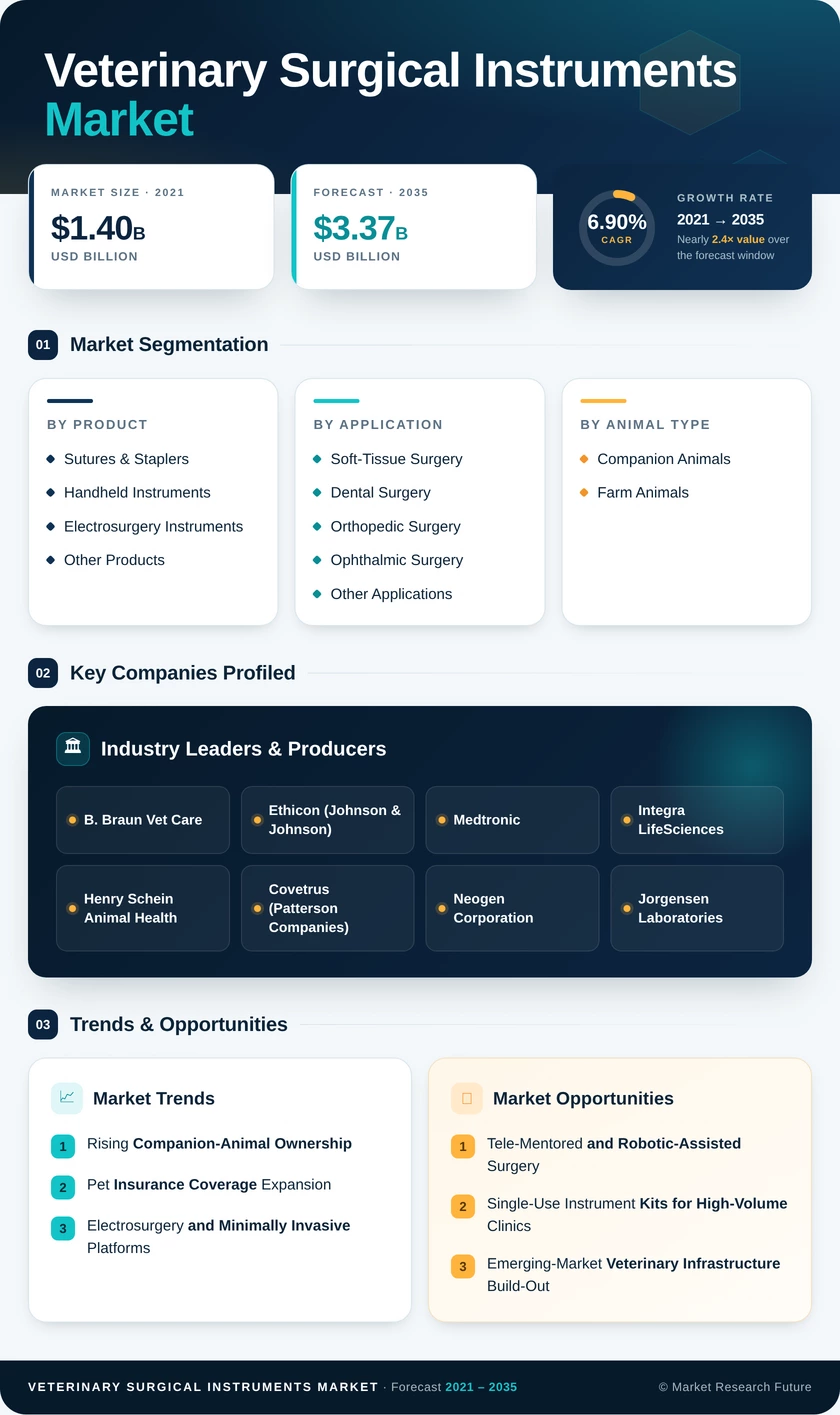
Segmentation Quick Reference
| Dimension | Sub-Segments | Dominant Segment | Fastest Growing Segment |
| By Product | Sutures & Staplers, Handheld Instruments, Electrosurgery Instruments, Other Products | Sutures & Staplers (35.5% share, 2025) | Electrosurgery Instruments (10.30% CAGR) |
| By Application | Soft-Tissue Surgery, Dental Surgery, Orthopedic Surgery, Ophthalmic Surgery, Other Applications | Soft-Tissue Surgery (42.5% share, 2025) | Orthopedic Surgery (8.90% CAGR) |
| By Animal Type | Companion Animals, Farm Animals | Companion Animals (72.8% share, 2025) | Farm Animals (stable demand) |
| By Geography | North America, Europe, Asia-Pacific, South America, Middle East & Africa | North America (40.2% share, 2025) | Asia-Pacific (10.80% CAGR) |
Market Segmentation Overview
By Product
| Sub-Segment | Key Trend |
| Sutures & Staplers | Shift from natural to synthetic absorbable materials; barbed suture adoption reducing closure time |
| Handheld Instruments | Ergonomic redesigns reducing surgeon fatigue; titanium replacing stainless steel in premium lines |
| Electrosurgery Instruments | Compact bipolar platforms entering mid-tier practices; integrated smoke-evacuation systems becoming standard |
| Other Products | Growth in single-use disposable kits; specialty instruments for dental and ophthalmic procedures |
The product landscape is evolving from commodity stainless-steel sets toward integrated, technology-enabled platforms. Electrosurgery instruments are capturing share from traditional handheld tools as veterinary practices seek shorter operative times and improved hemostasis, while sutures and staplers maintain volume leadership through their indispensable role in wound closure.
By Application
| Sub-Segment | Key Trend |
| Soft-Tissue Surgery | Oncological surgery growth driven by improved pet cancer diagnostics |
| Dental Surgery | Rising awareness of companion-animal periodontal disease driving dedicated instrument adoption |
| Orthopedic Surgery | 3D-printed patient-specific guides and custom implants expanding procedural scope |
| Ophthalmic Surgery | Phacoemulsification and microsurgical instruments gaining traction in specialty referral centers |
| Other Applications | Neurosurgery and cardiothoracic surgery emerging as new subspecialties requiring dedicated instrumentation |
Application-based segmentation reflects the broadening scope of veterinary surgical practice. While soft-tissue surgery dominates by volume, orthopedic and dental applications are the primary growth engines, each requiring specialized instrument inventories that drive incremental spending per facility.
By Animal Type
| Sub-Segment | Key Trend |
| Companion Animals | Insurance-backed surgical approvals increasing per-procedure instrument value |
| Farm Animals | Export-compliance veterinary standards driving surgical equipment upgrades in livestock-producing regions |
Companion animals account for the majority of market value due to higher per-procedure spending and owner willingness to finance elective and complex surgeries. Farm-animal demand, while growing more slowly, benefits from regulatory mandates around livestock welfare and food-safety compliance in major exporting nations.
By Geography
| Sub-Segment | Key Trend |
| North America | Corporate chain consolidation centralizing procurement; highest per-capita veterinary surgical spending |
| Europe | EU animal welfare regulation driving precision-instrument adoption; strong equine surgery tradition |
| Asia-Pacific | Government-led infrastructure investment and rapid urban pet-population growth |
| South America | Livestock-industry modernization and emerging companion-animal markets |
| Middle East & Africa | Equine and camel veterinary centers driving premium instrument demand; government hospital upgrades |
Regional dynamics are shaped by the interplay between companion-animal and farm-animal demand. Mature markets in North America and Europe are driven by specialization and technology upgrades, while emerging regions in Asia-Pacific and South America are building foundational veterinary surgical capacity through government investment and rising disposable income.