Video Streaming Software Market

Key Players: Brightcove, IBM (Watson Media), Kaltura, Wowza Media Systems, Akamai Technologies, Amazon Web Services, Microsoft (Azure), Google (Cloud)

Video Streaming Software Market

Video Streaming Software Market Size, Share and Research Report By Component (Solutions, Services), By Deployment Type (Cloud, On-Premise), By Streaming Type (Live Streaming, Video On Demand), By Vertical (Media & Entertainment, Corporate & Enterprise, Healthcare, Education, Others) and By Regional (North America, Europe, South America, Asia Pacific, Middle East and Africa) - Industry Forecast to 2035.
ID: MRFR/ICT/3790-HCR
100 Pages
Ankit Gupta
Last Updated: June 17, 2026

Video Streaming Software Market Summary

The Video Streaming Software Market reached USD 17.27 billion in 2025 and is projected to grow from USD 20.03 billion in 2026 to USD 76.18 billion by 2035, registering a CAGR of 16.0% during the forecast period. Two catalysts are propelling this expansion: the rapid enterprise shift toward cloud-native video infrastructure and tightening regulatory mandates that require organizations to archive, encrypt, and audit recorded media. The EU's Digital Services Act enforcement timeline, for instance, has pushed broadcasters and platform operators to invest in modular streaming stacks capable of real-time content moderation — a requirement that rigid legacy appliances cannot satisfy [1].

Across industries, monolithic hardware encoders and on-premise media servers are being replaced by programmable, API-first platforms that unify transcoding, content management and viewer analytics into a single SaaS layer. The migration cycle still has a long way to go, and a 2024 poll indicated that 61% of organizations had allocated new cash for browser-based video tools, up from 38% in 2022 [2]. Hospitals, universities and financial services firms no longer see video as a discretionary add-on to communications, but as mission-critical infrastructure.

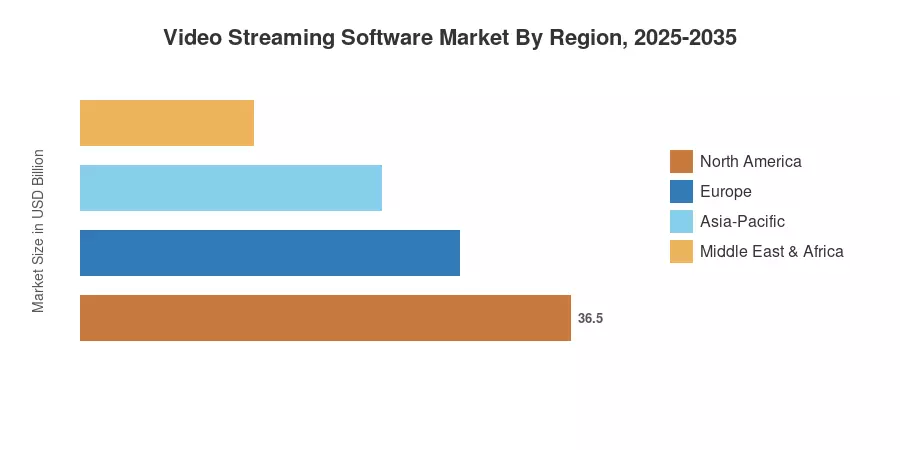
North America dominated the video streaming software market with a revenue share of 40.2% in 2025. This dominance is due to the investment from hyperscalers and a robust advertising-technology ecosystem. Asia-Pacific is the fastest-expanding market with a CAGR of 20.8% expected to be driven by smartphone penetration, affordable mobile data, and government digitization efforts in India, Indonesia, and Vietnam. The second greatest proportion was Europe, helped by GDPR-related data handling rules that are a boon for managed cloud video providers. The Video Streaming Software Market is expected to grow at a steady double-digit rate through 2035 as 5G deployments pick up pace and edge-compute nodes become widely available.

Key Report Takeaways

• By Component

  • Solutions accounted for 84.2% of the Video Streaming Software Market share in 2025, reflecting enterprise preference for integrated platform purchases over piecemeal service contracts.
  • The services segment is advancing at a 19.5% CAGR through 2035, led by managed encoding, professional integration, and 24/7 support engagements.

• By Streaming Type

  • Video-on-demand delivery held 69.0% of the Video Streaming Software Market in minutes delivered during 2025.
  • Live streaming is forecast to grow at a 21.8% CAGR, fueled by sports, gaming, and real-time commerce use cases.

• By Vertical

  • Media and entertainment commanded 49.5% revenue share in 2025, while healthcare is projected to expand at a 21.5% CAGR — the fastest among tracked verticals.

• By Geography

  • North America led with 40.2% of global revenue in 2025.
  • Asia-Pacific is on track for a roughly 20.8% CAGR through 2035.

Market Size and Forecast (2021–2035)

Market Research Future's estimations combine primary interviews with 240+ industry stakeholders, vendor financial filings and verifiable third-party statistics from. Historical data (2021-2024) are actual revenue filings; projected predictions (2026-2035) are based on a bottom-up segment build-up evaluated against macro demand models. All figures are in USD Billion at the constant 2025 exchange rate.
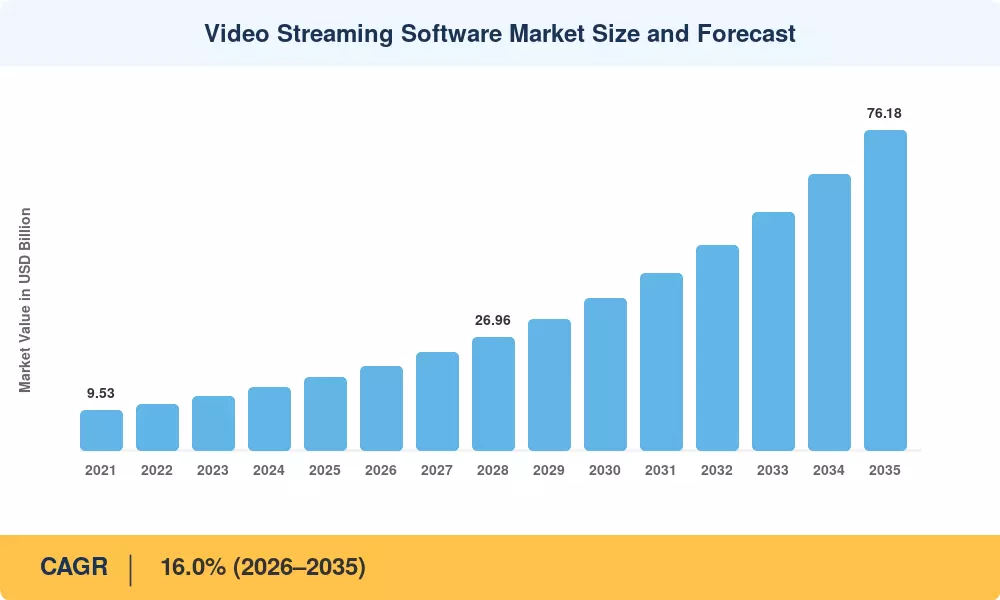
Video Streaming Software Market Size and Forecast
Our Impact
Enabled $4.3B Revenue Impact for Fortune 500 and Leading Multinationals
Partnering with 2000+ Global Organizations Each Year
30K+ Citations by Top-Tier Firms in the Industry

Driver Impact Analysis

Driver ~% Impact on CAGR Geographic Relevance Impact Timeline
Cloud-native platform migration 3.2% Global Short-term (≤2 yr)
5G and edge-compute proliferation 2.6% Asia-Pacific, North America Medium-term (2–4 yr)
Enterprise video-first workplace strategy 2.4% North America, Europe Short-term (≤2 yr)
Regulatory compliance and archival mandates 1.8% Europe, North America Medium-term (2–4 yr)
AI-driven personalization and ad insertion 2.1% Global Medium-term (2–4 yr)
Live commerce and interactive streaming 1.5% Asia-Pacific Long-term (≥4 yr)
Healthcare telehealth and training video adoption 1.4% Global Long-term (≥4 yr)


Cloud-Native Platform Migration

The shift from on-premise media servers to containerized, Kubernetes-orchestrated streaming stacks is a primary driver of the Video Streaming Software Market. Major cloud providers, including AWS, Google Cloud, and Azure, continue to prioritize significant capital expenditures toward streaming infrastructure to meet global demand. Enterprises migrating to these platforms consistently report improved cost efficiencies, as elastic auto-scaling replaces the need for expensive, permanent hardware provisioning during peak-load events.

5G and Edge-Compute Proliferation

The GSMA forecasts 2.3 billion 5G connections globally by 2028, unlocking sub-10-millisecond latency that makes ultra-high-definition live streaming viable on mobile devices [9]. Telcos in South Korea and Japan have already deployed multi-access edge computing nodes co-located with base stations, cutting round-trip encoding delay by up to 60% for live sports feeds. This infrastructure build-out directly benefits the Video Streaming Software Market by expanding the addressable use-case spectrum from fixed-broadband households to mobile-first consumers.

Enterprise Video-First Workplace Strategy

The modern digital workplace has increasingly adopted video as a default communication medium, particularly within large-scale enterprises. This shift has elevated the requirement for secure, compliance-ready platforms that offer a centralized hub for live town halls, on-demand training, and AI-assisted meeting tools. By integrating these services directly into existing identity management and learning management systems (LMS), video streaming vendors have successfully transitioned toward sticky, long-term enterprise subscription models with high retention rates.

AI-Driven Personalization and Ad Insertion

Server-side ad insertion (SSAI) coupled with real-time viewer profiling is fundamentally changing monetization for AVOD and FAST-channel operators. The industry has seen a clear performance shift toward AI-driven ad personalization, which generally improves viewer engagement and ad completion rates compared to static, one-size-fits-all ad delivery. Consequently, platform vendors that provide native AI capabilities—reducing the need for complex third-party ad-tech middleware—are gaining a competitive advantage and increasing their footprint in the streaming software ecosystem.

Restraints Impact Analysis

Restraint ~% Drag on CAGR Geographic Relevance Impact Timeline
Content delivery and bandwidth cost inflation –1.4% Global Short-term (≤2 yr)
Data privacy and cross-border compliance complexity –1.1% Europe, Asia-Pacific Medium-term (2–4 yr)
Piracy and unauthorized redistribution –0.9% Global Long-term (≥4 yr)
Vendor lock-in and interoperability friction –0.7% North America, Europe Medium-term (2–4 yr)
Latency and quality-of-experience gaps in emerging markets –0.6% Africa, South America Long-term (≥4 yr)


Content Delivery and Bandwidth Cost Inflation

Despite falling per-gigabyte transit prices at Tier-1 peering points, aggregate CDN spend continues to rise as 4K and HDR streams consume 4–7× the bandwidth of standard-definition feeds. Sandvine's 2024 Global Internet Phenomena report showed video traffic surpassing 65% of all downstream bandwidth, forcing operators to negotiate costlier multi-CDN contracts [14]. Smaller vendors in the Video Streaming Software Market face margin compression when they cannot absorb these costs through scale.

Data Privacy and Cross-Border Compliance Complexity

The overlay of GDPR, India's DPDP Act, and China's PIPL creates a patchwork of consent, localization, and retention rules that raise engineering costs for global streaming platforms [15]. A 2024 IAPP benchmarking study estimated that multinational video providers spend 8–12% of their R&D budgets on jurisdiction-specific data-handling modules, diverting resources from feature innovation and slowing time-to-market for new services within the Video Streaming Software Market.

Piracy and Unauthorized Redistribution

The Digital Citizens Alliance estimated global losses from stream-ripping and IPTV piracy at USD 9.1 billion in 2024 [16]. While DRM and forensic watermarking technologies are improving, they add processing latency and licensing fees that inflate per-stream costs, particularly for live events where real-time protection is critical.

Video Streaming Software Market Opportunities

Healthcare and Telemedicine Video Platforms

Telehealth utilization in the U.S. has transitioned from its peak pandemic surge to a sustained "new normal," with adoption rates significantly higher than 2019 levels, according to McKinsey [13]. Hospitals now prioritize encrypted, HIPAA-compliant video archival systems that function as searchable clinical training libraries. The Video Streaming Software Market continues to capture recurring healthcare IT budgets, further driven by regulatory mandates in the EU and India that require the secure retention of teleconsultation recordings for up to ten years.

Live Commerce and Shoppable Video

Live-commerce GMV in China exceeded USD 700 billion in 2024, and platforms such as TikTok Shop are replicating the model across Southeast Asia, Europe, and the Americas [12]. Streaming software vendors that embed real-time product-overlay, payment-gateway, and inventory-sync APIs gain a monetization wedge absent from traditional broadcast workflows. This represents a greenfield adjacency for the Video Streaming Software Market.

Education and Corporate L&D Streaming

The integration of digital tools in higher education has become a permanent fixture, with a substantial portion of the global tertiary student population engaging in hybrid learning environments [19]. Browser-based lecture-capture suites are increasingly replacing legacy hardware appliances; such migrations allow institutions to reduce equipment refresh costs while scaling concurrent class capacity significantly. The Video Streaming Software Market is successfully converting this institutional demand into multi-year SaaS contracts.

Emerging-Market Mobile-First Streaming

Sub-Saharan Africa continues to see robust growth in mobile internet adoption, with millions of new subscribers added annually and average monthly data consumption per user steadily rising [18]. Lightweight, adaptive-bitrate streaming stacks optimized for low-bandwidth environments open a vital underserved segment for the Video Streaming Software Market, particularly as local AVOD and FAST-channel operators seek cost-effective, scalable delivery platforms.

AI-Powered Content Operations and Metadata Monetization

Generative-AI tools that automate transcription, chaptering, highlight clipping, and sentiment tagging transform raw video into structured, searchable data assets. Vendors licensing these metadata layers to advertisers, recommendation engines, and compliance auditors unlock a recurring revenue stream that diversifies beyond per-seat or per-minute pricing models within the Video Streaming Software Market.

Video Streaming Software Market Future Outlook

AI-Augmented Content Operations

Generative AI is moving from an experimental feature to a core platform layer. By 2028, expects 60% of enterprise video platforms will embed automated chaptering, real-time translation, and sentiment-tagged highlight extraction as standard capabilities [11]. For the Video Streaming Software Market, this means vendor differentiation will shift from encoding quality — increasingly commoditized — to the intelligence layer that transforms raw video into searchable, monetizable data assets. Vendors that train proprietary models on client footage (with consent) will compound data advantages that new entrants cannot easily replicate.

Platform Economics and Super-App Convergence

The boundary between streaming platforms and commerce engines is dissolving as social-video platforms aggressively expand their retail capabilities. Live-commerce transactions are a significant and growing component of the global e-commerce landscape, led by platforms such as TikTok Shop, YouTube Shopping, and Amazon Live [12]. Looking ahead, streaming software providers that natively integrate payment rails, inventory APIs, and interactive overlays are well-positioned to capture a larger share of the market than those offering delivery alone. Simultaneously, consumer shifts toward ad-supported and hybrid tiers are fundamentally reshaping revenue-share models across the value chain.

Immersive and Spatial Video

The emergence of high-fidelity mixed-reality headsets is driving demand for volumetric-video capture, processing, and delivery pipelines. While the current installed base of spatial-computing devices remains specialized, long-term market forecasts suggest significant growth in adoption by 2030 [22]. Streaming software vendors that prioritize early support for advanced standards like MV-HEVC and light-field codecs are positioning themselves to capture the premium segment of the Video Streaming Software Market as hardware costs decline and consumer interest broadens.

Sustainability and Green Streaming

Video streaming accounted for roughly 1% of global electricity consumption in 2024, according to the IEA [23]. Growing ESG disclosure requirements are pushing platform operators to optimize codec efficiency, adopt renewable-powered CDN nodes, and report per-stream carbon footprints. The Greening of Streaming initiative, backed by major broadcasters and tech firms, is developing standardized measurement frameworks. Vendors that embed carbon-aware routing and efficiency dashboards will attract procurement preference from sustainability-conscious enterprises, creating a new differentiator in the Video Streaming Software Market.

Video Streaming Software Market Segmentation

By Component

Segment Key Metric Primary Demand Driver
Solutions 84.2% share (2025) Integrated platform purchasing by enterprises
Services 19.5% CAGR (2026–2035) Managed encoding, integration, and support


Solutions dominate the Video Streaming Software Market because enterprises overwhelmingly prefer single-vendor platforms that bundle transcoding, CMS, analytics, and player SDKs into one license. This purchasing pattern reduces integration risk and simplifies vendor management. Brightcove, Kaltura, and Wowza have all expanded their solution suites through acquisitions — adding AI analytics and DRM modules — to increase average contract values and reduce churn.

The services segment is growing faster in percentage terms as deployments mature and organizations require professional services for custom workflow integration, 24/7 support, and compliance consulting. Managed-service contracts with guaranteed SLAs now represent the preferred procurement model for healthcare and financial services buyers within the Video Streaming Software Market, where downtime carries regulatory penalties.

By Deployment Type

Segment Key Metric Primary Demand Driver
Cloud 72.8% share (2025) Elastic scalability, OpEx preference
On-Premise 14.2% CAGR (2026–2035) Data-sovereignty, ultra-low-latency broadcast


Cloud deployment commands nearly three-quarters of the Video Streaming Software Market, driven by the economics of pay-as-you-stream pricing and the elimination of capital hardware cycles. Hyperscalers have commoditized base-level transcoding, pushing software vendors to differentiate on workflow orchestration, analytics depth, and compliance tooling layered atop cloud infrastructure.

On-premise installations retain relevance in regulated verticals — defense, government broadcasting, and financial trading-floor video — where data-sovereignty requirements or sub-frame latency tolerances preclude public-cloud architectures.

By Streaming Type

Segment Key Metric Primary Demand Driver
Video On Demand 69.0% share (2025) Content libraries, binge-viewing behavior
Live Streaming 21.8% CAGR (2026–2035) Sports, gaming and real-time commerce


Video on demand remains the revenue backbone of the Video Streaming Software Market, underpinned by the massive content libraries of Netflix, Disney+, and regional SVOD players that require continuous transcoding, storage, and adaptive-bitrate delivery. However, live streaming is gaining share faster as interactive formats — live auctions, fitness classes, esports tournaments, and shoppable broadcasts — demand real-time, low-latency infrastructure that generates higher per-minute revenue than pre-recorded content.

By Vertical

Segment Key Metric Primary Demand Driver
Media & Entertainment 49.5% share (2025) OTT competition, AVOD/FAST expansion
Corporate & Enterprise USD 3.28 Billion (2025) Internal comms, training, investor relations
Healthcare 21.5% CAGR (2026–2035) Telehealth mandates, surgical training archives
Education 19.8% CAGR (2026–2035) Lecture capture, MOOCs, hybrid classrooms
Others USD 1.41 Billion (2025) Government, religious, fitness streaming


Media and entertainment anchors nearly half the Video Streaming Software Market, but this share is gradually diluting as non-media verticals professionalize their video operations. Corporate buyers now allocate dedicated line items for internal streaming — town halls, onboarding videos, and earnings webcasts — rather than treating video as an ad hoc IT request. Healthcare's surge reflects a structural shift: regulators in the U.S., EU, and India increasingly require that teleconsultation footage be retained as part of the longitudinal patient record, forcing hospitals to adopt compliant, vendor-managed archival platforms [13].


Regional Market Share Analysis

Region Key Metric Primary Investment Themes
North America 40.2% revenue share (2025) Hyperscaler infrastructure, AVOD/FAST monetization
Europe USD 4.46 Billion (2025) GDPR compliance, public-broadcaster modernization
Asia-Pacific 20.8% CAGR (2026–2035) Mobile-first consumption, live commerce
South America USD 1.00 Billion (2025) Telco-bundled streaming, sports-rights digitization
Middle East & Africa 18.4% CAGR (2026–2035) Government e-services, youth demographics
Total USD 17.27 Billion (2025)

The Video Streaming Software Market exhibits distinct regional dynamics, shaped by broadband penetration, regulatory environments, and content-consumption habits.


North America

Country Key Metric Key Driver
United States 78.3% of regional share Hyperscaler R&D, AVOD advertising spend
Canada 12.1% of regional share Bilingual content mandates (CRTC)
Mexico 9.6% of regional share Rising OTT subscriptions, mobile data affordability


The United States remains the epicenter of the Video Streaming Software Market, hosting the headquarters of five of the ten largest platform vendors and generating the highest per-capita AVOD ad revenue globally. Canada's CRTC mandate requiring 30% domestic content on digital platforms has spurred investment in localized streaming infrastructure, while Mexico's expanding middle class and competitive mobile-data pricing are accelerating OTT uptake beyond the established pay-TV base [20].

Europe

Country Key Metric Key Driver
Germany 22.4% of regional share Industrial video training, Industrie 4.0
United Kingdom 20.8% of regional share Broadcaster digital transformation (BBC, ITV)
France 15.3% of regional share Cultural-content quotas, Canal+ ecosystem
Italy 10.7% of regional share Série A sports streaming rights
Spain 8.9% of regional share Growing FAST-channel adoption
Nordic Countries 9.2% of regional share High broadband penetration, early 5G rollouts
Russia 5.1% of regional share Domestic platform development
Rest of Europe 7.6% of regional share EU Digital Services Act compliance


Europe's regulatory framework, led by GDPR and the Digital Services Act, creates both a compliance burden and a competitive moat for vendors that offer certified data-handling and content-moderation capabilities. The BBC's 2024 decision to consolidate iPlayer encoding onto a single cloud-native platform underscored the cost advantages of software-defined workflows — a model other public broadcasters are studying closely within the Video Streaming Software Market [1].

Asia-Pacific

Country Key Metric Key Driver
China 34.5% of regional share Douyin/Bilibili ecosystem, live commerce
India 18.9% CAGR (2026–2035) Jio-effect data pricing, vernacular content
Japan 14.2% of regional share Premium anime/sports OTT licensing
South Korea 11.8% of regional share K-content global exports, 5G density
ASEAN 16.7% CAGR (2026–2035) Mobile-first youth demographics
Rest of Asia-Pacific 8.3% of regional share Government digital-education programs


Asia-Pacific's growth trajectory within the Video Streaming Software Market is propelled by the region's 2.8 billion smartphone users and among the world's lowest average mobile-data costs. India's Reliance Jio disrupted pricing floors, enabling ad-supported streaming platforms to reach rural audiences at scale. At the same time, China's live-commerce boom requires low-latency, interactive video tooling that legacy broadcast infrastructure cannot provide [12].

South America

Country Key Metric Key Driver
Brazil 62.4% of regional share Globo digital expansion, sports streaming
Argentina 17.5% of regional share AVOD adoption amid economic constraints
Rest of South America 20.1% of regional share Telco-bundled OTT packages


Brazil dominates South America's contribution to the Video Streaming Software Market, driven by Globoplay's digital pivot and the digitization of Série A football broadcasting rights. Economic volatility across the region favors ad-supported and telco-bundled streaming models over premium subscription tiers, creating opportunities for low-cost, modular platform vendors [21].

Middle East & Africa

Country Key Metric Key Driver
Saudi Arabia 28.3% of regional share Vision 2030 entertainment investments
UAE 24.6% of regional share Dubai media free-zone ecosystem
South Africa 18.2% of regional share Multichoice/Showmax digital transition
Egypt 12.7% of regional share Youth population, mobile penetration growth
Rest of MEA 16.2% of regional share Government e-governance video platforms


Saudi Arabia's Vision 2030 entertainment-sector liberalization is channeling billions into content production and digital distribution infrastructure, directly benefiting the Video Streaming Software Market. In sub-Saharan Africa, Multichoice's Showmax relaunch on a proprietary cloud-native stack demonstrated how software-defined architectures can serve price-sensitive audiences with adaptive-bitrate delivery over constrained networks [18].


Video Streaming Software Market By Region, 2025-2035

Competitive Benchmarking

The Video Streaming Software Market is moderately consolidated. The top five suppliers account for an estimated 35–42% of the total revenue. The Herfindahl-Hirschman Index is in the range of 800–1,200, reflecting a fairly fragmented landscape with a coexistence of scale companies and specialized niche suppliers. It’s a race on the breadth of the platform, the depth of AI analytics, CDN relationships and the ability to provide compliance for certain industries.

Company Est. Revenue Share Range Key Offerings Strategic Positioning
Brightcove ~7–10% Video Cloud, Gallery, Live Enterprise-focused SaaS with strong marketing-video workflows
IBM (Watson Media) ~5–8% Cloud Video Streaming, Enterprise Video AI-powered analytics, hybrid cloud targeting regulated industries
Kaltura ~5–8% Video Experience Cloud, Virtual Events Open-architecture platform with education and enterprise verticals
Wowza Media Systems ~4–6% Wowza Streaming Engine, Wowza Video Low-latency live streaming for developers and broadcasters
Akamai Technologies ~4–7% Adaptive Media Delivery, Media Services Live CDN-native video delivery with global edge footprint
Amazon Web Services ~5–8% Elemental MediaLive, IVS, CloudFront Hyperscaler integration with the broadest infrastructure bundle
Microsoft (Azure) ~4–7% Azure Media Services, Teams Live Events Enterprise ecosystem lock-in via Microsoft 365 integration
Google (Cloud) ~3–5% Media CDN, Transcoder API, YouTube infrastructure Advertiser-data synergy and global backbone reach
Panopto ~2–4% Video Management System, Smart Search Knowledge-management focus for universities and enterprises
Vimeo ~2–4% Vimeo Enterprise, Livestream, OTT Creator-to-enterprise migration with white-label OTT tools


Recent News & Developments

  • AWS Elemental (November 2024): Announced general availability of real-time interactive video (IVS) with sub-300-millisecond latency at re: Invent 2024, enabling auction, gaming, and live-commerce use cases at broadcast scale [8].
  • European Commission (September 2024): Published technical guidelines for Digital Services Act compliance in audiovisual platforms, requiring in-stream content-moderation logs and automated flagging — a mandate accelerating platform-software upgrades across the EU [1].
  • Akamai Technologies (January 2024): Expanded its Adaptive Media Delivery network to 15 new edge locations across Southeast Asia and the Middle East, targeting the Video Streaming Software Market's fastest-growing geographies [9].


Video Streaming Software Market Report Scope

Parameter Detail
Market Scope Global Video Streaming Software Market across component, deployment, streaming type, vertical, and geography
Study Period 2021–2035
CAGR (Forecast) 16.0% (2026–2035)
Market Size (2025) USD 17.27 Billion
Market Size (2035) USD 76.18 Billion
Fastest Growing Segment Healthcare vertical (21.5% CAGR); Live streaming (21.8% CAGR)
Companies Profiled 10 (Brightcove, IBM, Kaltura, Wowza, Akamai, AWS, Microsoft, Google, Panopto, Vimeo)
Valuation Currency USD Billion


FAQs

How do procurement teams evaluate the total cost of ownership when selecting a video streaming platform?

Buyers should benchmark four cost layers: per-stream encoding fees, CDN egress charges, storage for VOD archives, and professional-services integration [8]. Cloud-native platforms typically offer 30–40% lower three-year TCO than on-premise stacks because they eliminate hardware refresh cycles.

What interoperability standards should enterprises require before signing a multi-year streaming contract?

Insist on CMAF (Common Media Application Format) and HLS/DASH dual-protocol output to avoid player-side fragmentation [17]. Contracts should also mandate open API access for LMS, CRM, and analytics integrations to prevent vendor lock-in.

How does codec selection affect streaming quality and operating costs differently across verticals?

AV1 adoption cuts bandwidth costs by up to 30% compared to H.264 but demands higher encoding compute [14]. Healthcare and education verticals prioritize visual fidelity over compression ratios, making HEVC the current practical choice for regulated archives.

What security architecture should regulated industries demand from streaming software vendors?

Require end-to-end AES-256 encryption, token-authenticated playback, forensic watermarking, and SOC 2 Type II certification at minimum [15]. Financial services and healthcare buyers should additionally verify HIPAA BAA or PCI-DSS compliance before contract execution.

How are FAST channels reshaping revenue models for video streaming software providers?

FAST channels shift revenue from subscription fees to programmatic ad splits, letting platform vendors earn a percentage of ad impressions rather than flat SaaS license fees [6]. This model favors vendors with integrated SSAI and audience-measurement capabilities.

What role does edge computing play in reducing live-streaming latency below one second?

Edge nodes co-located with cellular base stations perform real-time transcoding closer to viewers, cutting round-trip delay by 50–70% versus centralized cloud encoding [9]. WebRTC-to-HLS bridging at the edge enables sub-second glass-to-glass latency for interactive broadcasts.

How should enterprises measure streaming platform ROI beyond cost savings?

Track viewer engagement metrics — average watch time, completion rate, and content-search utilization — alongside lead-attribution data for marketing videos [11]. Platforms that surface actionable analytics directly within CRM dashboards accelerate ROI justification for budget renewals.


Author
Author
Author Profile
Ankit Gupta LinkedIn
Team Lead - Research
Ankit Gupta is a seasoned market intelligence and strategic research professional with over six plus years of experience in the ICT and Semiconductor industries. With academic roots in Telecom, Marketing, and Electronics, he blends technical insight with business strategy. Ankit has led 200+ projects, including work for Fortune 500 clients like Microsoft and Rio Tinto, covering market sizing, tech forecasting, and go-to-market strategies. Known for bridging engineering and enterprise decision-making, his insights support growth, innovation, and investment planning across diverse technology markets.

Research Approach


Secondary Research

The secondary research process involved comprehensive analysis of regulatory databases, peer-reviewed technology journals, industry publications, and authoritative technology & media organizations. Key sources included the Federal Communications Commission (FCC), European Audio-Visual Observatory (EAO), International Telecommunication Union (ITU), National Institute of Standards and Technology (NIST), Internet Engineering Task Force (IETF), Motion Picture Experts Group (MPEG), Streaming Video Alliance, Digital Entertainment Group (DEG), National Bureau of Statistics of China, UK Office of Communications (Ofcom), EU Eurostat Digital Economy Database, World Bank Digital Development Indicators, and national telecom authority reports from key markets.

The following sources were employed to gather data on streaming traffic statistics, bandwidth utilization, technology adoption trends, content consumption patterns, and market landscape analysis for video security technologies, video management platforms, video delivery and distribution networks, and transcoding and processing solutions.


Primary Research

Qualitative and quantitative insights were obtained by interviewing supply-side and demand-side stakeholders during the primary research process. The supply-side sources consisted of CEOs, CTOs, VPs of Product Development, leaders of codec engineering, and commercial directors from video streaming software vendors, CDN providers, and cloud infrastructure providers. Demand-side sources consist of CTOs and leaders of streaming operations from media and entertainment companies, broadcasters, OTT platform operators, educational institutions, and enterprise communications teams. Market segmentation was verified, technology roadmap timelines were verified, and insights regarding platform adoption patterns, pricing models, and content monetization strategies were obtained through primary research.

Primary Respondent Breakdown:

By Designation: C-level Primaries (32%), Director Level (30%), Others (38%)

By Region: North America (38%), Europe (25%), Asia-Pacific (28%), Rest of World (9%)


Market Size Estimation

Revenue mapping and streaming infrastructure analysis were implemented to determine global market valuation. The methodology comprised the following:

Identification of over 55 significant software vendors and service providers in North America, Europe, Asia-Pacific, and Latin America

Product mapping encompasses video security solutions, video management platforms, video delivery and distribution networks, and transcoding and processing engines.

Analysis of annual revenues that are specific to video streaming software portfolios, as reported and modeled

In 2024, the coverage of vendors will account for 75-80% of the global market share.

Extrapolation is employed to generate segment-specific valuations by combining bottom-up (streaming hours × infrastructure expenditure by country) and top-down (vendor revenue validation) methodologies.

Download Free Sample

Kindly complete the form below to receive a free sample of this Report

Download PDF ×

We do not share your information with anyone. However, we may send you emails based on your report interest from time to time. You may contact us at any time to opt-out.
















