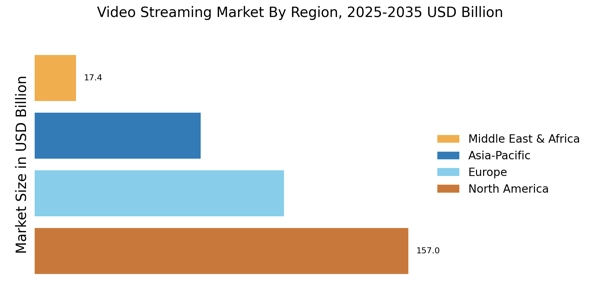
The Video Streaming Market is currently characterized by intense competition and rapid evolution, driven by technological advancements and shifting consumer preferences.Major video streaming companies are investing heavily in original content and international expansion to strengthen their market position. Strong video streaming brands benefit from high customer loyalty and lower churn rates in competitive markets. Major players such as Netflix (US), Amazon Prime Video (US), and Disney+ (US) are at the forefront, each adopting distinct strategies to enhance their market positioning. Netflix (US) continues to focus on original content production, aiming to differentiate itself through exclusive offerings. Meanwhile, Amazon Prime Video (US) leverages its extensive ecosystem, integrating streaming services with its e-commerce platform to enhance user engagement.
Disney+ (US) capitalizes on its vast library of beloved franchises, appealing to family-oriented audiences while expanding its international reach. Collectively, these strategies contribute to a competitive landscape that is both dynamic and multifaceted, with each player striving to capture a larger share of the growing market. In terms of business tactics, companies are increasingly localizing content to cater to diverse regional audiences, which appears to be a critical factor in enhancing viewer retention. The market structure is moderately fragmented, with a mix of established giants and emerging players vying for consumer attention. This fragmentation allows for varied content offerings, yet the influence of key players remains substantial, as they set trends that smaller entities often follow.
In September 2025, Netflix (US) announced a partnership with a leading
gaming company to develop interactive content that merges streaming with gaming experiences. This strategic move not only diversifies Netflix's content portfolio but also positions it to tap into the lucrative gaming market, potentially attracting a younger demographic that seeks immersive entertainment options. The integration of gaming elements into streaming services may redefine viewer engagement and retention strategies across the industry.
In August 2025, Amazon Prime Video (US) launched a new initiative aimed at enhancing its user interface through AI-driven recommendations. This development underscores Amazon's commitment to leveraging technology to personalize viewer experiences, thereby increasing user satisfaction and loyalty. By utilizing advanced algorithms, Amazon Prime Video seeks to create a more intuitive platform that anticipates viewer preferences, which could lead to higher subscription rates and reduced churn.
In July 2025, Disney+ (US) expanded its content library by acquiring rights to several international films and series, reflecting its strategy to localize content further. This acquisition not only enriches Disney+'s offerings but also aligns with its goal of appealing to global audiences. By investing in diverse content, Disney+ aims to enhance its competitive edge in international markets, where localized content is increasingly vital for attracting subscribers.
As of October 2025, the Video Streaming Market is witnessing trends that emphasize digitalization, sustainability, and the integration of artificial intelligence. Strategic alliances are becoming more prevalent, as companies recognize the value of collaboration in enhancing content offerings and technological capabilities. Looking ahead, competitive differentiation is likely to evolve from traditional price-based competition to a focus on innovation, technological advancements, and supply chain reliability. This shift suggests that companies will need to invest in unique content and user experiences to maintain their competitive edge in an increasingly crowded marketplace.