×
Request Free Sample ×

Kindly complete the form below to receive a free sample of this Report

Leading companies partner with us for data-driven Insights

clients tt-cursor
Hero Background

Virtual Dispersive Networking Market

ID: MRFR/ICT/35633-HCR
128 Pages
Aarti Dhapte
October 2025

Virtual Dispersive Networking Market Research Report: By Application (Secure Communication, Data Transmission, Network Security, Traffic Management), By Deployment Mode (On-Premises, Cloud-Based), By Service Type (Managed Services, Professional Services, Consulting Services), By End User (Government, BFSI, Healthcare, Telecommunications, IT and Software) and By Regional (North America, Europe, South America, Asia Pacific, Middle East and Africa) - Forecast to 2035.

Share:
Download PDF ×

We do not share your information with anyone. However, we may send you emails based on your report interest from time to time. You may contact us at any time to opt-out.

Virtual Dispersive Networking Market Infographic
Purchase Options

Virtual Dispersive Networking Market Summary

As per MRFR analysis, the Virtual Dispersive Networking Market Size was estimated at 3.019 USD Billion in 2024. The Virtual Dispersive Networking industry is projected to grow from 3.392 USD Billion in 2025 to 10.85 USD Billion by 2035, exhibiting a compound annual growth rate (CAGR) of 12.33 during the forecast period 2025 - 2035.

Key Market Trends & Highlights

The Virtual Dispersive Networking Market is poised for substantial growth driven by technological advancements and increasing security demands.

  • The market is witnessing an increased focus on cybersecurity as organizations prioritize data protection.
  • Adoption of cloud-based solutions is accelerating, particularly in the Asia-Pacific region, which is the fastest-growing market.
  • Integration with IoT technologies is becoming essential, enhancing connectivity and operational efficiency.
  • Rising demand for secure communication and the growth of remote work and collaboration tools are key drivers propelling market expansion.

Market Size & Forecast

2024 Market Size 3.019 (USD Billion)
2035 Market Size 10.85 (USD Billion)
CAGR (2025 - 2035) 12.33%

Major Players

Cisco Systems (US), Juniper Networks (US), Arista Networks (US), Hewlett Packard Enterprise (US), Nokia (FI), VMware (US), Palo Alto Networks (US), Fortinet (US), Extreme Networks (US)

Virtual Dispersive Networking Market Trends

The Virtual Dispersive Networking Market is currently experiencing a notable evolution, driven by the increasing demand for secure and efficient data transmission solutions. Organizations across various sectors are recognizing the potential of virtual dispersive networking to enhance their operational capabilities. This technology appears to offer a unique approach to data routing, which may lead to improved network performance and reduced latency. As businesses continue to prioritize digital transformation, the adoption of such innovative networking solutions is likely to gain momentum. Furthermore, the growing emphasis on cybersecurity is pushing enterprises to explore advanced networking options that can provide enhanced protection against potential threats. In addition, the Virtual Dispersive Networking Market seems to be influenced by the rise of remote work and the need for reliable connectivity. As more organizations embrace flexible work arrangements, the demand for robust networking solutions that can support distributed teams is increasing. This trend suggests that virtual dispersive networking could play a crucial role in facilitating seamless communication and collaboration among remote employees. Overall, the market appears poised for growth as technological advancements continue to shape the landscape of networking solutions.

Increased Focus on Cybersecurity

The Virtual Dispersive Networking Market is witnessing a heightened emphasis on cybersecurity measures. Organizations are increasingly aware of the vulnerabilities associated with traditional networking methods. As a result, there is a growing interest in solutions that offer enhanced security features, which virtual dispersive networking can potentially provide. This trend indicates a shift towards more secure data transmission practices.

Adoption of Cloud-Based Solutions

The trend towards cloud-based networking solutions is becoming more pronounced within the Virtual Dispersive Networking Market. As businesses migrate to cloud environments, the need for adaptable and scalable networking solutions is rising. Virtual dispersive networking appears to align well with these requirements, offering flexibility and efficiency in data management.

Integration with IoT Technologies

The integration of Internet of Things (IoT) technologies is emerging as a significant trend in the Virtual Dispersive Networking Market. As IoT devices proliferate, the demand for networking solutions that can effectively manage and secure these devices is increasing. Virtual dispersive networking may provide the necessary infrastructure to support the growing number of connected devices, enhancing overall network performance.

Virtual Dispersive Networking Market Drivers

Emergence of 5G Technology

The rollout of 5G technology is poised to transform the Virtual Dispersive Networking Market. With its promise of faster data transmission and lower latency, 5G enables more efficient and secure networking solutions. Virtual Dispersive Networking Market can leverage the capabilities of 5G to enhance data dispersal techniques, thereby improving overall network performance. As industries increasingly adopt 5G for various applications, the demand for advanced networking solutions that can operate effectively within this new framework is likely to surge. This development suggests a bright future for the market, as businesses seek to capitalize on the advantages offered by 5G technology.

Integration with Advanced Technologies

The integration of Virtual Dispersive Networking Market with advanced technologies such as artificial intelligence and machine learning is driving innovation within the Virtual Dispersive Networking Market. These technologies enhance the capabilities of dispersive networking by enabling real-time data analysis and adaptive security measures. As organizations seek to leverage AI and machine learning for improved operational efficiency, the demand for networking solutions that can seamlessly integrate with these technologies is likely to rise. This trend suggests a promising future for the market, as businesses increasingly recognize the value of combining advanced analytics with secure networking solutions.

Rising Demand for Secure Communication

The increasing need for secure communication channels is a primary driver for the Virtual Dispersive Networking Market. Organizations are increasingly concerned about data breaches and cyber threats, leading to a heightened demand for solutions that ensure secure data transmission. The Virtual Dispersive Networking Market technology offers a unique approach to data security by dispersing information across multiple channels, making it difficult for unauthorized entities to intercept. As businesses continue to prioritize cybersecurity, the market for these innovative networking solutions is expected to expand significantly. Recent estimates suggest that the market could grow at a compound annual growth rate of over 20% in the coming years, reflecting the urgency for enhanced security measures in communication.

Increased Regulatory Compliance Requirements

The evolving landscape of regulatory compliance is a significant driver for the Virtual Dispersive Networking Market. Organizations are facing stringent regulations regarding data protection and privacy, necessitating the adoption of secure networking solutions. Virtual Dispersive Networking Market offers a viable option for companies striving to meet compliance standards while safeguarding sensitive information. As regulatory bodies impose stricter guidelines, the demand for networking solutions that can ensure compliance is expected to grow. This trend indicates a potential expansion of the market, as businesses prioritize investments in technologies that align with regulatory requirements.

Growth of Remote Work and Collaboration Tools

The shift towards remote work has catalyzed the growth of the Virtual Dispersive Networking Market. As organizations adapt to flexible work environments, the need for reliable and secure networking solutions has become paramount. Virtual Dispersive Networking Market provides a robust framework that supports remote collaboration while ensuring data integrity and confidentiality. This technology allows employees to access sensitive information securely from various locations, thereby facilitating seamless communication and collaboration. The market is projected to witness substantial growth, with estimates indicating a potential increase in demand for such solutions as more companies embrace hybrid work models.

Market Segment Insights

By Application: Secure Communication (Largest) vs. Network Security (Fastest-Growing)

In the Virtual Dispersive Networking Market, the 'Application' segment is diversified across various critical functionalities. Secure Communication holds the largest market share due to its essential role in ensuring data confidentiality and integrity in an increasingly digital world. This area has seen significant uptake in various sectors, notably healthcare and finance, where data sensitivity is paramount. Conversely, Network Security is gaining traction as the fastest-growing segment, driven by heightened awareness of cyber threats and the need for robust security measures in network infrastructures.

Secure Communication (Dominant) vs. Data Transmission (Emerging)

Secure Communication stands as the dominant force in the Application segment of the Virtual Dispersive Networking Market. Its primary function hinges on establishing safe and encrypted data exchanges, crucial for businesses that prioritize confidentiality. On the other hand, Data Transmission, while traditionally viewed as a foundational element, is emerging rapidly as organizations require more efficient and reliable methods of transferring large data packets over networks. The rise of cloud services and IoT devices has fueled this growth, emphasizing the need for seamless data integration and communication processes. These segments reflect a broader trend towards enhanced security and efficiency in networking solutions.

By Deployment Mode: On-Premises (Largest) vs. Cloud-Based (Fastest-Growing)

The Virtual Dispersive Networking Market is currently dominated by the On-Premises deployment mode, which holds the largest market share. This model is favored by organizations that prioritize data control and security, particularly in sensitive industries like finance and healthcare. On-Premises solutions allow for enhanced customization and integration with existing IT infrastructure, making it a preferred choice for enterprises looking to maintain their operational integrity and compliance with regulations. In contrast, Cloud-Based deployment is emerging rapidly as the fastest-growing segment within this market. Businesses are increasingly adopting cloud solutions due to their flexibility, scalability, and reduced upfront costs. The surge in remote work and the need for seamless collaboration tools have further driven the demand for cloud-based Virtual Dispersive Networking Market solutions, allowing organizations to adapt quickly to changing market dynamics.

On-Premises (Dominant) vs. Cloud-Based (Emerging)

On-Premises deployment in the Virtual Dispersive Networking Market is characterized by its strong retention in enterprises that demand strict control over their data and networking environments. This mode offers significant advantages, such as reduced latency and direct oversight of hardware and network assets. It is particularly dominant in industries that handle sensitive information, where regulatory compliance is essential. On the other hand, Cloud-Based deployment is gaining traction due to its ability to provide organizations with flexibility and rapid deployment capabilities. As more businesses transition to hybrid work models, the demand for Cloud-Based solutions is expected to rise, offering cost-effective options that promote agility and seamless access to resources. Both deployment modes cater to distinct needs, ensuring a diversified growth trajectory in this competitive market.

By Service Type: Managed Services (Largest) vs. Professional Services (Fastest-Growing)

In the Virtual Dispersive Networking Market, the Managed Services segment holds the largest share, significantly influencing overall revenue. This segment benefits from the increasing demand for seamless network management solutions that enhance operational efficiency. In contrast, Professional Services, including consulting and advisory services, are rapidly gaining traction as businesses seek expert support to navigate complex networking environments.

Managed Services (Dominant) vs. Consulting Services (Emerging)

Managed Services are characterized by their comprehensive offerings, including network monitoring, maintenance, and security management, which are crucial for organizations looking to optimize their networking capabilities. This segment dominates the market due to its ability to provide end-to-end solutions and support. On the other hand, Consulting Services are emerging as businesses increasingly rely on specialized knowledge to implement and leverage innovative networking technologies. This trend reflects a growing recognition of the value that expert guidance brings to optimizing network performance and addressing unique business challenges.

By End User: Government (Largest) vs. Healthcare (Fastest-Growing)

In the Virtual Dispersive Networking Market, the end-user distribution is characterized by significant contributions from government agencies, BFSI, telecommunications, IT and software, and the healthcare sector. Currently, the government sector holds the largest market share, reflecting the critical need for secure communication and data transfer in sensitive operations. Meanwhile, healthcare is rapidly emerging as a vital segment, with increasing investments in digital health initiatives driving its growth.

Government (Dominant) vs. Healthcare (Emerging)

The government sector in the Virtual Dispersive Networking Market is dominant due to its extensive requirements for secure and efficient networking solutions aimed at protecting sensitive information and facilitating communication among various departments. As governments globally push towards digitization, demand for robust virtual networking solutions remains high. On the other hand, the healthcare sector is on the rise, driven by the need for advanced networking technologies to support telemedicine and secure patient information. As more healthcare organizations adopt virtual networking to enhance operational efficiency and patient care, this segment is recognized as the fastest-growing, highlighting a transition towards more digitally integrative health systems.

Get more detailed insights about Virtual Dispersive Networking Market

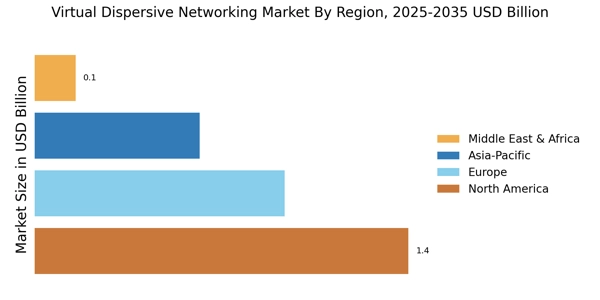
Regional Insights

North America : Innovation and Leadership Hub

North America is the largest market for Virtual Dispersive Networking Market, holding approximately 45% of the global market share. The region's growth is driven by increasing demand for advanced networking solutions, regulatory support for digital transformation, and a robust technological infrastructure. The presence of major players like Cisco and VMware further fuels market expansion, alongside rising cybersecurity concerns that necessitate innovative networking solutions. The United States leads the North American market, followed by Canada, which is also witnessing significant growth. The competitive landscape is characterized by the dominance of key players such as Juniper Networks and Palo Alto Networks, who are continuously innovating to meet the evolving needs of enterprises. The region's focus on cloud computing and IoT integration is expected to further enhance the demand for virtual networking solutions, solidifying its leadership position.

Europe : Emerging Market with Regulations

Europe is witnessing a significant rise in the Virtual Dispersive Networking Market, holding around 30% of the global share. The growth is propelled by stringent data protection regulations like GDPR, which drive organizations to adopt advanced networking solutions for compliance. Additionally, the European Union's focus on digital transformation initiatives is fostering a conducive environment for market expansion, with increasing investments in technology infrastructure. Leading countries in this region include Germany, the UK, and France, which are at the forefront of adopting innovative networking technologies. The competitive landscape features key players such as Nokia and Fortinet, who are actively enhancing their offerings to cater to the growing demand. The presence of a strong regulatory framework ensures that companies prioritize security and compliance, further driving the adoption of virtual networking solutions.

Asia-Pacific : Rapid Growth and Adoption

Asia-Pacific is rapidly emerging as a significant player in the Virtual Dispersive Networking Market, accounting for approximately 20% of the global market share. The region's growth is driven by increasing internet penetration, a surge in mobile device usage, and the rising demand for cloud-based solutions. Governments are also promoting digital initiatives, which act as catalysts for market expansion, particularly in countries like India and China. China and India are the leading countries in this region, with a growing number of startups and established companies investing in advanced networking technologies. The competitive landscape is becoming increasingly dynamic, with local players and The Virtual Dispersive Networking Market share. The focus on enhancing connectivity and network security is expected to drive further growth in the coming years, making Asia-Pacific a key region for virtual networking solutions.

Middle East and Africa : Emerging Market with Potential

The Middle East and Africa region is gradually emerging in the Virtual Dispersive Networking Market, holding about 5% of the global share. The growth is primarily driven by increasing investments in digital infrastructure and government initiatives aimed at enhancing connectivity. Countries in this region are focusing on smart city projects and digital transformation, which are expected to boost the demand for advanced networking solutions in the coming years. Leading countries such as the UAE and South Africa are at the forefront of adopting virtual networking technologies. The competitive landscape is characterized by a mix of local and international players, including Fortinet and Cisco, who are expanding their presence to tap into the growing market. The region's unique challenges, such as varying levels of technological adoption, present both opportunities and hurdles for market players.

Virtual Dispersive Networking Market Regional Image

Key Players and Competitive Insights

The Virtual Dispersive Networking Market is characterized by rapidly evolving technologies and increasing demand for secure communication solutions. As organizations shift towards digital transformation and embrace cloud-based infrastructures, the significance of virtual networking has escalated. Competitors in this sector are focused on innovating and developing robust solutions that enhance data flow and security while optimizing bandwidth. Key players are investing in research and development to improve their product offerings and meet the unique needs of various industries, including finance, healthcare and telecommunications.

The competitive landscape also sees partnerships and collaborations aimed at expanding market reach and improving technological capabilities, leading to a dynamic and diverse market environment.

Arista Networks stands out in the Virtual Dispersive Networking Market by leveraging its strengths in cloud networking solutions and high-performance, programmable switches. The company has developed a reputation for providing scalable and reliable networking architecture essential for modern data centers. Arista's commitment to delivering low latency and efficient performance has made it a preferred choice among organizations looking to optimize their network infrastructure. With a focus on automation and integration, Arista Networks empowers customers to streamline operations and enhance their network management capabilities, effectively positioning itself as a leader in virtual dispersive networking solutions.

Its strong customer base and continuous push for innovation contribute to a competitive edge that resonates well within the market.

IBM also plays a pivotal role in the Virtual Dispersive Networking Market, leveraging its expertise in artificial intelligence and cloud computing. With a strong emphasis on security and data analytics, IBM offers solutions that not only provide virtual networking capabilities but also enhance overall cybersecurity posture for enterprises. The company's advancements in hybrid cloud technologies allow for seamless integration of virtual networks, which is critical in today's interconnected landscape. A significant strength of IBM is its ability to provide comprehensive networking solutions that maximize efficiency and minimize risk, catering to the needs of large enterprises and government entities alike.

IBM's commitment to continuous innovation and its strategic initiatives solidify its position as a formidable competitor within the virtual dispersive networking market.

Key Companies in the Virtual Dispersive Networking Market market include

Industry Developments

Recent developments in the Virtual Dispersive Networking Market have focused on advancements in digital networking solutions as demand for enhanced security and flexibility has surged. Notably, Arista Networks has recently expanded its cloud networking portfolio, addressing the growing needs of enterprises in hybrid cloud environments.

Additionally, IBM made headlines with new partnerships aimed at integrating AI capabilities into their networking products, further solidifying their market position. Companies like Radware and Citrix Systems are also making strides with innovative security features to protect against emerging cyber threats. In terms of mergers and acquisitions, Cisco Systems has announced its acquisition of a cybersecurity startup, enhancing its offerings in secure networking solutions. A10 Networks has also gained traction through strategic partnerships that improve its service delivery capabilities. The growth of companies such as Zscaler and Cloudflare indicates increasing market valuation and a shift towards cloud-native networking solutions.

This surge is largely driven by businesses transitioning to remote work and requiring robust, scalable, and secure networking infrastructures, thereby significantly impacting the dynamics of the Virtual Dispersive Networking Market.

Future Outlook

Virtual Dispersive Networking Market Future Outlook

The Virtual Dispersive Networking Market is projected to grow at a 12.33% CAGR from 2024 to 2035, driven by increasing demand for secure data transmission and advancements in networking technologies.

New opportunities lie in:

  • Development of AI-driven network optimization tools
  • Expansion into emerging markets with tailored solutions
  • Partnerships with cybersecurity firms for enhanced service offerings

By 2035, the market is expected to achieve substantial growth, solidifying its position as a leader in networking solutions.

Market Segmentation

Virtual Dispersive Networking Market End User Outlook

  • Government
  • BFSI
  • Healthcare
  • Telecommunications
  • IT and Software

Virtual Dispersive Networking Market Application Outlook

  • Secure Communication
  • Data Transmission
  • Network Security
  • Traffic Management

Virtual Dispersive Networking Market Service Type Outlook

  • Managed Services
  • Professional Services
  • Consulting Services

Virtual Dispersive Networking Market Deployment Mode Outlook

  • On-Premises
  • Cloud-Based

Report Scope

MARKET SIZE 20243.019(USD Billion)
MARKET SIZE 20253.392(USD Billion)
MARKET SIZE 203510.85(USD Billion)
COMPOUND ANNUAL GROWTH RATE (CAGR)12.33% (2024 - 2035)
REPORT COVERAGERevenue Forecast, Competitive Landscape, Growth Factors, and Trends
BASE YEAR2024
Market Forecast Period2025 - 2035
Historical Data2019 - 2024
Market Forecast UnitsUSD Billion
Key Companies ProfiledMarket analysis in progress
Segments CoveredMarket segmentation analysis in progress
Key Market OpportunitiesIntegration of advanced cybersecurity measures enhances resilience in the Virtual Dispersive Networking Market.
Key Market DynamicsRising demand for secure data transmission drives innovation in Virtual Dispersive Networking technologies and competitive strategies.
Countries CoveredNorth America, Europe, APAC, South America, MEA

Leave a Comment

FAQs

What is the projected market valuation of the Virtual Dispersive Networking Market by 2035?

The projected market valuation for the Virtual Dispersive Networking Market is expected to reach 10.85 USD Billion by 2035.

What was the market valuation of the Virtual Dispersive Networking Market in 2024?

The overall market valuation of the Virtual Dispersive Networking Market was 3.019 USD Billion in 2024.

What is the expected CAGR for the Virtual Dispersive Networking Market during the forecast period 2025 - 2035?

The expected CAGR for the Virtual Dispersive Networking Market during the forecast period 2025 - 2035 is 12.33%.

Which companies are considered key players in the Virtual Dispersive Networking Market?

Key players in the Virtual Dispersive Networking Market include Cisco Systems, Juniper Networks, Arista Networks, and others.

What are the main application segments of the Virtual Dispersive Networking Market?

The main application segments include Secure Communication, Data Transmission, Network Security, and Traffic Management.

How does the deployment mode affect the Virtual Dispersive Networking Market?

The deployment modes, On-Premises and Cloud-Based, are projected to contribute significantly, with valuations of 5.25 and 5.6 USD Billion respectively by 2035.

What service types are included in the Virtual Dispersive Networking Market?

Service types in the market encompass Managed Services, Professional Services, and Consulting Services, with varying projected valuations.

Which end-user segments are driving the Virtual Dispersive Networking Market?

End-user segments driving the market include Government, BFSI, Healthcare, Telecommunications, and IT and Software.

What is the projected valuation for the Secure Communication segment by 2035?

The Secure Communication segment is projected to reach a valuation of 3.25 USD Billion by 2035.

How does the market performance of the Virtual Dispersive Networking Market compare across different segments?

The market performance varies, with segments like Secure Communication and Cloud-Based deployment showing higher projected valuations compared to others.

Download Free Sample

Kindly complete the form below to receive a free sample of this Report

Compare Licence

×
Features License Type
Single User Multiuser License Enterprise User
Price $4,950 $5,950 $7,250
Maximum User Access Limit 1 User Upto 10 Users Unrestricted Access Throughout the Organization
Free Customization
Direct Access to Analyst
Deliverable Format
Platform Access
Discount on Next Purchase 10% 15% 15%
Printable Versions