Virtual Private Network Market Summary
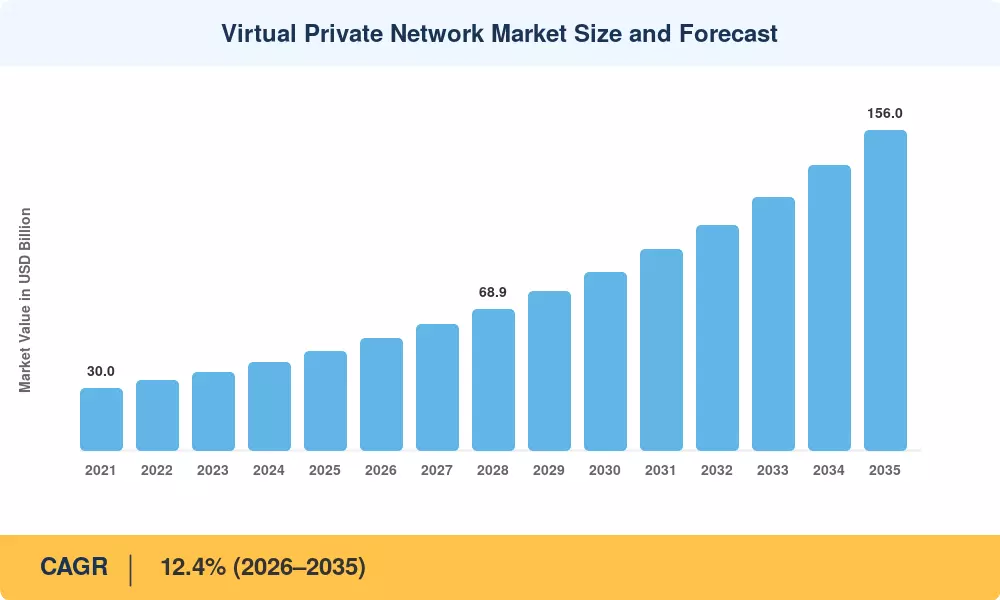
The Virtual Private Network Market was valued at USD 48.5 billion in 2025 and is projected to grow from USD 54.5 billion in 2026 to USD 156.0 billion by 2035, registering a CAGR of 12.4% during the forecast period (2026–2035). Two catalysts underpin this trajectory: the permanence of hybrid work models — with over 58% of knowledge workers globally now operating at least partially remote [1] — and the sharp escalation in regulatory mandates around data sovereignty. The EU's revised ePrivacy Regulation and California's CPRA enforcement actions have prompted enterprises to accelerate encrypted-tunnel adoption, directing an estimated USD 12 billion in incremental IT security spending toward virtual private network infrastructure between 2024 and 2026 alone [2].
Architecturally, legacy hardware-based VPN appliances are yielding ground to cloud-native, software-defined perimeter frameworks. estimates that by 2027, 65% of enterprise VPN deployments will be delivered as cloud-managed services rather than on-premises concentrators [3]. This transition is fueled by the integration of Zero Trust Network Access (ZTNA) principles directly into VPN platforms, a shift that Cisco, Palo Alto Networks, and Zscaler have each backed with acquisitions exceeding USD 1 billion in 2024 [4]. Government spending is reinforcing the same trend — the U.S. Cybersecurity and Infrastructure Security Agency (CISA) allocated USD 3.1 billion toward federal network modernization in FY2025, with encrypted remote-access connectivity listed as a priority [5].
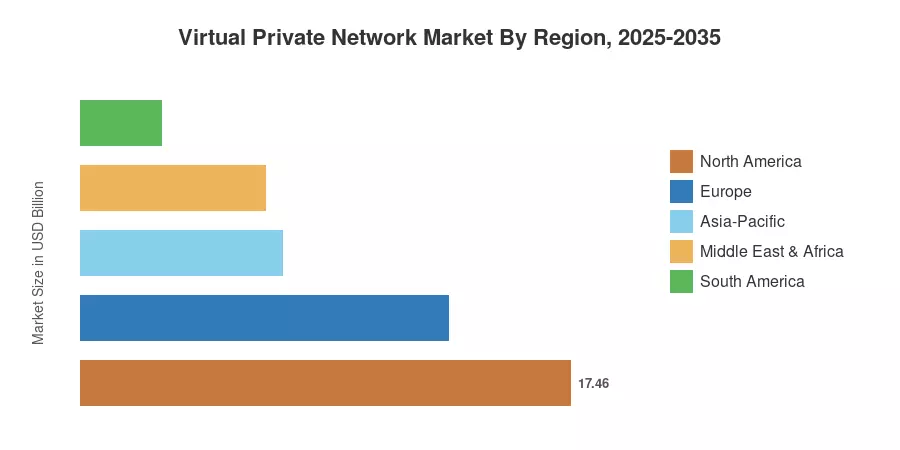
North America commands the dominant share of the Virtual Private Network Market at approximately 36% of 2025 revenue, driven by a mature enterprise IT landscape and stringent compliance requirements across healthcare and finance. Asia-Pacific stands as the fastest-growing region with a forecast CAGR of 14.8%, propelled by rapid digitalization programs in India, China, and Southeast Asia. Europe holds the second-largest share at roughly 27%, shaped by GDPR enforcement and cross-border data transfer rules. As 5G rollouts and edge computing expand the attack surface, the Virtual Private Network Market is positioned for sustained double-digit growth through 2035.
Key Report Takeaways
• By Component
- Solutions account for approximately 68% of the Virtual Private Network Market in 2025, reflecting enterprise demand for integrated VPN platforms with built-in threat detection.
- Services are expanding at a CAGR of 14.1%, as managed-VPN and VPN-as-a-Service offerings gain traction among mid-market firms.
• By Type
- Remote Access VPN holds a market share of roughly 62%, driven by the global hybrid-work inflection.
- Site-to-Site VPN is valued at approximately USD 18.4 billion in 2025, anchored by multi-branch enterprise connectivity needs.
• By Region
- North America leads the Virtual Private Network Market with a 36% revenue share in 2025.
- Asia-Pacific is the fastest-growing region at a projected CAGR of 14.8% through 2035.
- Europe contributes roughly USD 13.1 billion in 2025 revenue, shaped by regulatory compliance spending.
Market Size and Forecast (2021–2035)
Market sizing draws on a triangulated methodology combining vendor revenue disclosures, enterprise IT budget surveys covering 3,200+ organizations, and bottom-up calculations by deployment type and end-user vertical. Historical figures (2021–2024) reflect actual spending reported in annual filings and verified through third-party channel data. Forecast projections (2026–2035) apply regression modeling calibrated to macroeconomic indicators, remote-work penetration rates, and cybersecurity regulatory timelines [6].