×
Hero Background
English
Chinese
French
Japanese
Korean
German
Spanish

Virtual Reality Market Analysis

ID: MRFR/ICT/0411-CR
102 Pages
Ankit Gupta
February 2020

Virtual Reality Market Research Report: Information By Component (Hardware, Software), By Device Type (Head-Mounted Displays, Gesture Tracking Device, Projectors and Display Walls, 3D Cameras), By Technology (Non-Immersive, Semi-Immersive, Fully Immersive), By Vertical (Consumer Electronics, Aerospace and Defense, Healthcare, Commercial, Industrial) And By Region (North America, Europe, Asia-Pacific, And Rest Of The World) –Market Forecast Till 2035.

Share:
Download PDF ×

We do not share your information with anyone. However, we may send you emails based on your report interest from time to time. You may contact us at any time to opt-out.

Virtual Reality Market Infographic
Purchase Options

Market Analysis

Virtual Reality market (Global, 2023)

Introduction

Virtual reality has become a transformative force in many sectors, revolutionizing the way people interact with digital environments and experiences. As technology continues to evolve, new applications are emerging, from entertainment and gaming to education, health care, and real estate. With greater access to both hardware and software, and a growing appetite for more immersive experiences, innovation and investment are on the rise. The integration of artificial intelligence and machine learning into virtual reality platforms is also making it possible to create more personal and engaging experiences. Whether consumers or businesses are the end users, virtual reality is here to stay. As the technology advances and consumer preferences change, the virtual reality market is set to grow significantly.

PESTLE Analysis

Political
In 2023 the Virtual Reality (VR) market will be influenced by political factors such as government regulation and financial support. For example, the U.S. government has allocated $ 1.5 billion to develop VR in education and training, with the aim of improving the skills of workers and the quality of education. China has also launched a national policy to promote the development of VR as a strategic national industry, and has reportedly invested around $ 2 billion in the construction of VR and the development of content, with the goal of promoting the development of the country's high-tech industry.
Economic
The virtual reality market of 2023 will be shaped by trends in consumption and investment. The average amount spent on virtual reality devices and experiences is estimated at around $300 per household, which indicates a growing interest in this technology. In addition, investments in virtual reality companies in 2023 will reach $ 1 billion, a strong sign of the interest of investors in the potential of virtual reality in many industries, such as gaming, health and real estate.
Social
In 2023, the public's acceptance of virtual reality has been greatly improved, and a majority of consumers are interested in using virtual reality for entertainment and socializing. In addition, the popularity of virtual reality games has risen sharply, and the number of active users has exceeded 50 million. Among them, more than 30 percent of users have a virtual social experience. This shows that the public has begun to accept the digitalization of social relationships.
Technological
In the Virtual Reality market, technological innovations, both in hardware and in software, are driving the market. In 2023, the average resolution of the head-mounted display will be 4K per eye, and the leading manufacturers will have spent over $500 million on R&D to develop next-generation displays and haptic feedback systems. Artificial intelligence will also enhance the interactivity of virtual reality applications, and by 2024, over 40% of the virtual reality development teams will be using artificial intelligence-based tools to create content.
Legal
Legal considerations are becoming increasingly important in the virtual reality industry, especially with regard to data protection and intellectual property rights. In 2023, the European Union introduced new regulations that obliged all the virtual reality companies in its jurisdiction to observe the strictest data protection standards. In addition, in 2024 alone, over five thousand new patents were granted for virtual reality. This shows how important intellectual property is in a highly competitive environment.
Environmental
The environment has gained in importance in the VR industry, especially in terms of the sustainable practices. In 2023, it was reported that each virtual reality helmet produced about 1.1 kilograms of e-waste. In response, manufacturers have been putting more effort into the sustainable practices. Recyclable materials are used more and more in the industry, with an estimated twenty-five percent of all new virtual reality products being made from recycled materials. In addition, the carbon footprint of virtual reality experiences has been analyzed. A study has shown that a single virtual reality session can produce about 0.4 kilograms of CO2, which has prompted the industry to take measures to reduce the negative impact on the environment.

Porter's Five Forces

Threat of New Entrants
In 2023 the Virtual Reality market is under a moderate threat of new entrants. The technology is becoming more accessible, but considerable capital investment is still needed for R & D and for establishing brand recognition. In addition, the existing players have built up strong customer loyalty and distribution networks, which could deter new entrants.
Bargaining Power of Suppliers
Suppliers of virtual reality equipment have low bargaining power because of the many suppliers of the components, displays, sensors and software. Suppliers can easily change suppliers, which limits the influence of a single supplier on the market.
Bargaining Power of Buyers
The bargaining power of the buyer in the virtual reality market is high. There are many alternatives to choose from. The consumers can easily compare the products and services of the different brands and this leads to increased competition between the producers. In order to stay in the game, companies have to keep innovating and offer better value for money.
Threat of Substitutes
The threat of substitutes in the virtual reality market is moderate. The substitutes for virtual reality are augmented reality, conventional games, and other entertainment media. Virtual reality has unique experiences, but augmented reality, conventional games, and other entertainment media can be substitutes. However, the unique advantages of virtual reality in specific applications, such as training and simulation, will reduce the threat of substitutes.
Competitive Rivalry
Competition is high in the virtual reality market, where a number of established companies and new entrants compete for market share. The constant need to improve and differentiate drives companies to adopt aggressive marketing strategies and to compete on price. Competition is driving technological progress, but at the same time, it is putting pressure on profit margins.

SWOT Analysis

Strengths

  • Rapid technological advancements enhancing user experience and immersion.
  • Growing adoption in various sectors including gaming, education, and healthcare.
  • Strong investment from major tech companies driving innovation and market growth.
  • Increasing availability of affordable VR hardware making it accessible to a wider audience.
  • Expanding content library with diverse applications attracting different user demographics.

Weaknesses

  • High initial costs for quality VR systems may deter potential users.
  • Limited content availability for certain niche markets.
  • User discomfort and motion sickness issues affecting user experience.
  • Dependence on high-performance hardware which may not be widely available.
  • Fragmentation in the market with multiple platforms leading to compatibility issues.

Opportunities

  • Emerging markets showing interest in VR technology for education and training.
  • Potential for VR in remote work and virtual collaboration tools.
  • Integration with other technologies like AI and AR to enhance functionality.
  • Growing interest in VR for mental health and therapeutic applications.
  • Expansion of VR in tourism and real estate for virtual tours.

Threats

  • Intense competition from alternative technologies such as augmented reality.
  • Rapid changes in consumer preferences and technology trends.
  • Potential regulatory challenges regarding data privacy and user safety.
  • Economic downturns affecting consumer spending on non-essential technologies.
  • Cybersecurity risks associated with online VR experiences.

Summary

The virtual reality market in 2023 is characterized by technological advances and growing adoption in various industries. Its weaknesses are high cost and unease for users. Opportunities exist in emerging markets and the integration of other technologies. Threats are competition and regulatory issues. Strategic attention to improving the user experience and content will be crucial to sustaining growth in this dynamic market.


Author
Ankit Gupta
Senior Research Analyst

Ankit Gupta is an analyst in market research industry in ICT and SEMI industry. With post-graduation in "Telecom and Marketing Management" and graduation in "Electronics and Telecommunication" vertical he is well versed with recent development in ICT industry as a whole. Having worked on more than 150+ reports including consultation for fortune 500 companies such as Microsoft and Rio Tinto in identifying solutions with respect to business problems his opinions are inclined towards mixture of technical and managerial aspects.

Leave a Comment

FAQs

What is the current valuation of the Virtual Reality Market as of 2024?

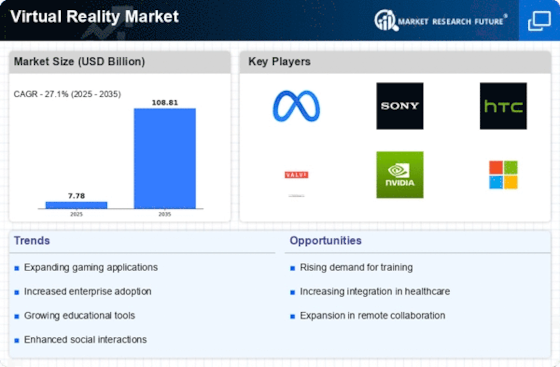
The Virtual Reality Market was valued at 7.78 USD Billion in 2024.

What is the projected market valuation for the Virtual Reality Market in 2035?

The market is projected to reach a valuation of 108.81 USD Billion by 2035.

What is the expected CAGR for the Virtual Reality Market during the forecast period 2025 - 2035?

The expected CAGR for the Virtual Reality Market during the forecast period 2025 - 2035 is 27.1%.

Which companies are considered key players in the Virtual Reality Market?

Key players in the market include Meta Platforms, Sony, HTC, Valve Corporation, NVIDIA, Microsoft, Samsung Electronics, Google, and Apple.

What are the main components of the Virtual Reality Market?

The main components of the market include hardware and software, each valued at 3.89 USD Billion in 2024.

What are the different device types within the Virtual Reality Market?

Device types include Head-Mounted Displays valued at 3.5 USD Billion, Gesture Tracking Devices at 1.5 USD Billion, Projectors and Display Walls at 1.0 USD Billion, and 3D Cameras at 1.78 USD Billion.

How does the technology segment break down in the Virtual Reality Market?

The technology segment consists of Non-Immersive valued at 2.5 USD Billion, Semi-Immersive at 2.0 USD Billion, and Fully Immersive at 3.28 USD Billion.

What verticals are driving growth in the Virtual Reality Market?

Growth is driven by verticals such as Consumer Electronics at 1.56 USD Billion, Aerospace and Defense at 1.2 USD Billion, Healthcare at 1.0 USD Billion, Commercial at 2.0 USD Billion, and Industrial at 2.02 USD Billion.

What is the market outlook for the Virtual Reality Market in the coming years?

The market outlook appears robust, with a projected increase in valuation and a strong CAGR of 27.1% anticipated through 2035.

How do the valuations of different segments compare within the Virtual Reality Market?

In 2024, the valuations indicate that hardware and software components are equal, while device types and technology segments show varied contributions to the overall market.

What are the major challenges faced by the Anchors and Grout Market?

Major challenges faced by the Anchors and Grout Market include:1) Fluctuating raw material prices2) Intense competition from unbranded and low-cost products3) Stringent regulations governing the construction industry4) Labor shortages in the construction sector

What are the key trends shaping the Anchors and Grout Market?

Key trends shaping the Anchors and Grout Market include:1) Adoption of sustainable and eco-friendly construction practices2) Increasing demand for innovative anchoring solutions3) Growing popularity of prefabricated construction methods4) Use of Building Information Modeling (BIM) in construction projects

What is the expected impact of the COVID-19 pandemic on the Anchors and Grout Market?

The COVID-19 pandemic had a negative impact on the Anchors and Grout Market in the short term, due to disruptions in construction activities. However, the market is expected to recover and grow in the long term, driven by pent-up demand for construction projects and government stimulus measures.

Market Summary

As per MRFR analysis, the Virtual Reality Market Size was estimated at 7.78 USD Billion in 2024. The Virtual Reality industry is projected to grow from 9.889 USD Billion in 2025 to 108.81 USD Billion by 2035, exhibiting a compound annual growth rate (CAGR) of 27.1 during the forecast period 2025 - 2035. The virtual reality industry continues to evolve with improved hardware, immersive content, and enhanced user experiences, driving strong long-term demand.

Key Market Trends & Highlights

The Virtual Reality Market is experiencing robust growth driven by diverse applications and technological advancements.

  • The North American region remains the largest market for virtual reality, showcasing a strong demand across various sectors. Asia-Pacific is emerging as the fastest-growing region, with increasing investments in VR technology and applications. The hardware segment dominates the market, while the software segment is witnessing rapid growth due to innovative applications. Technological advancements in VR hardware and the growing demand for immersive experiences are key drivers propelling market expansion. The trend VR segment is expanding rapidly in healthcare applications such as therapy, rehabilitation, and mental health treatment. The AR and VR headsets market is witnessing robust demand due to advancements in display technology, ergonomics, and affordability.

Market Size & Forecast

2024 Market Size 7.78 (USD Billion)
2035 Market Size 108.81 (USD Billion)
CAGR (2025 - 2035) 27.1%
Largest Regional Market Share in 2024 Asia Pacific

Major Players

<p>Meta Platforms (US), Sony (JP), HTC (TW), Valve Corporation (US), NVIDIA (US), Microsoft (US), Samsung Electronics (KR), Google (US), Apple (US)</p>

Market Trends

The Virtual Reality Market is currently experiencing a transformative phase characterized by rapid technological advancements and increasing consumer interest. As immersive experiences become more accessible, various sectors are integrating virtual reality solutions to enhance user engagement and satisfaction. This trend is particularly evident in entertainment, education, and healthcare, where the potential for innovative applications appears boundless. Companies are investing in research and development to create more sophisticated hardware and software, which may lead to a broader adoption of virtual reality technologies across diverse demographics. Moreover, the rise of social virtual reality platforms suggests a shift in how individuals interact and connect in digital spaces. These platforms enable users to engage in shared experiences, fostering a sense of community that transcends geographical boundaries. As the Virtual Reality Market continues to evolve, it seems poised to redefine social interactions, learning methodologies, and therapeutic practices. The ongoing exploration of virtual reality's capabilities indicates a promising future, where its integration into daily life could become commonplace, enhancing both personal and professional experiences.

Increased Adoption in Education

Educational institutions are increasingly incorporating virtual reality into their curricula. This trend allows for immersive learning experiences, enabling students to engage with complex subjects in a more interactive manner. As educators recognize the benefits of experiential learning, the demand for virtual reality tools in classrooms is likely to grow.

Expansion in Healthcare Applications

The healthcare sector is witnessing a surge in the use of virtual reality for training, therapy, and patient care. Medical professionals are utilizing VR simulations for surgical training, while patients benefit from therapeutic applications that help manage pain and anxiety. This expansion indicates a growing recognition of virtual reality's potential to improve health outcomes.

Emergence of Social Virtual Reality Market

Social virtual reality platforms are gaining traction, allowing users to interact in shared virtual environments. This trend reflects a shift towards more collaborative and engaging online experiences. As these platforms evolve, they may redefine social interactions, offering new avenues for connection and community building.

Virtual Reality Market Market Drivers

Growing Demand for Immersive Experiences

The Virtual Reality Market is witnessing a growing demand for immersive experiences, particularly in entertainment and gaming. Consumers are increasingly seeking out VR experiences that offer a sense of presence and interactivity. This trend is reflected in the rising sales of VR games and experiences, which have seen a substantial increase in revenue. Market data indicates that the gaming segment alone is expected to account for a significant portion of the Virtual Reality Market, with projections suggesting it could reach several billion dollars in the coming years. This demand for immersive content is likely to encourage developers to create more engaging VR applications, further propelling market growth.

Expansion of VR in Healthcare and Therapy

The expansion of Virtual Reality Market technology in healthcare and therapy is emerging as a crucial driver for the Virtual Reality Market. VR is being utilized for pain management, rehabilitation, and mental health therapy, providing patients with immersive environments that can aid in their treatment. For instance, VR exposure therapy has shown promise in treating phobias and PTSD. Market data indicates that the healthcare segment of the Virtual Reality Market is projected to grow significantly, with investments in VR solutions for therapeutic applications increasing. This trend suggests a bright future for VR in healthcare, as more practitioners recognize its potential benefits.

Technological Advancements in VR Hardware

The Virtual Reality Market is experiencing rapid technological advancements in hardware, which significantly enhances user experience. Innovations in headsets, such as improved resolution and field of view, are attracting consumers and businesses alike. For instance, the introduction of lightweight and wireless headsets has made VR more accessible. According to recent data, the VR headset market is projected to grow at a compound annual growth rate of over 30% through the next few years. This surge in hardware capabilities is likely to drive the demand for VR applications across various sectors, including gaming, training, and entertainment, thereby expanding the overall Virtual Reality Market.

Rise of VR in Real Estate and Architecture

The Virtual Reality Market is also being driven by the rise of VR applications in real estate and architecture. Real estate agents and architects are utilizing VR to create virtual tours of properties and designs, allowing potential buyers and clients to experience spaces before they are built or sold. This innovative approach not only enhances customer engagement but also streamlines the decision-making process. Recent data suggests that the use of VR in real estate is expected to grow, with many firms adopting this technology to differentiate themselves in a competitive market. As a result, the Virtual Reality Market is likely to see increased investment and development in this area.

Integration of VR in Training and Simulation

The integration of Virtual Reality Market technology in training and simulation is becoming a pivotal driver for the Virtual Reality Market. Industries such as aviation, military, and healthcare are increasingly adopting VR for training purposes, as it allows for realistic simulations without the associated risks. For example, VR training programs can simulate emergency scenarios for pilots or medical professionals, enhancing their skills in a controlled environment. Market analysis suggests that the training and simulation segment is expected to grow significantly, potentially reaching a multi-billion dollar valuation. This trend indicates a robust future for the Virtual Reality Market as more sectors recognize the benefits of VR in professional training.

Market Segment Insights

By Component: Hardware (Largest) vs. Software (Fastest-Growing)

<p>The Virtual Reality Market is predominantly driven by hardware, which holds the largest share within the component segment. This includes displays, sensors, and input devices that form the backbone of VR experiences. The substantial adoption of <a href="https://www.marketresearchfuture.com/reports/virtual-reality-gaming-market-2967">VR in gaming</a>, healthcare, and education bolsters hardware demand. Conversely, software, while a smaller segment, is rapidly gaining traction as developers create immersive applications to enhance user experience. The software segment is characterized by various entertainment and training applications that are revolutionizing the way users engage with virtual environments.</p>

<p>Hardware: Headsets (Dominant) vs. Software: Apps (Emerging)</p>

<p>In the component segment of the Virtual Reality Market, hardware, particularly headsets, is recognized as the dominant player due to its critical role in delivering immersive experiences. VR headsets are designed to provide high-quality visuals, accurate tracking, and comfort, which are essential for user satisfaction. On the other hand, software, represented by applications, is emerging as a significant contender. This segment encompasses a diverse range of applications that cater to entertainment, education, and training. As more developers tailor software solutions for specific industries, the demand for innovative and engaging VR content continues to surge, positioning software as a key area of growth.</p>

By Device Type: Head-Mounted Displays (Largest) vs. Gesture Tracking Devices (Fastest-Growing)

<p>In the Virtual Reality Market, the distribution of market share among device types reveals that Head-Mounted Displays (HMDs) dominate, capturing the most significant share due to their widespread adoption across gaming, education, and training sectors. <a href="https://www.marketresearchfuture.com/reports/gesture-recognition-touchless-sensing-market-1270">Gesture Tracking Devices</a>, while smaller in share compared to HMDs, are rapidly gaining traction through advancements in technology that enhance user interaction, making them increasingly appealing in various applications like gaming and virtual meetings. The growth trends in the Virtual Reality Market Device Type segment are heavily driven by technological innovations and an increasing consumer demand for immersive experiences. Head-Mounted Displays continue to be the go-to device for most users, while Gesture Tracking Devices are witnessing the quickest growth as they enable natural interactions within virtual environments. Factors such as affordability, enhanced performance, and growing content availability support this acceleration starting from experience-based applications to practical industrial uses.</p>

<p>Head-Mounted Displays (Dominant) vs. Gesture Tracking Devices (Emerging)</p>

<p>Head-Mounted Displays (HMDs) currently lead the Virtual Reality Market, establishing themselves as the preferred choice for users seeking immersive content. Their ability to deliver high-quality visuals and engaging experiences makes them essential for gaming, training, and simulation applications. As technology advances, HMDs are unlikely to lose their dominant position, consistently evolving with features like increased comfort, portability, and improved display resolution. On the other hand, Gesture Tracking Devices are emerging swiftly, enhancing user engagement through natural movement recognition within virtual spaces. They are increasingly utilized in gaming and collaboration tools, drawing attention to their potential in creating more intuitive user experiences. As both segments evolve, their synergy will likely define the future landscape of virtual reality.</p>

By Technology: Fully Immersive (Largest) vs. Non-Immersive (Fastest-Growing)

<p>In the Virtual Reality Market, the technology segment is primarily divided into three categories: <a href="https://www.marketresearchfuture.com/reports/virtual-reality-market-916">Non-Immersive, Semi-Immersive</a>, and Fully Immersive setups. Fully Immersive VR holds the largest share, appealing to industries like gaming and education, which value complete user engagement. Meanwhile, Non-Immersive VR is rapidly rising, largely driven by the accessibility it offers to consumers and enterprises alike, as it requires less sophisticated hardware compared to its immersive counterparts.</p>

<p>Technology: Fully Immersive (Dominant) vs. Non-Immersive (Emerging)</p>

<p>Fully Immersive VR technology provides users with a comprehensive virtual experience, allowing complete immersion in 3D environments that enhance interaction, making it dominant in sectors such as gaming, training simulations, and therapeutic applications. In contrast, Non-Immersive VR acts as an entry point for users, bringing the benefits of VR without requiring advanced equipment, thus attracting a broader audience. This segment is becoming increasingly important as developers create more engaging experiences that are also budget-friendly, leading to rapid adoption and innovation at a growing pace.</p>

By Vertical: Consumer Electronics (Largest) vs. Healthcare (Fastest-Growing)

<p>In the Virtual Reality Market, Consumer Electronics represents the largest segment, driven by the increasing adoption of VR headsets and gaming devices among consumers. This segment holds a substantial market share, significantly influencing overall market trends. As consumers continue to seek immersive experiences in gaming and entertainment, the demand for VR technology in this sector remains strong, propelling its dominance.</p>

<p>Consumer Electronics: Gaming (Dominant) vs. Healthcare (Emerging)</p>

<p>The Consumer Electronics segment, particularly in gaming, is characterized by robust sales of VR headsets and accessories, catering to a diverse consumer base eager for immersive experiences. Major players in this space focus on innovation and user engagement, enhancing their offerings through advanced technologies. Conversely, the Healthcare sector is emerging rapidly, leveraging VR for therapeutic purposes and medical training, thus gaining traction. This segment's growth is propelled by increasing investments in healthcare technology and the need for innovative solutions in patient care and medical education, positioning it as a significant player in shaping the future of VR.</p>

Get more detailed insights about Virtual Reality Market Research Report - Global Forecast to 2035

Regional Insights

North America : Innovation and Market Leadership

North America is the largest market for virtual reality, holding approximately 45% of the global share. The region's growth is driven by advancements in technology, increasing adoption in gaming, healthcare, and education, and supportive regulatory frameworks. The U.S. leads in VR development, with significant investments from both private and public sectors, while Canada follows closely with its growing tech ecosystem. Key players like Meta Platforms, Microsoft, and NVIDIA are headquartered here, fostering a competitive landscape. The presence of major tech companies and startups alike enhances innovation and market penetration. The U.S. government’s initiatives to promote technology adoption further bolster the market, ensuring a robust environment for VR growth.

Europe : Emerging Market with Potential

Europe is the second-largest market for virtual reality, accounting for about 30% of the global share. The region is witnessing a surge in demand driven by applications in entertainment, training, and virtual tourism. Regulatory support from the European Union, focusing on digital innovation and technology integration, is a significant catalyst for growth. Countries like Germany and the UK are at the forefront, with strong investments in VR technology. Germany leads the market, supported by a robust manufacturing sector and a focus on research and development. The UK follows closely, with a vibrant startup ecosystem. Major players like Sony and HTC are actively expanding their presence, while local companies are innovating in niche markets. The competitive landscape is dynamic, with increasing collaborations between tech firms and educational institutions.

Asia-Pacific : Rapid Growth and Adoption

Asia-Pacific is rapidly emerging as a powerhouse in the virtual reality market, holding approximately 20% of the global share. The region's growth is fueled by increasing consumer demand for immersive experiences in gaming and entertainment, along with significant investments in VR technology by governments and private sectors. Countries like China and Japan are leading the charge, with strong government support for tech innovation and infrastructure development. China is the largest market in the region, driven by a booming gaming industry and a growing interest in VR applications across various sectors. Japan follows, with established companies like Sony pushing the boundaries of VR technology. The competitive landscape is vibrant, with numerous startups and established players like HTC and Samsung Electronics contributing to the market's expansion. The region is poised for continued growth as technology becomes more accessible.

Middle East and Africa : Emerging Market with Challenges

The Middle East and Africa region is gradually emerging in the virtual reality market, currently holding about 5% of the global share. The growth is driven by increasing interest in VR applications in education, healthcare, and entertainment, although challenges such as infrastructure and investment levels persist. Countries like South Africa and the UAE are leading the way, with initiatives to promote technology adoption and innovation. South Africa is at the forefront, with a growing tech scene and increasing investments in VR startups. The UAE is also making strides, with government support for digital transformation initiatives. However, the competitive landscape remains fragmented, with many players still in the early stages of development. As infrastructure improves and awareness grows, the region is expected to see significant growth in the coming years.

Key Players and Competitive Insights

The Virtual Reality Market is currently characterized by a dynamic competitive landscape, driven by rapid technological advancements and increasing consumer demand for immersive experiences. Major players such as Meta Platforms (US), Sony (JP), and NVIDIA (US) are at the forefront, each adopting distinct strategies to enhance their market positioning. Meta Platforms (US) continues to focus on innovation through its Meta Quest line, emphasizing user engagement and social connectivity. Meanwhile, Sony (JP) leverages its strong gaming ecosystem, integrating VR capabilities into its PlayStation platform, thereby enhancing user experience and expanding its market reach. NVIDIA (US) is strategically positioned as a leader in graphics processing units, which are essential for high-quality VR experiences, and is actively exploring partnerships to enhance its software offerings.

The business tactics employed by these companies reflect a concerted effort to optimize supply chains and localize manufacturing, which is crucial in a moderately fragmented market. This competitive structure allows for a diverse range of offerings, yet the influence of key players remains substantial, as they set benchmarks for quality and innovation. The collective strategies of these companies not only shape their individual trajectories but also influence the overall market dynamics, fostering an environment where technological advancements are paramount.

In August 2025, Meta Platforms (US) announced a significant partnership with Unity Technologies (US) to enhance its VR development capabilities. This collaboration aims to streamline the creation of immersive content, which is vital for attracting developers and users alike. The strategic importance of this partnership lies in its potential to expand Meta's content library, thereby increasing user engagement and solidifying its position in the VR ecosystem.

In September 2025, Sony (JP) unveiled its latest VR headset, the PlayStation VR2, which features advanced haptic feedback and eye-tracking technology. This launch is pivotal as it not only enhances the gaming experience but also positions Sony as a leader in the high-end VR segment. The integration of cutting-edge technology is likely to attract a broader audience, reinforcing Sony's competitive edge in the market.

In July 2025, NVIDIA (US) introduced a new AI-driven software suite designed to optimize VR performance across various platforms. This strategic move underscores NVIDIA's commitment to enhancing user experience through technological innovation. By focusing on AI integration, NVIDIA is not only improving the performance of VR applications but also setting a new standard for the industry, which could influence competitors to follow suit.

As of October 2025, the competitive trends in the Virtual Reality Market are increasingly defined by digitalization, sustainability, and the integration of artificial intelligence. Strategic alliances are becoming more prevalent, as companies recognize the need for collaboration to drive innovation and enhance product offerings. Looking ahead, competitive differentiation is likely to evolve from traditional price-based competition to a focus on technological innovation, user experience, and supply chain reliability, suggesting a transformative shift in how companies approach market positioning.

Key Companies in the Virtual Reality Market market include

Industry Developments

  • Q2 2024: Sony launches new PlayStation VR2 headset for PC Sony announced the launch of its PlayStation VR2 headset for PC, expanding its VR hardware ecosystem beyond the PlayStation 5 console and targeting a broader gaming audience.
  • Q2 2024: Meta unveils Quest 3S, a more affordable VR headset Meta launched the Quest 3S, a lower-cost version of its flagship VR headset, aiming to make virtual reality more accessible to mainstream consumers.
  • Q2 2024: Apple Vision Pro launches in China and Europe Apple expanded the availability of its Vision Pro mixed reality headset to China and several European countries, marking a significant international rollout for its spatial computing device.
  • Q3 2024: ByteDance’s Pico launches new enterprise-focused VR headset ByteDance’s Pico division introduced a new VR headset designed for enterprise applications, targeting training, education, and remote collaboration markets.
  • Q3 2024: HTC partners with Siemens to deliver industrial VR solutions HTC announced a partnership with Siemens to develop and deploy virtual reality solutions for industrial design, simulation, and training.
  • Q3 2024: Meta acquires VR fitness app Supernatural Meta completed its acquisition of Within, the developer of the popular VR fitness app Supernatural, strengthening its content portfolio for the Quest platform.
  • Q4 2024: Magic Leap raises $590 million in new funding round Magic Leap secured $590 million in a new funding round to accelerate the development and commercialization of its next-generation mixed reality hardware.
  • Q4 2024: Sony opens new VR R&D center in Singapore Sony announced the opening of a new research and development center in Singapore focused on advancing virtual reality hardware and software technologies.
  • Q1 2025: Valve announces next-generation VR headset Valve revealed its next-generation VR headset, featuring improved resolution, wider field of view, and enhanced tracking capabilities for immersive gaming experiences.
  • Q1 2025: Meta appoints new head of VR hardware division Meta named a new executive to lead its VR hardware division, signaling a renewed focus on innovation and product development in the virtual reality sector.
  • Q2 2025: Samsung and Google announce partnership on XR platform Samsung and Google announced a strategic partnership to co-develop an extended reality (XR) platform, combining their hardware and software expertise to compete in the VR and AR markets.
  • Q2 2025: Varjo closes $150 million Series D funding round Varjo, a Finnish VR hardware company, raised $150 million in Series D funding to expand its presence in enterprise and professional virtual reality markets.

Future Outlook

Virtual Reality Market Future Outlook

<p>The Virtual Reality Market is projected to grow at a 27.1% CAGR from 2024 to 2035, driven by advancements in technology, increased adoption in various sectors, and enhanced user experiences.</p> <p>Key virtual reality trends include the rise of standalone headsets, enterprise metaverse applications, and AI-powered simulations. These developments are influencing the broader augmented reality and virtual reality market, particularly across industrial training and remote collaboration use cases.</p>

New opportunities lie in:

  • <p>Development of immersive training programs for corporate sectors</p>
  • <p>Expansion of VR content creation platforms for independent developers</p>
  • <p>Integration of VR in telehealth services for remote patient engagement</p>

<p>By 2035, the Virtual Reality Market is expected to be a pivotal industry, reshaping multiple sectors.</p>

Market Segmentation

Virtual Reality Market Vertical Outlook

  • Consumer Electronics
  • Aerospace and Defense
  • Healthcare
  • Commercial
  • Industrial

Virtual Reality Market Component Outlook

  • Hardware
  • Software

Virtual Reality Market Technology Outlook

  • Non-Immersive
  • Semi-Immersive
  • Fully Immersive

Virtual Reality Market Device Type Outlook

  • Head-Mounted Displays
  • Gesture Tracking Devices
  • Projectors and Display Walls
  • 3D Cameras

Report Scope

MARKET SIZE 2024 7.78(USD Billion)
MARKET SIZE 2025 9.889(USD Billion)
MARKET SIZE 2035 108.81(USD Billion)
COMPOUND ANNUAL GROWTH RATE (CAGR) 27.1% (2024 - 2035)
REPORT COVERAGE Revenue Forecast, Competitive Landscape, Growth Factors, and Trends
BASE YEAR 2024
Market Forecast Period 2025 - 2035
Historical Data 2019 - 2024
Market Forecast Units USD Billion
Key Companies Profiled Market analysis in progress
Segments Covered Market segmentation analysis in progress
Key Market Opportunities Integration of artificial intelligence enhances user experience in the Virtual Reality Market.
Key Market Dynamics Technological advancements drive competitive forces, reshaping consumer behavior and enhancing immersive experiences in the Virtual Reality Market.
Countries Covered North America, Europe, APAC, South America, MEA

FAQs

What is the current valuation of the Virtual Reality Market as of 2024?

The Virtual Reality Market was valued at 7.78 USD Billion in 2024.

What is the projected market valuation for the Virtual Reality Market in 2035?

The market is projected to reach a valuation of 108.81 USD Billion by 2035.

What is the expected CAGR for the Virtual Reality Market during the forecast period 2025 - 2035?

The expected CAGR for the Virtual Reality Market during the forecast period 2025 - 2035 is 27.1%.

Which companies are considered key players in the Virtual Reality Market?

Key players in the market include Meta Platforms, Sony, HTC, Valve Corporation, NVIDIA, Microsoft, Samsung Electronics, Google, and Apple.

What are the main components of the Virtual Reality Market?

The main components of the market include hardware and software, each valued at 3.89 USD Billion in 2024.

What are the different device types within the Virtual Reality Market?

Device types include Head-Mounted Displays valued at 3.5 USD Billion, Gesture Tracking Devices at 1.5 USD Billion, Projectors and Display Walls at 1.0 USD Billion, and 3D Cameras at 1.78 USD Billion.

How does the technology segment break down in the Virtual Reality Market?

The technology segment consists of Non-Immersive valued at 2.5 USD Billion, Semi-Immersive at 2.0 USD Billion, and Fully Immersive at 3.28 USD Billion.

What verticals are driving growth in the Virtual Reality Market?

Growth is driven by verticals such as Consumer Electronics at 1.56 USD Billion, Aerospace and Defense at 1.2 USD Billion, Healthcare at 1.0 USD Billion, Commercial at 2.0 USD Billion, and Industrial at 2.02 USD Billion.

What is the market outlook for the Virtual Reality Market in the coming years?

The market outlook appears robust, with a projected increase in valuation and a strong CAGR of 27.1% anticipated through 2035.

How do the valuations of different segments compare within the Virtual Reality Market?

In 2024, the valuations indicate that hardware and software components are equal, while device types and technology segments show varied contributions to the overall market.

What are the major challenges faced by the Anchors and Grout Market?

Major challenges faced by the Anchors and Grout Market include:1) Fluctuating raw material prices2) Intense competition from unbranded and low-cost products3) Stringent regulations governing the construction industry4) Labor shortages in the construction sector

What are the key trends shaping the Anchors and Grout Market?

Key trends shaping the Anchors and Grout Market include:1) Adoption of sustainable and eco-friendly construction practices2) Increasing demand for innovative anchoring solutions3) Growing popularity of prefabricated construction methods4) Use of Building Information Modeling (BIM) in construction projects

What is the expected impact of the COVID-19 pandemic on the Anchors and Grout Market?

The COVID-19 pandemic had a negative impact on the Anchors and Grout Market in the short term, due to disruptions in construction activities. However, the market is expected to recover and grow in the long term, driven by pent-up demand for construction projects and government stimulus measures.

  1. SECTION I: EXECUTIVE SUMMARY AND KEY HIGHLIGHTS
    1. EXECUTIVE SUMMARY
      1. Market Overview
      2. Key Findings
      3. Market Segmentation
      4. Competitive Landscape
      5. Challenges and Opportunities
      6. Future Outlook 2
  2. SECTION II: SCOPING, METHODOLOGY AND MARKET STRUCTURE
    1. MARKET INTRODUCTION
      1. Definition
      2. Scope of the study
    2. RESEARCH METHODOLOGY
      1. Overview
      2. Data Mining
      3. Secondary Research
      4. Primary Research
      5. Forecasting Model
      6. Market Size Estimation
      7. Data Triangulation
      8. Validation 3
  3. SECTION III: QUALITATIVE ANALYSIS
    1. MARKET DYNAMICS
      1. Overview
      2. Drivers
      3. Restraints
      4. Opportunities
    2. MARKET FACTOR ANALYSIS
      1. Value chain Analysis
      2. Porter's Five Forces Analysis
      3. COVID-19 Impact Analysis
  4. SECTION IV: QUANTITATIVE ANALYSIS
    1. Information and Communications Technology, BY Component (USD Billion)
      1. Hardware
      2. Software
    2. Information and Communications Technology, BY Device Type (USD Billion)
      1. Head-Mounted Displays
      2. Gesture Tracking Devices
      3. Projectors and Display Walls
      4. 3D Cameras
    3. Information and Communications Technology, BY Technology (USD Billion)
      1. Non-Immersive
      2. Semi-Immersive
      3. Fully Immersive
    4. Information and Communications Technology, BY Vertical (USD Billion)
      1. Consumer Electronics
      2. Aerospace and Defense
      3. Healthcare
      4. Commercial
      5. Industrial
    5. Information and Communications Technology, BY Region (USD Billion)
      1. North America
      2. Europe
      3. APAC
      4. South America
      5. MEA
  5. SECTION V: COMPETITIVE ANALYSIS
    1. Competitive Landscape
      1. Overview
      2. Competitive Analysis
      3. Market share Analysis
      4. Major Growth Strategy in the Information and Communications Technology
      5. Competitive Benchmarking
      6. Leading Players in Terms of Number of Developments in the Information and Communications Technology
      7. Key developments and growth strategies
      8. Major Players Financial Matrix
    2. Company Profiles
      1. Meta Platforms (US)
      2. Sony (JP)
      3. HTC (TW)
      4. Valve Corporation (US)
      5. NVIDIA (US)
      6. Microsoft (US)
      7. Samsung Electronics (KR)
      8. Google (US)
      9. Apple (US)
    3. Appendix
      1. References
      2. Related Reports 6 LIST OF FIGURES
    4. MARKET SYNOPSIS
    5. NORTH AMERICA MARKET ANALYSIS
    6. US MARKET ANALYSIS BY COMPONENT
    7. US MARKET ANALYSIS BY DEVICE TYPE
    8. US MARKET ANALYSIS BY TECHNOLOGY
    9. US MARKET ANALYSIS BY VERTICAL
    10. CANADA MARKET ANALYSIS BY COMPONENT
    11. CANADA MARKET ANALYSIS BY DEVICE TYPE
    12. CANADA MARKET ANALYSIS BY TECHNOLOGY
    13. CANADA MARKET ANALYSIS BY VERTICAL
    14. EUROPE MARKET ANALYSIS
    15. GERMANY MARKET ANALYSIS BY COMPONENT
    16. GERMANY MARKET ANALYSIS BY DEVICE TYPE
    17. GERMANY MARKET ANALYSIS BY TECHNOLOGY
    18. GERMANY MARKET ANALYSIS BY VERTICAL
    19. UK MARKET ANALYSIS BY COMPONENT
    20. UK MARKET ANALYSIS BY DEVICE TYPE
    21. UK MARKET ANALYSIS BY TECHNOLOGY
    22. UK MARKET ANALYSIS BY VERTICAL
    23. FRANCE MARKET ANALYSIS BY COMPONENT
    24. FRANCE MARKET ANALYSIS BY DEVICE TYPE
    25. FRANCE MARKET ANALYSIS BY TECHNOLOGY
    26. FRANCE MARKET ANALYSIS BY VERTICAL
    27. RUSSIA MARKET ANALYSIS BY COMPONENT
    28. RUSSIA MARKET ANALYSIS BY DEVICE TYPE
    29. RUSSIA MARKET ANALYSIS BY TECHNOLOGY
    30. RUSSIA MARKET ANALYSIS BY VERTICAL
    31. ITALY MARKET ANALYSIS BY COMPONENT
    32. ITALY MARKET ANALYSIS BY DEVICE TYPE
    33. ITALY MARKET ANALYSIS BY TECHNOLOGY
    34. ITALY MARKET ANALYSIS BY VERTICAL
    35. SPAIN MARKET ANALYSIS BY COMPONENT
    36. SPAIN MARKET ANALYSIS BY DEVICE TYPE
    37. SPAIN MARKET ANALYSIS BY TECHNOLOGY
    38. SPAIN MARKET ANALYSIS BY VERTICAL
    39. REST OF EUROPE MARKET ANALYSIS BY COMPONENT
    40. REST OF EUROPE MARKET ANALYSIS BY DEVICE TYPE
    41. REST OF EUROPE MARKET ANALYSIS BY TECHNOLOGY
    42. REST OF EUROPE MARKET ANALYSIS BY VERTICAL
    43. APAC MARKET ANALYSIS
    44. CHINA MARKET ANALYSIS BY COMPONENT
    45. CHINA MARKET ANALYSIS BY DEVICE TYPE
    46. CHINA MARKET ANALYSIS BY TECHNOLOGY
    47. CHINA MARKET ANALYSIS BY VERTICAL
    48. INDIA MARKET ANALYSIS BY COMPONENT
    49. INDIA MARKET ANALYSIS BY DEVICE TYPE
    50. INDIA MARKET ANALYSIS BY TECHNOLOGY
    51. INDIA MARKET ANALYSIS BY VERTICAL
    52. JAPAN MARKET ANALYSIS BY COMPONENT
    53. JAPAN MARKET ANALYSIS BY DEVICE TYPE
    54. JAPAN MARKET ANALYSIS BY TECHNOLOGY
    55. JAPAN MARKET ANALYSIS BY VERTICAL
    56. SOUTH KOREA MARKET ANALYSIS BY COMPONENT
    57. SOUTH KOREA MARKET ANALYSIS BY DEVICE TYPE
    58. SOUTH KOREA MARKET ANALYSIS BY TECHNOLOGY
    59. SOUTH KOREA MARKET ANALYSIS BY VERTICAL
    60. MALAYSIA MARKET ANALYSIS BY COMPONENT
    61. MALAYSIA MARKET ANALYSIS BY DEVICE TYPE
    62. MALAYSIA MARKET ANALYSIS BY TECHNOLOGY
    63. MALAYSIA MARKET ANALYSIS BY VERTICAL
    64. THAILAND MARKET ANALYSIS BY COMPONENT
    65. THAILAND MARKET ANALYSIS BY DEVICE TYPE
    66. THAILAND MARKET ANALYSIS BY TECHNOLOGY
    67. THAILAND MARKET ANALYSIS BY VERTICAL
    68. INDONESIA MARKET ANALYSIS BY COMPONENT
    69. INDONESIA MARKET ANALYSIS BY DEVICE TYPE
    70. INDONESIA MARKET ANALYSIS BY TECHNOLOGY
    71. INDONESIA MARKET ANALYSIS BY VERTICAL
    72. REST OF APAC MARKET ANALYSIS BY COMPONENT
    73. REST OF APAC MARKET ANALYSIS BY DEVICE TYPE
    74. REST OF APAC MARKET ANALYSIS BY TECHNOLOGY
    75. REST OF APAC MARKET ANALYSIS BY VERTICAL
    76. SOUTH AMERICA MARKET ANALYSIS
    77. BRAZIL MARKET ANALYSIS BY COMPONENT
    78. BRAZIL MARKET ANALYSIS BY DEVICE TYPE
    79. BRAZIL MARKET ANALYSIS BY TECHNOLOGY
    80. BRAZIL MARKET ANALYSIS BY VERTICAL
    81. MEXICO MARKET ANALYSIS BY COMPONENT
    82. MEXICO MARKET ANALYSIS BY DEVICE TYPE
    83. MEXICO MARKET ANALYSIS BY TECHNOLOGY
    84. MEXICO MARKET ANALYSIS BY VERTICAL
    85. ARGENTINA MARKET ANALYSIS BY COMPONENT
    86. ARGENTINA MARKET ANALYSIS BY DEVICE TYPE
    87. ARGENTINA MARKET ANALYSIS BY TECHNOLOGY
    88. ARGENTINA MARKET ANALYSIS BY VERTICAL
    89. REST OF SOUTH AMERICA MARKET ANALYSIS BY COMPONENT
    90. REST OF SOUTH AMERICA MARKET ANALYSIS BY DEVICE TYPE
    91. REST OF SOUTH AMERICA MARKET ANALYSIS BY TECHNOLOGY
    92. REST OF SOUTH AMERICA MARKET ANALYSIS BY VERTICAL
    93. MEA MARKET ANALYSIS
    94. GCC COUNTRIES MARKET ANALYSIS BY COMPONENT
    95. GCC COUNTRIES MARKET ANALYSIS BY DEVICE TYPE
    96. GCC COUNTRIES MARKET ANALYSIS BY TECHNOLOGY
    97. GCC COUNTRIES MARKET ANALYSIS BY VERTICAL
    98. SOUTH AFRICA MARKET ANALYSIS BY COMPONENT
    99. SOUTH AFRICA MARKET ANALYSIS BY DEVICE TYPE
    100. SOUTH AFRICA MARKET ANALYSIS BY TECHNOLOGY
    101. SOUTH AFRICA MARKET ANALYSIS BY VERTICAL
    102. REST OF MEA MARKET ANALYSIS BY COMPONENT
    103. REST OF MEA MARKET ANALYSIS BY DEVICE TYPE
    104. REST OF MEA MARKET ANALYSIS BY TECHNOLOGY
    105. REST OF MEA MARKET ANALYSIS BY VERTICAL
    106. KEY BUYING CRITERIA OF INFORMATION AND COMMUNICATIONS TECHNOLOGY
    107. RESEARCH PROCESS OF MRFR
    108. DRO ANALYSIS OF INFORMATION AND COMMUNICATIONS TECHNOLOGY
    109. DRIVERS IMPACT ANALYSIS: INFORMATION AND COMMUNICATIONS TECHNOLOGY
    110. RESTRAINTS IMPACT ANALYSIS: INFORMATION AND COMMUNICATIONS TECHNOLOGY
    111. SUPPLY / VALUE CHAIN: INFORMATION AND COMMUNICATIONS TECHNOLOGY
    112. INFORMATION AND COMMUNICATIONS TECHNOLOGY, BY COMPONENT, 2024 (% SHARE)
    113. INFORMATION AND COMMUNICATIONS TECHNOLOGY, BY COMPONENT, 2024 TO 2035 (USD Billion)
    114. INFORMATION AND COMMUNICATIONS TECHNOLOGY, BY DEVICE TYPE, 2024 (% SHARE)
    115. INFORMATION AND COMMUNICATIONS TECHNOLOGY, BY DEVICE TYPE, 2024 TO 2035 (USD Billion)
    116. INFORMATION AND COMMUNICATIONS TECHNOLOGY, BY TECHNOLOGY, 2024 (% SHARE)
    117. INFORMATION AND COMMUNICATIONS TECHNOLOGY, BY TECHNOLOGY, 2024 TO 2035 (USD Billion)
    118. INFORMATION AND COMMUNICATIONS TECHNOLOGY, BY VERTICAL, 2024 (% SHARE)
    119. INFORMATION AND COMMUNICATIONS TECHNOLOGY, BY VERTICAL, 2024 TO 2035 (USD Billion)
    120. BENCHMARKING OF MAJOR COMPETITORS 7 LIST OF TABLES
    121. LIST OF ASSUMPTIONS
    122. North America MARKET SIZE ESTIMATES; FORECAST
      1. BY COMPONENT, 2025-2035 (USD Billion)
      2. BY DEVICE TYPE, 2025-2035 (USD Billion)
      3. BY TECHNOLOGY, 2025-2035 (USD Billion)
      4. BY VERTICAL, 2025-2035 (USD Billion)
    123. US MARKET SIZE ESTIMATES; FORECAST
      1. BY COMPONENT, 2025-2035 (USD Billion)
      2. BY DEVICE TYPE, 2025-2035 (USD Billion)
      3. BY TECHNOLOGY, 2025-2035 (USD Billion)
      4. BY VERTICAL, 2025-2035 (USD Billion)
    124. Canada MARKET SIZE ESTIMATES; FORECAST
      1. BY COMPONENT, 2025-2035 (USD Billion)
      2. BY DEVICE TYPE, 2025-2035 (USD Billion)
      3. BY TECHNOLOGY, 2025-2035 (USD Billion)
      4. BY VERTICAL, 2025-2035 (USD Billion)
    125. Europe MARKET SIZE ESTIMATES; FORECAST
      1. BY COMPONENT, 2025-2035 (USD Billion)
      2. BY DEVICE TYPE, 2025-2035 (USD Billion)
      3. BY TECHNOLOGY, 2025-2035 (USD Billion)
      4. BY VERTICAL, 2025-2035 (USD Billion)
    126. Germany MARKET SIZE ESTIMATES; FORECAST
      1. BY COMPONENT, 2025-2035 (USD Billion)
      2. BY DEVICE TYPE, 2025-2035 (USD Billion)
      3. BY TECHNOLOGY, 2025-2035 (USD Billion)
      4. BY VERTICAL, 2025-2035 (USD Billion)
    127. UK MARKET SIZE ESTIMATES; FORECAST
      1. BY COMPONENT, 2025-2035 (USD Billion)
      2. BY DEVICE TYPE, 2025-2035 (USD Billion)
      3. BY TECHNOLOGY, 2025-2035 (USD Billion)
      4. BY VERTICAL, 2025-2035 (USD Billion)
    128. France MARKET SIZE ESTIMATES; FORECAST
      1. BY COMPONENT, 2025-2035 (USD Billion)
      2. BY DEVICE TYPE, 2025-2035 (USD Billion)
      3. BY TECHNOLOGY, 2025-2035 (USD Billion)
      4. BY VERTICAL, 2025-2035 (USD Billion)
    129. Russia MARKET SIZE ESTIMATES; FORECAST
      1. BY COMPONENT, 2025-2035 (USD Billion)
      2. BY DEVICE TYPE, 2025-2035 (USD Billion)
      3. BY TECHNOLOGY, 2025-2035 (USD Billion)
      4. BY VERTICAL, 2025-2035 (USD Billion)
    130. Italy MARKET SIZE ESTIMATES; FORECAST
      1. BY COMPONENT, 2025-2035 (USD Billion)
      2. BY DEVICE TYPE, 2025-2035 (USD Billion)
      3. BY TECHNOLOGY, 2025-2035 (USD Billion)
      4. BY VERTICAL, 2025-2035 (USD Billion)
    131. Spain MARKET SIZE ESTIMATES; FORECAST
      1. BY COMPONENT, 2025-2035 (USD Billion)
      2. BY DEVICE TYPE, 2025-2035 (USD Billion)
      3. BY TECHNOLOGY, 2025-2035 (USD Billion)
      4. BY VERTICAL, 2025-2035 (USD Billion)
    132. Rest of Europe MARKET SIZE ESTIMATES; FORECAST
      1. BY COMPONENT, 2025-2035 (USD Billion)
      2. BY DEVICE TYPE, 2025-2035 (USD Billion)
      3. BY TECHNOLOGY, 2025-2035 (USD Billion)
      4. BY VERTICAL, 2025-2035 (USD Billion)
    133. APAC MARKET SIZE ESTIMATES; FORECAST
      1. BY COMPONENT, 2025-2035 (USD Billion)
      2. BY DEVICE TYPE, 2025-2035 (USD Billion)
      3. BY TECHNOLOGY, 2025-2035 (USD Billion)
      4. BY VERTICAL, 2025-2035 (USD Billion)
    134. China MARKET SIZE ESTIMATES; FORECAST
      1. BY COMPONENT, 2025-2035 (USD Billion)
      2. BY DEVICE TYPE, 2025-2035 (USD Billion)
      3. BY TECHNOLOGY, 2025-2035 (USD Billion)
      4. BY VERTICAL, 2025-2035 (USD Billion)
    135. India MARKET SIZE ESTIMATES; FORECAST
      1. BY COMPONENT, 2025-2035 (USD Billion)
      2. BY DEVICE TYPE, 2025-2035 (USD Billion)
      3. BY TECHNOLOGY, 2025-2035 (USD Billion)
      4. BY VERTICAL, 2025-2035 (USD Billion)
    136. Japan MARKET SIZE ESTIMATES; FORECAST
      1. BY COMPONENT, 2025-2035 (USD Billion)
      2. BY DEVICE TYPE, 2025-2035 (USD Billion)
      3. BY TECHNOLOGY, 2025-2035 (USD Billion)
      4. BY VERTICAL, 2025-2035 (USD Billion)
    137. South Korea MARKET SIZE ESTIMATES; FORECAST
      1. BY COMPONENT, 2025-2035 (USD Billion)
      2. BY DEVICE TYPE, 2025-2035 (USD Billion)
      3. BY TECHNOLOGY, 2025-2035 (USD Billion)
      4. BY VERTICAL, 2025-2035 (USD Billion)
    138. Malaysia MARKET SIZE ESTIMATES; FORECAST
      1. BY COMPONENT, 2025-2035 (USD Billion)
      2. BY DEVICE TYPE, 2025-2035 (USD Billion)
      3. BY TECHNOLOGY, 2025-2035 (USD Billion)
      4. BY VERTICAL, 2025-2035 (USD Billion)
    139. Thailand MARKET SIZE ESTIMATES; FORECAST
      1. BY COMPONENT, 2025-2035 (USD Billion)
      2. BY DEVICE TYPE, 2025-2035 (USD Billion)
      3. BY TECHNOLOGY, 2025-2035 (USD Billion)
      4. BY VERTICAL, 2025-2035 (USD Billion)
    140. Indonesia MARKET SIZE ESTIMATES; FORECAST
      1. BY COMPONENT, 2025-2035 (USD Billion)
      2. BY DEVICE TYPE, 2025-2035 (USD Billion)
      3. BY TECHNOLOGY, 2025-2035 (USD Billion)
      4. BY VERTICAL, 2025-2035 (USD Billion)
    141. Rest of APAC MARKET SIZE ESTIMATES; FORECAST
      1. BY COMPONENT, 2025-2035 (USD Billion)
      2. BY DEVICE TYPE, 2025-2035 (USD Billion)
      3. BY TECHNOLOGY, 2025-2035 (USD Billion)
      4. BY VERTICAL, 2025-2035 (USD Billion)
    142. South America MARKET SIZE ESTIMATES; FORECAST
      1. BY COMPONENT, 2025-2035 (USD Billion)
      2. BY DEVICE TYPE, 2025-2035 (USD Billion)
      3. BY TECHNOLOGY, 2025-2035 (USD Billion)
      4. BY VERTICAL, 2025-2035 (USD Billion)
    143. Brazil MARKET SIZE ESTIMATES; FORECAST
      1. BY COMPONENT, 2025-2035 (USD Billion)
      2. BY DEVICE TYPE, 2025-2035 (USD Billion)
      3. BY TECHNOLOGY, 2025-2035 (USD Billion)
      4. BY VERTICAL, 2025-2035 (USD Billion)
    144. Mexico MARKET SIZE ESTIMATES; FORECAST
      1. BY COMPONENT, 2025-2035 (USD Billion)
      2. BY DEVICE TYPE, 2025-2035 (USD Billion)
      3. BY TECHNOLOGY, 2025-2035 (USD Billion)
      4. BY VERTICAL, 2025-2035 (USD Billion)
    145. Argentina MARKET SIZE ESTIMATES; FORECAST
      1. BY COMPONENT, 2025-2035 (USD Billion)
      2. BY DEVICE TYPE, 2025-2035 (USD Billion)
      3. BY TECHNOLOGY, 2025-2035 (USD Billion)
      4. BY VERTICAL, 2025-2035 (USD Billion)
    146. Rest of South America MARKET SIZE ESTIMATES; FORECAST
      1. BY COMPONENT, 2025-2035 (USD Billion)
      2. BY DEVICE TYPE, 2025-2035 (USD Billion)
      3. BY TECHNOLOGY, 2025-2035 (USD Billion)
      4. BY VERTICAL, 2025-2035 (USD Billion)
    147. MEA MARKET SIZE ESTIMATES; FORECAST
      1. BY COMPONENT, 2025-2035 (USD Billion)
      2. BY DEVICE TYPE, 2025-2035 (USD Billion)
      3. BY TECHNOLOGY, 2025-2035 (USD Billion)
      4. BY VERTICAL, 2025-2035 (USD Billion)
    148. GCC Countries MARKET SIZE ESTIMATES; FORECAST
      1. BY COMPONENT, 2025-2035 (USD Billion)
      2. BY DEVICE TYPE, 2025-2035 (USD Billion)
      3. BY TECHNOLOGY, 2025-2035 (USD Billion)
      4. BY VERTICAL, 2025-2035 (USD Billion)
    149. South Africa MARKET SIZE ESTIMATES; FORECAST
      1. BY COMPONENT, 2025-2035 (USD Billion)
      2. BY DEVICE TYPE, 2025-2035 (USD Billion)
      3. BY TECHNOLOGY, 2025-2035 (USD Billion)
      4. BY VERTICAL, 2025-2035 (USD Billion)
    150. Rest of MEA MARKET SIZE ESTIMATES; FORECAST
      1. BY COMPONENT, 2025-2035 (USD Billion)
      2. BY DEVICE TYPE, 2025-2035 (USD Billion)
      3. BY TECHNOLOGY, 2025-2035 (USD Billion)
      4. BY VERTICAL, 2025-2035 (USD Billion)
    151. PRODUCT LAUNCH/PRODUCT DEVELOPMENT/APPROVAL
    152. ACQUISITION/PARTNERSHIP

Virtual Reality Market Segmentation

Virtual Reality (VR) Component Outlook (USD Billion, 2018-2032)

Hardware

Software

Virtual Reality (VR) Device Technology Outlook (USD Billion, 2018-2032)

Head-Mounted Displays

Gesture Tracking Device

Projectors and Display Walls

3D Cameras

Virtual Reality (VR) Technology Outlook (USD Billion, 2018-2032)

Non-Immersive

Semi-Immersive

Fully Immersive

Virtual Reality (VR) Vertical Outlook (USD Billion, 2018-2032)

Consumer Electronics

Aerospace and Defense

Healthcare

Commercial

Industrial

Virtual Reality (VR) Regional Outlook (USD Billion, 2018-2032)

North AmericaOutlook (USD Billion, 2018-2032)

North America Virtual Reality (VR) by Component

Hardware

Software

North America Virtual Reality (VR) by Device Technology

Head-Mounted Displays

Gesture Tracking Device

Projectors and Display Walls

3D Cameras

North America Virtual Reality (VR) by Technology

Non-Immersive

Semi-Immersive

Fully Immersive

North America Virtual Reality (VR) by Vertical

Consumer Electronics

Aerospace and Defense

Healthcare

Commercial

Industrial

US Outlook (USD Billion, 2018-2032)

US Virtual Reality (VR) by Component

Hardware

Software

US Virtual Reality (VR) by Device Technology

Head-Mounted Displays

Gesture Tracking Device

Projectors and Display Walls

3D Cameras

US Virtual Reality (VR) by Technology

Non-Immersive

Semi-Immersive

Fully Immersive

US Virtual Reality (VR) by Vertical

Consumer Electronics

Aerospace and Defense

Healthcare

Commercial

Industrial

CANADA Outlook (USD Billion, 2018-2032)

CANADA Virtual Reality (VR) by Component

Hardware

Software

CANADA Virtual Reality (VR) by Device Technology

Head-Mounted Displays

Gesture Tracking Device

Projectors and Display Walls

3D Cameras

CANADA Virtual Reality (VR) by Technology

Non-Immersive

Semi-Immersive

Fully Immersive

CANADA Virtual Reality (VR) by Vertical

Consumer Electronics

Aerospace and Defense

Healthcare

Commercial

Industrial

Europe Outlook (USD Billion, 2018-2032)

Europe Virtual Reality (VR) by Component

Hardware

Software

Europe Virtual Reality (VR) by Device Technology

Head-Mounted Displays

Gesture Tracking Device

Projectors and Display Walls

3D Cameras

Europe Virtual Reality (VR) by Technology

Non-Immersive

Semi-Immersive

Fully Immersive

Europe Virtual Reality (VR) by Vertical

Consumer Electronics

On-Premise

Healthcare

Commercial

Industrial

Germany Outlook (USD Billion, 2018-2032)

Germany Virtual Reality (VR) by Component

Hardware

Software

Germany Virtual Reality (VR) by Device Technology

Head-Mounted Displays

Gesture Tracking Device

Projectors and Display Walls

3D Cameras

Germany Virtual Reality (VR) by Technology

Non-Immersive

Semi-Immersive

Fully Immersive

Germany Virtual Reality (VR) by Vertical

Consumer Electronics

Aerospace and Defense

Healthcare

Commercial

Industrial

France Outlook (USD Billion, 2018-2032)

France Virtual Reality (VR) by Component

Hardware

Software

France Virtual Reality (VR) by Device Technology

Head-Mounted Displays

Gesture Tracking Device

Projectors and Display Walls

3D Cameras

France Virtual Reality (VR) by Technology

Non-Immersive

Semi-Immersive

Fully Immersive

France Virtual Reality (VR) by Vertical

Consumer Electronics

Aerospace and Defense

Healthcare

Commercial

Industrial

UK Outlook (USD Billion, 2018-2032)

UK Virtual Reality (VR) by Component

Hardware

Software

UK Virtual Reality (VR) by Device Technology

Head-Mounted Displays

Gesture Tracking Device

Projectors and Display Walls

3D Cameras

UK Virtual Reality (VR) by Technology

Non-Immersive

Semi-Immersive

Fully Immersive

UK Virtual Reality (VR) by Vertical

Consumer Electronics

Aerospace and Defense

Healthcare

Commercial

Industrial

ITALY Outlook (USD Billion, 2018-2032)

ITALY Virtual Reality (VR) by Component

Hardware

Software

ITALY Virtual Reality (VR) by Device Technology

Head-Mounted Displays

Gesture Tracking Device

Projectors and Display Walls

3D Cameras

ITALY Virtual Reality (VR) by Technology

Non-Immersive

Semi-Immersive

Fully Immersive

ITALY Virtual Reality (VR) by Vertical

Consumer Electronics

Aerospace and Defense

Healthcare

Commercial

Industrial

SPAIN Outlook (USD Billion, 2018-2032)

Spain Virtual Reality (VR) by Component

Hardware

Software

Spain Virtual Reality (VR) by Device Technology

Head-Mounted Displays

Gesture Tracking Device

Projectors and Display Walls

3D Cameras

Spain Virtual Reality (VR) by Technology

Non-Immersive

Semi-Immersive

Fully Immersive

Spain Virtual Reality (VR) by Vertical

Consumer Electronics

Aerospace and Defense

Healthcare

Commercial

Industrial

Rest Of Europe Outlook (USD Billion, 2018-2032)

Rest Of Europe Virtual Reality (VR) by Component

Hardware

Software

REST OF EUROPE Virtual Reality (VR) by Device Technology

Head-Mounted Displays

Gesture Tracking Device

Projectors and Display Walls

3D Cameras

REST OF EUROPE Virtual Reality (VR) by Technology

Non-Immersive

Semi-Immersive

Fully Immersive

REST OF EUROPE Virtual Reality (VR) by Vertical

Consumer Electronics

Aerospace and Defense

Healthcare

Commercial

Industrial

Asia-Pacific Outlook (USD Billion, 2018-2032)

Asia-Pacific Virtual Reality (VR) by Component

Hardware

Software

Asia-Pacific Virtual Reality (VR) by Device Technology

Head-Mounted Displays

Gesture Tracking Device

Projectors and Display Walls

3D Cameras

Asia-Pacific Virtual Reality (VR) by Technology

Non-Immersive

Semi-Immersive

Fully Immersive

Asia-Pacific Virtual Reality (VR) by Vertical

Consumer Electronics

On-Premise

Healthcare

Commercial

Industrial

China Outlook (USD Billion, 2018-2032)

China Virtual Reality (VR) by Component

Hardware

Software

China Virtual Reality (VR) by Device Technology

Head-Mounted Displays

Gesture Tracking Device

Projectors and Display Walls

3D Cameras

China Virtual Reality (VR) by Technology

Non-Immersive

Semi-Immersive

Fully Immersive

China Virtual Reality (VR) by Vertical

Consumer Electronics

Aerospace and Defense

Healthcare

Commercial

Industrial

Japan Outlook (USD Billion, 2018-2032)

Japan Virtual Reality (VR) by Component

Hardware

Software

Japan Virtual Reality (VR) by Device Technology

Head-Mounted Displays

Gesture Tracking Device

Projectors and Display Walls

3D Cameras

Japan Virtual Reality (VR) by Technology

Non-Immersive

Semi-Immersive

Fully Immersive

Japan Virtual Reality (VR) by Vertical

Consumer Electronics

Aerospace and Defense

Healthcare

Commercial

Industrial

India Outlook (USD Billion, 2018-2032)

India Virtual Reality (VR) by Component

Hardware

Software

India Virtual Reality (VR) by Device Technology

Head-Mounted Displays

Gesture Tracking Device

Projectors and Display Walls

3D Cameras

India Virtual Reality (VR) by Technology

Non-Immersive

Semi-Immersive

Fully Immersive

India Virtual Reality (VR) by Vertical

Consumer Electronics

Aerospace and Defense

Healthcare

Commercial

Industrial

Australia Outlook (USD Billion, 2018-2032)

Australia Virtual Reality (VR) by Component

Hardware

Software

Australia Virtual Reality (VR) by Device Technology

Head-Mounted Displays

Gesture Tracking Device

Projectors and Display Walls

3D Cameras

Australia Virtual Reality (VR) by Technology

Non-Immersive

Semi-Immersive

Fully Immersive

Australia Virtual Reality (VR) by Vertical

Consumer Electronics

Aerospace and Defense

Healthcare

Commercial

Industrial

Rest of Asia-Pacific Outlook (USD Billion, 2018-2032)

Rest of Asia-Pacific Virtual Reality (VR) by Component

Hardware

Software

Rest of Asia-Pacific Virtual Reality (VR) by Device Technology

Head-Mounted Displays

Gesture Tracking Device

Projectors and Display Walls

3D Cameras

Rest of Asia-Pacific Virtual Reality (VR) by Technology

Non-Immersive

Semi-Immersive

Fully Immersive

Rest of Asia-Pacific Virtual Reality (VR) by Vertical

Consumer Electronics

Aerospace and Defense

Healthcare

Commercial

Industrial

Rest of the World Outlook (USD Billion, 2018-2032)

Rest of the World Virtual Reality (VR) by Component

Hardware

Software

Rest of the World Virtual Reality (VR) by Device Technology

Head-Mounted Displays

Gesture Tracking Device

Projectors and Display Walls

3D Cameras

Rest of the World Virtual Reality (VR) by Technology

Non-Immersive

Semi-Immersive

Fully Immersive

Rest of the World Virtual Reality (VR) by Vertical

Consumer Electronics

Aerospace and Defense

Healthcare

Commercial

Industrial

Middle East Outlook (USD Billion, 2018-2032)

Middle East Virtual Reality (VR) by Component

Hardware

Software

Middle East Virtual Reality (VR) by Device Technology

Head-Mounted Displays

Gesture Tracking Device

Projectors and Display Walls

3D Cameras

Middle East Virtual Reality (VR) by Technology

Non-Immersive

Semi-Immersive

Fully Immersive

Middle East Virtual Reality (VR) by Vertical

Consumer Electronics

On-Premise

Healthcare

Commercial

Industrial

Africa Outlook (USD Billion, 2018-2032)

Africa Virtual Reality (VR) by Component

Hardware

Software

Africa Virtual Reality (VR) by Device Technology

Head-Mounted Displays

Gesture Tracking Device

Projectors and Display Walls

3D Cameras

Africa Virtual Reality (VR) by Technology

Non-Immersive

Semi-Immersive

Fully Immersive

Africa Virtual Reality (VR) by Vertical

Consumer Electronics

Aerospace and Defense

Healthcare

Commercial

Industrial

Latin America Outlook (USD Billion, 2018-2032)

Latin America Virtual Reality (VR) by Component

Hardware

Software

Latin America Virtual Reality (VR) by Device Technology

Head-Mounted Displays

Gesture Tracking Device

Projectors and Display Walls

3D Cameras

Latin Virtual Reality (VR) by Technology

Non-Immersive

Semi-Immersive

Fully Immersive

Latin Virtual Reality (VR) by Vertical

Consumer Electronics

Aerospace and Defense

Healthcare

Commercial

Industrial

Infographic

Free Sample Request

Kindly complete the form below to receive a free sample of this Report

Get Free Sample

Customer Strories

Compare Licence

×
Features License Type
Single User Multiuser License Enterprise User
Price $4,950 $5,950 $7,250
Maximum User Access Limit 1 User Upto 10 Users Unrestricted Access Throughout the Organization
Free Customization
Direct Access to Analyst
Deliverable Format
Platform Access
Discount on Next Purchase 10% 15% 15%
Printable Versions