×
Request Free Sample ×

Kindly complete the form below to receive a free sample of this Report

* Please use a valid business email

Leading companies partner with us for data-driven Insights

clients tt-cursor
Hero Background

Volleyball Equipment Market

ID: MRFR/CG/40016-HCR
200 Pages
Snehal Singh
October 2025

Global Volleyball Equipment Market Research Report: By Product Type (Volleyballs, Nets, Posts, Protective Gear, Footwear), By Material Type (Synthetic, Natural Leather, Rubber, PVC, Composite), By Distribution Channel (Online, Offline Retail, Sports Specialty Stores, Supermarkets, Direct Sales), By End User (Professional Players, Amateur Players, Schools, Colleges, Clubs) and By Regional (North America, Europe, South America, Asia Pacific, Middle East and Africa) - Forecast to 2035.

Share:
Download PDF ×

We do not share your information with anyone. However, we may send you emails based on your report interest from time to time. You may contact us at any time to opt-out.

Volleyball Equipment Market Infographic
Purchase Options

Volleyball Equipment Market Summary

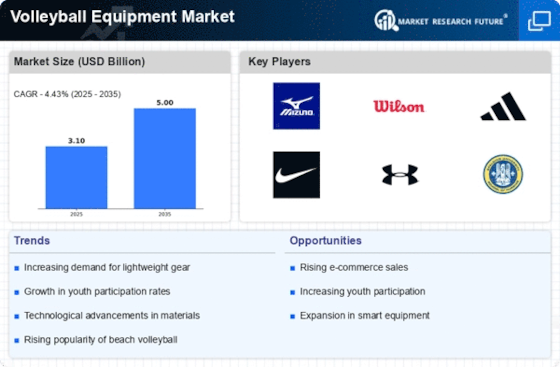
As per MRFR analysis, the Volleyball Equipment Market Size was estimated at 3.102 USD Billion in 2024. The volleyball equipment industry is projected to grow from 3.239 USD Billion in 2025 to 4.996 USD Billion by 2035, exhibiting a compound annual growth rate (CAGR) of 4.43 during the forecast period 2025 - 2035.

Key Market Trends & Highlights

The Volleyball Equipment Market is experiencing a dynamic shift towards sustainability and technological innovation.

  • North America remains the largest market for volleyball equipment, driven by a robust sports culture and infrastructure.
  • The Asia-Pacific region is emerging as the fastest-growing market, fueled by increasing participation in sports and recreational activities.
  • Volleyballs dominate the market as the largest segment, while protective gear is witnessing rapid growth due to heightened safety awareness.
  • Key market drivers include the rising popularity of volleyball and significant investments in sports infrastructure, enhancing overall market potential.

Market Size & Forecast

2024 Market Size 3.102 (USD Billion)
2035 Market Size 4.996 (USD Billion)
CAGR (2025 - 2035) 4.43%

Major Players

Mizuno (JP), Wilson Sporting Goods (US), Adidas (DE), Nike (US), Under Armour (US), Spalding (US), Tachikara (JP), ASICS (JP), Molten (JP)

Volleyball Equipment Market Trends

The Volleyball Equipment Market is currently experiencing a dynamic evolution, driven by various factors that influence consumer preferences and technological advancements. As the sport gains popularity globally, there is an increasing demand for high-quality equipment that enhances performance and safety. Manufacturers are focusing on innovation, creating products that not only meet the needs of professional athletes but also cater to recreational players. This shift towards inclusivity is likely to expand the market reach, appealing to a broader audience. Furthermore, sustainability is becoming a pivotal concern, with companies exploring eco-friendly materials and production methods to align with consumer values. In addition to these trends, the rise of digital platforms for marketing and sales is reshaping how products are promoted and distributed. Online shopping has become a preferred method for many consumers, prompting brands to enhance their digital presence. Social media plays a crucial role in influencing purchasing decisions, as athletes and influencers showcase their preferred gear. This interconnectedness between technology and consumer behavior suggests that the Volleyball Equipment Market will continue to adapt and grow, reflecting the changing landscape of sports and leisure activities.

Sustainability Initiatives

The focus on eco-friendly materials and sustainable production practices is gaining traction within the Volleyball Equipment Market. Companies are increasingly aware of the environmental impact of their products and are striving to implement greener alternatives. This trend not only appeals to environmentally conscious consumers but also aligns with global efforts to reduce carbon footprints.

Technological Advancements

Innovations in design and materials are transforming the Volleyball Equipment Market. Enhanced performance features, such as improved grip and durability, are becoming standard expectations among consumers. As technology continues to evolve, manufacturers are likely to introduce smarter equipment that integrates performance tracking and analytics.

Digital Marketing Strategies

The rise of e-commerce and social media is reshaping how brands engage with consumers in the Volleyball Equipment Market. Online platforms are increasingly utilized for marketing and sales, allowing companies to reach a wider audience. Influencer partnerships and targeted advertising are becoming essential components of successful marketing strategies.

Volleyball Equipment Market Drivers

Growing Health Consciousness

The growing health consciousness among individuals is significantly influencing the Volleyball Equipment Market. As more people recognize the importance of physical fitness, sports like volleyball are gaining traction as enjoyable ways to stay active. This trend is particularly prominent among younger demographics, who are increasingly seeking engaging physical activities. The rise in health awareness has led to a corresponding increase in the purchase of volleyball equipment, as individuals invest in quality gear to enhance their playing experience. Market analysis suggests that this shift towards healthier lifestyles could drive a 10% increase in equipment sales over the next few years, further solidifying the Volleyball Equipment Market's growth trajectory.

Rising Popularity of Volleyball

The increasing popularity of volleyball as a recreational and competitive sport is a primary driver for the Volleyball Equipment Market. Participation rates in volleyball have shown a steady rise, with millions of players engaging in both indoor and beach volleyball. This surge in interest is reflected in the growing number of volleyball clubs and leagues, which has led to an increased demand for quality equipment. According to recent statistics, the number of registered volleyball players has reached over 800,000 in various regions, indicating a robust market potential. As more individuals take up the sport, the Volleyball Equipment Market is likely to experience significant growth, driven by the need for high-performance gear, including balls, nets, and protective equipment.

Expansion of E-commerce Platforms

The expansion of e-commerce platforms is reshaping the Volleyball Equipment Market by providing consumers with greater access to a wide range of products. Online retail has become a preferred shopping method for many, allowing customers to compare prices, read reviews, and purchase equipment conveniently from home. This trend is particularly beneficial for niche sports like volleyball, where specialized equipment may not be readily available in local stores. E-commerce platforms are also enabling manufacturers to reach a broader audience, thereby increasing sales opportunities. As online shopping continues to gain popularity, the Volleyball Equipment Market is likely to experience a significant boost, with projections indicating a potential growth rate of 12% in online sales over the next few years.

Investment in Sports Infrastructure

Investment in sports infrastructure plays a crucial role in the expansion of the Volleyball Equipment Market. Governments and private entities are increasingly funding the construction of volleyball courts and facilities, which enhances accessibility for players of all ages. This trend is particularly evident in educational institutions, where volleyball programs are being integrated into physical education curricula. The establishment of new venues not only promotes participation but also necessitates the procurement of quality volleyball equipment. As a result, the Volleyball Equipment Market is poised to benefit from this influx of investment, with projections indicating a potential increase in equipment sales by 15% over the next few years.

Technological Innovations in Equipment

Technological innovations in volleyball equipment are transforming the Volleyball Equipment Market. Manufacturers are increasingly incorporating advanced materials and design techniques to enhance performance and durability. For instance, the introduction of lightweight, high-strength composite materials in volleyballs has improved their flight characteristics and player control. Additionally, smart technology is being integrated into training equipment, allowing players to track their performance metrics. This trend not only appeals to professional athletes but also to amateur players seeking to improve their skills. As these innovations continue to evolve, the Volleyball Equipment Market is expected to witness a surge in demand for technologically advanced products, potentially increasing market value by 20% in the coming years.


Market Segment Insights

By Type: Volleyballs (Largest) vs. Protective Gear (Fastest-Growing)

In the Volleyball Equipment Market, Volleyballs hold the largest share, being essential for the sport. Nets and Posts follow closely, providing the necessary infrastructure for gameplay. Protective Gear, while currently representing a smaller component, shows significant potential for growth due to increasing safety awareness among players. Footwear complements this segment by offering the specific support and grip needed for performance on the court.

Volleyballs (Dominant) vs. Protective Gear (Emerging)

Volleyballs are the cornerstone of the Volleyball Equipment Market, given their central role in gameplay and training. They come in various types suitable for different levels of play, from recreational to professional. Protective Gear, on the other hand, is emerging rapidly as players become increasingly conscious of the need for safety. This segment includes knee pads, ankle braces, and other safety equipment designed to prevent injuries. With rising participation rates in volleyball and a greater emphasis on player safety, Protective Gear is likely to see accelerated growth, thus reshaping the market landscape.

By Material Type: Synthetic (Largest) vs. Natural Leather (Fastest-Growing)

In the Volleyball Equipment Market, the material type segment is categorized into various values, with synthetic materials holding the largest share due to their durability, weather resistance, and consistent performance. Natural leather is gaining traction among players who value traditional craftsmanship and tactile feedback during play. Rubber, PVC, and composite materials also contribute to the market but are less favored compared to synthetic and leather options. The growth trends within the material type segment are shaped by evolving player preferences, with synthetic materials projected to maintain dominance due to their affordability and performance. Meanwhile, natural leather is experiencing rapid growth as consumers seek more authentic experiences in sports. This trend is supported by rising disposable incomes and increased participation in volleyball worldwide, boosting demand for equipment made from high-quality materials.

Synthetic (Dominant) vs. Natural Leather (Emerging)

Synthetic materials have established themselves as the dominant choice in the volleyball equipment market, primarily due to their ability to withstand various playing conditions while providing optimal performance. They are lightweight, resistant to moisture, and cost-effective, appealing to both recreational and professional players. On the other hand, natural leather is emerging as a favorite among enthusiasts who appreciate its classic feel and superior grip. While initially more expensive, natural leather products offer players an enhanced playing experience, combining aesthetics with functionality. As such, we see a rising trend where consumers are willing to invest in higher-quality natural leather options. This interplay between synthetic and natural leather illustrates a dynamic market where performance meets tradition.

By Distribution Channel: Online (Largest) vs. Sports Specialty Stores (Fastest-Growing)

The Volleyball Equipment Market is increasingly divided among various distribution channels, with online sales commanding the largest share. The convenience of online shopping, coupled with advanced e-commerce platforms, has led to a significant preference for buying volleyball equipment through digital channels. In contrast, offline retail methods, such as sports specialty stores and supermarkets, continue to hold their ground, albeit with a smaller market share as consumer behavior shifts. Online channels have adapted to meet the demands for variety, price comparison, and home delivery, showcasing their dominance in this segment. In recent years, sports specialty stores have emerged as the fastest-growing segment, driven by a targeted approach to consumer engagement and a focus on in-depth customer service. These stores are capitalizing on the increase in volleyball participation rates, tactical promotion, and community involvement. As more individuals engage in volleyball at recreational and competitive levels, sports specialty stores have carved out a niche that appeals to passionate players seeking expert advice and tailored equipment, boosting their growth trajectory.

Online (Dominant) vs. Sports Specialty Stores (Emerging)

Online distribution channels have established themselves as the dominant force in the Volleyball Equipment Market by offering a vast array of products, competitive pricing, and user-friendly shopping experiences. Consumers are attracted to convenience and the ability to access resources like reviews and comparisons at their fingertips. On the other hand, sports specialty stores are emerging as a valuable alternative, focusing on personalized service and expertise in the volleyball niche. These stores not only provide high-quality products but also foster a sense of community among players. By creating engaging in-store experiences and organizing local events, they are rapidly gaining popularity, particularly among players who value knowledge and support over mere convenience.

By End User: Professional Players (Largest) vs. Amateur Players (Fastest-Growing)

In the Volleyball Equipment Market, the end user segment showcases a diverse distribution. Professional Players constitute the largest subgroup, reflecting their significant consumer power due to lucrative sponsorships and professional contracts. Amateur Players are emerging strongly, driven by an increasing interest in sport and recreational participation, thus highlighting an evolving consumer landscape. Educational institutions like Schools and Colleges also form a critical market niche, accounting for substantial demand, while Clubs play a pivotal role in grassroots engagement.

Professional Players: Dominant vs. Clubs: Emerging

Professional Players represent the dominant force in the Volleyball Equipment Market, characterized by their high purchasing power and preference for advanced technology and performance-enhancing gear. This segment is supported by endorsements and brand collaborations, leading to brand loyalty among top players. In contrast, Clubs emerge as a crucial segment, focusing on community engagement and fostering young talent. These grassroots organizations are gaining prominence as they increasingly invest in quality equipment to enhance training and competition experiences, making them vital players in the overall market dynamics.

Get more detailed insights about Volleyball Equipment Market

Regional Insights

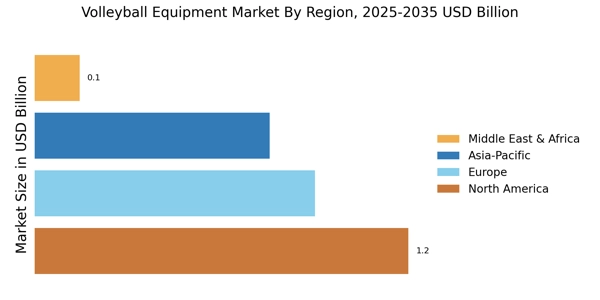
The Global Volleyball Equipment Market showcases significant regional growth, with North America leading the way, valued at 1.05 USD Billion in 2024 and expected to rise to 1.65 USD Billion in 2035. This region's dominance is attributed to a strong sports culture and increasing participation in volleyball. Europe follows with a valuation of 0.85 USD Billion in 2024, growing to 1.25 USD Billion by 2035, supported by popular leagues and tournaments boosting equipment sales.

The APAC region, also valued at 0.85 USD Billion in 2024 and projected to increase to 1.45 USD Billion, reflects growing interest in volleyball, particularly in countries like Japan and Australia.South America, while smaller, with values of 0.25 USD Billion in 2024 and 0.50 USD Billion in 2035, is witnessing a gradual rise due to increasing youth participation. The MEA region starts with a lower valuation of 0.11 USD Billion in 2024 and is expected to reach 0.15 USD Billion by 2035, indicating emerging markets for volleyball equipment within this area.

Overall, the Global Volleyball Equipment Market data reveals growth potential, driven by rising sports recognition and increased recreational participation across these regions.


 Source: Primary Research, Secondary Research, Market Research Future Database and Analyst Review

Volleyball Equipment Market Regional Image

Key Players and Competitive Insights

The Global Volleyball Equipment Market has seen significant evolution and competitiveness over the past few years, driven by the increasing popularity of the sport across various demographics. This market encompasses a wide range of products, including volleyballs, nets, footwear, knee pads, and other accessories tailored for both recreational and professional players. The competitive landscape is characterized by numerous key players vying for market share, each offering unique value propositions and innovations. Companies are continuously improving their product quality and adopting advanced materials to enhance player performance and safety while promoting sportsmanship and physical fitness.

The rise in investments in sports infrastructure and the growing influence of social media in promoting sports events have further fueled the demand for volleyball-related products. Kawasaki holds a prominent position within the Global Volleyball Equipment Market, leveraging its strong brand reputation and commitment to quality. Known for its focus on innovation, Kawasaki has developed a comprehensive range of volleyball equipment that caters to the needs of both amateur and professional players. The brand emphasizes the use of cutting-edge materials and technologies in its products, which enhances the performance and durability of its volleyball gear.

This commitment to superior quality has not only helped Kawasaki establish a loyal customer base but also enabled it to gain traction in various international markets. Moreover, the company's strategic partnerships with sports organizations and sponsorship of volleyball events have enhanced its visibility and presented opportunities for growth in emerging markets. Kawasaki's ability to adapt to changing consumer trends and its dedication to continuous improvement solidify its competitive edge within the industry.Puma, while more commonly associated with general athletic wear and accessories, has also made a notable impact in the Global Volleyball Equipment Market.

The brand is recognized for its stylish and functional designs, which appeal to the youth demographic and active lifestyle enthusiasts. Puma offers a diverse selection of volleyball footwear and apparel, enhancing the playing experience through both aesthetics and functionality. Their products are often characterized by innovative features such as enhanced cushioning and breathability, catering to the specific requirements of volleyball players. Additionally, Puma's strategic marketing campaigns and collaborations with influential athletes have strengthened its presence in the market.

The company's global outreach and comprehensive distribution network facilitate accessibility to its products, allowing them to maintain a competitive foothold alongside other specialized volleyball equipment manufacturers. Puma's blend of style, comfort, and performance positions it as a favorable choice for volleyball enthusiasts looking for quality and trend-setting sportswear.

Key Companies in the Volleyball Equipment Market market include

Industry Developments

  • Q2 2024: Molten Launches New V5M5000 Volleyball for 2024 Paris Olympics Molten Corporation announced the release of its new V5M5000 volleyball, which will be the official game ball for the 2024 Paris Olympic Games, featuring enhanced grip and durability designed for elite competition.
  • Q2 2024: Mikasa Unveils Smart Volleyball with Embedded Sensors for Real-Time Data Tracking Mikasa Sports introduced a new smart volleyball equipped with embedded sensors that provide real-time data on ball spin, speed, and trajectory, targeting professional teams and training academies.
  • Q3 2024: Wilson Sporting Goods Announces Partnership with USA Volleyball for Official Equipment Supply Wilson Sporting Goods entered a multi-year partnership with USA Volleyball to supply official volleyballs and nets for national competitions and development programs.
  • Q3 2024: Adidas Launches New Volleyball Footwear Line Featuring Advanced Traction Technology Adidas AG launched a new line of volleyball shoes incorporating advanced traction and support technology, aimed at improving player performance and reducing injury risk.
  • Q4 2024: Nike Debuts Sustainable Volleyball Apparel Collection Made from Recycled Materials Nike Inc. released a new volleyball apparel collection made entirely from recycled polyester, emphasizing sustainability and performance for athletes.
  • Q1 2025: Under Armour Opens New Volleyball Equipment Market Manufacturing Facility in Vietnam Under Armour inaugurated a new manufacturing facility in Vietnam dedicated to producing volleyball equipment, aiming to meet rising demand in Asia-Pacific markets.
  • Q1 2025: Puma Signs Sponsorship Deal with International Volleyball Federation (FIVB) Puma SE signed a sponsorship agreement with the International Volleyball Federation (FIVB) to provide official apparel and footwear for major international tournaments.
  • Q2 2025: ASICS Launches Volleyball Knee Pads with Enhanced Impact Protection ASICS Corporation introduced a new line of volleyball knee pads featuring advanced impact protection technology, designed to reduce injuries among competitive players.
  • Q2 2025: Decathlon Expands Volleyball Equipment Market Distribution to North America Decathlon SA announced the expansion of its volleyball equipment distribution network to North America, increasing product availability in major retail outlets.
  • Q3 2025: Mizuno Launches Lightweight Volleyball Jersey for Professional Teams Mizuno Corporation launched a new lightweight volleyball jersey designed for professional teams, featuring moisture-wicking fabric and improved breathability.
  • Q3 2025: Spalding Introduces Beach Volleyball Designed for Extreme Weather Conditions Spalding unveiled a new beach volleyball engineered to withstand extreme weather conditions, targeting outdoor tournaments and recreational players.
  • Q4 2025: Easton Sports Announces Acquisition of Volleyball Net Manufacturer NetPro Easton Sports completed the acquisition of NetPro, a leading manufacturer of volleyball nets, to expand its product portfolio and strengthen its position in the volleyball equipment market.

Future Outlook

Volleyball Equipment Market Future Outlook

The Volleyball Equipment Market is projected to grow at a 4.43% CAGR from 2024 to 2035, driven by increasing participation rates, technological advancements, and rising consumer spending.

New opportunities lie in:

  • Development of smart volleyballs with integrated performance tracking technology.
  • Expansion of e-commerce platforms for direct-to-consumer sales.
  • Partnerships with schools and universities for bulk equipment supply contracts.

By 2035, the market is expected to achieve robust growth, solidifying its position as a key segment in the sports equipment industry.

Market Segmentation

Volleyball Equipment Market Type Outlook

  • Volleyballs
  • Nets
  • Posts
  • Protective Gear
  • Footwear

Volleyball Equipment Market End User Outlook

  • Professional Players
  • Amateur Players
  • Schools
  • Colleges
  • Clubs

Volleyball Equipment Market Material Type Outlook

  • Synthetic
  • Natural Leather
  • Rubber
  • PVC
  • Composite

Volleyball Equipment Market Distribution Channel Outlook

  • Online
  • Offline Retail
  • Sports Specialty Stores
  • Supermarkets
  • Direct Sales

Report Scope

MARKET SIZE 20243.102(USD Billion)
MARKET SIZE 20253.239(USD Billion)
MARKET SIZE 20354.996(USD Billion)
COMPOUND ANNUAL GROWTH RATE (CAGR)4.43% (2024 - 2035)
REPORT COVERAGERevenue Forecast, Competitive Landscape, Growth Factors, and Trends
BASE YEAR2024
Market Forecast Period2025 - 2035
Historical Data2019 - 2024
Market Forecast UnitsUSD Billion
Key Companies ProfiledMarket analysis in progress
Segments CoveredMarket segmentation analysis in progress
Key Market OpportunitiesIntegration of smart technology in Volleyball Equipment Market enhances performance tracking and player analytics.
Key Market DynamicsRising consumer interest in performance-enhancing volleyball gear drives innovation and competition among manufacturers.
Countries CoveredNorth America, Europe, APAC, South America, MEA

Leave a Comment

FAQs

What is the current valuation of the Volleyball Equipment Market as of 2024?

The Volleyball Equipment Market was valued at 3.102 USD Billion in 2024.

What is the projected market valuation for the Volleyball Equipment Market in 2035?

The market is projected to reach 4.996 USD Billion by 2035.

What is the expected CAGR for the Volleyball Equipment Market during the forecast period 2025 - 2035?

The expected CAGR for the Volleyball Equipment Market during 2025 - 2035 is 4.43%.

Which segment of volleyball equipment had the highest valuation in 2024?

In 2024, the segment of Volleyballs had the highest valuation at 0.775 USD Billion.

How do online sales compare to offline retail sales in the Volleyball Equipment Market?

In 2024, online sales were valued at 0.93 USD Billion, while offline retail sales were at 0.78 USD Billion.

What is the valuation range for protective gear in the Volleyball Equipment Market?

The valuation for protective gear ranged from 0.525 to 0.675 USD Billion in 2024.

Which material type is expected to dominate the Volleyball Equipment Market?

Synthetic materials are expected to dominate, with a valuation range of 1.2 to 1.8 USD Billion in 2024.

What is the valuation of volleyball equipment for professional players in 2024?

The valuation for volleyball equipment aimed at professional players was between 0.775 and 1.215 USD Billion in 2024.

Which key players are leading the Volleyball Equipment Market?

Key players in the market include Mizuno, Wilson Sporting Goods, Adidas, Nike, and Under Armour.

What is the projected growth trend for volleyball clubs in the market?

The valuation for volleyball clubs is projected to grow from 1.232 to 1.461 USD Billion by 2035.

Download Free Sample

Kindly complete the form below to receive a free sample of this Report

Compare Licence

×
Features License Type
Single User Multiuser License Enterprise User
Price $4,950 $5,950 $7,250
Maximum User Access Limit 1 User Upto 10 Users Unrestricted Access Throughout the Organization
Free Customization
Direct Access to Analyst
Deliverable Format
Platform Access
Discount on Next Purchase 10% 15% 15%
Printable Versions